Weight Loss and Obesity - Lewis
 Call Kai
 Learn
 Practice Test
 Spaced Repetition
 Match
 Flashcards
 Knowt Play
1/46

There's no tags or description
Looks like no tags are added yet.
47 Terms
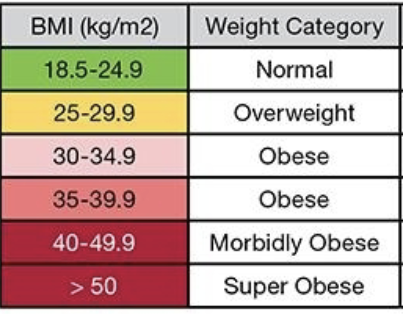
BMI / Weight category
visceral vs subcutaneous fat
Visceral fat: fat surrounding organs
Considered more harmful
Subcutaneous fat: fat under the skin
Considered less harmful, but can contribute to overall weight gain
metabolic syndrome: must contain 3 out of 5 out of following
Fasting glucose: 100-125 mg/dL
BP ≥ 135/80 OR receiving HTN trx
Triglycerides > 150 mg/dL
HDL
< 50 mg/dL for women
< 40 mg/dL for men
Waist circumference
≥ 35 inches for women
≥ 40 inches for men
Meds associated with weight gain
ASMs
CBZ, gabapentin, pregabalin
Antidepressants
MAOIs, TCAs, paroxetine, citalopram, escitalopram, mirtazapine
Antipsychotics
Clozapine, olanzapine, quetiapine, risperidone, haloperidol, aripiprazole
Antiretrivirals
Protease inhibitors (-virs)
Glucocorticoids
Progestins
DM medications
Insulin, sulfonylureas, meglitinides, thiazolidinediones
Mood stabilizers
Lithium
other etiology of obesity
Genetics
environment
easily accessible food supply
reduction in physical activity
sedentary lifestyle
friends, family members
socioeconomic status
religious belief
gut microorganisms
lack of sleep
types of bariatric surgery
adjustable gastric band
more restrictive than malaborptive
affect on absorption: minimal
sleeve gastrectomy
restrictive, somewhat malaborptive
reduced gastric volume, increased gastric pH, accelerated gastric emptying
roux-en-Y gastric bypass
restrictive, malabsorptive
reduced gastric volume, increased gastric pH, accelerated gastric emptying, decreased surface area for absorption, reduced 1st-pass metabolism, shorter intestinal transit time, more distal delivery of pancreatic secretions
surgery indications
BMI ≥ 40
BMI 35-39.9 + at least ONE comorbidity
affects of surgery on medications
absorption
distribution
metabolism
excretion
Absorption
Increased gastric pH
Reduced bioavailability of ER meds → pH causes ER to dissolve too early
Shorter t1/2
Distribution
Reduced volume of distribution
Metabolism
Potentially decreased CYP metabolism in the small intestine
Excretion
Not likely to be affected, however, CrCl may be altered
surgery may lead to
reduced vitamin and mineral absorption
deficiencies
thiamine
copper zinc
all needed supplementation usually accomplished w/ 2 chewable MVI each day
medication concerns post surgery:
what formulations avoided?
avoid drugs that increase risk of GI ulceration
re-assess treatment for obesity-related disease
formulations
enteric coated
delayed release
extended-release formulations
medications avoided
DOACs
NSAIDs
corticosteroids
biphosphonates
obesity-related diseases
HTN
dyslipidemia
diabetes
use — to reduce risk of GI ulcer post-surgery
PPIs (omeprazole)
when should medications be used for weight-loss?
BMI ≥ 27 w/ ≥1 comorbidities
HTN
dyslipidemia
T2DM
obstructive sleep apnea
BMI ≥ 30 w/o comorbidities
weight loss medications
short term
long term
short term
Phentermine (Adipex)
long term
Phentermine/Topiramate XR (Qsymia)
Naltrexone/Bupropion (Contrave)
Orlistat (Xenical; Alli)
Semaglutide (Wegovy) - GLP1 agonist
Orforglipron (Foundayo) - GLP1 agonist
Tirzepatide (Zepbound) - dual mechanism GLP-1 and GIP
all drugs for weight loss maintenance:
CI or avoided in
adjunt to
d/c if
CI or avoided in
pregnancy / breastfeeding
adjunct to
reduced-calorie diet and increased physical activity
d/c if
weight loss ≥ 5% is not achieved within 12 weeks (at max dose)
Phentermine (Adipex)
Approved for SHORT-TERM USE ONLY (≤ 3 months)
C-IV control
8-37.5 mg daily as QD or BID
Dose adjustments
eGFR 15-29 → max 15 mg/day
eGFR < 15 → AVOID
Phentermine (Adipex): contraindications
CVD (arrythmias, CAD, HF, uncontrolled HTN)
hyperthyroidism
glaucoma
hx of drug abuse
Phentermine (Adipex): ADEs
CV
HTN
Tachycardia
CNS
dizziness/HA
insomnia/psychosis
GI
N/D/C
Xerostomia
Neuromuscular
tremor
Phentermine/Topiramate XR (Qsymia)
3.75-15/23-92 mg QD dosing
C-IV Control
Dose adjustments
CrCl < 50 → max dose: 7.5/46 mg
CrCl < 30 → AVOID
MUST TAPER on and off
Only available through REMS
Requires MONTHLY pregnancy testing during use
Phentermine/Topiramate XR (Qsymia): ADEs
Increased HR
CNS (mood changes, anxiety, depression, insomnia)
Decreased serum K+ and bicarb → metabolic acidosis [electrolytes]
Kidney stones
Phentermine/Topiramate XR (Qsymia): contraindications
Hyperthyroidism
Glaucoma
Use of MAO-Is
Pregnancy
Phentermine/Topiramate XR (Qsymia): DDIs
avoid w/
may decrease effect of
may lead to
avoid w/
alcohol
carbonic anhydrase inhibitors
may decrease effect of
hormonal contraceptives
may lead to
increased risk of hypokalemia when combined w/ thiazide or loop diuretics
Phentermine/Topiramate XR (Qsymia): Monitoring
Weight
Resting HR and BP
Mood
Symptoms of glaucoma
ADEs
Electrolytes and SCr (bicarb, K)
Phentermine/Topiramate XR (Qsymia):
counseling
follow up
counseling
take in AM ± food d/t insomnia (want to be able to sleep)
follow up
weight
resting HR and BP
mood swings
glaucoma symptoms
ADEs
increased SCr
decreased bicarb, K+
Naltrexone/Bupropion ER (Contrave)
dose
dosing schedule
8/90 mg → 32/360 mg
Dosing schedule
Week 1: 1t QAM
Week 2: 1t BID
Week 3: 2t QAM + 1t QHS
Week 4: 2t BID
Naltrexone/Bupropion ER (Contrave)
ADE
BBW
ADEs
Tachycardia, HTN
N/V/C
HA
BBW for suicidality with depression
Naltrexone/Bupropion ER (Contrave): contraindications
concomittant use of other bupropion products
Uncontrolled HTN
Chronic opioid use
Seizure disorders
Patients undergoing withdrawal from AIMS medications
anorexia/bulimia
Use of MAO-Is
Naltrexone/Bupropion ER (Contrave): DDIs
Avoid with alcohol (lowers seizure threshold)
Opioids + (tramadol, buprenorphine, methadone)
Dopaminergic drugs
Other meds containing bupropion or naltrexone
Naltrexone/Bupropion ER (Contrave)
monitoring
counseling
Monitoring
Weight
BP and HR
BG
renal/liver
Changes in mood
ADEs
Counseling
Do not take with a high fat meal
Orlistat dosing
Alli (OTC)
Xenical
Alli → 60 mg TID
Xenical → 120 mg TID ≤ 60 minutes after meal-containing fat (or with the meal)
If there is no fat going through GI tract, meds won’t work on anything
Orlistat: contraindications
Chronic malabsorption syndrome
Cholestasis → slowed flow of bile from liver to intestine (slower fat clearance)
Pregnancy
Orlistat: ADRs
Decreased fat-vitamin absorption
GI (improved w continued use)
MAY develop kidney stones

Orlistat:
counseling
monitoring
counseling
Do not take if meal is skipped or does not contain fat
Ensure proper supplementation of ADEK and β-carotene
Take vitamins 2 hour before or after orlistat → within 2 hours, vites won’t absorb
weight
does not need to be d/c if pt does not acheive ≥ 5% weight loss
Orlistat: DDIs
Decreased absorption of fat-soluble vitamins
Separate 4 hours from levothyroxine ← otherwise, reduced absorption/efficacy of levothyroxine
Monitor INR if on warfarin (can increase)
Liraglutide (Saxenda): dosing
Liraglutide: 0.6mg inc to 3.0 mg over 5 weeks
Multi-dose pen, box of 5 pens if using 3.0 mg/day dose
Semaglutide (Wegovy)
Semaglutide: 0.25mg inc to 2.4mg over 17 weeks
Single-use pen
4 pens per month
SAFETY
GI and cholelithiasis (gallstones) more common
Less common: pancreatitis, cancer, CV events
GLP-1 agonist - Semaglutide: contraindications
CONTRAINDICATIONS
Personal OR FAMILY history of medullary thyroid cancer
MEN2 (multiple endocrine neoplasia – tumors in endocrine glands)
Semaglutide injection
once weekly w/ or w/o food
SQ
store in fridge
RT for up to. 28 days
scheduled dose
more than 2 days away → take missed dose ASAP
less than 2 days away → skip dose, take next dose on scheduled day
2+ weeks since last dose → take next dose on scheduled day
Semaglutide injection and oral: more info
take on empty stomach w/ water
wait 30 mins before eating, drinking, meds
swallow whole
room temp
dose missed → skip and take next dose following day
switch from injection → tab
25 mg tab 1x daily for 1 week after d/cing injection
switch from tab → injection
day after tab → initiate 2.4 mg SQ injection once weekly
can’t tolerate 25 mg tab → switch to 1.7 mg injection
Tirzepatide (Zepbound)
contraindications
ADEs
CONTRAINDICATIONS – same bc it has a GLP
Personal OR FAMILY history of medullary thyroid cancer
MEN2
ADEs
N/D
Tirzepatide (Zepbound): info
1x weekly w/ or w/o food
SQ injection
multi-dose Kwikpen (must Rx pen needles)
missed doses can be administered within 4 days of missed dose
store in fridge
single dose good at RT for 21 days
kwikpen and multidose goof at RT for 30 days
Ofroglipron (Foundayo)
dosing
contraindications
dosing
0.8 mg → 2.5 mg after 30 days → 5.5 mg → continue or increase after 30 days
contraindications
personal/family hx of medullary thyroid cancer
MEN2
Ofroglipron (Foundayo): more info
1x daily oral admin
taken any time of day w/o fasting or water restrictions
swallow whole
RT
missed doses can be taken as soon as remembered, do not double up
Ofroglipron (Foundayo):
DDI
Strong CYP3A4 Inhibitors – max dose of Foundayo® is 9 mg once daily when used w/strong CYP3A4 inhibitor
Avoid concomitant use with strong CYP3A4 inducers
May decrease Foundayo® efficacy and need to increase dose
Do not exceed simvastatin 20 mg once daily when used concomitantly with Foundayo®
• Same DDI w/OCP as tirzepatide
indications
Semaglutide
Tirzepatide
Oforglipron
Semaglutide
≥ 18 yrs old
SQ or PO - overweight or obesity
SQ only ≥ 12 yrs old
CV risk reduction
treatment of MASH (SQ only)
Tirzepatide
≥ 18 yrs old
overweight or obesity + at least one comorbid condition
OSA
Oforglipron
≥ 18 yrs old
overweight or obesity + at least one comorbid condition
Compelling indications for WL
Pre-diabetes, T2DM, or high CV risk → GLP-1 agonists
Depression → Naltrexone/bupropion
Obstructive sleep apnea (OSA) → phentermine/topiramate XR, GLP-1 agonists (specifically tirzepatide)
Current tobacco use (with desire to quit) → Naltrexone/bupropion
Food cravings → Naltrexone/bupropion
Metabolic dysfunction → GLP-1 agonists (specifically semaglutide)
weight loss
≥5%
≥10%
≥15%
≥5% sustained weight loss improves insulin sensitivity, BP, and lipids
≥10% sustained weight loss is usually required to improve most obesity-related diseases
≥15% weight loss may be needed for sleep apnea, metabolic steatohepatitis, and HFpEF
— and — provide greatest weight reduction
— and — → highest efficacy
GI effects common w/ — and —
GLP-1 RA and dual GIP/GLP-1 R
Semaglutide and tirzepatide → highest efficacy
Gastrointestinal adverse effects common with semaglutide, and tirzepatide