370 DNA Transcription (5.2)
 Call Kai
 Learn
 Practice Test
 Spaced Repetition
 Match
 Flashcards
 Knowt Play
1/20

There's no tags or description
Looks like no tags are added yet.
21 Terms
DNA transcription
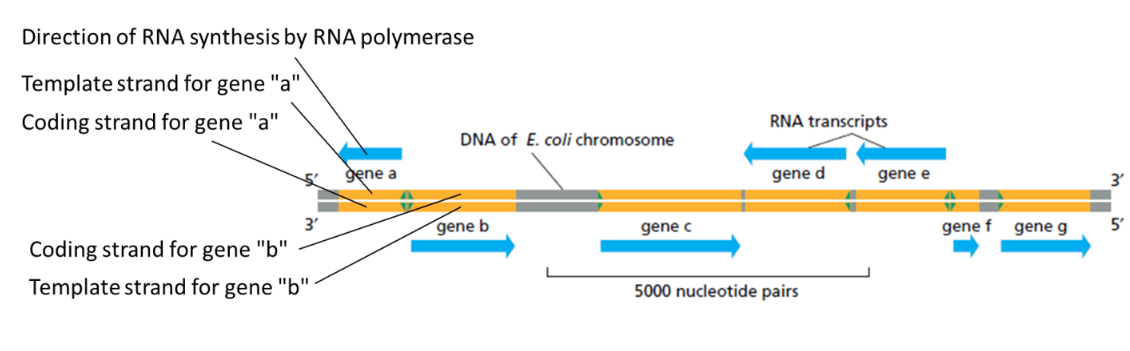
—A single DNA strand acts as template for synthesized RNA
——→Either DNA strand can be the tmeplate
—RNA always synthesized from 5 to 3
——→Template strand read 3 to 5 by RNA polymerase (synthesizes RNA), but all strands are reported (written) from 5 to 3)
Gene
—DNA sequence that gets transcribed to RNA and has:
Promoter
Coding sequence
Terminator

Promoter
—Non-coding sequence that initiates the transcription
—Located upstream of coding sequence
—RNA polymerase binding site
——→The polymerase is recruited to the site indirectly by proteins that recognize these promoter sequences
——→These sub-proteins are sigma factors (pro) and transcription factors (euks)
Efficient promoters: promoters that lead to higher transcription rates, useful for genes you want to transcribe a lot (recombinant proteins)

Coding sequence
—Area that is transcribed by RNA polymerase
——→DNA unwind and separates once RNA polymerase bonds
Terminator
—RNA polymerase will continue transcription until it reaches this sequence
RNA polymerase
—Free nucleotides in cell as NTP, and they line up with the complemenatry bases
—RNA polymerase covalently binds NTPs together
——→Reaction only occurs if substrate in active site can form a base pair on the template strand
—Transcription occurs from 5 to 3
—Transcription can be initiated again at the same site for the same gene before the previous polymerase finishes transcription

Consensus sequence
—DNA sequences that are highly conserved between species
—Helps with DNA transcription initiation
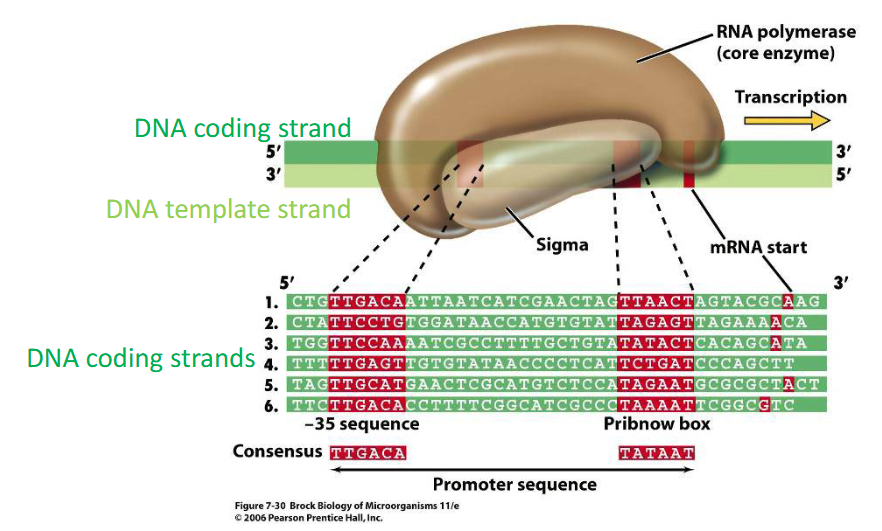
Transcription initiation (prokaryotes)—Consensus sequences
Pribnow box: -10 (10 nucleotides before the first RNA is transcribed, typically of sequence TATAAT
Upstream recognition sequence: ~ -35 upstream, determines type of sigma factor associated with the promoter
TLDR these sequences help RNA polymerase and sigma factor to bind to promoter and start transcription
Transcription initiation (eukaryotes)—Consensus sequences
GC box: Seuquence rich in G and C, associated with housekeeping genes
——→Housekeeping genes: expressed constitutively, meaning they are continuously expressed to support basic cellular functions. Other cells are compared to it
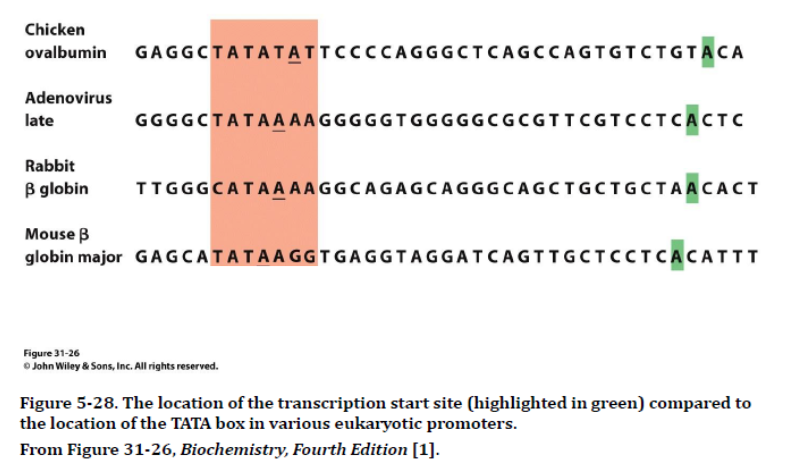
TATA box: Selectively expressed in different tissues, helps position transcription machinery near transcription site
——→Illustrated in picture, not all exactly the same for all genes
Transcription initiation (eukaryotes)—Transcription factors
—Regulates promoters that bind RNA polymerase II
General: Required to synthesize all mRNA, help recruite RNA polymerase at promoter
Upstream: Proteins that bind upstream from initiation site, repress/activate (decrease/increase) transcription, control how storngly some genes are expressed
Inducible: Must be activated/inhibited before binding to DNA and increase/decrease gene transcription (like upstream)
Transcription initiation (eukaryotes)—Enhancer/silencer
Enhancer: DNA sequences that aren’t transcribed but needed for full promoter activation (increase transcription)
Silencer: DNA sequences that decreases transcription if bound by repressor proteins
—Both are located far from promoter, and do not contain sequences bound by RNA polymerase
Termination (prokaryotes)—Intrinsic terminators
—Have inverted pairs naturally
—Resulting RNA wants to bind together because they’re complementary; the structure folds
—The fold knocks off the RNA polymerase

Termination (prokaryotes)—Rho-factor dependent
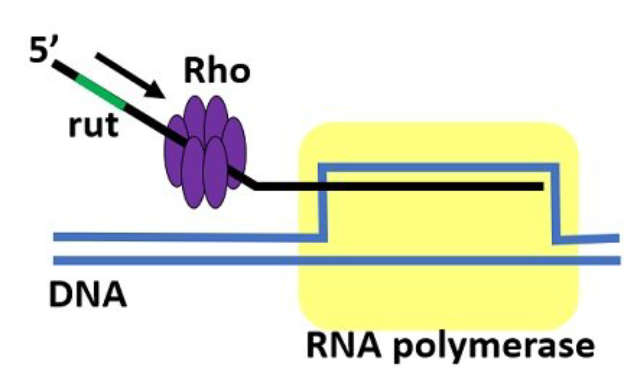
—Rho factor: Protein that binds to the growing RNA strand on Rut sites, travels along the RNA towards the polymerase, remobes RNA polymerase from transcirption bubble once it overtakes
Termination (eukaryotes)
—Happens via the cleavage of new RNA chain
—RNA produced are monocistronic: each mRNA codes for 1 gene/protein
—Post-transcriptional modification: alter levels of gene translation to proteins
5’ capping
—Place an m7G cap to the 5’ end of the new RNA
——→Determines the translation start site of the RNA
——→Needed to move mRNA from nucleus to cytoplasm
——→Increases mRNA stability (protects against degradation by exonucleases)

mRNA splicing
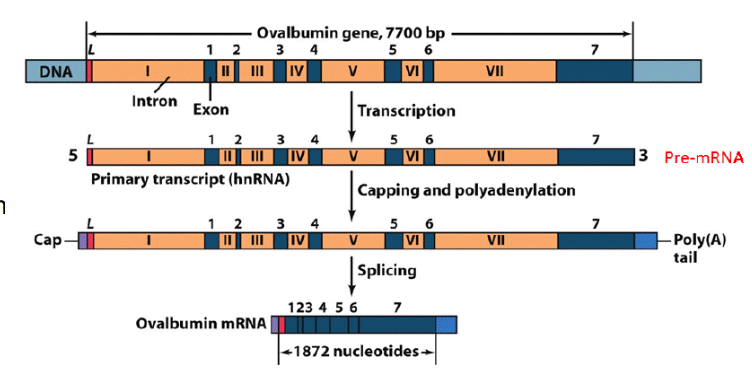
—Primary RNA transcripts contains portions that aren’t translated into proteins (introns) and they are removed
—Translated portions are exons
Different mechanisms:
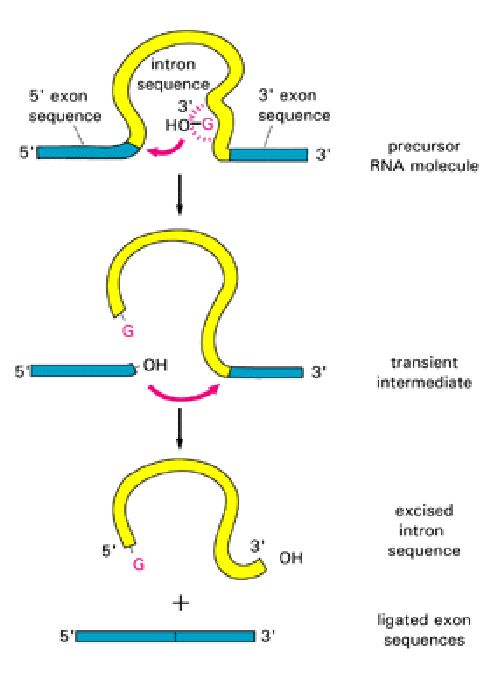
Self splicing
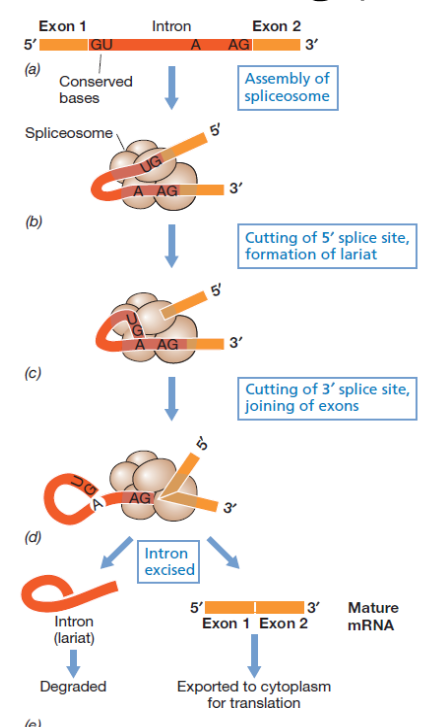
Spliceosome-catalyzed splicing
Self-splicing
—Fold to form an active structure
—Catalyze its autohydrolysis → cleaves intron at 5’ end → catalyzes joining of the two exons around the intron → cleaves intron at 3’ end
Spliceosome-catalyzed splicing
—Spliceosomes (protein complex that participate in splicing) contain snRNAs (small nuclear RNAs), which recognize the introns, and splice them accordingly
—Requires participation of proteins (not part of spliceosome) called splicing factors
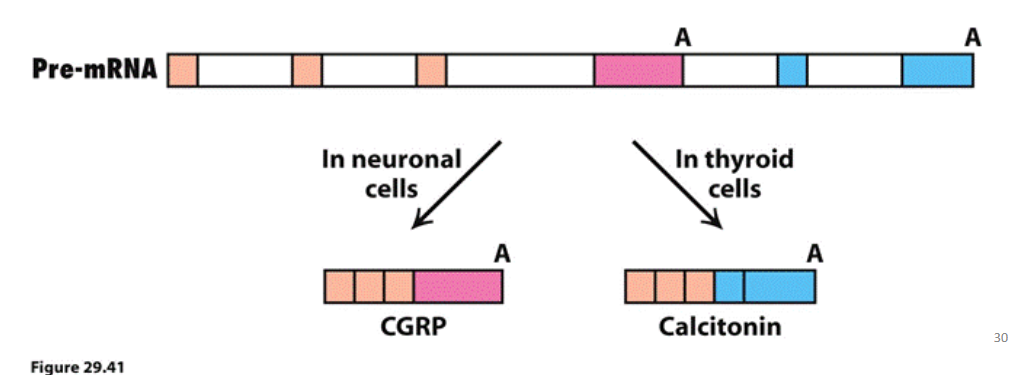
Alternative splicing
—Splicing does not always occur at the same location
—Certain introns can become exons and vise versa depending on what cell it is
—Depends on splicing factors and snRNAs present
—Results in the translation of different proteins from the same given RNA transcript depending on cell type
Polyadenylation
—Primary transcription in eukaryotes are cleaved at a specific site coded AAUAAA, before a GU rich sequence
—GU rich sequence is recognized by CstF
—After cleavage, poly(A) chain is added by PAP
—PABPN1 binds to poly(A) chain, ends the polyadenylation process
—Improves stability of RNA and facilitates nucleus → cytoplasm transport

Nuclear export of mature mRNA
—After all modifications, mRNA is packaged by proteins into a curved fiber
—Fiber binds to a nuclear transport receptor protein that allows active (needs ATP) transport
—Travels across nuclear pore complex on nuclear membranes
—mRNA passes through starting 5’ capped end
—Nuclear receptor protein returns in nucleus after it is transported
