Cell Bio: Chapter 31- Eukaryotic Transcription
 Call Kai
 Learn
 Practice Test
 Spaced Repetition
 Match
 Flashcards
 Knowt Play
1/18

There's no tags or description
Looks like no tags are added yet.
19 Terms
What is a basal level of transcription?
Transcription that occurs using just the general transcription factors and RNA pol 2
What are specific transcription factors?
Help with transcription of specific genes + bind upstream
What are the three different types of regulated gene expression?
Tissue specific: different genes are expressed at different levels in different cell types (ex: neurons make proteins to make neurotransmitters but other cell types don’t)
Hormone responsive: different genes expressed at different levels due to hormones
Developmentally regulated: different genes expressed at different levels at different embryonic levels
What is the proximal promoter sequence?
CAAT box and GC box are roughly 200 bp away from core promoter
Enhancer and Silencer sequences
Specific regions of DNA that increase or decrease transcription
Can be 100-1000 bp away from core promoter
Usually upstream but can be downstream
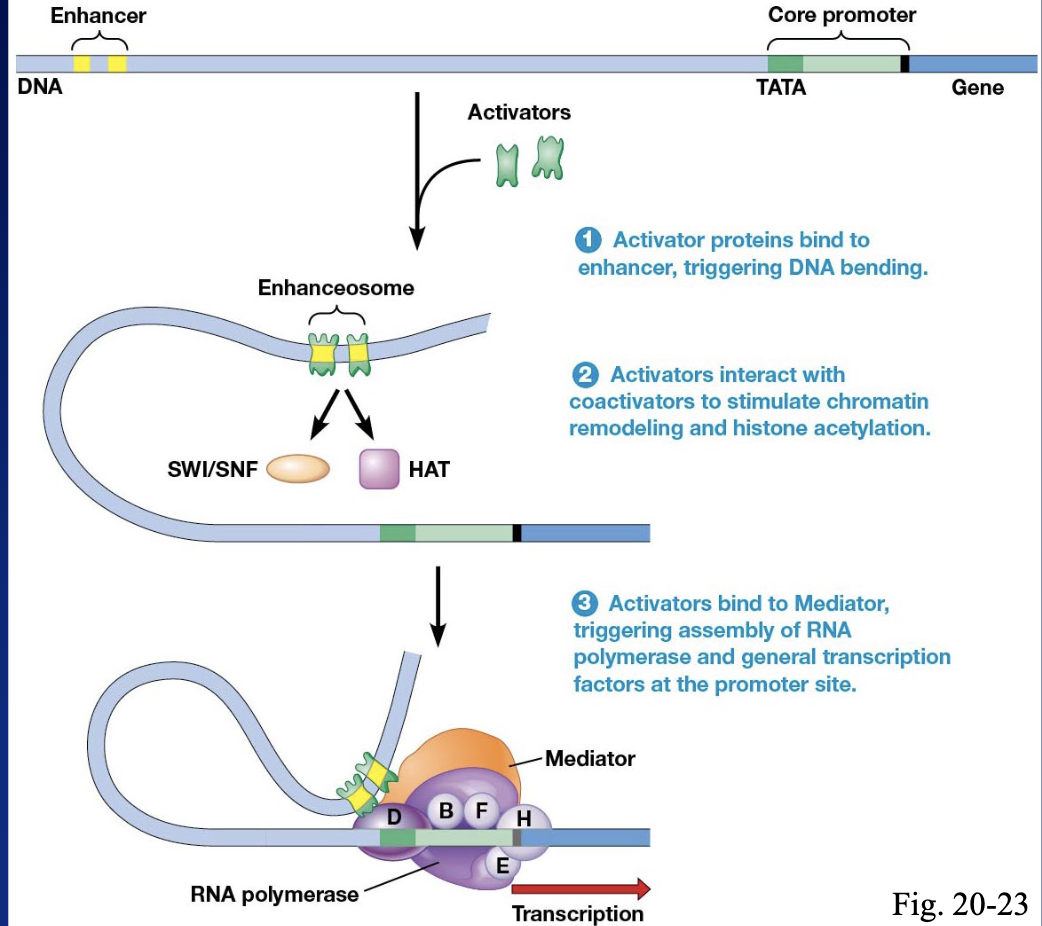
Activators (transcription factors) can bind to enhancers
Repressors (transcription factors) can bind to silencers
Why can enhancers and silencers be so far away from the core promoter but still affect transcription?
DNA can bend and twist so transcription factors bound to the enhancer or silencer can interact with transcription factor bound to core promoter or RNA pol.
Transcription factor structure
TF contain DNA binding domain and either an activator (bind to the enhancer) or repressor (bind to the silencer) domain
Almost all TF are dimers and most are homodimers but some can be heterodimers
May also have regulatory site (third domain)
Ligand binding site: steroid hormone receptors bind steroids that increase transcription
Phosphorylation site
Activators
Contain activator domain
Help recruit RNA Pol. to make it bind better and can bind to general TF
Binding of activator to enhancer triggers DNA bending
May bind coactivator
Coactivators
Binds to activator to increase transcription
Ex: chromatin remodeling factors (SWI/SWF) or histone modifiers (acetyltransferase or demethylase)
After coactivator has been bound activators bind mediator which triggers the assembly of RNA pol. and general transcription factors at promoter
Repressors
Bind to general TF or RNA Pol. and sequester them causing decrease in transcription
May bind to a corepressor
Corepressors
Bind to repressor to decrease transcription
Ex: Chromatin remodeling factors & histone modifiers (methyltransferase or deacetylase)
What happens if a transcription factor binds to the enhancer but isn’t an activator?
Decrease in transcription because that TF is competing with activator
How is the level of transcription determined?
Determined by the relative strength of the number of transcription factors binding to enhancers v silencers
Structure of DNA binding domain
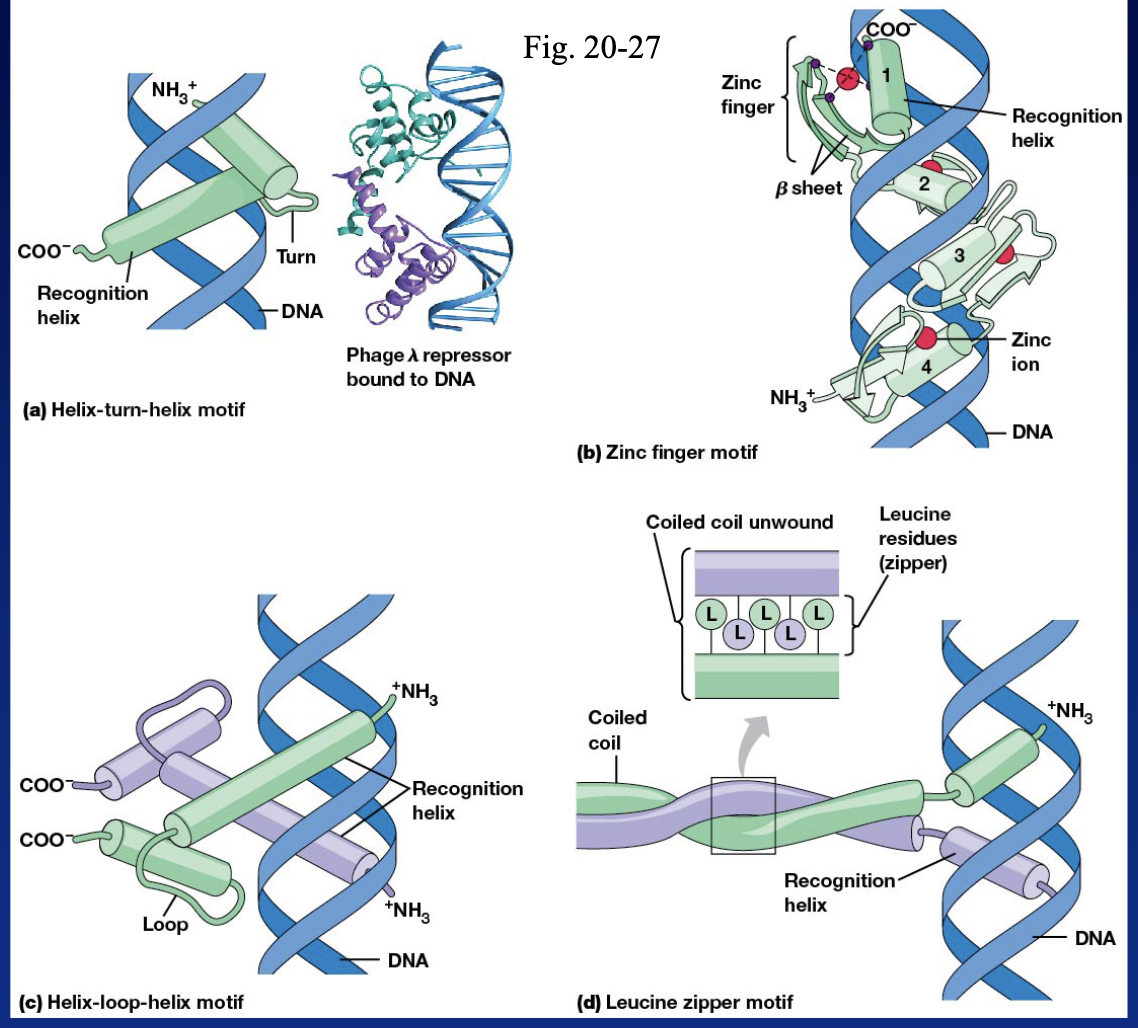
All contain a pair of recognition helices which contain basic amino acids
Leucine zipper: made of two alpha helices coiled together to form a dimerized coiled coil; leucine residues in between helices
Ex: CREB: contains a phosphorylation domain
Helix-loop-helix: dimer made of 2 alpha helices, each helix connected via a loop; bind to major groove on DNA
Zinc Finger: Zinc ion causes alpha helix and beta pleated sheet to interact and make finger shape; contains 4 recognition helices
Ex: steroid hormone receptor
Helix turn helix: dimer made of 1 alpha helix and a turn between them
Proks: lac and trp repressor proteins; Euks: homeodomain proteins
cAMP response element binding protein (CREB)
Binds to enhancer element (CRE: cAMP response element)
cAMP activates protein kinase A and PKA phosphorylates CREB
CREB binds CREB binding protein (CBP)
CREB binding protein (CBP)
A co-activator
Binds TF2B
Histone acetyltransferase activity
Steroid Hormone Receptor
Transcription factor that is mainly homodimers
Ligand activated
Glucocorticoid receptors recruit CBP and chromatin remodeling factors and increase transcription
Glucocorticoid: DNA site the receptor binds
Each end of the glucocorticoid receptor binding site (glucocorticoid) has palindromic site where the bases are identical but inverted
5’ to 3’ = AGAACA and 3’ to 5’ = TCTTGT
A palindromic site is a sign that the TF is a homodimer

Homeodomain
Transcription factors containing a homeodomain bind to the homeotic genes which regulate the development of entire body parts (make homeoproteins)
Homeotic genes contain highly conserved homeobox
Contain a helix-turn-helix DNA-binding domain
How can misexpressing homeotic genes affect gene expression?
Drosophila contain 9 homeotic genes and a mutation in antennapedia (homeotic gene) causes legs to grow from head