natural selection, the problem of polymorphism and the strength of selection
 Call Kai
 Learn
 Practice Test
 Spaced Repetition
 Match
 Flashcards
 Knowt Play
1/6

There's no tags or description
Looks like no tags are added yet.
7 Terms
polymorphism is common
In 1966 found that 39% of D.pseudobscura's proteins are polymorphic
genes appear to be evolving too fast
With the amino acid sequence of alpha and beta haemoglobin, cytochrome c and triosephosphate isomerase, from humans and other mammals Kimura (1968) estimated that the average 100 amino acid protein sees one substitution every 28 x 104 yrs.
Multiplying this up across the genome, he estimates that there must be one nucleotide substitution every two years.
But Haldane had noted that as selection requires mortality, there will be a limit to the amount of selectively driven change - a maximum of one every 300 years.
Kimura thus argued that the total amount of change couldn’t be owing to selection as there would need to be too much selective death.
natural theory
What is our 2 variants have no effects on fitness
Neither will deterministically spread, but we will still get changing allele frequencies owing to chance
Think of it like gas particles diffusing
When the particles hit a surface they are absorbed rather than bounce back.
The probability a neutral allele will go up in frequency = probability it will go down in frequency.
The probability of fixation of A over a at any given instant = frequency of A. (cf prob of pulling a black ball out of a barrel with n black balls and m white ones = n/n+m)
how fast will neutral evolution be
Rate of evolution = p(fixation) x rate of introduction of new mutations
p(fixation) = 1/2N
Rate of introduction = 2N μ
Hence Rate of evolution = 2Nμ/2Ν= μ substitutions per generation
The neutral theory predicts a constant rate of evolution if all species have the same generation time
The model predicts polymorphism. It also predicts that polymorphism should be more common in species with large populations than small ones
H=4Neμ/(1+4Neμ)
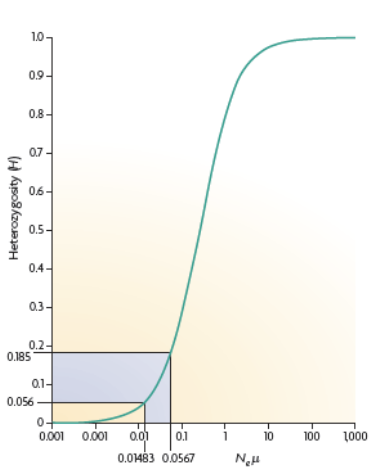
problems with neutral theory
We see very little difference in polymorphism levels between species
If anything we find a constant rate of protein evolution per unit time. The theory predicts a constant rate per generation time
weakly selected alleles
The nearly neutral theory allows for weakly selected alleles and attempts to explain these problems
Three types of deleterious allele are defined:
s<<1/(2Ne) – effectively neutral
s~ 1/(2Ne) – weakly deleterious
s>> 1/(2Ne) - deleterious

3 theories for evolutionary change
Positive selection
Strict neutral evolution
Nearly-neutral evolution