Exam 2
 Call Kai
 Learn
 Practice Test
 Spaced Repetition
 Match
 Flashcards
 Knowt Play
1/61

Earn XP
Description and Tags
based on study guide
62 Terms
What is Direct Current (DC)?
What is its alternate name?
What is DC not commonly used for?
What 2 things IS it commonly used for?
A continuous stream of charged particles (electrons) that flows in ONE direction only
Also called 'galvanic' current
Not commonly used for muscle stim because it's uncomfortable
IS used for iontophoresis and for stimulating denervated muscle

What is Alternating Current (AC)?
What are the 2 instances AC is used for?
A continuous, back-and-forth (bidirectional) flow of charged particles where the current keeps switching direction
Used for pain control and muscle contraction (it's why you feel that 'tingly' sensation with IFC, premod, or TENS)
*this is the type of current that comes out of a wall socket!

What is Pulsed Current (PC)?
What are its 2 forms? Describe them.
What are 3 reasons why it’s used?
An interrupted flow of current where it flows in short pulses, then stops (no current) for a period, then pulses again
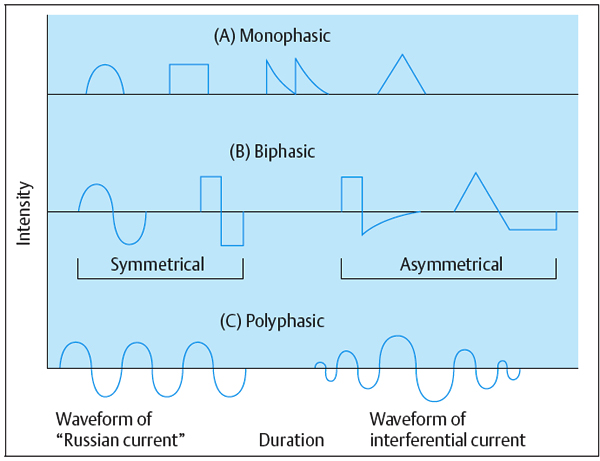
Can be monophasic (flows in only one direction per pulse) or biphasic (flows back and forth within each pulse)
Used for pain control, tissue healing, and muscle contraction
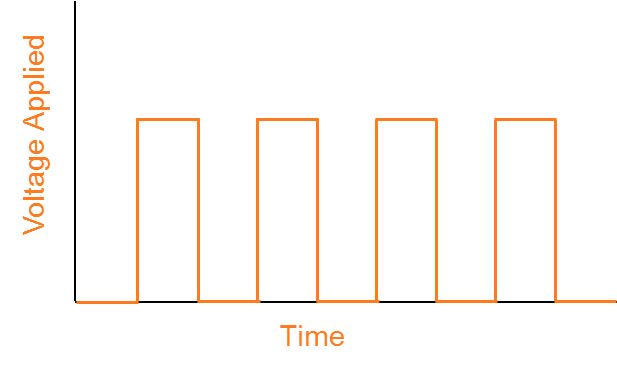
What's the difference between monophasic and biphasic pulsed current?
Monophasic = current flows in only ONE direction during each pulse (example: HVPC, used for wound healing & edema)
Biphasic = current flows back and forth (both directions) during each pulse; this is the most common waveform used to produce muscle contractions or control pain
What is pulse duration (pulse width)?
What unit is it typically measured in?
What current type has phase duration & pulse duration as the same thing?
How long one single pulse lasts, measured from the start of the first phase to the end of the last phase of that pulse
Measured in microseconds (µs)
Monophasic current

What is phase duration?
What are 2 ways you can see it?
What’s the difference between phase duration & pulse duration?
The time it takes for ONE phase of a pulse to occur
Can have one phase (monophasic) or two phases (biphasic)
Phase duration is just the time of a single phase, while pulse duration covers the whole pulse

What is duty cycle (on:off time) in e-stim?
The ratio of ON time (when current flows to create a muscle contraction) to OFF time (rest period) during treatment
*this prevents fast fatigue!

What is frequency in electrical stimulation? What 2 units is it measured in & for what waveforms?
How does higher frequency affect muscle activity?
*needs pic
The number of pulses or cycles delivered per second, measured in Hertz (Hz) for AC or pulses per second (pps) for PC
Higher frequency = more muscle fibers recruited, but also causes faster muscle fatigue
What is ramp time in e-stim?
Why is it used?
The time it takes for the current to gradually rise to peak amplitude (ramp-up) at the start of the 'on' time, and gradually fall back to zero (ramp-down) at the end
Used to make the sudden start/stop of a muscle contraction more comfortable for the patient

What is an analgesic?
Something that relieves pain (brings about analgesia) without causing loss of consciousness
*it takes away the 'ouch' feeling!
What is an endogenous opiate?
What 2 forms of TENS triggers the release of these?
A natural, pain-relieving chemical your OWN body produces (like endorphins)
Low-frequency/'acupuncture-like' TENS trigger your body to release these
What 4 aspects should patient set-up for electrical stimulation include?
Informed consent/education about what to expect
Comfortable patient positioning & draping
Intact skin checked for abnormalities
Intact sensation confirmed
What are the 5 standard contraindications for ALL electrical currents?
Cardiac pacemaker/implanted defibrillator or unstable arrhythmia
Epilepsy
Placing electrodes over the carotid sinus
Areas with venous/arterial thrombosis or thrombophlebitis
Pregnancy (over/around the abdomen or low back, except DURING labor for pain control)
What are the 5 standard precautions for electrical currents?
Cardiac disease
Impaired mentation (confusion/altered awareness)
Impaired sensation
Malignant tumors
Areas of skin irritation or open wounds
What are the 6 general indications for using e-stim?
To control pain
To produce a muscle contraction (for strengthening)
To improve endurance/motor control
To reduce spasticity
To promote tissue healing
To deliver medication through the skin (iontophoresis)
What is 'modulation' in e-stim settings? Why use it?
Device changes the frequency, amplitude, or duration over time instead of keeping it perfectly steady
Used to reduce the patient's accommodation (getting 'used to' and no longer feeling the stimulation), which is especially useful for patients wearing a unit like TENS for 10+ hours a day
How does electrode size affect treatment (same size vs. different size electrodes)?
Smaller electrodes = higher current density (more intense feeling) in a smaller area
Larger electrodes = lower current density so current spreads over a bigger area, feels less intense
If two electrodes are different sizes, the patient will feel MORE sensation under the smaller one
What is impedance (resistance) to electrical current?
The ability of body tissue to resist the flow of electrons (current)
Higher impedance = harder for current to pass through
What 9 body tissues contribute to increased impedance to electrical current?
Skin
Hair
Fascia
Ligament
Callus
Fat
Bone
Tendon
Scar tissue
How do you decrease impedance between the electrode and the skin?
Use adhesive conductive agents (gel) on the electrodes
What is Neuromuscular Electrical Stimulation (NMES)?
E-stim used to create a muscle contraction in an INNERVATED muscle (one with a working nerve supply) by electrically activating the nerve, which then triggers the muscle fibers (specifically fast-twitch Type II fibers first)
What is Functional Electrical Stimulation (FES)?
Using NMES to directly assist a functional, purposeful movement/activity (ex. stimulating dorsiflexors at the exact right moment during the swing phase of walking to correct foot drop)

What is Interferential Current (IFC)?
A current made by crossing two separate AC currents (at slightly different high frequencies, like 5000 Hz and 5100 Hz) from 4 electrodes, which intersect INSIDE the patient's tissue to create a lower 'beat frequency' (ex. 100 Hz) at the target area
Reaches deeper than TENS and is more comfortable because of the lower skin resistance at high frequencies

What is Transcutaneous Electrical Nerve Stimulation (TENS)?
What are the 2 ways it can work?
E-stim specifically for PAIN control
Works by either the Gate Control Theory (high frequency, blocks pain signals while it's on) or the Endogenous Opiate System (low frequency, triggers the body's own natural pain-relief chemicals, lasting hours after treatment)

What is iontophoresis?
What type of current does it use? Why?
The delivery of medication (ions) through the skin using an electrical current instead of swallowing a pill or getting a shot
Uses low-amplitude, monophasic direct current (DC)
DC is needed because it repels the charged drug molecules through the skin

How should a patient be set up for iontophoresis treatment?
Position the patient comfortably so the electrode pads won't shift or move
Space electrodes no closer than about 2 cm (1 inch) apart to avoid a short circuit
Begin introducing the current slowly, and never change it abruptly
How does polarity work in iontophoresis? Where does the medication go?
Negatively charged medications go on the cathode (negative electrode) and get pushed (repelled) toward the anode (+)
Positively charged medications go on the anode (positive electrode) and get pushed toward the cathode (-).
(Think: like charges repel, so the medication repels off its same-charge electrode and travels into the tissue)
What are the medications used in iontophoresis, and their polarity/use?
Dexamethasone = negative (anti-inflammatory)
Lidocaine = positive (anesthetic/pain reliever)
Acetic acid = negative (breaks up calcium deposits)
Zinc oxide = positive (promotes wound healing)
What are 2 precautions/contraindications for iontophoresis?
Follow the same contraindications/precautions as general electrotherapy + all contraindications/precautions for the specific medication being delivered
Don't apply iontophoresis right after anything that changes skin permeability, like heat, ice, or ultrasound (heat especially can speed up drug dispersion too much via vasodilation)
What are the 4 indications for iontophoresis?
Delivering anti-inflammatory medication
Pain relief/anesthesia
Breaking up calcium deposits
Promoting wound healing
*Basically, transdermal (through-the-skin) drug delivery for a localized therapeutic effect
What is the standard dosage range for iontophoresis, and how are doses calculated?
What are the 4 different doses?
Between 40 and 80 mA-min.
Dosage = mA*min = current (mA) x time (minutes)
40 mA*min = 4 mA x 10 min
40 mA*min = 2 mA x 20 min
80 mA*min = 4 mA x 20 min
80 mA*min = 2 mA x 40 min
How does current amplitude affect iontophoresis treatment time and comfort?
Higher amplitude = shorter treatment time, but more risk of discomfort or burn
Lower amplitude = more comfortable, but takes longer to deliver the same total dose
How deep does iontophoresis typically penetrate?
About 3 to 20 mm deep
What is diathermy (short wave diathermy)?
What is the common frequency used?
A deep-heating modality that uses electromagnetic energy that passes into the body and gets converted into heat WITHIN the tissue itself (unlike hot packs, which apply heat from the outside)
Most commonly uses a radiofrequency of 27.12 MHz

What are the 6 purposes/indications for short wave diathermy?
Pain relief
Reducing muscle spasm
Decreasing joint stiffness
Treating contractures
Increasing blood flow
Managing chronic inflammatory conditions like bursitis, tenosynovitis, synovitis, and chronic pelvic inflammatory disease
What are the 5 thermal vs. 4 nonthermal effects of short-wave diathermy?
Thermal effects:
increases tissue temperature up to 3-5 cm deep
increases metabolism
increases oxygen
increases vasodilation
relaxes muscle
Nonthermal (athermal) effects:
changes activity at the cellular level
alters cell membrane permeability
cellular metabolism
ATP production
What's the difference between continuous and pulsed short wave diathermy?
Continuous (CSWD) = the strongest thermal (heating) effect, but has a higher risk of burning the patient if energy concentrates
Pulsed (PSWD) = interrupts the current, reducing the overall heating effect; the longer the off-time between pulses, the less thermal the treatment
What are 14 contraindications for continuous SWD?
Pacemakers or implanted electronic devices (on ANYONE in the area, since the field extends away from the machine)
pregnancy
Active bleeding
Cancer
Acute inflammation
Impaired sensation
Tissue recently treated with radiation
DVT
Hemorrhagic conditions
Impaired circulation
Obesity (fat retains heat)
Skin disorders
Plastic/cement implants
metal implants
What are the 7 contraindications for pulsed SWD?
heart, neck region
pregnancy
malignancy
compromised tissue recently treated with radiation
DVT
Hemorrhagic conditions
Electronic implants
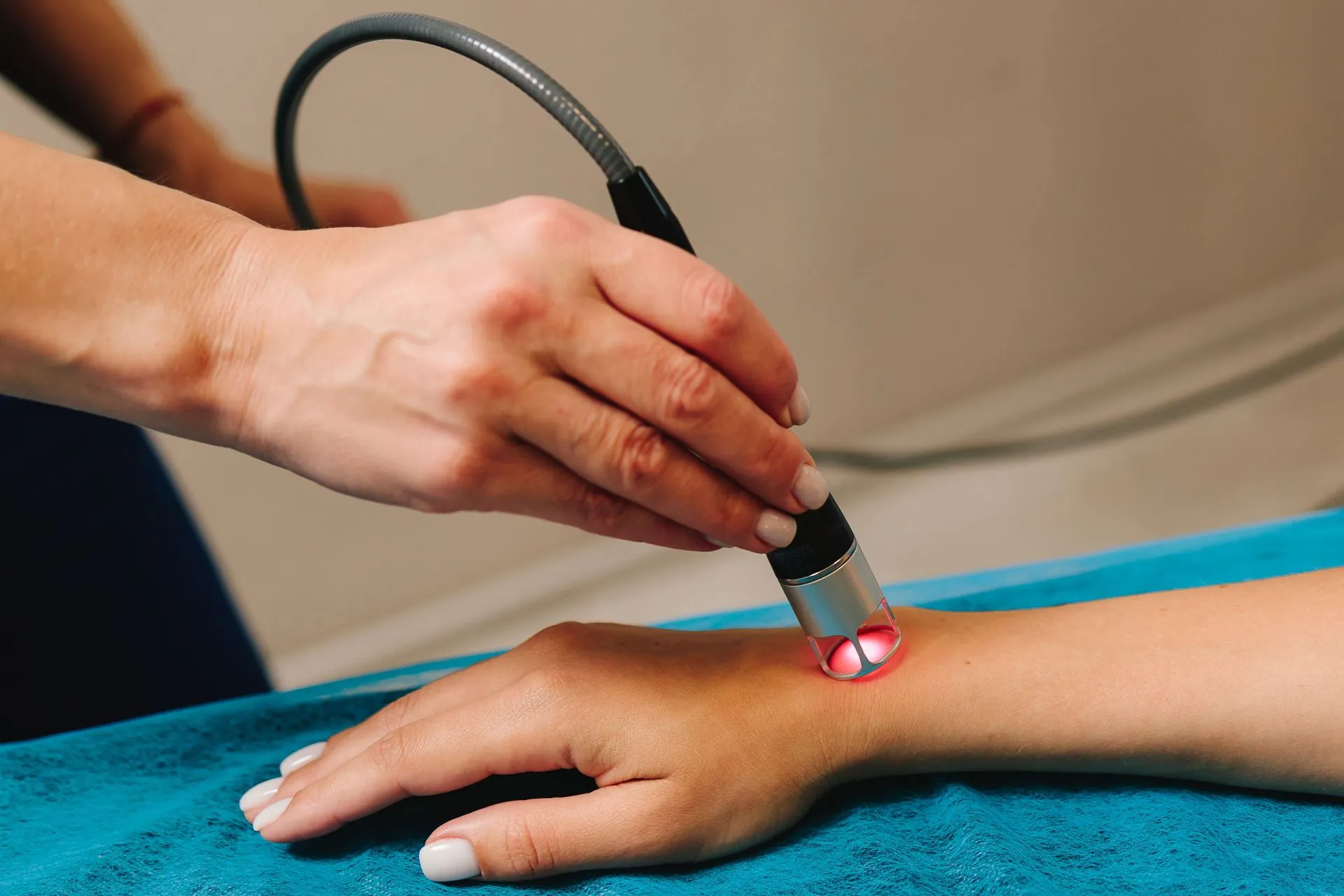
What is Low-Level Laser Therapy (LLLT)?
A 'cold laser' treatment using low-power laser light (power level is too low to produce a thermal (heating) effect)
What are the 5 purposes/indications for LLLT?
Pain relief (increases endorphins/serotonin, decreases C-fiber activity)
promoting soft tissue healing (boosts collagen synthesis)
reducing inflammation
improving blood supply (angiogenesis)
improving nerve function (ex. carpal tunnel syndrome)
What are 7 contraindications for LLLT (laser)?
Directly over the eye
over unclosed fontanels in children (soft spots on an infant's skull)
over malignancy/cancerous lesions
over endocrine glands
hemorrhagic conditions
pregnancy
over photosensitive skin
What are the precautions for LLLT?
Confused pts
Fever
Directly over infected skin
Cardiac pt population
What is UV light therapy used for in wound care?
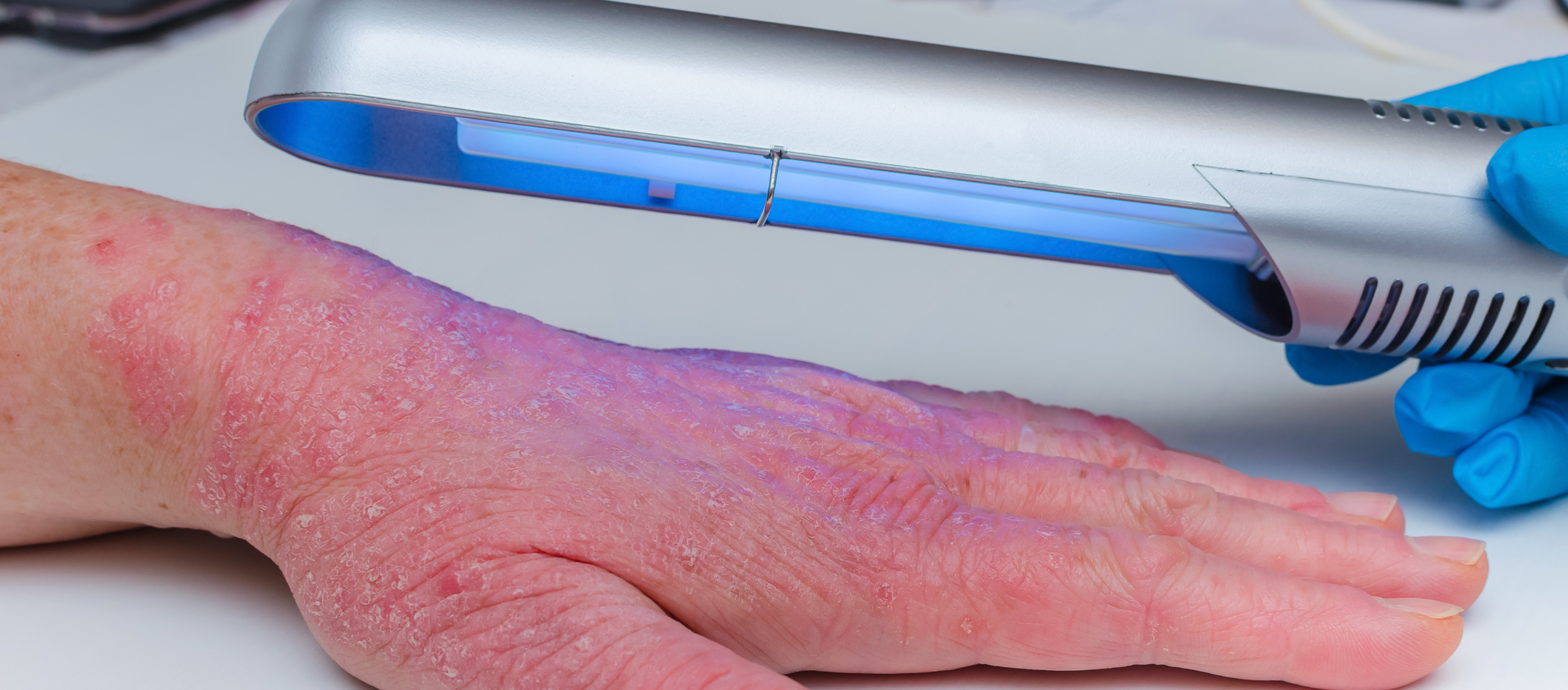
Used in preparing wound beds for healing and to kill harmful bacteria (including MRSA)
Mainly using UV-C from cold quartz lamps, which stimulates tissue repair, destroys bacteria, and increases blood supply
What are the 3 bands of UV light, and how deep does each penetrate?
UV-A (320-400 nm) = lowest frequency, longest wavelength, penetrates into the dermis (deepest)
UV-B (250-320 nm) = higher frequency, shorter wavelength, penetrates the epidermis
UV-C (250 nm, artificial sources only) = highest frequency, shortest wavelength, most superficial; used for wound debridement and killing bacteria
What are 6 contraindications for UV light treatment?
Photosensitive patients (those who sunburn easily)
Pellagra (niacin-deficiency dermatitis)
Systemic lupus erythematosus (SLE) with dermatitis
Active tuberculosis
Fever or acute diabetes
Patients taking photosensitizing medications
What is an MED test, and why is it performed before UV treatment?
MED = Minimal Erythemal Dose; the shortest UV exposure time that produces visible redness (erythema) within 1-6 hours, then fades within 24 hours
Tested individually for each patient before their first UV treatment to find their safe starting dose
How does external compression relate to the lymphatic/circulatory system to reduce edema?
Fluid balance in tissue depends on the push-pull between hydrostatic pressure (pushes fluid OUT of capillaries into tissue) and oncotic pressure (pulls fluid back INTO capillaries)
Compression increases pressure in the interstitial (tissue) space, helping keep fluid inside the vessels/lymphatics so it can circulate away instead of pooling in the limb

What is a venous stasis ulcer, and what are 3 ways compression helps treat it?
Tissue breakdown/necrosis caused by poor (impaired) venous circulation
Compression is the gold-standard, first-line treatment
It improves venous circulation, lowers the risk of new ulcers forming, and helps heal existing ones
What are the 6 main purposes/indications for using external compression?
Improving fluid balance/circulation
preventing DVT (deep vein thrombosis)
limiting edema
helping heal venous stasis ulcers
shaping a residual limb after amputation
controlling/reducing hypertrophic scar formation
What is the ideal pressure range for controlling general lower extremity edema?
30-40 mmHg will control lower extremity edema in most patients who are up and walking (ambulatory)
What is the ideal pressure range & time for controlling hypertrophic scar formation?
20-30 mmHg of compression, worn 23-24 hours a day for 12 months or longer
What inflation/deflation pressure ranges are typical for intermittent pneumatic compression (IPC) pumps?
Generally 30-80 mmHg overall
30-60 mmHg for the upper extremities
40-80 mmHg for the lower extremities
Inflation pressure should never exceed the patient's diastolic blood pressure!
What are the 8 contraindications for intermittent/sequential compression pumps?
Symptomatic heart failure or pulmonary edema
Recent/acute DVT or pulmonary embolism
Obstructed lymphatic/venous return
Severe peripheral arterial disease
Acute local skin infection (like cellulitis)
Very low blood protein levels (hypoproteinemia, under 2 g/dL)
Acute trauma or fracture
Recent arterial revascularization
What are 4 precautions for compression therapy?
Impaired sensation or mentation
Uncontrolled hypertension
Cancer
Areas with superficial peripheral nerves
What is EMG biofeedback, and what is its main purpose?
A technique that shows a patient real-time information about their own muscle activity (detected by surface EMG electrodes) so they can learn to better control that muscle—either to contract it more, or relax it more
What's the difference between 'up training' and 'down training' in biofeedback?
Up training (neuromuscular facilitation) = helping the patient INCREASE muscle activity/contraction; used for weak muscles
Down training (neuromuscular inhibition) = helping the patient DECREASE or relax muscle activity/tension; used for overly tight or overactive muscles
Give an example of when you'd use up-training vs. down-training with biofeedback.
Up-training example = quadriceps weakness after knee surgery (want to increase contraction/strength)
Down-training example = tension headache with tight upper trap (want to decrease tension and help the patient relax the muscle)
What are the 3 contraindications/precautions for EMG biofeedback?
Acute inflammatory conditions (rest/immobilization is the priority during the inflammatory stage)
Pregnancy (specifically, pregnant patients should not use intravaginal biofeedback devices due to infection risk)
Adhesive allergies
Why is EMG biofeedback considered very safe compared to other e-stim modalities?
Where can adverse effects stem from?
No electrical current is actually delivered to the patient, it only reads/measures their own muscle's electrical activity
Any adverse effects come from the exercise itself (like muscle soreness or cardiac strain) or skin irritation from the electrode adhesive, not from a delivered current
What is the 'threshold' setting in EMG biofeedback?
The level of muscle electrical activity (in microvolts, µV) the patient must reach to trigger a signal/feedback
*aka their target to hit during training
What is the 'gain' setting in EMG biofeedback?
What is low gain vs. high gain & how do they relate to sensitivity?
Controls how sensitive the device is to detecting muscle activity
LOW gain = high sensitivity (small muscle flickers produce a big response); good for very weak muscles
HIGH gain = low sensitivity (requires a much bigger muscle effort to produce a response); good for later-stage rehab where you want the patient to work harder