GEO1110 - Exam 1
 Note
Note Call Kai
 Learn
Learn Practice Test
 Spaced Repetition
 Match
Match Flashcards
 Knowt Play
1/70

There's no tags or description
Looks like no tags are added yet.
Name | Mastery | Learn | Test | Matching | Spaced | Call with Kai | Chat |
|---|
No analytics yet
Send a link to your students to track their progress
71 Terms
Physical Geology
Examines the materials composing Earth and processes operating beneath and on Earth's surface.
Historical Geology
Attempts to understand Earth’s origin and its development through time, establishing a chronological arrangement of changes in Earth’s geologic past.
Catastrophism
The theory suggesting that landscapes are shaped primarily by disasters, proposed by James Ussher in the mid-1600s.
Uniformitarianism
Developed by James Hutton in 1795, stating that laws of nature today have always applied, introducing the idea that "the present is the key to the past."
Hypothesis
A tentative, testable explanation in scientific inquiry.
Theory
A well-tested explanation accepted by the scientific community.
Scientific Method
The systematic process for research involving questions, data gathering, and hypothesis testing.
Earth as a System
Consists of interacting parts forming a complex whole: atmosphere, hydrosphere, biosphere, and geosphere.
Divergent Boundaries
plates move apart, creating new seafloor.
Convergent Boundaries
plates move toward each other, forming mountain belts or recycling oceanic lithosphere.
Transform Boundaries
plates grind past one another without lithosphere production or destruction.
Mineral
A naturally occurring, solid, crystalline, inorganic substance with a specific chemical composition.
Rock
A solid mass of minerals or mineral-like matter occurring naturally.
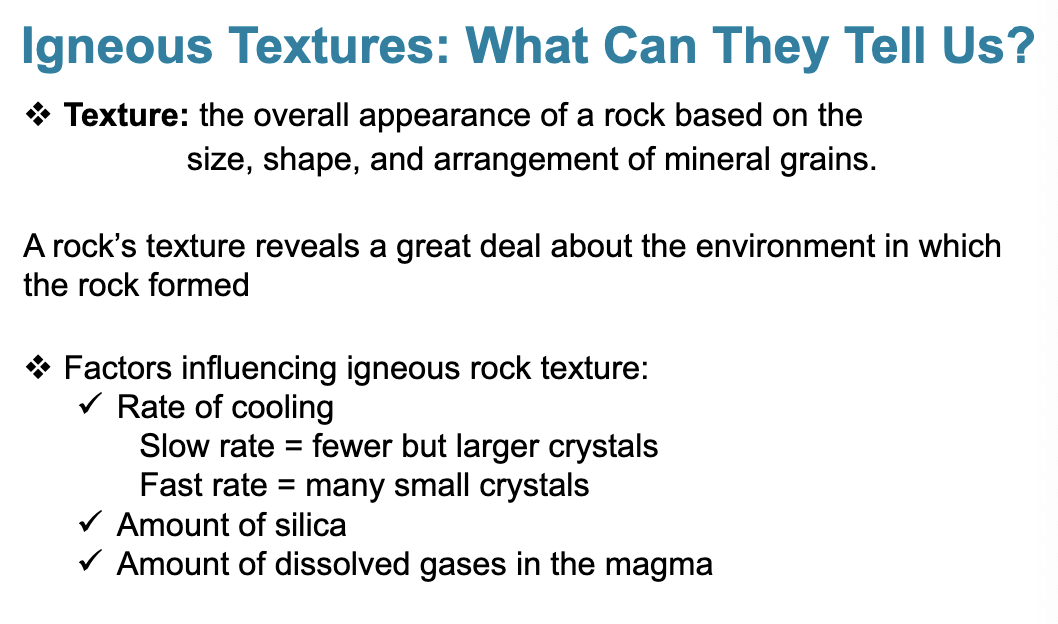
Igneous Rocks
Formed from the cooling and solidification of magma.
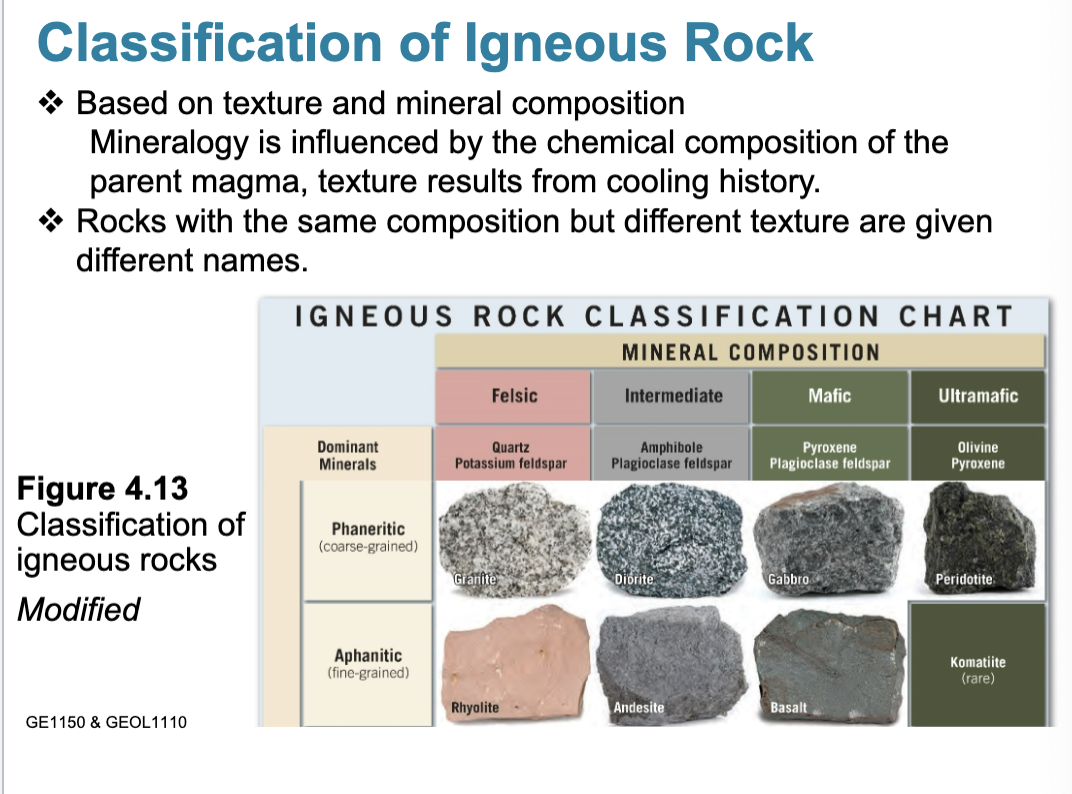
Felsic Rocks
Light-colored igneous rocks with high silica content (e.g., granite).
Mafic Rocks
Dark-colored igneous rocks with lower silica content (e.g., basalt).
Rock Cycle
Explains geological processes that form each rock type from the others.
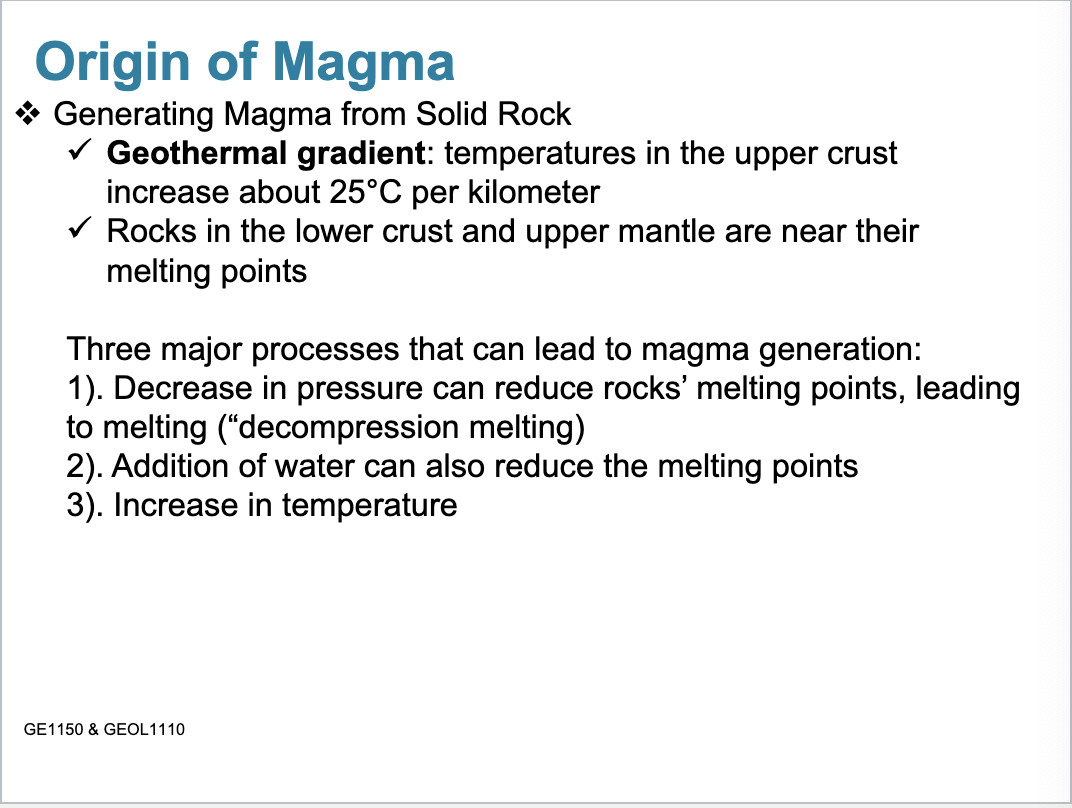
Magma
Molten rock located at depth.
Lava
Molten material that has surfaced.
Silica Content and Magma Behavior
High silica content results in more viscous magma which erupts at lower temperatures, while low silica content leads to less viscous magma which erupts at higher temperatures.
Atmosphere
gaseous envelope
Hydrosphere
global ocean and fresh water
biosphere
all plant and animal life
Geosphere
the solid earth
Inner planets
Mercury, venus, earth, and mars - form from metallic and rocky substances, small and rocky terrestrial planets, “Earth like”
Outer Planets
Jupiter, Saturn, Uranus, Neptune - forming from fragments of ices and gases (H2O, CO2, and others)
Earth’s Internal Structure
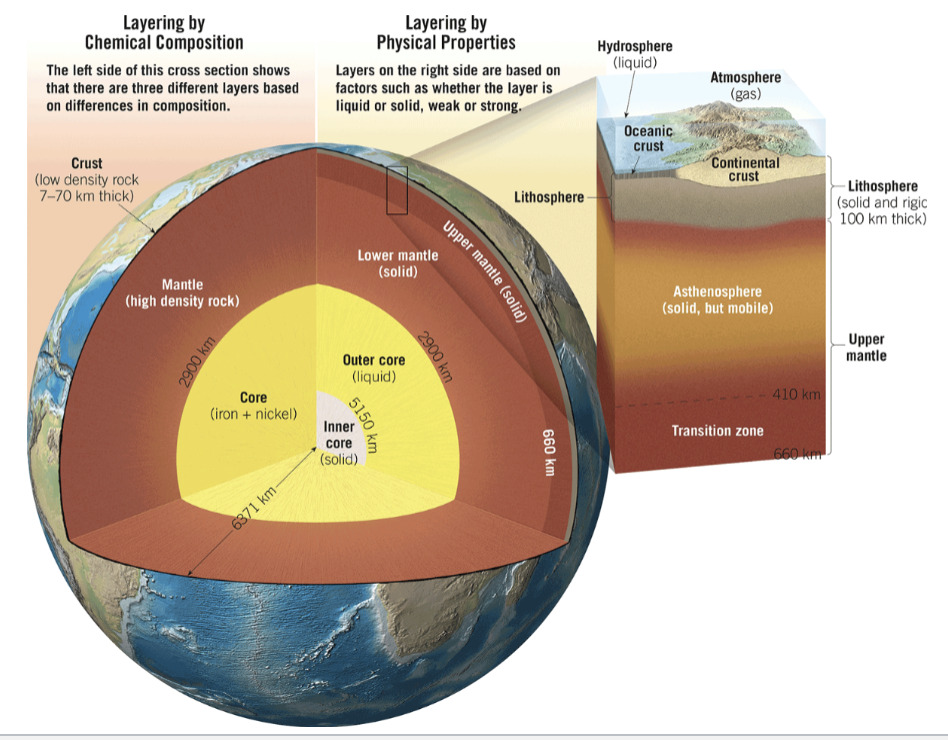
Crust
Earth’s thin, rocky outer skin, divided into the continental and oceanic crust. Oceanic curst is 7km thick and composed of basalt. Continental crust is 35-70km thick and composed primarily of granodiorite.
Mantle
2900km thick and composed of peridotite
Core
iron rich
Lithosphere
(rock sphere) the rigid outer layer of the earth that consists of the crust and the upper mantle
Asthenosphere
(weak sphere) the soft, weak layer below the lithosphere
Transition zone
a zone marked by a sharp increase in density below the asthenosphere
Lower mantle
a zone of strong, very hot rocks subjected to gradual flow
outer core
liquid outer layer of core
inner core
solid inner layer of core
Who first proposed the continental drift hypothesis and when?
Alfred Wegener in 1915
Continental drift hypothesis
Super continent named Pangaea, consisting of all of the Earth’s landmasses, once existed.
Around 200 million years ago, this supercontinent began fragmenting.
“drifted” to their present positions over millions of years.
How old is the earth
4.6 billion years old
Whats the radius of the earth?
6371 km
What is the length of the equator of the earth?
6378 km
Evidence for Pangaea
Oceanic ridge system, no oceanic crust is older than 180 million years old, thin sediment accumulation in the deep oceans
Lithosphere (100-200km)
comprised of the crust and upper mantle
asthenosphere (100-200km)
hotter, weaker region of the mantle under the lithsphere
rigid lithosphere overlies weak asthenosphere
Lithosphere and asthenosphere move independently with each other
Evidence of seafloor spreading
used fossil remains of microorganisms for dating, showed that the sediments increased with increasing distance from the ridge.
Major differences between rocks and minerals
A rock is a solid material composed of one or more minerals.
Rocks do not have a specific chemical composition and can be made up of different minerals in varying proportions.
What are the three general processes that form minerals?
Precipitation: occurs when a solid forms then falls out of solution
Crystallization: similar to water freezing
Deposition: as a result of biological processes. Water dwelling organisms transform dissolved material into mineral matter.
Eight most abundant elements in the continental crust
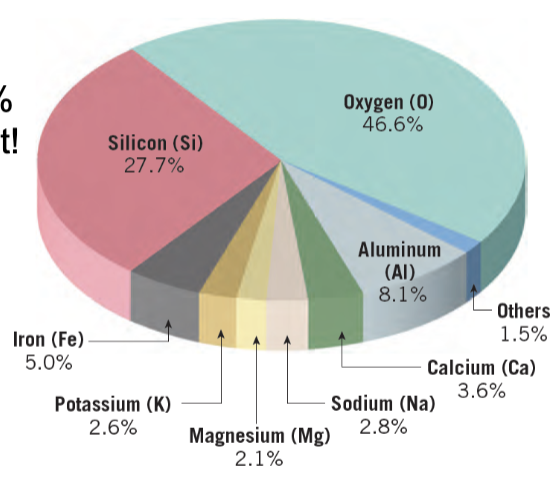
5 rock-forming minerals
Silicate - account fro >90% of Earth’s crust, silicone and oxygen make up the basic building blocks of silicate minerals
Nonsilicate minerals are not as common as silicates but important to our economy.
Carbonates
Oxides
Sulfates
Halides
Rocks are divided into these three major groups
Igneous, sedimentary, metamorphic
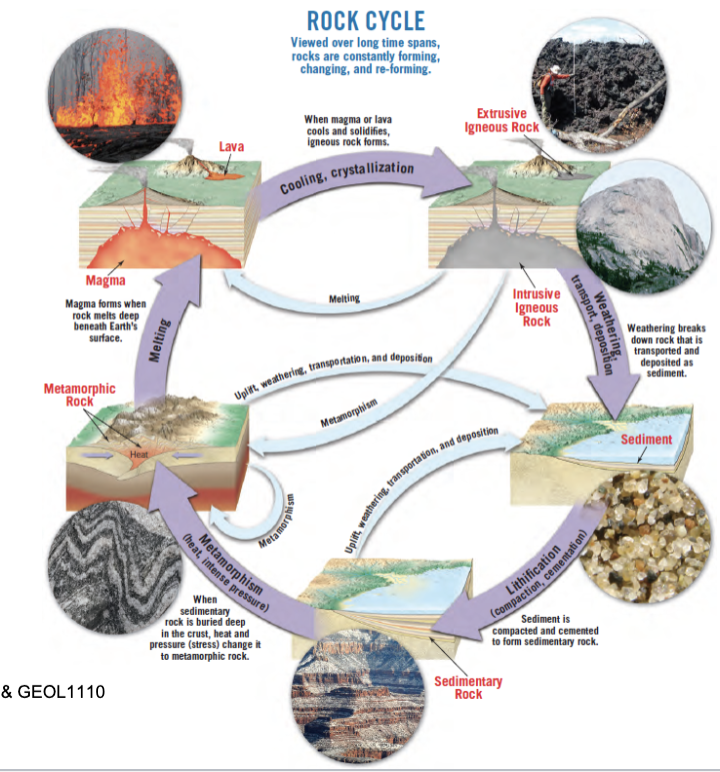
Igneous rocks
formed from cooling and solidification of molten rock
sedimentary rocks
sediments are derived from weathering of preexisting rocks
undergo lithification which means conversion into rock. Compacted and cemented together
accumulate in layers at earth’s surface
metamorphic rocks
formed by changing preexisting igenous, sedimentary, or other metamorphic rocks
driving forces are heat and pressure
Magma
completely or partly molten rock located at depth
Lava
molten material at the surface
Igneous rocks:
created when magma or lava solidifies
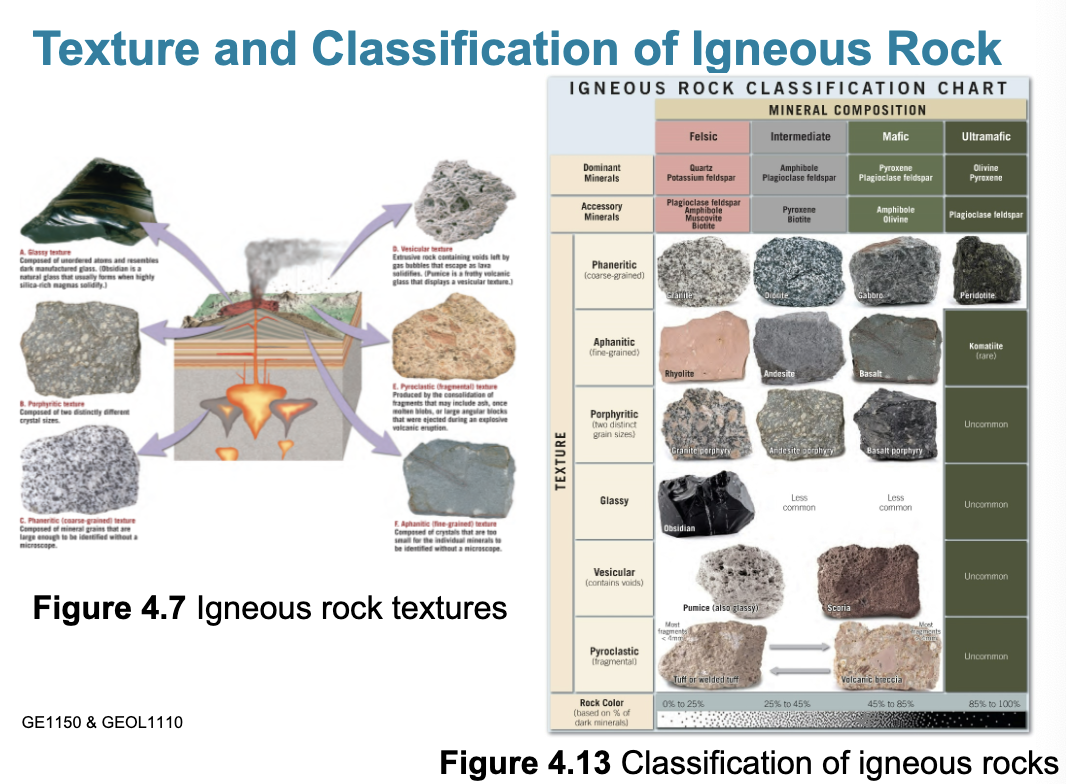
Intrusive igneous rock
magma crystallizes at depth. plutonic rock. example: granite
coarsely grained texture
Igneous compositions - four broad groups based on compositional differences
Felsic, intermediate, mafic, ultramafic
Felsic or granitic composition
felsic - feldspar and silica
light colored silicates
composed almost entirely of quartz and potassium feldspar
high silica content
contains small portion of dark silicate minerals
mamor constituent of continental crust
example rocks: granite and rhyolite
Intermediate or andesitic composition
composition between felsic and mafic
associated with volcanic activity on the seaward margins of the continents and volcanic island arcs.
Example rocks: diorite, andesite
Mafic or basaltic composition
mafic - magnesium and ferrum (iron)
contains dark silicates
higher density and darker color than granitic rocks
comprise the ocean floor and many volcanic islands
forms extensive lava flows on the continents
example: gabbro and basalt
Crustal rocks exhibit a considerable range of silica content
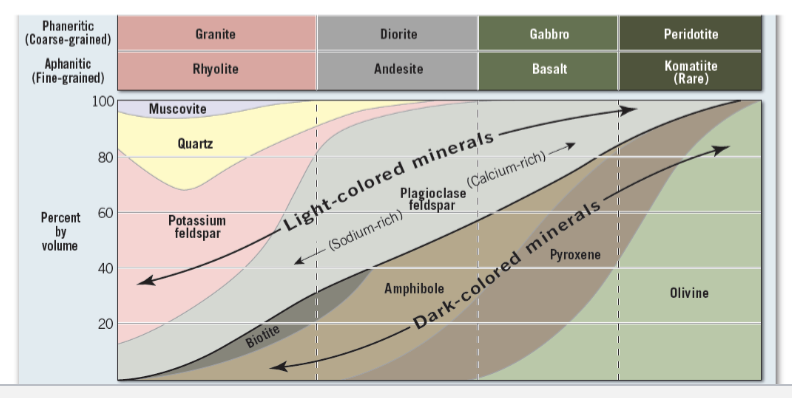
common silicate minerals in igneous rocks
quartz, potassium feldspar, mica, amphibole, pyroxene, olivine
silica content influences magma behavior
granitic magmas have high silica content, are viscous (thick) and erupt at a lower temperature
basaltic magmas have much lower silica content, more fluid like behavior, and erupt at a high temperature