Ecology: Parasitism
 Call Kai
 Learn
 Practice Test
 Spaced Repetition
 Match
 Flashcards
 Knowt Play
1/66

There's no tags or description
Looks like no tags are added yet.
67 Terms
whats the frequency of parasitism in animals?
50%
whats the frequency of parasitism in plants?
1%
whats the frequency of parasitism in viruses and prions?
100%
parasite
an organism that lives in another organism that takes resources but rarely kills it
ectoparasites
live on the outer surface of the host
endoparasites
live inside the hosts body
regarding to exposure to natural enemies, do ecto and endoparasites have high or low exposure?
ectoparasites have high exposure while endoparasites have low exposure
regarding exposure to external environment, do ecto and endoparasites have high or low exposure?
ectoparasites have high exposure while endoparasites have low exposure
regarding difficulty of moving to a new host, do ecto and endoparasites have high or low difficulty?
ectoparasites have low difficulty while endoparasites have high difficulty
regarding exposure to host immune system, do ecto and endoparasites have high or low exposure?
ectoparasites have low exposure while endoparasites have high exposure
regarding ease of feeding on host, do ecto and endoparasites have high or low ease?
ectoparasites have low ease while endoparasites have high ease
host
an organism from which the parasite takes resources
what are examples of ectoparasites?
mosquito and wasp larva
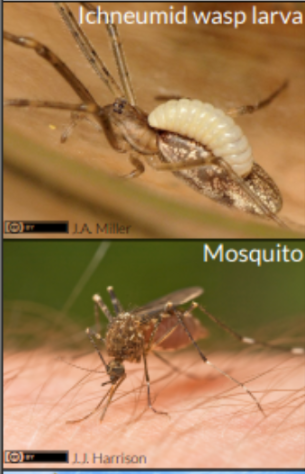
what are examples of endoparasites?
hookworm and malaria

pathogen
a parasitic organism that causes disease in its host
parasitoid
an organism that lives parasitically within another organism but eventually kills host
vector
organism that parasites use to disperse from one host to a new host
horizontal transmission
when hosts transmits parasites to non offspring
using the picture how does horizontal transmission through a vector work?
blood sucking insect bites an infected bird, picks up the virus, then transmits it to a healthy bird
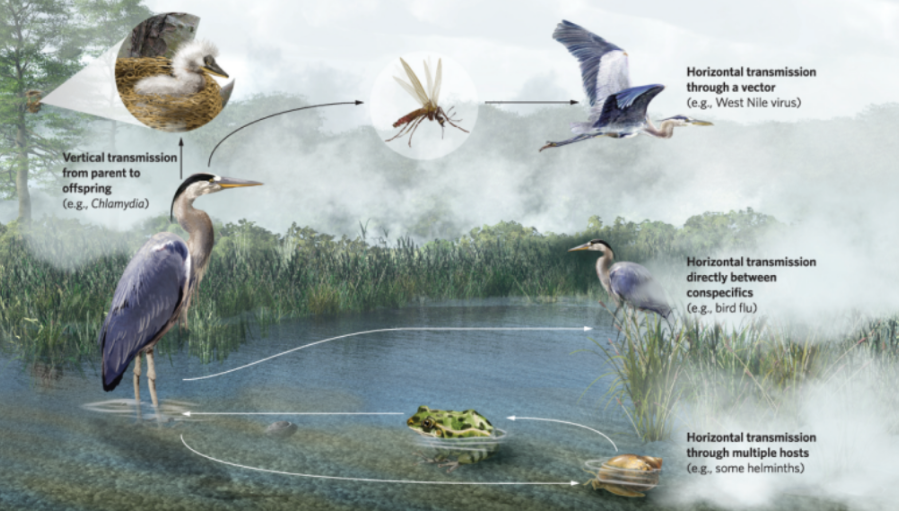

using the picture how does horizontal transmission between conspecies (same species) work?
the disease spreads directly from one bird to another often through contact
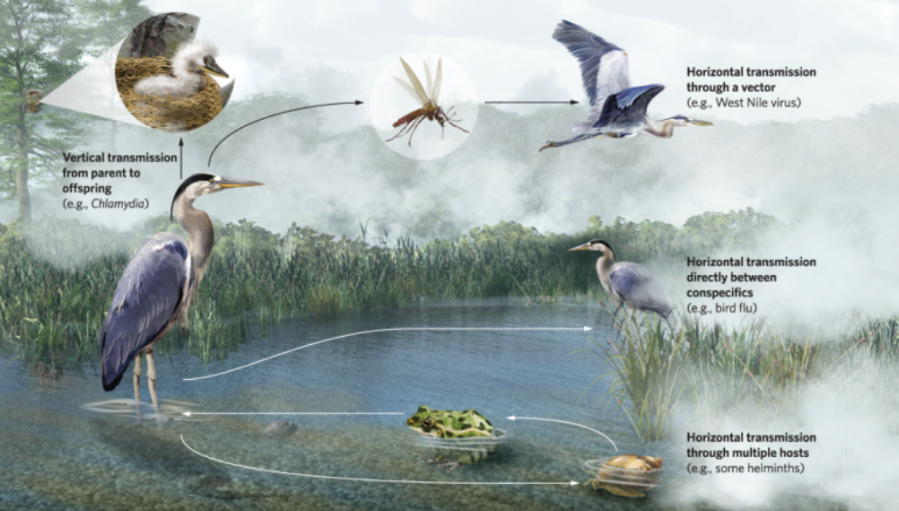
using the picture how does horizontal transmission through multiple hosts work?
parasite passes through a snail, to a toad, then to a heron
what is horizontal transmission through multiple hosts?
parasite relies on intricate life cycle where is must pass through different animal species before it can fully mature
vertical transmission
when parents transmit parasites to their offspring
vertical transmission is common among what hosts?
hosts that give live bitrh, build nests, or provide care to offspring
regarding vertical and horizontal transmission, which parasites do you think have adaptations to persist environment without host for a period of time?
horizontal transmission

Using this diagram, how are host-parasite population cycles similar to predator-prey population cycles?
host population increases while parasite population lags behind, then as parasite population increases host population decreases then parasite population decreases due to lack of hosts then cycle repeats
SIR compartment model of disease dynamics
divides a population into 3 groups to track and predict how an infectious disease spreads
what are the 3 groups in SIR compartment modeling? (hint: its what the SIR stand for)
susceptible, infected, and removed

The equation for susceptible is pictured. What does dS/dt represent?
rate at which the susceptible population changes

The equation for susceptible is pictured. What does the b stand for?
transmission rate

The equation for susceptible is pictured. Why is there a negative sign?
susceptible people become infected so the susceptible population decreases
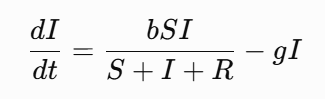
The equation for infected is pictured. What does the
bSI/ S+I+R represent?
new infections being added to the infected population

The equation for infected is pictured. What does the g represent?
recovery/removal rate

The equation for infected is pictured. What does the gI represent?
infected people recovering in being removed from the infected population
In simple words, how would you express the infected SIR equation?
change in infected population= new infections- recoveries/removals

The equation for removed is pictured. Why is the gI positive here?
people are continously recovering or being removed so the R population increases

There’s a school of 1000 people and an infectious disease is spreading through it. The susceptible are 800, the infected are 100, and the recovered are 100. The transmission rate is 0.5 and the removal rate is 0.1. Find the rate at which the susceptible, infected, and removed population changes. Explain what each rate means.
dS/dt= -40 → susceptible population decreases by 40 people per unit of time
dI/dt= 30 0> the infected population increases by 30 people per unit time because 40 people become infected while 10 people recover
dR/dt= 10 → the removed population increases by 10 people per unit time
Ask chat to run problems for you!
got it

What does the trend of each colored line represent? Break down into blue, red, and green.
Blue= susceptible line starts high because most people haven’t been infected then decreases as people catch the disease
Red= infected line starts low then increases as the disease spreads then eventually decreases as people recover or get removed faster than new people becoming infected
Green= the removed line starts at zero and steadily increases as people recover or are removed from population
Without looking at a graph summarize the trends of SIR lines in a population experiencing parasitism?
S (susceptible) line goes from high to low
I (infected line) goes from low to high to low
R (removed/recovered) line goes from low to high to steady
whats Ro in SIR compartment modeling?
average number of new infections caused by one infected individual in a fully susceptible population
what does b and g represent in the equation Ro=b/g? (hint: its the same meaning as before)
b is the rate at which infected individuals produce new infections and g is the rate at which infected individuals recover or are removed
if Ro>1 what does that mean?
each infected person infects more than one person on average so the disease spreads
if Ro<1 what does that mean?
each infected person infects fewer than one person on average so the disease eventually dies out
if Ro=1 what does that mean?
the infection is maintained at a roughly stable level
Example, if b=0.5 and g=0.1 what is Ro and what does that mean for the population?
Ro= 0.5/0.1=5
this means the individuals infects an average of 5 others
since 5>1 the infection spreads
many individuals will end up in the removed category
what 4 factors influence Ro?
1) pathogen characteristics
2) transmission mechanism
3) host characteristics
4) host population characteristics
pathogen characteristics
how easily/how effective the pathogen infects people
transmission mechanism
how the disease spreads
host characteristics
how strong an individuals immune response is
host population characteristics
population density and behavior such as how frequently individuals interact
How can vaccines change the order of SIR?
if susceptible people get a vaccine then can skip the infected stage and go right to the recovered stage S→ R
what does the critical vaccination threshold equation, 1-1/Ro, represent?
the minimum proportion of the population that needs to be vaccinated to prevent sustained disease spread under the basic model assumptions
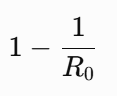
If R0=5, what is the critical vaccine threshold? Explain that number as a percentage.
1-1/5= .80
80% of the population needs to be vaccinated
broadly describe how parasites can manipulate their hosts?
can change their hosts behaviors or physical characteristics to improve their own survival
how does parasitic fungus manipulate yellow dung flies?
fungus infects flies and changes their behavior causing them to perch in exposed positions that help spread fungal spore to other flies
how does the parasite, Spirobacillus cienkowskii, manipulate water fleas?
the parasite infects water fleas and causes them to change color, making infected individuals appear orange and red
what are the 4 defenses hosts have developed to protect against parasites?
1) immune systems
2) mechanical defenses
3) behavoiral chnages
4) self medication
whats an example of a mechanical defense
skin, bark or thorns that prevent parasites from entering
self medication defense
animals consume certain substances that help fights parasites

This graph is an example of self medication. Caterpillars were observed eating plants with and without toxins. Without toxins, unparasitized had 97% survival and parasitized had 40%. With toxins, unparasitized had 82% survival and parasitized had 57% survival. Why did the parasitized caterpillars have better survival with food toxins?
the toxins helped them fight parasites, killing them off, and allowing them to survive more
selection on the host favors what 2 things?
1) defenses that limit parasite impact on fitness
2) priming of offspring defenses
what is priming of offspring defenses?
parents help prepare their offspring to defend against parasites
selection on the parasites favors what 2 things?
1) bypassing of defenses
2) changes in virulence
how does changes in virulence favor parasites?
parasites can evolve to become more or less harmful depending on which traits help them reproduce and spread
how do hosts and parasites co evolve?
hosts evolve better defenses against parasites while parasites evolve ways to overcome those defenses
What is lost when parasites go extinct?
biodiveristy, food webs, population control, and co evolution