BK2 9 Uniform Circular Motion
 Call Kai
 Learn
 Practice Test
 Spaced Repetition
 Match
 Flashcards
 Knowt Play
1/12

There's no tags or description
Looks like no tags are added yet.
13 Terms
What is a radian, and how do you convert between radians, arc length, and degrees?
A radian is the angle subtended at the centre of a circle by an arc equal in length to the radius, defined as θ = s / r.
Conversion: 2π rad = 360 degrees, so θ in radians = (θ in degrees) * π / 180.
[Formula Status: θ = s / r is NOT IN DSE FORMULA SHEET - MUST MEMORIZE]

What are the formulas connecting linear speed v, angular speed ω, period T, and radius r?
Angular speed ω = θ / t (rad/s).
Linear speed v = s / t = r * ω (m/s).
Period T = 2π / ω = 2πr / v (s).
[DSE Trap: Points on the same rigid rotating body share the exact same angular speed ω, but linear speed v is directly proportional to distance r from the center
[Formula Status: v = r * ω and T = 2π / ω are NOT IN DSE FORMULA SHEET - MUST MEMORIZE]
What is centripetal acceleration, what direction does it point, and what are its formulas?
Centripetal acceleration is the rate of change of velocity direction in uniform circular motion.
Direction ALWAYS points radially towards the centre of the circular path.
Formulas: a = v^2 / r = r * ω^2 = v * ω.
[HKEAA Keyword: "pointing towards the centre of the circular path"].
[Formula Status: a = v^2 / r = r * ω^2 is IN DSE FORMULA SHEET]
Why does centripetal force do zero work and keep kinetic energy constant? [Formula Status: W = F * s * cos θ and F = m * v^2 / r are IN DSE FORMULA SHEET]
Centripetal force is always perpendicular to velocity and instantaneous displacement.
Work done W = F * s * cos(90°) = 0 J.
Speed and kinetic energy stay constant; centripetal force ONLY changes the direction of motion.
[HKEAA Keyword: "perpendicular to velocity, no work done, KE remains constant"].
What is the most common mistake when drawing centripetal force on a Free-Body Diagram (FBD)?
Centripetal force is NOT a separate physical force and must NEVER be drawn as an additional force arrow on an FBD.
It is simply the net radial force provided by real forces like friction, normal force, tension, or weight.
[HKEAA Exam Trap: Drawing an extra arrow labeled "centripetal force" on an FBD loses marks immediately].
What path does an object take if the centripetal force suddenly vanishes?
According to Newton's First Law, the object flies off in a straight line along the tangential direction at constant speed due to inertia.
[HKEAA Keyword: "moves along the tangential direction in a straight line due to inertia"].

What provides centripetal force for a car turning on a flat level road, and what is the max speed?
Centripetal force is provided solely by sideways friction f between tires and road (f = m * v^2 / r).
Max speed without skidding v_max = sqrt(f_max * r / m).
[DSE Trap: On wet roads, maximum friction f_max drops, lowering v_max and increasing skidding risk].
[Formula Status: v_max = sqrt(f_max * r / m) is NOT IN DSE FORMULA SHEET - MUST DERIVE from F = m * v^2 / r]

What is the ideal banking angle formula for a curved road, and does it depend on mass?
Horizontal normal force component R sin θ = m * v^2 / r.
Vertical component R cos θ = mg.
Dividing gives tan θ = v^2 / (g * r).
Ideal banking angle θ depends ONLY on speed v and radius r, completely INDEPENDENT of vehicle mass m.
Formula Status: tan θ = v^2 / (g * r) is NOT IN DSE FORMULA SHEET - MUST DERIVE]
![<p>Horizontal normal force component R sin θ = m * v^2 / r. <br>Vertical component R cos θ = mg. <br>Dividing gives tan θ = v^2 / (g * r). <br>Ideal banking angle θ depends ONLY on speed v and radius r, completely INDEPENDENT of vehicle mass m. <br>Formula Status: tan θ = v^2 / (g * r) is NOT IN DSE FORMULA SHEET - MUST DERIVE]</p>](https://assets.knowt.com/user-attachments/2284a48c-ebaf-4b8e-9fd6-5062efc3c43c.png)
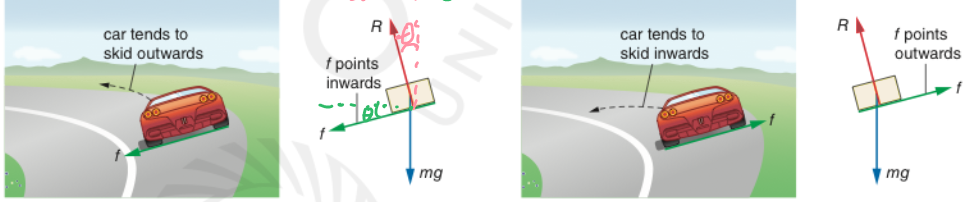
Which way does friction point on a banked road if a car goes faster or slower than ideal speed?
Faster than ideal speed: Car tends to skid outwards (up the slope), so sideways friction f points INWARDS (down the slope) to assist turning.
Slower than ideal speed: Car tends to slide inwards (down the slope), so friction f points OUTWARDS (up the slope).
How does an aeroplane turn in horizontal flight, and what is its tilt angle formula?
The aeroplane banks so that horizontal lift component L sin θ provides centripetal force (L sin θ = m * v^2 / r).
Vertical lift component balances weight (L cos θ = mg).
Dividing gives tan θ = v^2 / (g * r).
[Formula Status: tan θ = v^2 / (g * r) is NOT IN DSE FORMULA SHEET - MUST DERIVE]

What are the conical pendulum equations, and why can the string never be 100% horizontal?
Vertical: T cos θ = mg.
Horizontal: T sin θ = m * r * ω^2 = m * L sin θ * ω^2 => Tension T = m * ω^2 * L.
The string can NEVER be horizontal (θ = 90°) because cos(90°) = 0, which would leave vertical tension T cos θ = 0 and unable to support weight mg.
[Formula Status: T = m * ω^2 * L is NOT IN DSE FORMULA SHEET - MUST DERIVE]

How do riders stick to the wall in a spinning Rotor ride, and does minimum speed depend on mass?
Wall normal force R provides centripetal force (R = m * r * ω^2).
Wall friction f balances weight (f = mg).
To prevent slipping: f_max >= mg => μ * R >= mg => μ * m * r * ω^2 >= mg => min angular speed ω_min = sqrt(g / (μ * r).
Rider mass m cancels out, so ω_min is IDENTICAL for heavy and light riders.
[Formula Status: ω_min = sqrt(g / (μ * r)) is NOT IN DSE FORMULA SHEET - MUST DERIVE]

How do you find stopping distance when a turntable suddenly stops and an object slips?
Before stopping, initial linear speed v = r * ω.
Once the turntable stops, the object slides in a straight line.
Use Energy Conservation: Loss in KE = Work done against friction => 1/2 m v^2 = f * s => stopping distance s = m * (r * ω)^2 / (2 * f).
[DSE Trap: Do NOT use circular motion formulas after the turntable stops][cite: 64, 86]. [Formula Status: s = m * (r * ω)^2 / (2 * f) is NOT IN DSE FORMULA SHEET - MUST DERIVE]