A&P of Speech and Swallowing Exam 3
 Call Kai
 Learn
 Practice Test
 Spaced Repetition
 Match
 Flashcards
 Knowt Play
1/31

There's no tags or description
Looks like no tags are added yet.
32 Terms
Biological functions of the larynx
primary
protective, inhibits entry of foreign objects
coughing, throat clearing
abdominal fixation
reflexive actions
Coughing physiology
Deep inhalation - widely open vocal tract
Elevation of the larynx
Tensing and tight closing of the vocal folds
Positive subglottal air pressure blows the vocal folds apart and expels the object
Repeated coughing can cause damage to the voice
Throat clearing physiology
Same as cough but with less force, and what is expelled is mucus rather than an object
Not as violent as coughing but can still cause damage to the voice
Abdominal fixation physiology
Deep inhalation
Tensing and tight closing of the vocal folds
Enclosed air in the throrax stabilizes torso, allowing muscular force to be focused on the legs for weight lifting
Reflective actions physiology
Dilation or opening of the larynx- mostly involuntary
Somewhat controlled ex: when you hold your breath underwater; however at a certain point the reflex will kick in because your body senses the need to breathe
5 layers of the vocal folds
Squamous epithelium with basement membrane
keeps in saliva in salivary glands and mucosa from laryngeal membranes - mucosa keeps it slippery and traps debris
Superficial elastin (2-4 make up the lamina propia)
Intermediate elastin (intermediate + deep make up the vocal ligament)
gives tensile strength and density
Deep collagen
Muscle
Abduction (caused by muscular action)
open, when air passes to and from the respiratory tract, such as breathing or release of air flow
Adduction (caused by muscular action)
closed, happens throughout phonation and during some other biological functions
Cricothyroid joint movement
synovial joint, only rocking down in front and back up (anteriorly to posteriorly)
Cricoarytenoid joint movement
synovial joint permits 3 types of movement: inward rocking, gliding, rotation
changing the glottis
Phonation
production of vocalization or “voice” due to the cyclic opening and closing of the vocal folds as a result of muscle tension and aerodynamics
respiration is the source of energy for speech to create voice needed
the larynx is the main anatomical structure
Fundamental frequency
the number of vocal fold vibrations per second, measured in Hertz (Hz)
Fundamental frequency is controlled by these three changes in the vocal folds:
length
tension
mass per unit length: how musch the muscle, mucosa, and ligament is spread out over a distance (how fat/thin)
Larynx movements that cause changes: to increase frequency (higher pitch)
cricothyroid joint rocks down
lengthens or stretches the vocal folds
vibrate faster due to decreased mass (thinner)
thyrovocalis further increases tension
Larynx movements that cause changes: to decrease frequency (lower pitch)
cricothyroid returns back up
shortens the vocal folds
vibrates slower due to increased mass (fatter)
thyromuscularis loosen vocal folds, decreases tension
Role of Bernoulli Effect in vocal fold vibration
decrease in pressure helps pull vocal folds back toward midline
Sustained phonation
Laryngeal posture is maintained by:
sufficient adduction and medial compression to keep VF vibrating
appropriate tension of the tensor/relaxers
Vocal registers
Modal register: used in daily conversation
Glottal fry: lowest register, crackly sound - lowered subglottal pressure and tension of thyrovocalis
Falsetto: thin, lengthened, relaxed VF, anf VF only make brief contact
Vocal intensity
the increase in the sound pressure of the speech signal, controlled by increases in
medial compression
subglottal pressure
lung alveolar pressure

Looking at DIAGRAM V, which 2 anatomical structures are directly related to the PRIMARY function of the larynx?
A. #3 & #7
B. #1 & #6
C. #3 & #10
D. #7 & #9
C. #3 & #10
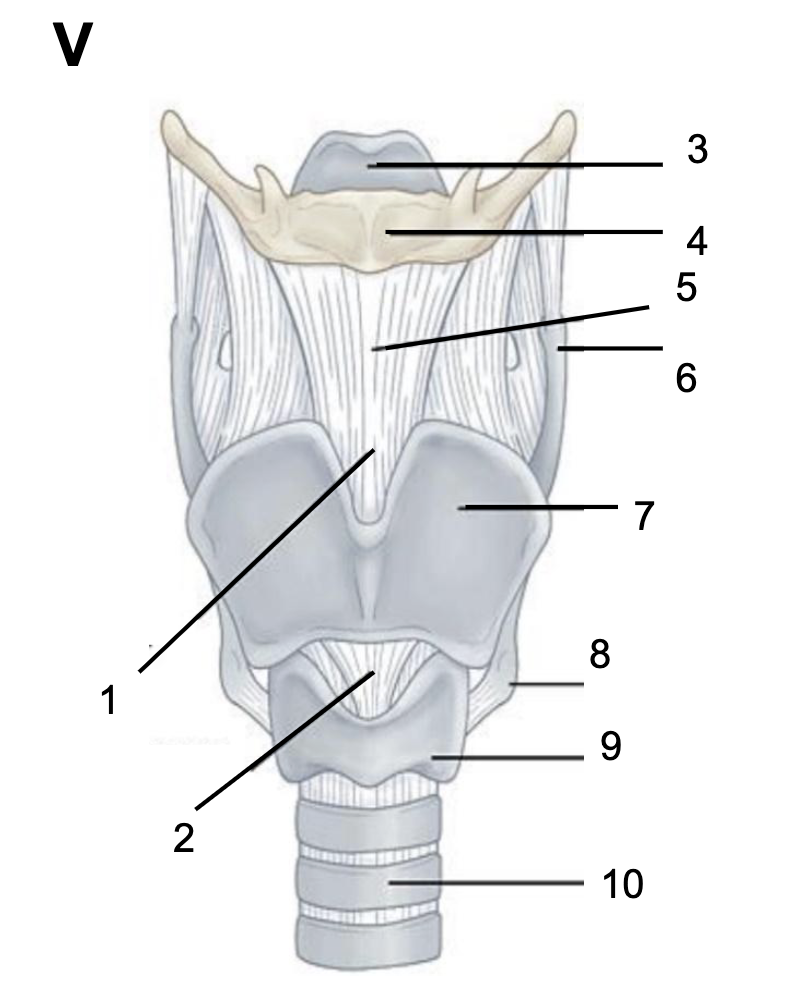
Looking at DIAGRAM V, what is unique about #4?
A. It is a bone.
B. It is an unpaired cartilage.
C. It secretes mucous.
D. It attaches to extrinsic muscles of the larynx.
A. It is a bone.

Looking at DIAGRAM W, which correctly labeled extrinsic muscles elevate the hyoid?
A. #7 genioglossus, # 8 stylohyoid
B. #6 stylomyoid, #1 stylohyoid
C. #7 genioglossus, # 8 stylohyoid, #2 thyrovocalis
D. #7 genioglossus, #1 stylohyoid, #8 hyoglossus
D. #7 genioglossus, #1 stylohyoid, #8 hyoglossus
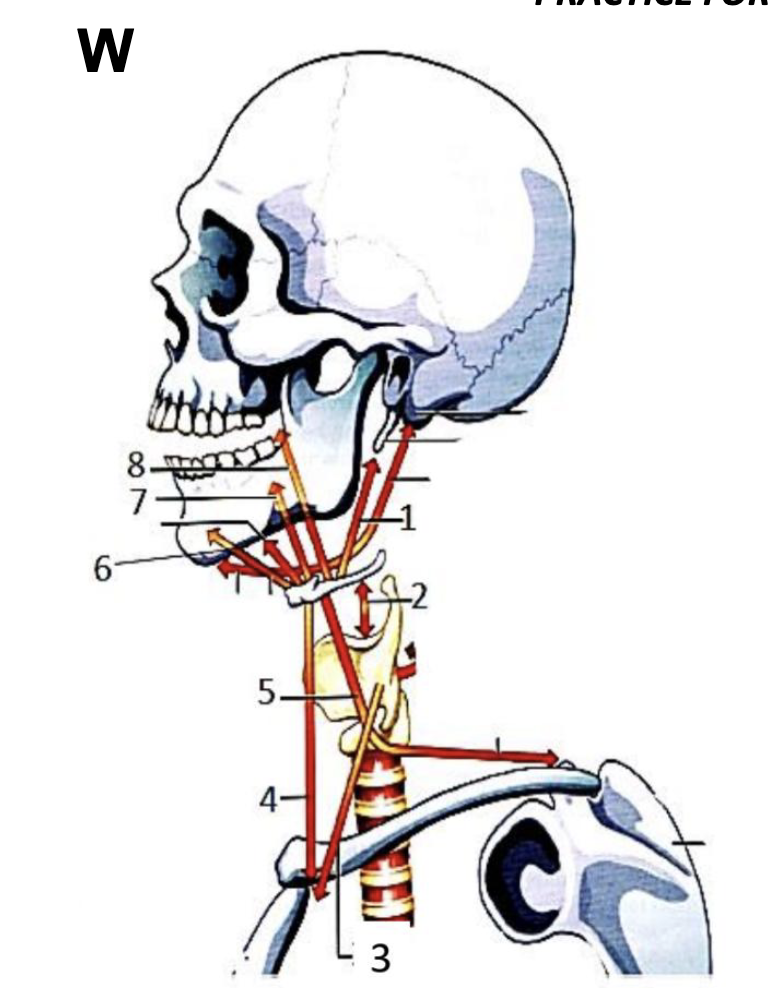
Select all that apply: Looking at DIAGRAM W, what is completely correct regarding the innervation of the muscles shown?
A. #5 omohyoid is innervated by spinal nerves
B. #2 & #5 are innervated by the superior laryngeal nerve (CN X)
C. #7 & #8 are innervated by CN XII Hypoglossal
D. #7, the mylohyoid is innervated by CN V Trigeminal
A. #5 omohyoid is innervated by spinal nerves
C. #7 & #8 are innervated by CN XII Hypoglossal

Looking at DIAGRAM W, which of these correctly labeled muscles are considered ‘strap muscles’?
A. #7 geniohyoid, #8 hyoglossus, #1 stylohyoid, #6 digastric (anterior belly)
B. #5 sternocleidomastoid, #4 sternohyoid, #2 stylohyoid, #4 sternothyroid
C. #5 sternohyoid, #4 omohyoid, #2 thyrohyoid, #3 tracheosternoid
D. #5 omohyoid, #4 sternohyoid, #2 thyrohyoid, #3 sternothyroid
D. #5 omohyoid, #4 sternohyoid, #2 thyrohyoid, #3 sternothyroid
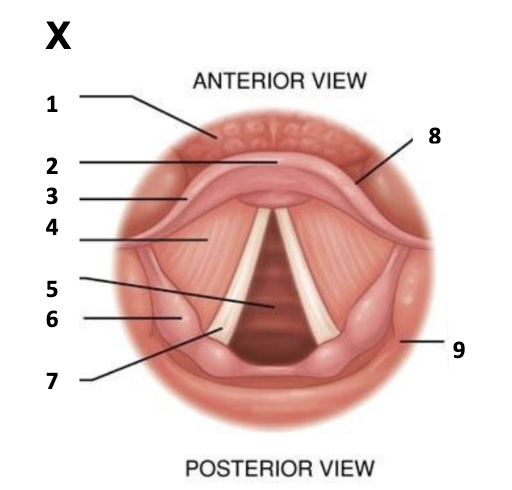
Select all that apply: Looking at DIAGRAM X, what supports the continual vibration of #7?
A. fast airflow velocity due to the Bernoulli effect
B. adduction and abduction effected by the intrinsic laryngeal muscles
C. its inertia, elasticity, and stiffness
D. gliding movement of the arytenoid cartilages
A. fast airflow velocity due to the Bernoulli effect
C. its inertia, elasticity, and stiffness

Looking at DIAGRAM X, what is #2?
A. The vestibular vocal folds
B. The piriform sinus
C. The epiglottis
D. The vallecula
C. The epiglottis

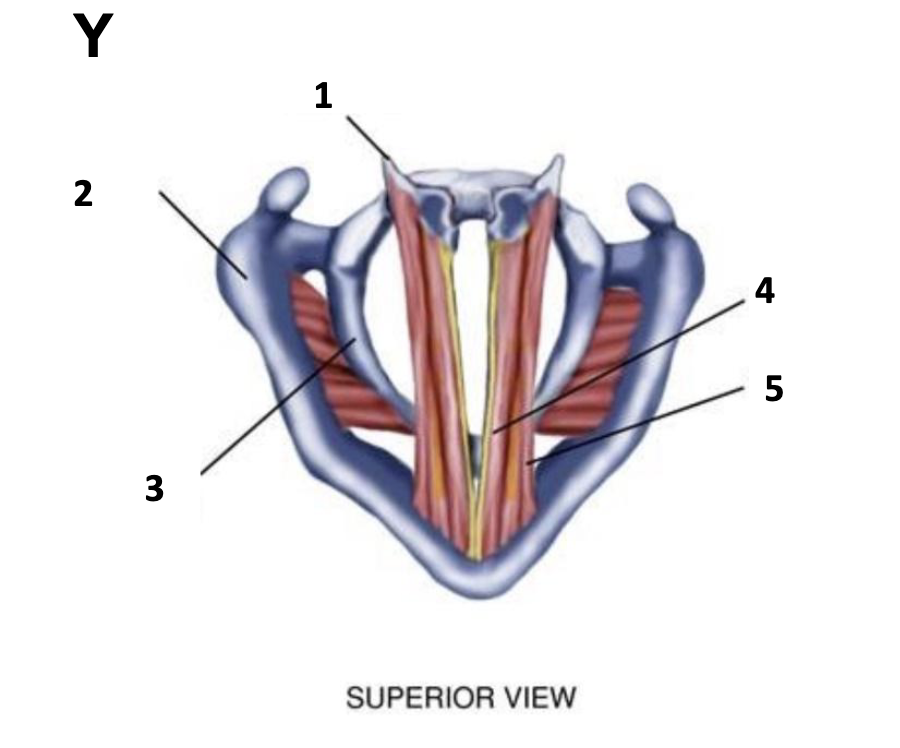
Select all that apply: Which structures are shown in DIAGRAM X but NOT in DIAGRAM Y?
A. the epiglottis
B. the quadrangular membrane
C. the true vocal folds
D. the glottis
E. the aryepiglottic fold
A. the epiglottis
B. the quadrangular membrane
E. the aryepiglottic fold

Select all that apply: Looking at DIAGRAM Y, which of these statement(s) are TRUE about the shown
cartilages?
A. #1 is one of a pair of arytenoid cartilages
B. #2 & #3 articulate at the cricothyroid joint
C. muscles #4 and #5 connect to the cricoid cartilage
D. the cuneiform cartilages are small cartilages on the superior surface of
the arytenoids
A. #1 is one of a pair of arytenoid cartilages
B. #2 & #3 articulate at the cricothyroid joint

Select all that apply: Looking at DIAGRAM Y, which statements are FALSE regarding the shown muscles?
A. all depicted muscles are innervated by the recurrent laryngeal nerve
B. #4 the cricothyroid tenses the vocal folds
C. #5 is the thyromuscularis
A. all depicted muscles are innervated by the recurrent laryngeal nerve
B. #4 the cricothyroid tenses the vocal folds
Select all that apply: Read the following statements about the voice & choose ALL that are TRUE.
A. Pitch range is based on vocal cord tension and usually consists of 2.5 octaves
B. Habitual pitch can be the same as optimal pitch
C. Optimal pitch varies by age and gender, which changes with puberty and aging
D. Falsetto is created by thin, lengthened and relaxed vocal folds that make brief contact
E. Modal register, whistle register and whispering are the 3 true vocal registers
F. Glottal fry vibrates at a slower and aperiodic pattern than normal
B. Habitual pitch can be the same as optimal pitch
C. Optimal pitch varies by age and gender, which changes with puberty and aging
D. Falsetto is created by thin, lengthened and relaxed vocal folds that make brief contact
F. Glottal fry vibrates at a slower and aperiodic pattern than normal
All intrinsic muscles of the larynx are innervated by the ___, recurrent laryngeal branch EXCEPT for cricothyroid which is innervated by ___.
CN X Vagus; superior laryngeal branch
All extrinsic muscles of the larynx are innervated by ___ nerves in some cases in conjuction with cervical ___ nerves
cranial; spinal