Topic 4: Equity
 Call Kai
 Learn
 Practice Test
 Spaced Repetition
 Match
 Flashcards
 Knowt Play
1/72

There's no tags or description
Looks like no tags are added yet.
Name | Mastery | Learn | Test | Matching | Spaced | Call with Kai | Chat |
|---|
No analytics yet
Send a link to your students to track their progress
73 Terms
What are the 2 main sources of finance?
Bank loans
Investors’ equity
What are bank loans?
pay annual interest
repay loan on its maturity date
if it fails to pay interest or loan bank can force bankruptcy
What are equity investors?
no legal right to any form of repayment
annual dividends not guaranteed.
less financially stressful for company.
What do equity investors get in return?
share in ownership of business
potential to receive a share in profits (dividends)
sell their shares at a profit if the business is successful.
What is the company view?
The company is deciding whether to raise money by selling shares (equity).
No repayments required: Unlike a bank loan, the company does not have to repay the money invested.
Ownership is diluted: Founders give up a percentage of ownership to new shareholders.
More time-consuming: Raising equity can take longer to organise than getting a bank loan.
More people to satisfy: The company must consider the interests of many shareholders rather than dealing with just one bank.
What is the investor view?
The investor is deciding whether to invest money in the company.
Higher risk: Investors are not guaranteed dividends or repayment of their investment.
Less information: Managers usually know more about the company than investors do.
Less negotiating power: Individual investors may have limited influence over the returns they receive.
Higher potential returns: Shares can generate greater returns than bonds, but they carry greater risk.
Historically higher returns: Equities have historically outperformed bonds by more than twice in the context of your notes.
What is ordinary share capital?
most common in share capital
real owners of the company
shares have an official value when they are issued, but the price people buy and sell them for can be differen
no guaranteed rights to dividend payments
What are ordinary shareholders voting rights?
mergers, acquisitions and corporate policy
board of directors and management
decisions to raise/expand equity share capital
What are advantages of ordinary share capital?
dividends (not guaranteed)
(unlimited) capital gain
limited liability
internal corporate governance through voting
preemptive rights
Disadvantages of ordinary shares?
uncertain and irregular income
limited control
last to get paid if company goes bankrupt
What are preference shares created as a hybrid between?
equity and loans
What are preference shares?
give investors priority over ordinary shareholders when receiving dividends and getting their money back if the company closes down.
reduce company debt without reducing company voting control
lower-risk investment
What are the two types of preference shares?
Cumulative preference shares: Missed dividends accumulate and generally must be paid before ordinary shareholders can receive dividends.
Non-cumulative preference shares: Missed dividends do not accumulate, so investors may lose that dividend permanently.
What are advantages of preference shares?
appeals to cautious investors
classified as equity so limits debt
provides flexibility
used as incentives during transactions
Disadvantages of preference shares?
low and limited return to investors
no voting rights
will only be paid once other creditors have been paid during bankruptcy
lack of tax deductibility
What are depository receipts?
Certificated that allow investors to invest in foreign companies more easily
How do depository receipts work?
A foreign company's shares are held by a bank or custodian.
A bank issues certificates representing ownership of those shares.
Investors buy and sell these certificates on another country's stock market.
What are two main types of depository receipts?
ADR - American Depositary Receipt (traded in US)
GDR - Global Depositary Receipt (traded outside US)
Why are depository receipts useful?
companies: attract investment from other countries
investors: can buy foreign-company investments more conveniently through their local markets
trading: ADRs priced in dollars, transactions easier for US investors.
What are the characteristics of ADRs?
registered, issued, and traded in US
get more US exposure and into the equity market
most common way for US investors to invest and trade in foreign corporations
dont remove currency risks or political and economic risks associated with home country.
What are primary markets?
Markets where a company sells shares to the public for the first time to raise money, known as an Initial Public Offering (IPO).
What are secondary markets?
Markets where investors buy and sell existing shares between themselves on a regular basis.
Why is liquidity in second markets critical?
to raise equity finance, must sell newly issued shares to public investors
successful equity needs strong primary and secondary market
only subscribe to primary if confident they can be sold in secondary later
What is the structure of equity and bond markets?

What are institutional underwriters?
large financial institutions, such as investment banks, that help companies sell new shares to investors.
What is the structure of equity and bond markets?

What is initial public offering (IPO)?
when a private company sells its shares to the public for the first time and becomes listed on a stock exchange.
Why is IPO attractive to the company?
Finances expansion
Reduces debt-equity and risk exposure to loan interest payments
opens way to secondary market, business founders reduce their stakes
raises public profile of the company
What are the challenges of IPO?
high costs
more regulations and audits
loss of control
risk of incorrect share pricing
must convince investors to buy shares
must attract investors without underpricing
meet tougher accounting standards
regular reporting to investors
needs an investor relations team
What is the under-pricing phenomenon?
Significant price surge on debut day.
generates strong initial investor enthusiasm and secondary market demand.
What is the downside for issuer from underpricing?
leaves cash on the table that could have funded corporate development
What are mis-priced IPOs?
when a company sets the initial share price too high or too low when it first sells shares to the public
What is a dilutive issue?
when a company created and sells new shares to raise more money
company receives cash
earnings may stay the same
earning per share falls
existing shares are diluted
What is a Non-dilutive issue?
when existing shares are sold to new investors, rather than the company creating new shares.
founders reduce ownership
benefit of an IPO
more shareholders
What are successful M&A examples?
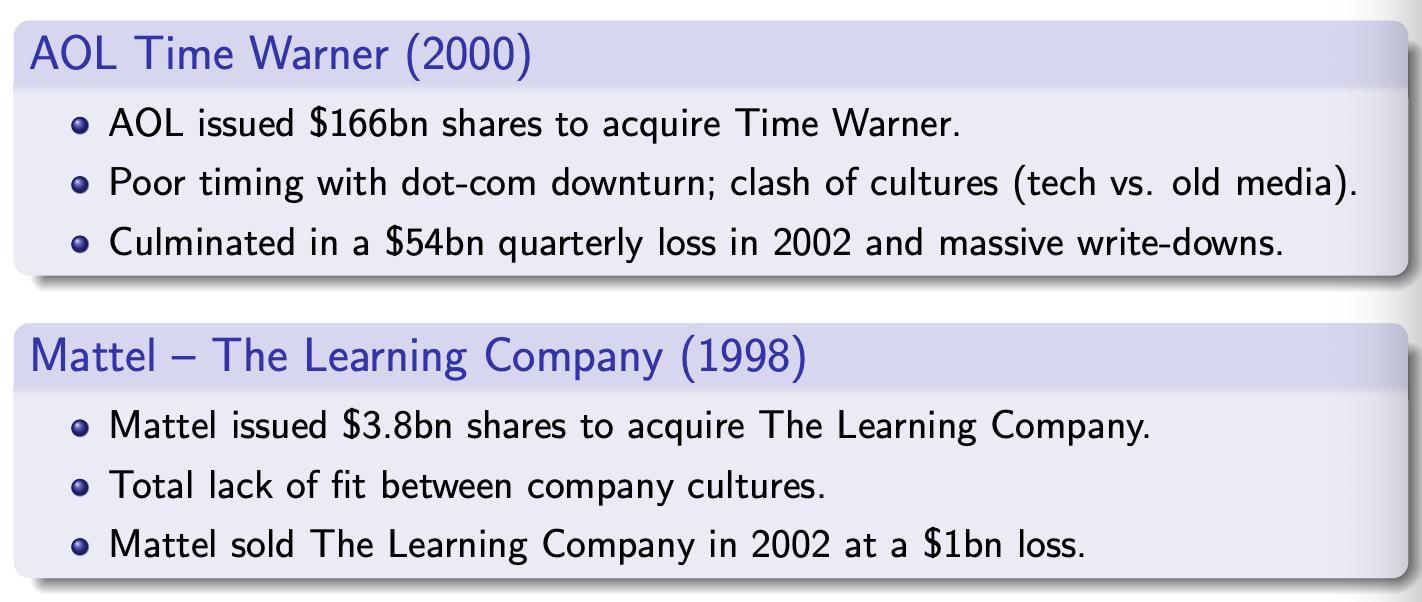
What causes mergers and acquisitions funded by equity issuance to fail?
overvaluation
poor timing
cultural incompatibility
What are unsuccessful M&A examples?
What are techniques used to issue shares?
what target needs to be achieved
primary issuance execution mechanisms
What are the three ways to price and issue shares?
fixed pricing - sets share price in advance
tender auction - based on investors’ bids
book-building. - based on investor demand and willingness to pay
What are the targets to be achieved?
all share issues sold - if not damaged reputation
sell new shares at accurate price
leave room for share price to rise modestly post issue
demand should outstrip supply
How much room should be left for a post issued price rise?
(+10% to +15%)
What techniques are used to achieve targets? and what are the objectives?
placing offers
offer for sale
book-building
maximum security for company
pricing shares fairly
What is a placing?
When a company uses an investment bank or broker to sell its new shares, mainly to large investors such as pension funds and investment companies.
What are the advantages of placing?
guaranteed funds
lower fees
quicker and simpler
What are the limitations of placing?
best for smaller issues
fewer investors
lower public profile
risk of underpricing
What is an intermediaries offer?
Similar to placing, instead of using one bank or broker, they use several to sell its shares.
What is an offer for sale?
company invites the general public to buy its shares. unlike a placing, which mainly targets selected investor. Still goes through and investment bank or broker
What are the two main ways to set the share price for an offer for sale?
fixed-price offer - company and its investment bank set the share price in advance
tender auction - company asks investors to bid for the shares by stating how many they want and how much they are willing to pay. avoids committing to a price in advance.
What is book building?
instead of setting a price straight away, the company asks investors how many shares they want and how much they are willing to pay.
How does book building work?
company hires an investment bank
investors state their demand
bank ‘builds’ a book
final price is decided
What are the advantages of book building?
replaces lengthy public offer for sale
short period of intensive negotiations
accelerates book building (often within 24-48 hours)
full and fair pricing
cut expenses and market risk
What is an introduction to an equity exchange?
When a company joins a stock exchange without issuing new shares to raise money at that time.
no fresh capital
much lower fees
lower public profile
liquid platform for future fundraising
What is a reverse takeover?
when a private company takes control of a company that is already listed on a stock exchange, allowing the private company to gain a listing indirectly.
faster and cheaper
immediate public profile
What is crowdfunding?
When lots of people invest smaller amounts of money in a company, usually through an online platform.
What can a company do after it has become publicly listed on a stock exchange?
rights issues
scrip issues
stick splits
share buybacks
Whats a rights issues?
company gives its existing shareholders the first opportunity to buy additional shares (normally at a discounted rate and before offered to the wider market).
What does a 1-for-4 rights issue mean?
you can buy 1 new share for every 4 shares you already own
What if you dont want to buy new shares from the rights issues?
take up your rights
sell your rights
do nothing
Why are the new shares sold at a discount?
to encourage existing shareholders to buy them
What is the theoretical ex-rights price (TERP)?
calculated share price after a rights issue, assuming the share price adjusts to reflect the new shares being sold at a discounted price
What is the rights issue process?
shareholders have 3-4 weeks to decide whether to subscribe
if choose not to subscribe, can sell rights on the market
requires calculating theoretical prices
What are nil-paid rights?
rights that allow an existing shareholder to buy new shares at a discounted price, but the shareholder has not yet paid for those new shares.
What is the cum-rights price (before issue)?
share price prior to rights issue
What is the ex-rights price?
share price after rights issue
What is the theoretical ex-rights price equations?
(the value of existing shares held + cost of new shares)/number of shares held after right issue
What is the standalone value of the right equation?
Standalone value of the right = theoretical ex-rights price – rights issue price