Reactivity
 Call Kai
 Learn
 Practice Test
 Spaced Repetition
 Match
 Flashcards
 Knowt Play
1/9

There's no tags or description
Looks like no tags are added yet.
10 Terms
what is a nucleophile
what is an electrophile
electron pair donor, either negatively charged or neutral
electron pair acceptor positively charged or neutral
3 important ways to identify electron distribution
formal charges - indicates atoms overall charge
bond polarisation - creates partial charges across a bond
atomic orbitals - relevant to availability and distribution of electrons
what is delocalisation
occurs when electrons are spread across several atoms - affects how readily a species reacts and how stable it is after a reaction.
provides additional stability to a molecule or region of a molecule
influences electron distribution and therefore chemical reactivity
what is a leaving group
when an atom or group of atoms break away from a molecule taking the shared electrons with it.
what is a bronsted lowry acid and base
what is a lewis acid and base
bronsted acid = donates a proton
bronsted base = accepts a proton
lewis acid = accepts an electron pair
lewis base - donates an electron pair
pKa indicates what
acid strength
low pKa = stronger acid
High pKa - weaker acid
how do identify an acid in a drug molecule
Look for an atom bonded to a hydrogen that can be lost, with the resulting species being stable. This typically involves a hydrogen attached to an electronegative atom (like O or N)
Example: A hydroxyl group (-OH) can lose its proton to form an alkoxide (-O),
phenols (OH on a ring) or carboxylic acid (COOH)
how to identify a base from a drug molecule
Bases: Look for atoms with lone pairs of electrons that can accept a proton. These are typically electronegative atoms like nitrogen or oxygen.
usually amines (NH2,NH,N) Over amides
what happens in SN1 mechanism
what happens in SN2 mechanism
SN1
Leaving group departs —> carbocation intermediate forms sp² hybridised
Nucleophile attacks the carbocation —> product forms
Rate = k [substrate]
consequence: nucleophile can attack from either face of the planar carbon after it attacks you get 50% enantiomer and 50% mirror image one
equal probability —> racemic mixure
favoured by tiertiary
SN2
single step
nucleophile attacks backside of electrophillic carbon at the same time the leaving group departs
Rate = k [substrate]
Consequence: whatever shape you start with you will get the exact opposite shape
favoured by primary and then secondary
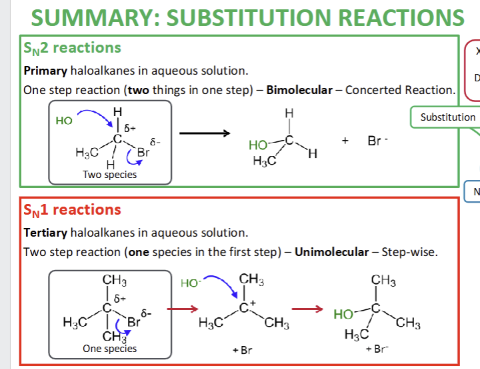
major difference between SN1 and SN2
sn2 proceeds in one step, whilst SN1 proceeds in two steps
sn2 leads to inversion of stereochemistry, SN1 leads to racemic mixtures