Microbiome/Commensal Protozoa Flashcards - Dr. Mansfield - Exam 1
 Call Kai
 Learn
 Practice Test
 Spaced Repetition
 Match
 Flashcards
 Knowt Play
1/48

There's no tags or description
Looks like no tags are added yet.
49 Terms
⭐ Q: How do microbiota, microbiome, and metagenome differ?
A microbiota is the community of microorganisms living in or on a host, whereas the microbiome is the collection of genetic material within that microbial community and can also be called its metagenome.
Microbiota
the actual microorganisms
can include bacteria, archaea, protozoa, fungi, viruses, and sometimes helminths
Microbiome
the genetic material of a microbiota
associated with a particular niche, such as the gut
Metagenome
another term used in the lecture for the genetic material of the microbiota
⭐ Q: What groups of microorganisms can make up a mammalian microbiota?
A: A mammalian microbiota can include bacteria, archaea, protozoa, fungi, viruses, and sometimes helminths.
🔎 What this means:
The microbiota is not just bacteria.
Even though much microbiome research focuses heavily on bacteria, the lecture explicitly includes several different types of microorganisms.
For the learning objective, the professor particularly names:
bacteria
viruses
fungi
protozoa
⭐ Q: How do symbiosis, commensalism, mutualism, and parasitism compare?
Symbiosis broadly describes organisms living together, while commensalism benefits one organism without harming or benefiting the other, mutualism benefits both organisms, and parasitism involves dependence of a parasite on its host.
⭐ Q: How do a pathogen, pathobiont, and opportunistic pathogen differ?
A pathogen can cause disease, a pathobiont normally lives as a symbiont but has disease-causing potential, and an opportunistic pathogen causes infection when an unusual opportunity makes the host more susceptible.
Pathobiont
A potentially disease-causing organism that normally lives as a symbiont.
Opportunistic pathogen
Takes advantage of conditions not normally available, such as:
weakened immunity
disrupted microbiota
breached body barriers
Q: How do zoonosis, anthroponosis, and reservoir differ?
A zoonosis can transfer naturally between vertebrate animals and humans
an anthroponosis is a human disease transmissible to animals
and a reservoir is the normal source in which an infectious agent lives and multiplies.
can be a person, an animal, a plant, soil and etc
A reservoir does not necessarily have to be clinically sick.
It is simply the ecological source maintaining the infectious agent.
Q: How do disease, pathogenesis, and pathology differ?
Disease is an abnormal condition that impairs normal function, pathogenesis describes how the disease develops, and pathology is the study of the changes, the structural and functional changes, caused by disease.
Q: What does “health” mean in the terminology pre-work?
The pre-work presents health as a concept that can include normality, biological function, homeostasis, physical and psychological well-being, and productivity including reproduction.
Q: Why is culture alone unable to completely characterize a microbial community?
Culture gives an incomplete view of a microbial community because it detects only an unknown fraction of the organisms and many microbes cannot be cultured using standard methods.
If you only grow microorganisms on plates, organisms that won't grow under your chosen laboratory conditions become invisible to you.
⚠ Lower priority Q: Why can 16S rRNA gene sequencing be used to characterize bacterial communities?
16S rRNA gene sequencing can characterize bacterial communities because bacteria possess ribosomal genes with variable regions that can be sequenced and compared with reference databases for identification.
⚠ Lower priority Q: How does shotgun metagenomic sequencing differ from 16S-based community analysis?
Shotgun metagenomics sequences community DNA broadly rather than specifically targeting the 16S rRNA gene, allowing strain-level resolution and functional information such as virulence and antibiotic-resistance content.
🔎 What this means:
16S mainly helps answer:
“Which bacteria are present?”
Shotgun sequencing can additionally help answer:
“What genetic capabilities does this community have?”
such as:
strain-level resolution
functional profiling
antibiotic-resistance genes
virulence-factor content
⚠ Lower priority Q: How do metagenomics, metatranscriptomics, and metabolomics differ?
Metagenomics studies community DNA, metatranscriptomics studies community RNA, and metabolomics studies the small-molecule metabolic products produced by the community.
⚠ Lower priority: These methods are lecture background rather than explicit learning-objective targets.
⭐ Q: How does the gut microbiota develop over time according to the infant example in the lecture?
The gut bacterial community changes in a predictable sequence over time.
The baby's gut does not start out with the same microbiota it will have later. Different broad groups of bacteria become more common at different stages of development. The slide shows Firmicutes first → then more Proteobacteria → then more Bacteroidetes after solid food → then a more diverse/enriched Bacteroidetes community later.
Gut microbiota develops through microbial succession, with different groups becoming prominent at different developmental stages and dietary transitions.
For example:
Early baby gut:
🦠 lots of certain Firmicutes
Then the baby gets older:
🦠 Firmicutes
🦠🦠 more Proteobacteria
Then solid food starts:
🦠 Firmicutes
🦠 Proteobacteria
🦠🦠🦠 more Bacteroidetes
its not that the bacteria disappear, its that proportions change and the whole community composition changes over time
💡 Think:
The gut microbiota develops like an ecosystem after a new island forms: different populations arrive and change over time.

⭐ Q: How can microbiota be naturally transferred between animals?
Microbiota can be transferred through behaviors such as fecal re-ingestion in herbivores and social/environmental contact, allowing animals to acquire microorganisms from other animals or their surroundings.
Fecal re-ingestion
Occurs especially in herbivorous species, including examples such as:
rabbits
rodents
piglets
foals
dogs
nonhuman primates
It can also allow animals to recover microbial products such as vitamins and amino acids.
for example in Hyena pasting, a scent-marking behavior, allows Young hyenas to acquire clan-associated bacteria by rubbing their anal glands against grass n stuff
🔎 What this means:
Microbiota aren't permanently isolated within one individual.
Animals continually interact with:
other animals
food
feces
physical environments
and those interactions can transfer microorganisms.
Q: Why can fecal re-ingestion be physiologically useful to some animals?
Fecal re-ingestion can be useful because it allows animals to recover nutrients supplied by gut microbes and can help compensate for dietary changes.
The lecture notes that rats prevented from re-ingesting feces showed reduced growth rates.
⭐ Q: What are the major roles of indigenous microbiota in mammalian health?
Indigenous microbiota support mammalian health by promoting tissue and immune development, improving nutritional capabilities, supplying nutrients, detoxifying dietary compounds, and preventing colonization by outside pathogens.
In List form:
development/differentiation of mucosal epithelium
immune-system development
nutritional development
nutrient provision
detoxification
colonization resistance
⭐ Q: How can normal microbiota influence intestinal development and function?
Normal microbiota can provide nutrients, promote nutritional capabilities, increase intestinal movement and water absorption, alter the chemical environment, and stimulate intestinal epithelial growth and differentiation.
In list form its:
↑ peristalsis
↑ large-intestinal water absorption
detoxification of harmful dietary constituents
altered stomach pH
altered large-intestinal redox conditions
epithelial growth/proliferation/differentiation
altered intestinal epithelial gene expression
⚠ Lower priority Q: What vitamins can normal intestinal microbiota provide according to the lecture?
Normal intestinal microbiota can contribute to production of vitamin K and several B vitamins.
Examples listed:
vitamin K
folic acid/B9
vitamin B12
vitamin B2
biotin/B7
thiamine/B1
nicotinic acid/B3
pyridoxine/B6
⭐ Q: How do the microbiota and innate immune system influence one another?
The innate immune system helps control which microbes live in the body and how abundant they are, while normal microbiota help the immune system develop and function properly.
The microbiota can:
increase lymphocytes and plasma cells in the gut
increase the size of some peyer’s patches, lymph nodes, spleen, thymus etc
increase macrophage movement and phagocytosis
increase IgG and IgA production
improve colonization resistance against pathogens
Microbiota → immune system:
Living with normal microbes helps “train” and develop the immune system so it becomes better at responding to pathogens.
⭐ Q: What is colonization resistance, and how does normal microbiota protect the host from pathogens?
Colonization resistance is when the normal (commensal) bacteria already living in the body make it harder for harmful pathogens to move in and establish themselves.
They do this by:
taking up attachment sites
using available nutrients
changing the local environment
producing substances that inhibit other microbes
🔎 What this means:
The pathogen has to compete with bacteria that are already living there.
⭐ Q: How do microbial food webs form in the gastrointestinal tract?
Microbial food webs form because different microbes interact and use products generated by other members of the community, allowing nutrients to flow through interconnected microbial populations.
🔎 What this means:
One microorganism's waste product can become another microorganism's food.
So the microbiota functions more like an ecosystem than a random pile of independent organisms.
Q: What is the gut-brain axis?
The gut-brain axis is a bidirectional communication system between the gastrointestinal tract and brain that also involves the resident microbiota.
The lecture says this connects emotional/cognitive brain centers with peripheral gut function and its microbial community.
⭐ Q: What can cause loss of normal colonization resistance, and what is the consequence?
Antibiotic treatment or rapid dietary changes can disrupt normal gut microbiota, causing loss of colonization resistance and increased susceptibility to infection.
⭐ Q: Why is microbiome failure especially important in herbivores such as cattle?
Microbiome failure is especially important in herbivores because they depend on symbiotic gut microorganisms to obtain usable energy and nutrients from plant structural material that the host cannot efficiently digest alone.
⭐ Q: What is transfaunation/FMT in cattle, and how can it help restore a failed rumen microbiota?
Transfaunation or fecal microbiota transplantation in this lecture involves orally transferring ruminal fluid from a normal donor animal to provide rumen bacteria, protozoa, and fermentation products to an animal with a disrupted rumen ecosystem.
⭐ Q: What are the general characteristics of protozoa?
Protozoa are single-celled eukaryotic organisms that lack a rigid cell wall, vary widely in form, and are usually motile and heterotrophic.
Characteristics list from the slides:
eukaryotic
unicellular
no rigid cell wall
highly variable size and structure
most are motile
most are heterotrophic
🔎 What this means:
Eukaryotic means their cells contain membrane-bound structures
Heterotrophic means they need to obtain nutrients from other sources because they can’t produce everything themselves
The slides also describe:
food vacuoles for digestion
contractile vacuoles for eliminating excess water
direct uptake of soluble nutrients
some protozoa living symbiotically with bacteria

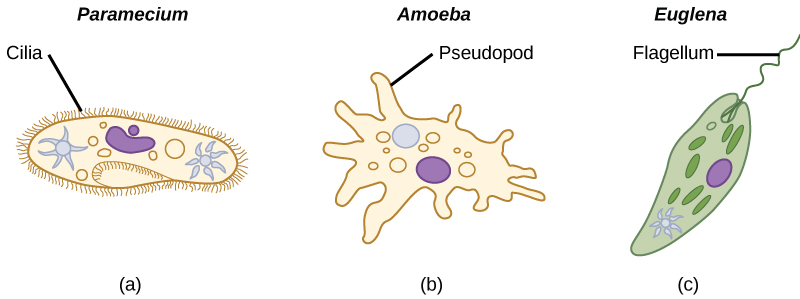
⭐ Q: What are the four major protozoal groups in this lecture?
The four protozoal groups are:
Ciliates — Ciliophora
Flagellates/Hemoflagellates — Mastigophora and Zoomastigophora
Amoebae — Sarcodina
Apicomplexa — Sporozoa and Hemosporidians

⭐ Q: How do ciliates, flagellates, amoebae, and Apicomplexa differ structurally or in locomotion?
Ciliates use cilia
they have two types of nuceli
a macronucelus and a micronucleus
Macronucleus = runs the cell's everyday activities, like metabolism and gene expression.
Micronucleus = mainly involved in reproduction/genetic exchange and preserving genetic information.
Flagellates use flagella
Flagella can be used for:
movement
capturing/moving food
Amoebae use pseudopodia
A pseudopodium is a temporary extension of the cell membrane and cytoplasm.
Amoebae don't have permanent “legs.” They basically change their body shape to crawl.
Apicomplexa possess specialized apical structures used to enter host cells
Apical just means “at one end of the cell.”
its a ring-like, tubular, and filamentous structures at that end
These structures help the parasite attach to and enter host cells.
⭐ Q: What role do commensal (normal) protozoa play in the rumen?
Rumen protozoa, especially anaerobic ciliates, contribute to feed digestion and fermentation and form an important component of the rumen microbial ecosystem.
These organisms live in an anaerobic environment and help break down plant material such as cellulose.
⭐ Q: How do the commensal ciliates in ruminants, Holotrich and Spirotrich rumen ciliates differ?
Holotrich ciliates primarily convert soluble sugars into starch, whereas Spirotrich ciliates consume starch and cellulose.
⭐ Q: How can rumen protozoa both benefit and sometimes compete with their host?
Rumen protozoa generally benefit the host by digesting plant material and other nutrients and by becoming a nutrient source themselves, but during starvation they can compete with the host for rumen protein.
⭐ Q: What are the major stages, location, and structural characteristics of Balantidium coli?
Balantidium coli is a protozoan that exists in two different forms during its life cycle: a trophozoite and a cyst.
Trophozoite
the active form inside the host
lives in the cecum and colon
moves using cilia
reproduces
can invade the large-intestinal mucosa
Cyst
the tough, protected form
has a resistant wall
survives harsh conditions such as stomach acid
is passed in feces
helps the organism survive and spread to another host
⭐ Q: What is the life cycle of Balantidium coli?
Balantidium coli is a protozoan that switches between a tough cyst form for survival/transmission and an active trophozoite form that lives and reproduces in the large intestine.
The sequence goes:
Cyst is ingested and survives GI conditions, stomach acid etc
Cyst reaches the large intestine → undergoes excystation
Excystation = the cyst opens and releases the active trophozoite.
Trophozoite = active intestinal form
the trophozite lives in the large intestine and reproduces by binary fission (where one divides into two) or conjugation (where two organisms exchange nuclear material)
Some trophozoites can invade the intestinal mucosa
some can become invasive and damage host tissue
Trophozoites turn back into cysts
as they reach the rectum they undergo encystation to turn back into cysts
Finally, Cysts leave the host in feces and the cycle repeats
⭐ Q: How does Balantidium coli differ in pigs versus humans?
Balantidium coli is generally a commensal/asymptomatic (normal) organism in pigs but can act as a zoonotic pathogen in humans and cause balantidiosis.
Pigs have no clinical signs bc its normal for them to have it. They act as a reservoir for the protozoa
Humans get infected with it, can cause dysentery (severe diarrhea with blood and mucus)
For pigs its a normal gut protozoa, for humans its a pathogen
⭐ Q: what is Tritrichomonas musculis and how does it interact with its mammalian host?
Tritrichomonas musculis is a single-celled commensal flagellated protozoan that lives in the intestines of mice.
It stimulates host antibacterial defenses and colonization resistance without causing direct mucosal injury in the example presented.
It attaches to small-intestinal epithelium
promotes inflammatory signaling
promotes T-helper cell responses
increases antibacterial defenses
can protect against Salmonella Typhimurium
This example shows that a protozoan can stimulate the immune system without simply being classified as a disease-causing parasite.
⭐ Q: Why is Tritrichomonas musculis a good example of the complexity of “commensal” organisms?
Tritrichomonas musculis illustrates that a commensal organism can enhance antibacterial protection while also increasing susceptibility to harmful intestinal inflammation and colon cancer under some circumstances.
🔎 General Idea:
“Commensal” doesn't necessarily mean:
“This organism can never contribute to anything harmful.”
The host-microbe relationship depends on context.
⭐ Q: How does Tritrichomonas foetus disease differ in cattle versus cats?
Tritrichomonas foetus is pathogenic in both cattle and cats, but in cattle it primarily causes sexually transmitted reproductive disease, whereas in cats it primarily causes prolonged diarrhea.
In cattle it can cause abortion and even pyometras
In cats its just diarrhea
Main idea is just that in different species, the same protozoan has different effects
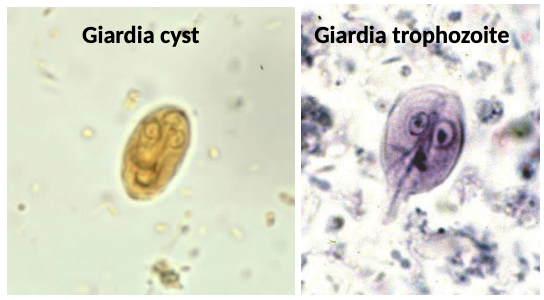
⭐ Q: What are the two stages of Giardia, where does it live, and how does each stage function in its life cycle?
Giardia also has two stages named Trophozite and Cyst
Giardia’s trophozoite stage attaches to intestinal epithelium and its tough cyst stage survives outside the host and permits transmission.
Trophozoite
tear-drop shaped
has attachment/suction structure
adheres to intestinal epithelium
colonizes the duodenum
reproduces by binary fission
Cyst
tough oval form
environmental/transmission stage
passed in feces
⭐ Q: What is the general Giardia life cycle?
Host ingests a cyst
Trophozoite develops and attaches to the brush border of the villous epithelium of the intestines
it reproduces through binary fission
at some point in the intestine encystation happens again
cyst leaves host in feces
⭐ Q: What is the epidemiology and transmission pattern of Giardia described in the lecture?
Giardia is commonly found in dogs, cats, and many other animals and is transmitted primarily by the fecal-oral route, often through contaminated water
There are different genetic groups of giardia that infect different species, these genetic families are called assemblages
Assemblage Families:
A and B: Mammals including humans
C and 😩 Dogs
E: Hoofed animals like horses, etc
F: cats
G: Rats
⭐ Q: Why can Giardia be considered a commensal/pathobiont in some animals but a pathogen in others or under some conditions?
Giardia can exist without clinical disease in many infected animals but can also cause giardiasis with gastrointestinal dysfunction, making its host relationship context-dependent.
Most infected animals are asymptomaticm this is called pathobiont, meaning the organism may be present without causing disease but it has the potential to become harmful
🔄 UPDATED Card ⭐ Q: How should Entamoeba histolytica be classified and understood based on the later protozoa lecture?
This protozoa lecture classifies Entamoeba histolytica as a pathobiont of dogs, cats, and humans that is usually asymptomatic but can cause severe intestinal and systemic disease.
The terminology pre-work mentioned E. histolytica while explaining commensalism, but this later organism-specific lecture gives you more detail and explicitly calls it a pathobiont.
⭐ Q: What are the transmission, tissue effects, and disease pattern of Entamoeba histolytica in this lecture?
Entamoeba histolytica is an amoeba that iusually causes an asymptomatic intestinal infection but can cause severe colitis and may spread hematogenously to damage other organs.
So it is a pathobiont
Transmission methods:
transmitted through fecal contamination, including contaminated water
can invade the intestine → colitis and bloody diarrhea
can spread through the bloodstream to other organs
Disease pattern:
intestinal invasion
→ colitis
→ bloody diarrhea
Possible extraintestinal spread (outside the intestines):
organism enters bloodstream
→ hematogenous spread (spread through bloodstream)
→ can cause damage in other organs
Yes we need to know ALL this stuff :,) based on the LOs
⭐ Q: What structural features distinguish Apicomplexa from the other protozoal groups?
Apicomplexa are distinguished by specialized structures at their apical end that help them interact with and penetrate host cells.
Apical = at one end of the organism.
The apical end can include structures like the polar ring, conoid, rhoptries, and micronemes.

⭐ Q: How do coccidia interact with host tissues, and why are they pathogenic?
Coccidia are pathogenic because they replicate inside host cells and damage or kill those cells when new parasites emerge.
Consequences described:
Replicates inside host cell
→ replicated parasites exits cell
→ breakout causes host cell to die
→ intestinal barrier is disrupted from cell damage/death
→ greater opportunity for secondary pathogens to infect
→ causes diarrhea, including bloody diarrhea

⭐ Q: What are merogony, gametogony, and sporogony in the generalized coccidian life cycle?
Coccidia use merogony for asexual multiplication, gametogony for production of male and female gametes, and sporogony to produce infectious sporozoites from the zygote/oocyst stage.
In list form:
Merogony/Schizogony = the asexual reproduction process, they are the same thing
Merogony = make LOTS of parasites
Merogony/Schizogony clones itself to make merzoites (daughter parasites)
Gametogony: makes male and female sex cells aka gametes for sexual reproduction
Microgamete (male gamete)
Macrogamete (female gamete)
and thus they create zygotes the fusion baby
Sporongony: Makes the infectious form, sporozoites, for the next host
zygote goes on to become oocyst that develops into sporoziote
⭐ Q: What is the complete generalized coccidian life cycle taught in the lecture?
1. Host ingests oocyst
↓
2. Oocyst excysts (breaks open) in gut
↓
3. Sporozoites penetrate intestinal epithelial cells
↓
4. Sporozoites develop and undergo merogony
↓
5. Merozoites are released and infect new cells
↓
6. Additional merogony occurs
↓
7. Gametogony produces micro- and macrogametes
↓
8. Gametes fuse → zygote
↓
9. Thick-walled oocyst is shed in feces
↓
10. Oocyst sporulates (lets out spores) in the environment
↓
infectious oocyst ready for another host
⭐ Q: How do the protozoa in this lecture illustrate the spectrum from commensalism to pathobiont behavior to pathogenicity?
The lecture presents protozoal relationships as a continuum in which some organisms normally benefit or coexist with the host, some can shift between harmless and harmful behavior, and others directly cause tissue injury and disease.
COMMENSALS
Rumen ciliates
Holotrichs
Spirotrichs
contribute to digestion/fermentation
Tritrichomonas musculis
can enhance antibacterial defense
PATHOBIONTS
Giardia
many infections asymptomatic
can cause giardiasis
Entamoeba histolytica
usually asymptomatic
can cause severe disease
Host-dependent/opportunistic example
Balantidium coli
commensal in pigs
pathogenic/zoonotic in humans
PATHOGENS
Tritrichomonas foetus
reproductive disease in cattle
diarrhea in cats
GI coccidia
intracellular replication
epithelial-cell death
intestinal disease
⭐ Q: How do the major protozoa examples compare in host, location/tissue interaction, and disease relationship?
The protozoal examples differ substantially in where they live, whether they invade tissue, which hosts they infect, and whether they behave primarily as commensals, pathobionts, or pathogens.
Rumen ciliates
→ ruminant rumen
→ participate in fermentation
→ commensal/symbiotic
Balantidium coli
→ cecum/colon
→ pigs commonly asymptomatic; may invade mucosa
→ pig commensal/reservoir, human pathogen
Tritrichomonas musculis
→ intestinal epithelium
→ stimulates immune defenses without mucosal injury in example
→ commensal with potential inflammatory downside
Tritrichomonas foetus
→ cattle reproductive tract / cat GI tract
→ disease
→ pathogen
Giardia
→ duodenum/villous brush border
→ attaches rather than following coccidian intracellular pattern
→ often asymptomatic, but can cause disease
Entamoeba histolytica
→ intestine; may spread through blood
→ asymptomatic or invasive
→ pathobiont
Coccidia
→ inside intestinal epithelial cells
→ host-cell destruction during replication
→ pathogens
Memorize this table. yes i mean it :,)
Learning Objectives:
recall the scientific/common names of example protozoa mentioned
describe their general life cycles and host interactions
describe how they interact with host tissues
distinguish commensal vs pathobiont vs pathogenic
compare their epidemiology and host interactions
Organism | What I think you should definitely know |
|---|---|
Balantidium coli | Ciliate; cyst + trophozoite; pigs often asymptomatic/reservoir; can cause disease in humans |
Tritrichomonas musculis | Flagellate; mouse intestinal commensal; can alter/stimulate immune responses |
Tritrichomonas foetus | Flagellate pathogen; cattle = reproductive disease; cats = diarrhea |
Giardia | Flagellate; cyst + trophozoite; fecal-oral/water transmission; attaches to intestine |
Entamoeba histolytica | Amoeba/pathobiont; usually asymptomatic but can invade intestine → colitis/bloody diarrhea |
Coccidia | Apicomplexa; intracellular parasites; damage host cells; generalized merogony → gametogony → sporogony cycle |
