Nervous System (Pt. 1)
 Call Kai
 Learn
Learn Practice Test
 Spaced Repetition
 Match
Match Flashcards
 Knowt Play
1/46

There's no tags or description
Looks like no tags are added yet.
Name | Mastery | Learn | Test | Matching | Spaced | Call with Kai | Chat |
|---|
No analytics yet
Send a link to your students to track their progress
47 Terms
Nervous system
Control and communication center of the body
How nervous system carries out function
variety of receptors to monitor changes (inside and outside the body)
Sensory input
Summation of information gathered by receptors

Integration
Body takes in information and decides what to do with it

Motor output
response determined by nervous system

Central Nervous System (CNS)
1. Command center of body
2. Spinal cord and brain
3. Lacks neurilemma

Peripheral Nervous System (PNS)
1. Nerves extending from CNS
2. Delivers information to CNS (Afferent nerves)
3. Carries instructions from CNS to motor component (Efferent nerves)

2 Classifications of nervous system
Structural, Functional
Structural classification
1. Contains ALL nervous system organs
2. Broken into CNS and PNS
Functional classification
Involves ONLY PNS,Breaks PNS into subdivisions
2 Subdivisions of PNS
1. Sensory
2. Motor
Sensory
1. Afferent (Arrives)
2. Carries impulses TO CNS from sensory organs
3. Keeps body informed on what is happening
Motor
Efferent (Exits), Carries impulse FROM CNS to body, Contains 2 subdivisions
2 Subdivisions of Motor
1. Somatic controls
2. Autonomic controls
Somatic controls
1. Skeletal muscle
2. AKA voluntary nervous system
Autonomic controls
1. Smooth muscle, cardiac muscle and glands
2. AKA involuntary nervous system
2 Main cells of nervous system
1. Supporting cells
2. Neurons
Support cells
1. AKA neuroglia or glia cells
2. Support, insulate and protect neurons
3. Each neuroglia has special function
4. Unable to transmit information
5. Retain ability to divide
4 Neuroglia cells
1. Astrocytes
2. Microglia
3. Ependymal cells
4. Oligodendrocytes
Astrocytes
Star shaped, Account for 1/2 of neural tissue, numerous projections connecting to neurons anchoring them to capillaries, Barrier between capillaries and neurons (assist permeability), assist taking in leaked potassium ions and neurotransmitters in the brain

Microglia
1. Spider-like cells
2. Phagocytic in nature
3. Function to dispose of debris (dead cells and bacteria in brain)

Ependymal
1. Line central cavity of brain and spinal cord
2. Beating of cilia attached helps circulate the CSF

Oligodendrocytes
Wrap flat extension around nerve fibers,Produce fat insulation coverings (AKA myelin sheaths)

2 types of PNS support cells
1. Schwann cells
2. Satellite cells
Schwann cells
Form myelin sheaths around nerve fibers in PNS

Satellite cells
Act as protective and cushioning cells

Neurons
1. Highly specialized cells
2. Transmit impulses from one part of the body to another
3. Differ structurally (many common features)
4. Loose ability to divide (reason for gliomas)
5. ALL have a cell body and one or more processing extending from body

Neuron cell body
Metabolic center, cytoplasm contain all expected organelles (except for centrioles), Rough ER AKA Nissl bodies
Neuron processes
1. Long extensions or fibers from cell body
2. Dendrites and Axons
Dendrite
1. Extensions transmitting information TO cell body
2. Can be hundreds

Axon
1. Transmit information FROM cell body
2. May only have one originating from axon hillock
3. Branch at terminal into hundreds and thousands ds of terminals

Axon terminal
1. Contain neurotransmitters
2. Separate from neuron by synaptic cleft

Myelin sheath
1. Insulates fibers
2. Increases transmission speed of nerve impulse

Neurilemma
1. Outermost layer of myelin sheath
2. Assists fiber regeneration

Nodes of ranvier
Gaps between individual cells of myelin sheath

3 Main types of nerve structure
1. Sensory (Afferent)
2. Motor (Efferent)
3. Association (Interneuron)
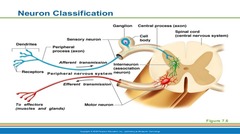
Association (Interneuron)
1. Connect sensory and motor neurons in neural pathway
2. Cell bodies found in CNS

5 Functional classifications of Neurons
1. Free nerve endings
2. Meissner's corpuscle
3. Lamellar corpuscle
4. Golgi tendon organ
5. Muscle spindle
Free nerve endings
Temperature and threat
Meissner's corpuscle
touch
Lamellar corpuscle
Deep touch
Golgi tendon organ
proprioceptor and tension
Muscle spindle
proprioceptor and stretch
3 structural classifications of neurons
1. Multipolar
2. Bipolar
3. Unipolar

Multipolar
1. Several projections
2. Most common
3. ALL motor neurons

Bipolar
Found in special sense organs (Optic, olfactory)

Unipolar
Sensory neurons in PNS ganglia
