Physics: Magnetism, Earth's Magnetic Field, and Energy
 Call Kai
 Learn
 Practice Test
 Spaced Repetition
 Match
 Flashcards
 Knowt Play
1/17

Earn XP
Description and Tags
Vocabulary practice flashcards covering basic principles of magnetism, permanent and induced magnets, Earth's magnetic field and animal navigation, experimental variables in the bouncing ball practical, and energy concepts.
18 Terms
Magnet
An object capable of exerting a magnetic force.
Permanent magnet materials
Materials commonly used to manufacture permanent magnets, specifically iron, cobalt, and neodymium.
Magnetic materials
Materials that can be attracted or magnetised by a permanent magnet, including iron, steel, nickel, and cobalt.
Magnetic poles
The two ends of a magnet, termed North and South, where the magnetic force is at its strongest.
Law of magnetic poles
The rule stating that two of the same poles repel each other (S and S, N and N), whereas different poles attract each other (N and S, S and N).
Non-contact force
A force that acts on an object across a distance without physical contact, such as a magnetic force.
Magnetic field
The region around a magnet where its magnetic force acts on another magnet or on a magnetic material.
Induced magnet
A material that becomes magnetic only when placed inside a magnetic field; it is only attracted by other magnets (never repelled) and loses most or all of its magnetism when removed from the magnetic field.
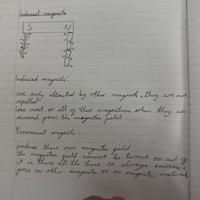
Permanent magnet
A magnet that produces its own magnetic field all the time; because its field cannot be turned on and off, it continuously exerts a force on other magnets or magnetic materials.
Magnetic field lines
Lines used to map a magnetic field that never cross each other, have arrowheads pointing from North to South, and are spaced closer together where the magnetic field is stronger.

Magnetic compass
A navigational tool with a magnetized needle whose north pole points toward Earth's geographic North Pole, which corresponds to Earth's magnetic south pole.
Polar drift
The gradual movement of Earth's magnetic poles; since its discovery in the early 19th century, the magnetic north pole has drifted northwards by 600miles and continues to move at 40miles/year.
Geomagnetic reversal
A complete flip of Earth's magnetic field orientation, occurring approximately every ∼200,000years.
Animal magnetoreception
The navigational mechanism utilized by animals—such as sharks, turtles, insects, wolves, and worms—via compass-like proteins located in the retina to navigate precise locations.
Total energy input
The total energy supplied to a system, governed by the relationship: Total energy input=useful energy output+wasted energy.
Independent variable (Bouncing balls practical)
The factor that is intentionally altered during the investigation, specifically the starting drop height of the ball.
Dependent variable (Bouncing balls practical)
The factor measured to observe the effect of the experiment, specifically the average bounce height of the ball.
Watt (W)
The standard unit of power, defined as 1joule of energy transferred every second (1W=1J/s); for example, a 60W bulb transfers 60J of energy every second.