PHIL 384 Midterm 2
 Call Kai
 Learn
 Practice Test
 Spaced Repetition
 Match
 Flashcards
 Knowt Play
1/41

There's no tags or description
Looks like no tags are added yet.
42 Terms
1. What four components jointly make up utilitarianism? Explain each component.
Consequentialism: The moral rightness of an action depends on its consequences.
Welfarism: The consequences that matter morally are those affecting welfare or well-being.
Sum-total: The welfare of everyone is added together, rather than prioritizing the worst-off.
Maximization: We should choose the action that produces the greatest total welfare.
2. What point does Sandel make in using the Philip Morris and the Ford Pinto cases in his discussion of cost-benefit analysis?
Sandel demonstrates that cost-benefit analysis can produce morally troubling conclusions by assigning monetary values to human life and suffering.
- Philip Morris: Smoking appeared to produce a net financial benefit due to tax revenue and healthcare savings despite its harms.
- Ford Pinto: Ford rejected safety upgrades because their costs exceeded expected lawsuit costs.
- Both cases raise questions about whether human lives should be reduced to monetary calculations.
3. How do we use the value of a statistical life to determine whether to invest in a road safety improvement?
We multiply the expected number of statistical lives saved by the VSL and compare the result to the project's cost. If benefits exceed costs, the improvement is economically justified.
The VSL estimates society's willingness to pay to reduce small mortality risks. It does not represent the monetary worth of an individual person's life.
4. Act utilitarianism runs into the problem of condoning certain actions that violate rights or deeply held moral principles. Provide an example. How does rule utilitarian avoid this kind of objection?
Act utilitarianism judges individual actions by their consequences, potentially justifying rights violations if they maximize utility.
multiple examples in which acting against a moral rule of violating a right (ex. Christians in the Colosseum may have a “right” to be innocent/not be subject to death, but by violating this right, technically more utility was produced) will lead to greater utility in its consequences.
Rule utilitarianism follows rules whose general acceptance maximizes utility, protecting rights and promoting long-term trust and stability.
if a rule is adopted by society, it should be followed regardless of how much utility breaking it would produce
5. Provide two arguments in support of rule utilitarianism. Provide one argument against rule utilitarianism.
In support of rule utilitarianism:
there are long term benefits to abiding by rules of justice (ex. securing trust)
rules of justice guarantee stability because people are concerned with liberty and respect for human dignity
individual calculations tend to be ill informed, biased, and self serving; while rules on the other hand, embody the cumulative wisdom throughout time
Objections:
But what if rules conflict?
ex. what if there’s a duty to save lives conflicting with duty not to torture in a ticking time bomb??
But what if we are certain a rule violation will maximize total utility?
rule utilitarianism is “rule worship”
6. What does Mill respond to the objection that utilitarianism is a ‘philosophy of the swine’? How does he defend utilitarianism against this objection? Is this a plausible defense?
responds by making the distinction that humans are able to discern the quality of pleasure and pain rather than just the quantity; humans can experience higher quality pleasures than animals
“so, poetry is better than push pin”
Mill distinguishes higher pleasures (intellectual, moral, and cultural) from lower pleasures (bodily or sensory). He argues that competent judges who have experienced both generally prefer higher pleasures, even when they involve more dissatisfaction.
Its plausibility is debatable because it's difficult to not be subjective when determining which pleasures are superior to one another, and not everyone may agree on this
7. How does Nozick’s experience machine pose a challenge to hedonic utilitarianism?
hedonism says that pleasure and happiness are what we desire most in life, and what we value above all
Nozick challenges this because most people did not want to be plugged into the experience machine, even though they could get immense happiness and any fulfillment they wanted. This is because we value real experiences and identity, showing that the outcome from experience is not what we primarily value.
8. How is Scanlon’s example of Jones and the World Cup transmission a critique of utilitarianism?
implies that from a utilitarian approach, no one should help Jones until the match is over because if this transmission goes out, then millions of people would be “harmed” by missing parts of the game. From a non-utilitarian standpoint, people would usually help Jones because he is actively being harmed more the longer you leave him stuck in the equipment
Millions of World Cup viewers might experience inconvenience if the broadcast is interrupted to help Jones. A utilitarian calculation could prioritize their combined enjoyment over Jones's suffering, which Scanlon suggests is morally problematic.
1. Utilitarianism faces the objection that it is too demanding. How might one
explain this objection by appealing to the demands of Effective Altruism. You
should address (i) the moral status of charitable giving and (ii) career choice.
Utilitarianism is considered too demanding because it requires us to maximize overall utility, potentially requiring us to sacrifice personal preferences, leisure, money, and career goals whenever those resources could produce greater happiness for others.
charitable giving allows you to be partial with who you’re giving your money to, which gives back that element of choice, while still emphasizing donating to causes that make the greatest amount of impact given your funds
career choice: by picking any lucrative career, like finance, you can make a massive impact through charitable giving without having to work directly in the non profit sector. You’re not restricted to careers in the non profit/volunteer sector if you want to make an impact
2. What is the impartiality requirement of utilitarianism? How do Effective Altruists
abide by this criterion? Why might this seem counterintuitive?
utilitarian is impartial because it weighs everyone’s happiness and suffering equally, meaning you can’t be partial to loved ones needs even if you value their happiness more
this applies to EAs because they also want to emphasize the equal value of all lives, regardless of whether they’re close to us or not
counter-intuitive because partiality to those who are close to us is permissible; we should also be able to give to local charities along with charities that impact those we’re not familiar with
. Lay out the matrix of a 2-person game in which Adam Smith’s invisible hand is at work, that is, in which individually rational agents choose strategies that lead to a
collectively rational outcome.
invisible hand matrix shows that individuals pursuing their own self interest will bring about the best possible outcomes for society

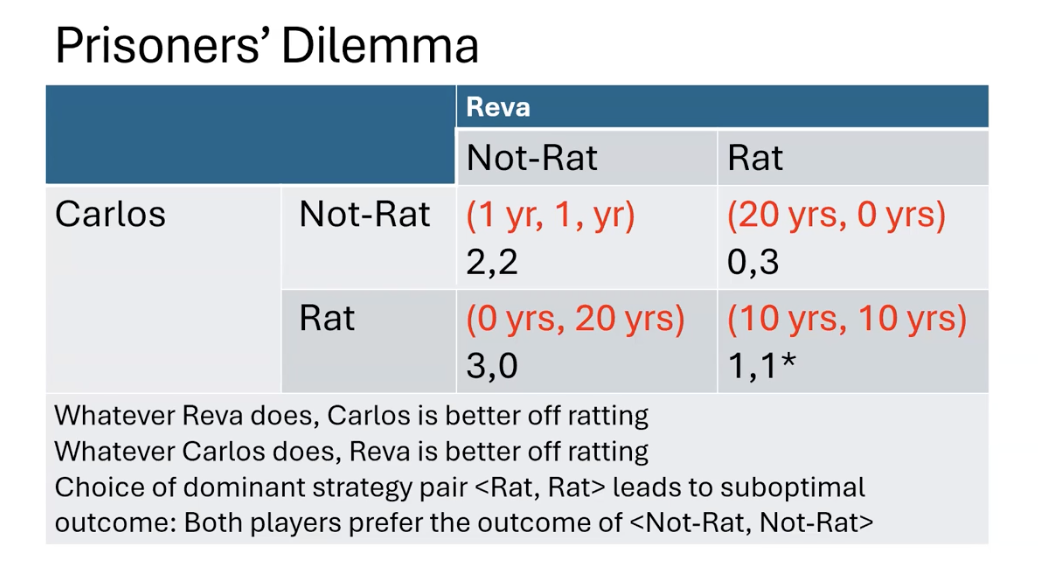
3. In a Prisoners’ Dilemma, individual rationality does not lead to collective rationality. Explain. (You need to explain the Prisoners’ Dilemma, the matrix and how the solution to the game is suboptimal.)
Prisoners’ Dilemma: 2 people acting in their own self interest leads to a suboptimal outcome; each player has a dominant strategy, but when both choose their dominant strategy, they end up with a worse outcome. (ratting the other out yields a better individual outcome, but by both choosing this option, they both end up with 10 years in prison as compared to 0)
4. A public goods game is an n-person Prisoners’ Dilemma. Explain.
a public goods game benefits everyone regardless of whether they personally contribute, which creates the issue of free riding; each person has an incentive not to contribute because they can save their own resources while still benefitting from others’ contributions; but in reality, everyone would benefit more if everyone collectively contributes
this relates to the prisoner’s dilemma because the prisoners would have both had a better option if they both contributed to each other’ best interest, rather than prioritizing their dominant strategy (getting 0 years in prison)
5. What four motivations might lead to cooperation in a repeated Public Goods game? Explain each motivation.
Altruism: people identify with the common good
Reciprocity: By contributing I invite others to contribute as well, which will benefit me in the long run
social norms: I abide by a social norm that people should abide to because it contributes to the common good
inequality aversion: by contributing I expect to increase social equity
6. What two reasons could be offered for decreasing contributions at later stages of a public goods game with a fixed number of runs?
Reciprocity: a perception of lacking cooperation makes people want to contribute less
Backward induction: in a public goods game with a fixed number of runs, players know that by the last round they will no longer have an incentive to cooperate because there’s no more runs after that. As the game approaches the last round, players also know other players will most likely stop contributing for this same reason, so they gradually contribute less.
1. Are all Nash equilibria dominant strategy pairs? Are all dominant strategy pairs Nash
equilibria? Explain your answers.
Nash equilibrium: when neither player can benefit if they unilaterally change their strategy, given everybody’s outcome
ex. Betraying the other person is a dominant strategy that leads to a Nash equilibrium where both confess (prisoner dilemma)
not all nash equilibria are dominant strategy pairs because a nash equilibrium doesn’t have to be the players’ best choice overall, it only needs to be the best response to the other players’ chosen strategy
But, all dominant strategy pairs are nash equilibriums because each player is choosing their best strategy regardless of what the other player does, so neither player has the incentive to unilaterally deviate
Two farmers have different crop specializations: each is capable of growing both crops competently, but one is better at growing one crop, the other is better at growing the other crop. However, if they both grow the same crop, there will be a glut and prices will collapse. The worst outcomes for the farmers are the outcomes on which they are both growing the same crops. Show the matrix for this game and show how it is a coordination game with two Nash equilibria (in pure strategies) with one equilibrium that is preferred by both players.
this is a nash equilibrium because neither farmer wants to switch crops alone because this would create a glut in the market
the equilibrium preferred by both players is the 3,3 because there will be no gluts in the market, and they can both grow what they’re best at
this is a coordination game because there is 1 optimal (3,3) and one suboptimal coordinated outcome (2,2)

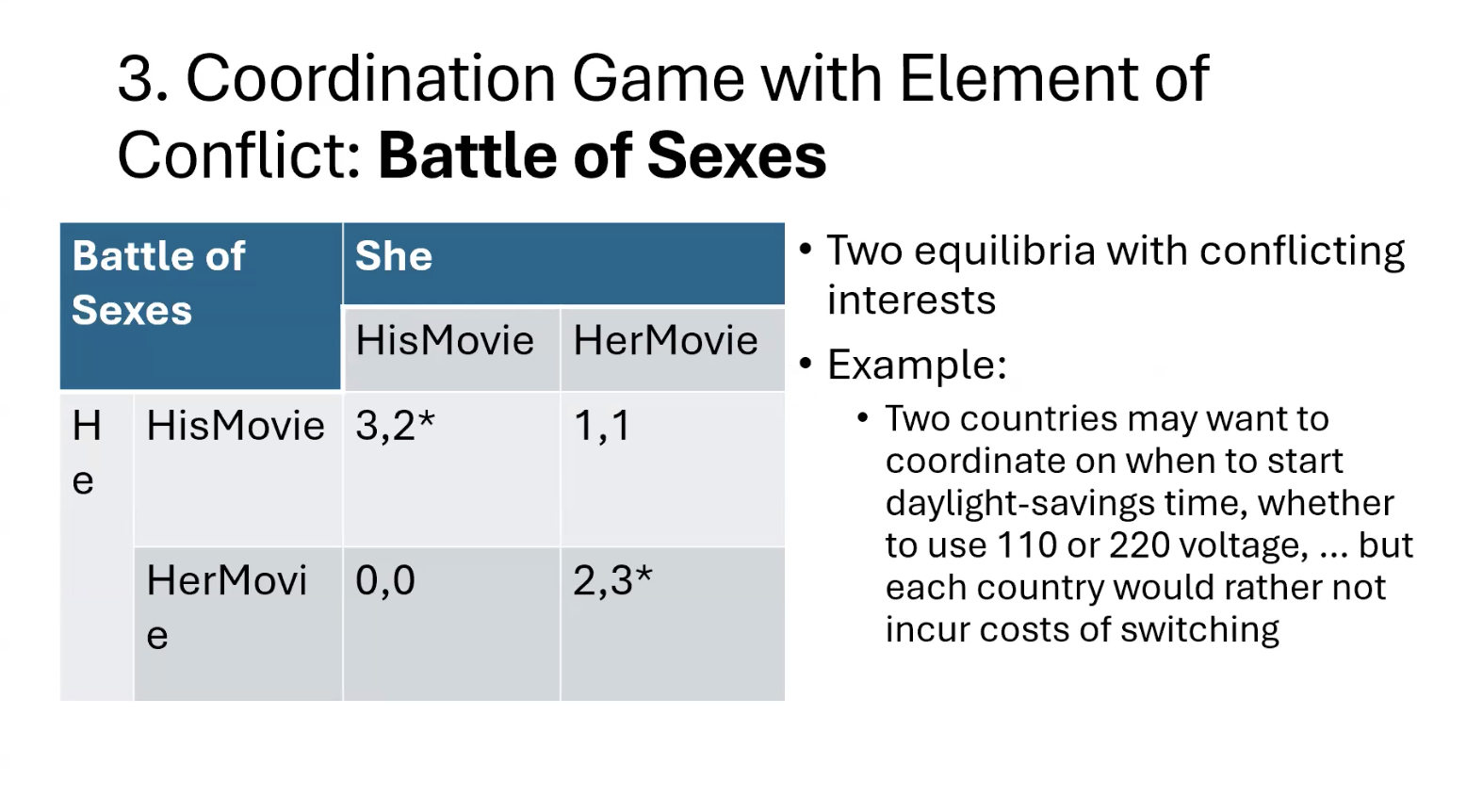
4. Explain the game that is known as the battle of sexes. What are the Nash Equilibria in pure strategies? Explain your answer.
In Battle of the Sexes, both players want to coordinate on seeing the same movie, but each wants to see a different movie. They would both benefit from coordinating, but they disagree on which option to choose.
3,2 is a pure strategy nash equilibria because the boyfriend gets to watch the action movie, and the girlfriend doesn’t get to watch her movie but is just happy to be with her boyfriend; the other nash equilibrium is 2,3, which is the exact opposite situation
Neither wants to change their choice alone because it means they’d be watching different movies and not be together
5. Explain why the Game of Chicken and the Hawk-Dove game are
represented by a single matrix. What strategies in one game map onto what
strategies in the other game? Why might it lead to a disastrous situation?
Both games are represented by the same matrix because in both, each player prefers to be aggressive when the other backs down, but both players get the worst outcome if they’re both aggressive.
In Chicken, the strategies are either to swerve or not to swerve, and the strategies in Hawk Dove, which are Dove (be peaceful) or Hawk (be aggressive), are essentially the same.
This can lead to a disastrous situation because neither player wants to back down, resulting in either a collision (Chicken) or violence (Hawk-Dove)
6. Explain how climate change can be represented as a Hawk-Dove game and show what can be done to avoid that disaster will ensue.
Climate change can be represented as a game of conflict because China and the US can either choose to cut back on emissions or continue business as usual. Choosing business as usual responds to the Hawk because the country is prioritizing their economic interests and dodging the costs, while cutting emissions represents the Dove because a country cooperates with restrictions and bears the costs.
If both countries choose to do business as usual because they want to avoid the costs, there will be a disastrous climate outcome. If even one of them chooses to bear the costs and cut emissions, there will be no immediate climate crisis.
This crisis can be avoided by increasing the payoff of restricting emissions, such as cost sharing, or decreasing the benefit of choosing business as usual, such as through carbon taxes.
7. If climate change negotiations between the US and China are a hawk-dove game, there are two types of interventions that would make <restrict emissions, restrict emissions> into a Nash Equilibrium. Explain. Name one concrete policy intervention as an example of each type of intervention.
Increasing the payoff of restricting emissions: an example of this is providing government subsidies for wind power and other green technologies to make green power more affordable
Decreasing the payoff of business as usual: ex. implement a carbon tax that charges businesses based on how much carbon emissions they omit
1. What is the driving idea about the nature of political actors in Public Choice?
Public Choice theory assumes politicians, voters, and bureaucrats are motivated by personal incentives, rather than automatically pursuing the public good.
Politicians may pursue reelection, power, or personal benefits rather than the public interest. Therefore, institutions must be designed to constrain self-interested behavior and prevent government failure.
2. Why, according to Anthony Downs is it rational for voters to not inform themselves about politics and to refrain from voting?
rational ignorance: becoming informed about politics takes time, effort, and resources; the probability that one individual will determine an election outcome is small
Therefore, the personal benefit of becoming fully informed or voting may be smaller than the cost.
3. How does the Condorcet Jury Theorem show that a democracy with relatively poorly informed voters may still lead to good results?
In a sufficiently large population, the chance that a majority of independent voters will correctly assess a binary issue is close to 1 even if each voter is just slightly better than merely random in their assessment.
a collective is likely to arrive at a correct decision even if they’re relatively uninformed, so even minimally informed voters are likely to produce correct outcomes through majority votes
4. What motivates people to vote, even though the chance of their vote making a difference is minimal?
Voters do not vote because they want to improve their expected benefit, but
They vote from a sense of civic duty
Because they see voting as an opportunity to express themselves, to exercise voice
5. What is the median voter theorem? Why is elite polarization inconsistent with the prediction of the median voter theorem?
The Median Voter Theorem predicts that in a two-candidate election with voters distributed along a single ideological dimension, candidates have an incentive to move toward the position of the median voter to maximize electoral support.
This can make candidates' positions converge toward the center
elite polarization: occurs when political candidates or parties move farther apart ideologically rather than converging toward the center.
One possible explanation is the role of primary elections in the United States. Candidates must first appeal to their party's primary voters, who may be more ideologically extreme than the general electorate. This can incentivize candidates to adopt more extreme positions.
6. What is the difference between implicit and explicit logrolling?
Logrolling is the exchange of political support or votes between policymakers.
Implicit logrolling: Different policy proposals are bundled into one bill. A policymaker may support the bill because it contains a proposal they favor, even if they oppose other parts.
Explicit logrolling: Policymakers make a direct agreement to support one another's proposals in exchange for reciprocal support.
9. Illustrate how Condorcet Pairwise Majority Voting can lead to a cycle. (For
Condorcet Pairwise Majority Voting you should be able to construct a profile that
leads to a circle yourself.)
Condorcet Pairwise Majority Voting compares alternatives two at a time. A cycle occurs when the majority prefers A over B, B over C, but C over A. This means there is no single option that beats every other option, creating a cycle

11. Name and explain each of the five requirements in Arrow’s Impossibility
Theorem. What does Arrow’s Theorem show?
Arrow’s impossibility theorem: states that no voting system can convert individual preferences into a collective social ranking while satisfying all five fairness requirements simultaneously. says a voting method should:
1. Not lead us into cycles (unlike Condorcet pairwise majority voting)
2. Respect IIA (unlike the Borda Count)
3. Respect Pareto: If everyone prefers X to Y then X should rank higher in the social ranking than Y
4. Respect Unrestricted Domain: It should be able to handle any set of votes
5. Respect Non-Dictatorship: The social ranking shouldn’t just mirror the vote of one voter, no matter what the preferences of the other voters are.
1. Explain the strategies of cracking and packing in gerrymandering.
packing: packing as many voters from a “disfavored” party or majority into one or fewer districts; helps the party who is drawing the map (the “favored” party) gain representation in other surrounding districts
party favored in packed districts win by massive margins; idea of “wasted votes because the massive amount of extra votes don’t help them win any extra seats
cracking: distributing opponents over many districts so they cannot form a majority in any district
2. Explain why MA, a state with 35-40% GOP voters, has no congressional seats in
the House.
Even though there’s roughly equal support for both parties, the minority party (GOP) is spread evenly across districts where democrats are the majority, so Democrats tend to win big in few urban districts, and Republicans tend to have small wins across more rural districts. Thus, Democrats get more representation than Republicans
3. The distribution of rural and urban voters in NC explains to some extent why
Republicans can elect more representatives than Democrats, even if the state-
wide vote is roughly 50-50. Explain.
Democratic voters tend to be concentrated in urban districts, where they win by large margins, while Republican voters are more evenly distributed across rural districts, allowing them to win more districts by smaller margins. As a result, Republicans can win more congressional seats even when the statewide vote is roughly 50-50.
4. Explain how Section 2 of the Voting Rights Act affects the issue of drawing
congressional districts.
Section 2 required respecting “majority minority districts” (districts where minorities can elect minority representatives); the 1st congressional district has traditionally been represented by an African American rep.
The new 2026 map cracked the 1st district, and by gerrymandering, the black vote is reduced, and there is a potential loss of one more DEM rep.
5. How might one argue that the Free and Fair Election clauses in the NC
Constitution affect gerrymandering?
The Free and Fair Election clauses state that all elections should be free and frequent, meaning that the party that wins cannot entrench itself in power. Gerrymandering contradicts this because the governing party is able to draw new district lines in their favor, allowing them to entrench themselves in power even in states with a roughly 50-50 vote.
6. What is the Independent State Legislature Doctrine and what is the relevance for
gerrymandering?
independent state legislature doctrine: argues that article 1, section 4 of the Constitution can be read to grant state legislatures the sole authority to determine congressional districts, giving them absolute power in elections. (currently elections are subject to legislative process, meaning they have oversight by the courts)
if this was passed, then state legislatures would have the uncontested power to draw extremely partisan maps
1. How does the Golden Rule provide an inspiration for impartiality in personal morality and in policy making?
“do to others what you want them to do to you” (golden rule)
personal morality: if you’re wondering whether to do something that affects you and someone else; you put yourself into someone else's shoes (“you don’t know who you were”); would you want what you’re considering doing to be done to yourself?
policymaking: as a policymaker, you don’t know “who you are in society”; what policy would one choose if you didn’t know whose shoes you’d be in? Making sure policies are impartial and positively benefit all
2. How does Dworkin’s card-game analogy provide an explanation of the appeal of Rawls’ veil of ignorance?
Imagine you and a friend are in the middle of a card game and an unusual situation arises that the official rulebook doesn't cover. Because you cannot simply throw your cards down and quit, you must invent a new rule on the spot to resolve the dispute and finish the game (card game analogy)
by imagining that you don’t know your cards, you should then, as rational agents, try to come up with a rule or set of rules that is reasonable.
Dworkin suggests that the only way to generate a genuinely fair rule is to imagine what rule you would have agreed upon before the cards were dealt, when neither of you knew what hand you would hold
Like Rawls, not knowing your place in society at all, what would you think is a good rule for the “game”? (the original position: we don’t know the “cards” we are dealt: our natural assets, social assets, aspirations, and conception of the good)
shows how the veil of ignorance provides a way to make the most rational decision for people with diverse backgrounds and statuses in society
3. What is the role of Harsanyi’s Impartial Observer? How does his theory lead to
utilitarianism?
Harsanyi’s impartial observer: we also don’t know who we will be, which allows us to judge policies as an impartial observer
Because you have an equal chance of being anyone in society, as an IO you must choose a set of principles that maximizes the greatest amount of utility for everyone= utilitarianism
used this as a justification for utilitarianism
“The impartial observer decides on principles of justice from a position of ignorance about who they will be in the real world”
4. Rawls believes that Harsanyi mistakenly treats interpersonal applications of welfare in the same way as one would treat intertemporal allocations of welfare within a single
life. Explain.
intertemporal allocations of welfare, it’s acceptable for one person to sacrifice welfare in one period of life to secure greater welfare in another period of life
ex. sacrificing greater income as a student in order to increase your projected income later in life; Rawls says this is perfectly fine, but:
in interpersonal allocations of welfare, it is not acceptable to sacrifice the welfare of one person to secure greater welfare for other people (ex. the person a, b and c scenario)
Harsanyi makes this acceptable through his explanation of the impartial observer and justification of utilitarianism, and Rawls argues this is the mistake
5. What does Rawls mean by the ‘separateness of persons’? How does this feature in his critique of utilitarianism?
separateness of persons: each individual is a distinct person with their own welfare, rights, and interests. The benefits or suffering experienced by one person cannot simply be combined with those of others as if society were one individual.
Rawls argues that utilitarianism can justify sacrificing one person’s well-being for the greater happiness of others.
For example, if Person A receives 1 unit of utility while Persons B and C each receive 10, utilitarianism may favor this outcome because it generates 21 total units of utility. However, this effectively barters away A’s welfare to secure gains for B and C.

6. The people in the Original Position choose the Difference Principle rather than a set of Principles of Justice that offers an equal division. Why do they want to do so?
choose the Difference Principle rather than strict equality because it allows for inequalities in wealth and resources as long as those inequalities benefit the least advantaged members of society.
They would want to ensure that even if they ended up in the least advantaged position, they would still benefit from the social system.
if there’s equal division, then everyone is classified as the worst off in society; by having economic inequalities that benefit those worse off, you are actually lifting them up more than if there was exact equal division
also with inequality, people are more incentivized to work, which increases the total pot of resources
7. Explain what social arrangements Harsanyi and Rawls would choose in the matrix
below:
Harsanyi would choose capitalism because it generates the greatest average amount of utility, even if person c is more disadvantaged.
Rawls would choose social democracy because it yields the best outcome for the least advantaged person (person d), which supports his idea that inequality is permissible if it helps the least advantaged people in society.
