Unit 5 Cell membrane and transport
 Call Kai
 Learn
 Practice Test
 Spaced Repetition
 Match
 Flashcards
 Knowt Play
1/37

Earn XP
Description and Tags
PRACTICE FOR SCIENCE 👽👹
38 Terms
Isotonic solution
Equal salt
a solution where the solute concentration and the water concentration is equal to the inside of the cell.
Equal rate of H2O diffusion, cell size stays the same in both animal and plant cells
Hypotonic solution
Less salt
a solution where the H2O concentration is higher than inside the cell
In animal cell, the higher concentration of water on outside of cell enters and bursts cell (cytolysis)
In plant cell the high concentration of water enters the cell and the vacuole enlarges - osmotic pressure and Turgor pressure increases
Hypertonic
More salts
A solution where the H2O concentration is lower than that inside the cell
In animal cell, the high concentration of water in the cell leaves it to the outside and the cell loses water and can shrivel up
In a plant cell, the high concentration of water leaves the cell and the osmotic pressure and turgor pressure decreases, Plasmolysis occurs
Plasmolysis
Cell membrane shrinks with water loss, in plant cells, the cell wilts
As the plant cell loses water in a hypertonic solution,the inner plasma membrane pulls away from the outer cell wall, this happens due to the decrease in turgor pressure and the not-moving rigid cell wall
Osmosis
diffusion of H2O from high to low concentration
No energy required
Water can slowly diffuse across lipid bilayer despite being polar
Selectively permeable membrane
Doesnt allow molecules to pass that are too big or charged molecules
Cytolysis
Process in which a cell has a lower concentration of water, causing an osmotic imbalance in which water rushed in the cell, causing it to burst
Net movement
Overall direction of movement of molecules before equilibrium is reached
Cell membrane
Bilayer, 2 layers of phospholipid
Selectively permeable - allows some molecules in but not others
flexible
Passive/active transport
Passive: No energy needed (high to low)
Active: Energy is needed (low to high)
Concentration gradient
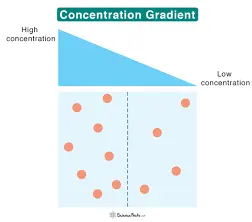
Difference in the concentration of molecules across a space
Equalibrium

Concentration of molecules is qual throughout a space
NO concentration gradient
Molecules move randomly with NO NET movement in one direction
Simple diffusion
Molecules moving from an area of high to low concentration
Sometimes across a phospholipid bilayer
Going down with concentration gradient, no energy required
Facilitated diffusion


Diffusion using the help of MEMBRANE PROTEINS to allow molecules, ions (salts) or slightly larger molecules into and out of cell
Molecules move from high to low concentration
Membrane proteins include: channel protein, carrier protein and aquaporins (transport water only)

What is this (answer up to down)
Phosphate ( hydrophilic head, loves water-polar)
Glycerol
Fatty acid (hydrophilic, hate water, non-polar

Label this:
A, B, C, D, E, F, G, H, I
A: Lipid bilayer
B: phospholipid
C: Hydrophilic heads
D: Hydrophobic tails
E: cholesterol- allow fluidity
F: protein channels
G: carrier proteins
H: Sodium-Potassium pump (nerve cells)
I: Aquaporins (water only)
What is Turgor pressure in a plant cell
Pressure of full vacuol against membrane/ wall
What happens to a sell in a salty enviroment
Hypertonic,vacuole shrinks due to water leaving cell
Sodium-potassium pump
Endocytosis
Substances pulled in through the membrane
Receptor mediated (type of endocytosis)
Gets specific molecules. Involves binding to specific protein receptor molecules on a cell surface
Exocytosis
Substances pushing out through the membrane
Simple diffusion
Going down with the concentration gradient, no energy required
Transport proteins..
Allow specific ions or molecules to enter and exit cell