products of transcription
 Call Kai
 Learn
 Practice Test
 Spaced Repetition
 Match
 Flashcards
 Knowt Play
1/28

There's no tags or description
Looks like no tags are added yet.
29 Terms
mRNA
copy of DNA which codes for the protein
tRNA
small adaptor molecules which align specific amino acids opposite their triplet codon in the mRNA molecule
rRNA
makes up ribosomes
important for protein synthesis
the ‘cap’ in RNA capping is also called:
7-methylguanosine
poly-A tail is made up of
long string of adenosines attached to 3’ end of mRNA
roles of 5’ end cap and 3’ end polyadenylation
assists the export of mRNA molecules from the nucleus
protect the mRNA from degradation in the cytoplasm and increase its half life
enables the binding of ribosomes and promotes translation
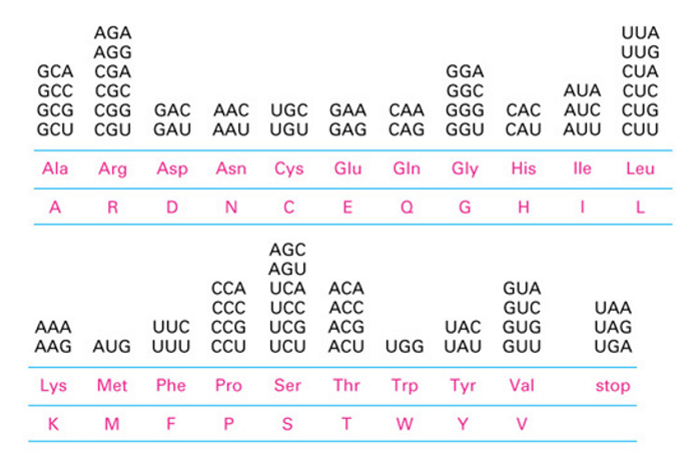
degeneracy within the amino acid code
some amino acids can be coded for more than one codon
e.g. leucine can be encoded by 6 codons
e.g. methionine is encoded by 1 codon
bases other than the main 4 in DNA are present in tRNA as a result of ?
post-transcriptional modification
inosine is the modified version of
adenine
the ? of tRNA determines attachment of particular amino acid
shape
the amino acid attachment site is at ? end of tRNA
3’ end

amino acids are attached to their corresponding tRNA via what enzyme?
aminoacyl-tRNA synthetases
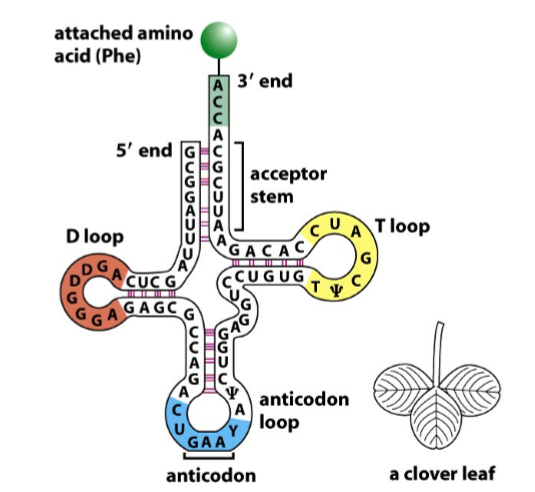
D and T loop
recognised by the aminoacyl tRNA synthetases
anticodon loop
contains the anticodon which is recognised by the aminoacyl-tRNA-synthetase
codes for corresponding amino acid attached to 3’ end of tRNA
aminoacyl-tRNA synthetases are specific to a particular (?)
amino acid

when the correct amino acid has been attached to its tRNA, the tRNA is said to be:
charged (or acylated)
a charged tRNA is termed:
amino acyl tRNA
prokaryotic ribosome structure
5S, 23S rRNA in their large ribosomal subunit
16S rRNA in their small ribosomal subunit
eukaryotic ribosome structure
5S, 5.8S and 28S rRNA in their large ribosomal subunit
18S rRNA in their small ribosomal subunit
small subunit vs large subunit function (ribosomes)
small subunit reads codon and matches corresponding tRNA
large subunit contains three sites and is primarily responsible for the formation of peptide bonds that link the amino acids together into a polypeptide
each ribosome has (a) binding site for mRNA and (b) binding sites for tRNA
(a) 1
(b) 3
A site
new tRNA enters ribosomal complex
P site
where tRNA amino acid attaches to polypeptide chain
E site
empty tRNA exits after amino acid detaches

explain the diagram
Amino acyl tRNA (4) binds to A-site
Anticodon base pairs with codon in mRNA
Simultaneously tRNA (2) leaves from E-site
Formation of peptide bond between amino acid 3 and 4
Large ribosomal subunit moves to the right along mRNA
Small ribosomal subunit moves to the right along mRNA
tRNA (4) is now in P-site
tRNA (3) is now in E-site
Amino acyl tRNA (5) bind to A-site
Anticodon base pairs with codon in mRNA
Simultaneously tRNA (3) leaves from E-site
eukaryotic ribosomes recognise a ? to initiate translation
5’ cap
prokaryotic ribosomes initiate translation at (?) sites
ribosome-binding sites
as ribosome-binding sites are located throughout an mRNA molecule, this allows prokaryotes to:
prokaryotes can synthesise more than one type of protein from a single polycistronic mRNA molecule

polyribosome
large assembly of several ribosomes on a single mRNA molecule