Chapter 1 - Units, Physical Quantities, and Unit Vector
 Call Kai
 Learn
Learn Practice Test
 Spaced Repetition
 Match
Match Flashcards
 Knowt Play
1/27

There's no tags or description
Looks like no tags are added yet.
Name | Mastery | Learn | Test | Matching | Spaced | Call with Kai | Chat |
|---|
No analytics yet
Send a link to your students to track their progress
28 Terms
Any (1)___that is used to (2)___a physical phenomenon (3)____is called a (4)____
ex. Weight, Distance, Height, Time, Speed, etc.
1. number
2. describe
3. quantitatively
4. physical quantity
(1)___are used to (2)___ natural phenomena so it is necessary to (3)____ the (4)____ that are used to describe and the relationship (5)____these quantities
1. Physical quantities
2. describe
3. identify
4. quantities
5. between
(1)___is an experimental science. (2)___require (3)___, and we generally use (4)___ to describe the results of measurements
1. Physics
2. Experiments
3. measurements
4. numbers
Physical Quantities are defined by their___
magnitude
Magnitude is composed of a (1)___ and a (2)___
ex.
(3)___, t = 2 seconds (s).
(4)___, x = 200 meters (m).
(5)___, v = 20 meters per second (m/s)
(6)___, m = 1000 kilograms (kg).
(7)___, V = 30 cubic meter (m^3).
(8)___, p = 1.2 𝑔𝑟𝑎𝑚𝑠 𝑝𝑒𝑟 𝑐𝑢𝑏𝑖𝑐 𝑐𝑒𝑛𝑡𝑖𝑚𝑒𝑡𝑒𝑟 (𝑔/𝑐𝑚^3)
1. number
2. unit
3. Time
4. Distance
5. Speed
6. Mass
7. Volume
8. Density
(1)___fundamental quantities of physics are
(2)____ (units: mm, cm, m, km, miles)
(3)____ (units: g, kg, amu)
(4)____ (milliseconds (ms), seconds (s), minute (min), hour (h))
1. Three
2. Length
3. Mass
4. Time
Which of the 3 fundamental quantities of physics have the following units? mm, cm, m, km, miles.
Length
Which of the 3 fundamental quantities of physics have the following units? g, kg, amu.
Mass
Which of the 3 fundamental quantities of physics have the following units? milliseconds (ms), seconds (s), minute (min), hour (h)
Time
Units can be (1)____and/or (2)____just like ordinary algebraic expressions. This gives an easy way to convert a quantity from one unit to another to be (3)____.
1. multiplied
2. divided
3. dimensionally consistent
The number of (1)___ is the number of digits about which we have some degree of (2)___. It is a measure of the degree of (3)___ of a certain measurement.
1. significant figures
2. certainty
3. reliability
RULES IN DETERMINING THE NUMBER OF SIGNIFICANT FIGURES
1. All nonzero digits are significant. Ex: 3.1416 has (1)___ significant figures
2. All zeros between nonzero digits are significant. Ex: 5.0046 has (2)___ significant figures
3. All zeros before the first nonzero digit are NOT significant. Ex: 0.0001 has only (3)____ significant figure
4. All zeros to the right of the last nonzero digit are significant ONLY if the number has a DECIMAL POINT, otherwise it is NOT significant.
Ex:
7000 has (4)___ significant figure
7000. has (5)___ significant figures
77.800 has (6)___ significant figures
0.000200 has (7)___ significant figures
5
5
1
1
4
5
3
(1) ___ vary from very large numbers to very small numbers.
A more convenient and compact way of writing these values uses the powers of (2) ___ notation, (3) ___ notation or (4) ___ notation.
In (5) ____ notation, one can determine the number of (6) ___ immediately as well as the (7) ___ of the digit.
(8) ____ are used to denote these place values.
Physical Quantities
ten
exponential
scientific
scientific
significant figures
place value
Prefixes
Format: C.MMMMMM x 10^e
where:
C – (1) ___digit from 1 to 9.
M – the (2) ___digits, from 0 to 9.
10 – the (3) ___
e – the (4) ___, the of times the decimal point is moved to either towards left or right.
RULES
(5) ____exponent results when the decimal point is moved from (6) __ direction. Example: 98067.5321 = 9.80675321 × 10 4
(7) ___exponent results when the decimal point is moved from (8) ___. Example:0.00098067 = 9.8067 × 10 −4
characteristic
mantissa
base
exponent
positive
right to left
negative
left to right
(1) ___Quantity
➢ A physical quantity that is completely described by its (2) ___only.
➢ It can be operated ordinarily using the (3) ___fundamental arithmetic operations.
(4) ___Quantity
➢ A physical quantity that is completely described by a (5) ___
➢ It is denoted usually by an alphabet with arrow over it indicating its direction.
Scalar
magnitude
four
Vector
magnitude and direction
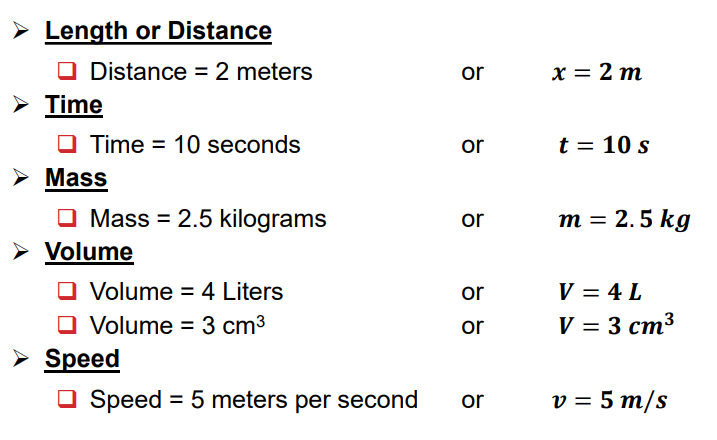
EXAMPLES OF ______
SCALAR QUANTITY

EXAMPLES OF ______
VECTOR QUANTITY
Total or vector sum of two or more vectors

Methods of (1) ____
Graphical Method
(2) ____Method
(3) ____Method
Analytical Method
(4) ___ Method
(5) ___Method
Vector Addition
Parallelogram
Polygon
Law of Cosine and Sine
Component
GRAPHICAL METHOD
➢ Magnitude of 𝑹 is measured using a (1)___.
➢ Direction of 𝑹 is measured using a (2)____.
ruler
protractor
Parallelogram Method
➢ a line is drawn parallel to the given vector whose length is equal to the vector.
➢ The (1)____ 𝑅 is drawn from the origin to the tip of the intersection of the parallel lines and measured using a Ruler.
➢ The (2)____ is determined from the horizontal using a Protractor.
➢ In plotting the given vectors in the Cartesian plane, (3) ____.
➢ Applicable to (4) _____
magnitude of resultant
resultant direction
always start at the origin
TWO vectors ONLY
Polygon (Head-to-Tail) Method
➢ Head-to-tail connection of vectors.
➢ Connect the next given vectors to the (1) ____.
➢ The (2) ____ is connected (3) ____
➢ The (4) ____ is determined from the horizontal using a Protractor.
➢ Applicable to (5) ____
head of the preceding vector
magnitude of resultant
from the tail of the first vector up to the head of the last vector.
resultant direction
more than two vectors

Law of Cosine and Sine Method
➢ Requires basic trigonometry knowledge in adding ___vectors.
➢ Applicable to ___ vectors ONLY.
➢ To plot the given vectors, connect the second vector to the head of the first vector.
two
Component Method
➢ Each vector is resolved into its components (1) (____).
➢ Applicable to (2)___.
➢ To plot each vector given, always start at the (3) ____.
2nd Quadrant (5) (___,___) 1st Quadrant (4) (___,___)
3rd Quadrant (6) (___,___) 4th Quadrant (7) (___,___)
x and y components
two or more vectors given
origin
+x, +y
-x, +y
-x, -y
+x, -y
A (1) ___ is a vector of length 1, sometimes also called a (2).
Points in a particular direction of a vector in space.
𝒊 - points in the positive (3)___ direction.
𝒋- points in the positive (4)___direction.
𝒌 - points in the positive (5)___ direction.
unit vector
direction vector
x-axis
y-axis
z-axis

What formula is this?
Vector Sum
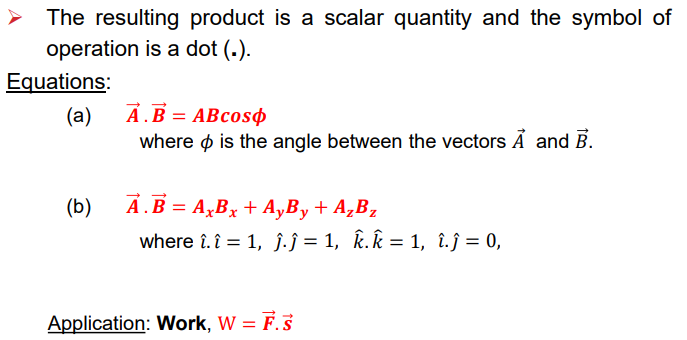
Which of the 2 types of Product of Vectors is this?
Scalar or Dot Product

Which of the 2 types of Product of Vectors is this?
Vector or Cross Product