acid base recitiation
 Call Kai
 Learn
 Practice Test
 Spaced Repetition
 Match
 Flashcards
 Knowt Play
1/7

There's no tags or description
Looks like no tags are added yet.
8 Terms
Claim: When dissolved in water, HI exists as ions.
Evidence: When HI is dissolved in water, the solution conducts electricity.
Reasoning: Solutions conduct electricity when they contain freely moving charged particles called ions. HI separates into hydrogen ions (H⁺) and iodide ions (I⁻) when dissolved in water. These ions move through the solution and carry an electric current, showing that HI exists as ions rather than intact molecules in water.
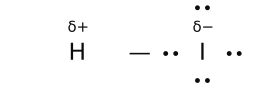
Draw the Lewis structure for HI and label the partial charges. Now, draw Lewis structures for two water molecules (including their partial charges) showing how they interact with an HI molecule.e.
HI is a polar molecule. Hydrogen is δ+δ+ and iodine is δ−δ− because iodine is more electronegative
HI interacting with two water molecules
Water molecules orient their oxygen atoms (\(\delta-\)) toward the hydrogen of HI (\(\delta+\)). This represents the attraction between partial charges.
Important: In actual water, HI ionizes almost completely:
Draw a molecular level representation of a solution of HI(aq).
For HI(aq), draw separated H₃O⁺ ions and I⁻ ions surrounded by water molecules, because HI ionizes almost completely in water.

what does ionize in water mean
Ionize in water means that a substance forms charged particles called ions when it dissolves in water.
2d. When you dissolve HI in water, does a chemical reaction occur? Explain how you know.
Yes, a chemical reaction occurs when HI dissolves in water because HI transfers a hydrogen ion to a water molecule, forming new substances: hydronium ions (H₃O⁺) and iodide ions (I⁻). We know a chemical reaction occurs because chemical bonds change and new particles form, and the resulting solution conducts electricity due to the presence of mobile ions.
When you dissolve KBr in water, does a chemical reaction occur? Explain how you
know
No, a chemical reaction does not occur when KBr dissolves in water. KBr is an ionic compound that separates into its existing potassium ions (K⁺) and bromide ions (Br⁻). No new substances are formed; the ions simply separate and become surrounded by water molecules. This process is called dissociation, rather than a chemical reaction.
When water boils, does a chemical reaction occur? Explain how you know
No, a chemical reaction does not occur when water boils. Boiling is a physical change because liquid water (H₂O) changes into water vapor (H₂O), but the molecules remain the same. No new substances are formed; only the state of matter changes.