EM Radiation and Quantum Phenomena
 Call Kai
 Learn
 Practice Test
 Spaced Repetition
 Match
 Flashcards
 Knowt Play
1/38

There's no tags or description
Looks like no tags are added yet.
39 Terms
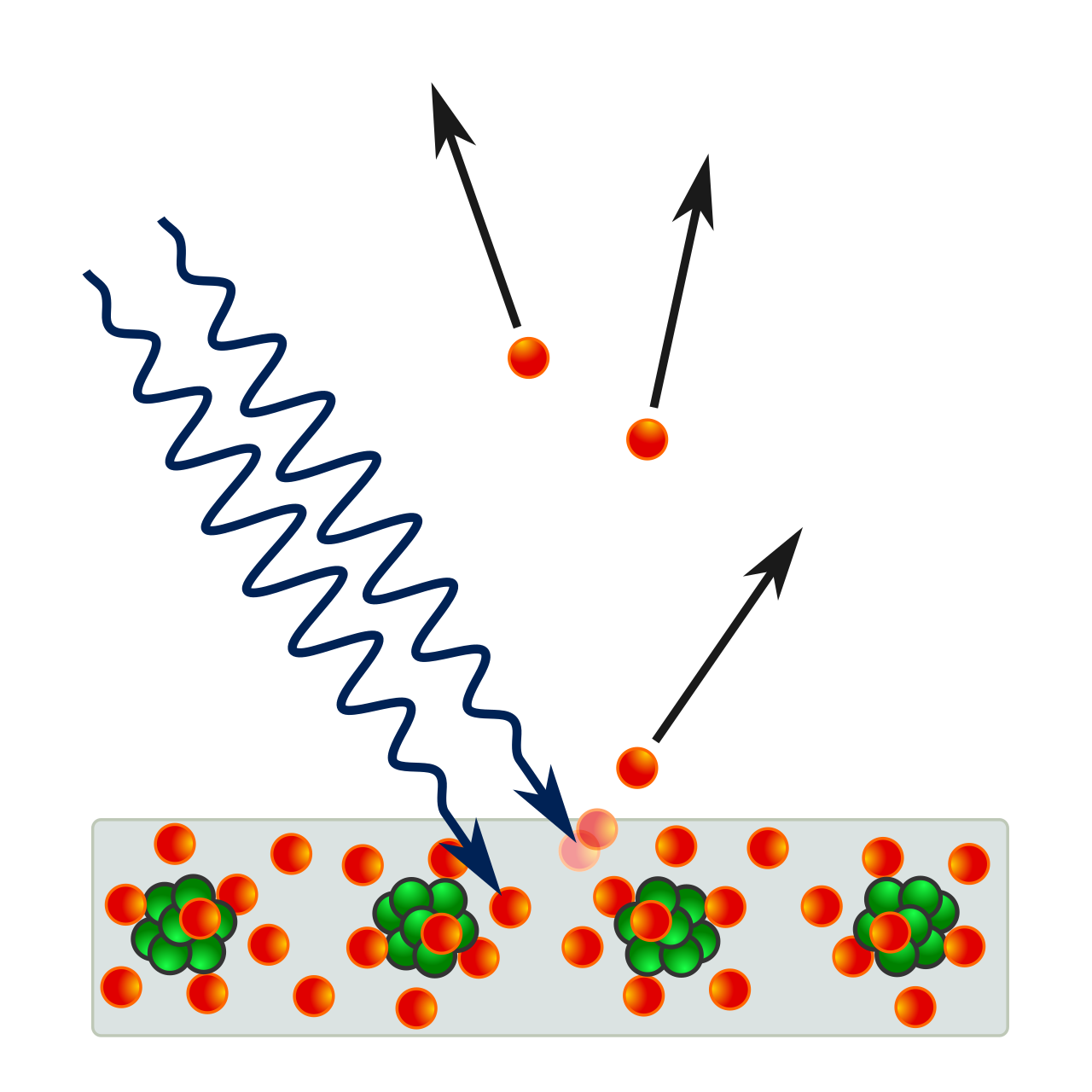
Describe the photoelectric effect
Photons of EM radiation are incident on a metal surface.
One photon transfers all its energy to one electron near the surface.
If the photon has a greater energy or equal energy to the work function, one photoelectron is emitted.
How is KE of the photoelectrons emitted?
Photoelectrons have a range of kinetic energies.
From zero up to a maximum value they are emitted (determined by the frequency of radition).
Define work function
The minimum photon energy required, to cause the emission of an electron from the surface of a metal.
Define threshold frequency
The minimum frequency of Electromagentic radition required to cause the emission of an electron from the surface of a metal.
This is related to the work function as photon energy given by E=hf
What equation links work function and threshold frequency?
Work function = h x f0
What equation links frequency, work function, and maximum kinetic energy?
Photon energy = work function + max KE of electrons
hf = work function + Ek(max)
Explain how increasing frequency or decreasing wavelength of EM radiation affects the photoelectric effect
If frequency (f) increases, or wavelength decreases then Photon energy (E) increases as E=hf
Since work function is constant, maximum Kinetic Energy of electrons increases as Ek(max) = hf - work function
Explain how increasing intensity of Electromagnetic radiation affects the photoelectric effect
If intensity increases, the number of photons incident per second on the surface increases as one photon transfers all its energy to one electron, causing one photoelectron to be released.
This means the number of photoelectrons emitted per second increases.
What is the graph that shows the maximum kinetic energy of electrons against frequency?
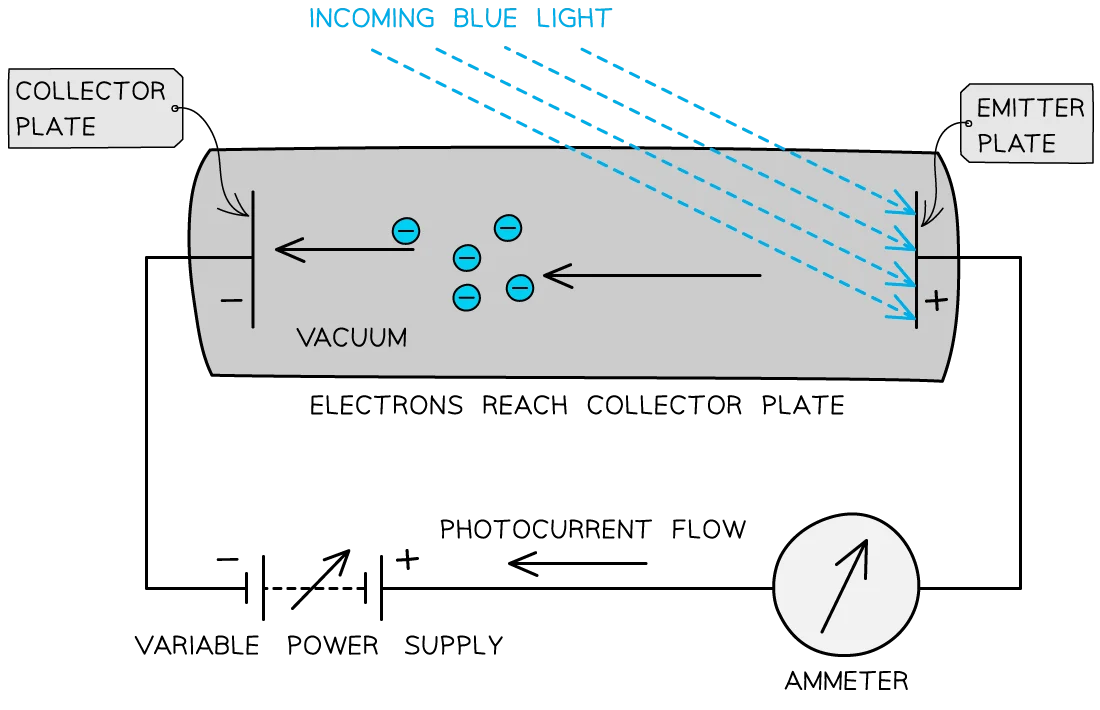
A photocell is setup so the photoelectric effect can occur.
How does increasing the PD impact the current?
Increasing the PD of a photocell causes the current to decrease.
The photoelectrons have a range of Kinetic Energies.
Increasing the PD causes the emitter plate to become more positive causing photoelectrons to be more attracted back to it.
Photoelectrons must do more work against the PD to reach the collector plate causing them to lose more Kinetic Energy.
Fewer photoelectrons have sufficient Kinetic Energy to reach the collector plate, decreasing the current.

Define the stopping potential of a photocell
The minimum PD that reduces the current in a photocell circuit to zero.
Explain why a stopping potential exists, in terms of photoelectrons
No photoelectrons are able to cross the cell to the collector plate
The required work done against the PD to reach the collector plate is equal to the maximum Kinetic Energy of the photoelectrons.
What is the equation for stopping potential?
Vs (Stopping distance) = Ek(max) / charge of an electron
Does the photoelectric provide evidence for the wave or particle nature of light?
It provides evidence for the particle nature of light.
The existence of threshold frequency means that one photon transfers its energy to one electron causing one photoelectron to be emitted.
Electron emission is instantaneous, so increasing intensity increases the number of electron emitted per second.
Increasing the frequency, increases the Kinetic Energy of electrons.
Define ground state
The lowest energy level (n = 1), closest to the nucleus
Define excitation in terms of energy levels and energy
An electron moves to a higher energy level, when it gains energy, equal to the difference between the two energy levels.
What 2 ways can electrons gain energy to become excited?
One photon transfers its energy to one electron.
A free electron collides with the electron and transfers some energy from its Kinetic Energy store.
Define de-excitation
An electron moves to a lower energy level, it loses energy by emitting a photon, with equal energy to the difference between the two levels.
It can happen directly, or indirectly (in stages).
Define ionisation
An electron gains enough energy to be removed from an atom.
Define ionisation energy
The amount of energy required to completely remove an electron from an atom to the ground state.
Why are energy levels defined as having negative energy?
A free electron (removed from an atom) is defined as 0J.
All energy levels are negative relative to this as energy needs to be supplied to remove an electron.
Define the structure pf the discharge tube used for fluorescent lights
A glass tube is filled with Mercury Vapor.
The beam of free electrons is accelerated by a PD.
It has a Phosphor coating.

What happens to the electrons in the Mercury vapour?
Free electrons collide with electrons in mercury atoms and transfers some of their Kinetic Energy equal to the difference in energy levels.
Mercury electrons excite to higher energy levels then immediately de-excite to lower energy levels, emitting UV photons with energy equal to the difference in energy levels.
Describe what happens to the electrons in the phosphor coating
One UV photon is absorbed by one electron in the phosphor coating.
The phosphor electron is excited to a higher energy level, then de-excites in stages to lower energy levels.
As the de-excitation is in stages, the energy differences are lower, so multiple photons of lower energy and lower frequency are emitted in the visible part of the spectrum.
Many different energy transitions then lead to the production of white light.
What do line emission spectra look like?
Black background and coloured lines at discrete wavelengths/ frequencies.

How are line emission spectra formed?
Discharge tubes filled with gas, with beams of accelerated electrons.
Electrons in gas atoms occupy discrete energy levels.
Free electrons in the tube collide with atomic electrons and transfer some of their Kinetic Energy.
Atomic electrons are excited to higher energy levels.
The electrons then de-excite to lower energy levels causing photons to be emitted with discrete energies equal to difference in energy levels.
The different transitions produce photons with discrete energies which correspond to discrete wavelengths / frequencies due to E=hf or E=hc/lander, producing the coloured lines on the spectrum
What do line absorption spectra look like?
Coloured spectrum background with black lines at discrete wavelengths/ frequencies.

How are line absorption spectra formed?
White light is made up of all wavelengths and frequencies of visible light as it is shone through a cold gas.
Electron in the gas atoms occupy discrete energy levels causing the electrons to be excited to higher energy levels when they absorb photons from the white light with discrete energies, equal to the difference in wavelengths which correspond to discrete wavelengths/ frequencies due to E=hf and E=hc/lander
The wavelengths / frequencies are missing from the spectrum (so appear as dark lines) as when the electrons de-excite, the photons are re-emitted in all directions.
What is meant by the duality of particles?
Particles can behave as both particles and waves
What is the equation for the de Brogile wavelength?
Lander = h/p
Lander = h/ mv
What is diffraction?
Spreading out of waves as they pass through a gap or around an obstacle.
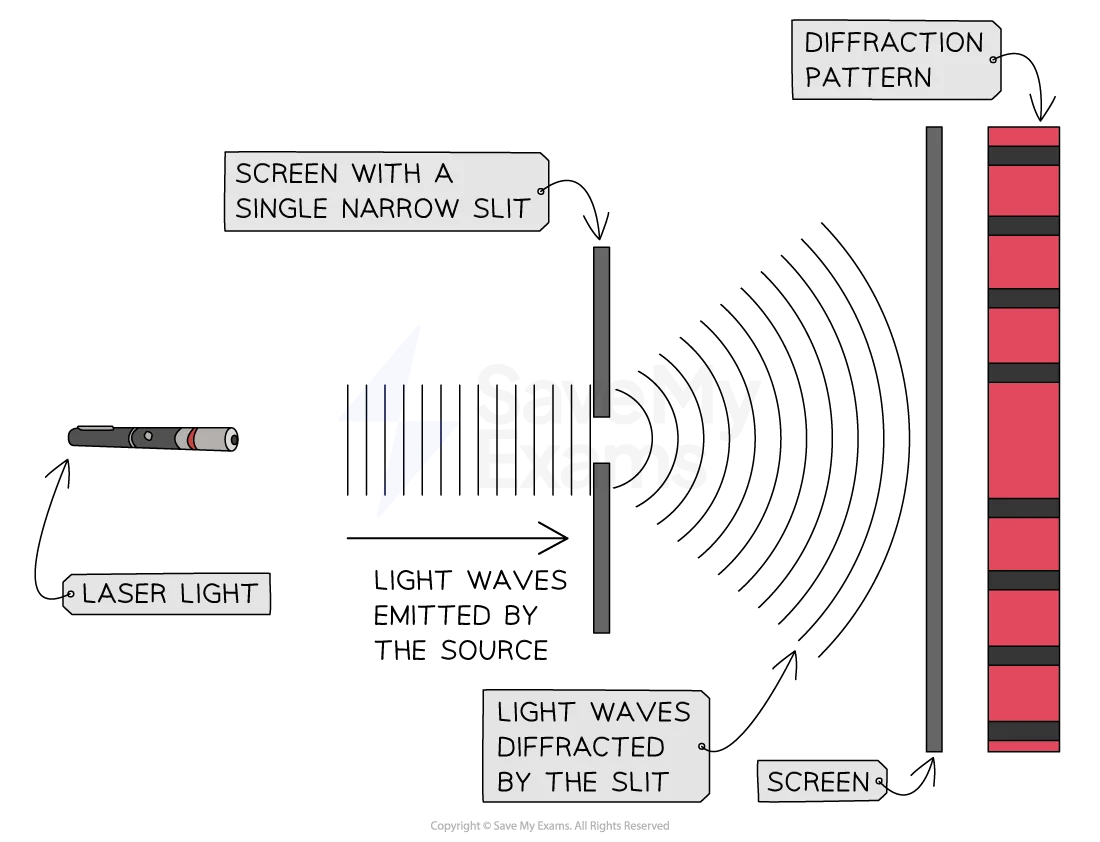
When is diffraction noticeable?
When the wavelength is the same order of magnitude as the width of the gap/ object.
What factors affect diffraction?
Smaller width gap (constant wavelength) results in a greater diffraction effect.
Longer wavelength (constant width gap) results in a greater diffraction effect.
What is the set-up of equipment for the electron diffraction experiment?

How is a beam of electrons produced for the electron diffraction experiment?
A metal filament is heated until electrons have enough energy to be emitted (known as thermionic emission).
In electron diffraction, how do electrons reach high speeds?
Accelerated by a potential difference, as particle behaviour must be charged.
In electron diffraction, how are electrons diffracted?
Diffracted through gaps between the layers of atoms in graphite.
The gap width is a similar order of magnitude to the de Brogile wavelength of the electrons.
Wave behaviour as only waves can be diffracted.
In electron diffraction, how do the electrons produce pattern on the screen?
Electrons collide with atomic electrons in the screen that excite and de-excite causing fluorescence (visible light emitted).
Particle behaviour as electrons transfer energy to the atomic electron in one to one interactions.
How does the speed of electrons affect the diffraction pattern?
If the speed of the electrons (v) increases, the de Brogile wavelength (lander) is greater as lander = h/ mv
There is less diffraction as there is a shorter wavelength relative to the spacing between the layers of atoms in the graphite.
The diffraction rings will be closer together (smaller diameter).