Midterm 1 International Politics NYU
 Call Kai
 Learn
 Practice Test
 Spaced Repetition
 Match
 Flashcards
 Knowt Play
1/91

There's no tags or description
Looks like no tags are added yet.
92 Terms
Assumptions of Realism/Neorealism (4)
1. International Politics is anarchic.
2. States are rational, unitary actors. They are key to international politics.
3. Stats try to maximize their security above all else, and consider other factors only after security is assured.
4. States try to increase their power so long as doing so does not place their security at risk.
Hypotheses of Realism/Neorealism (3)
1. Bipolarity more stable than multipolarity.
2. War is avoided by balancing power.
3. Alliances are a way to balance power/protect security.
Strategic Perspective Principles (3)
1. Leaders care about themselves.
2. International relations cannot be separated from domestic politics.
3. Relations between nations and between leaders are driven by strategic considerations.
Rational Actor Preferences
1. Completeness: can compare alternatives.
2. Transitivity: if x>y>z, then x>z.
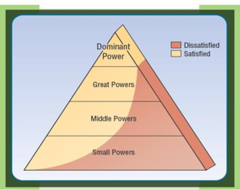
Power Transition Theory
Generally, the hegemon is going to be displaced by a great power
1. Status quo more nearly reflects interests of dominant state and great powers
2. Shaded area in Figure represents satisfied states
3. Small states much more often dissatisfied
How realistic is Balance of Power?
Realist claims that bipolarity promotes stability and that uncertainty provokes instability, that states mimic each other, and that BOP fosters stability are logically flawed and unsupported
How realistic is Power Transition Theory?
Power transition theory is more consistent with the historical facts
Necessary vs Sufficient (2)
1. A necessary condition for "s" is something that has to be true for "s" to be realized.
2. A sufficient condition for "s" is something that if true, guarantees "s" (ONE OF MANY POSSIBLE SITUATIONS). All of the necessary conditions have to hold for "s" to be true.
If A is a necessary condition for B, then is B a sufficient condition for A?
Yes
If A is a sufficient condition for B, then A is a necessary condition for B?
No
Three Principles of International Politics
The actions that leaders take to influence events in the international
arena are motivated by their personal welfare and, especially, by a desire
to stay in office. Leaders define the national interest to coincide with
their personal interests.
2. International relations cannot be separated from domestic politics. Every
foreign policy action is undertaken in the shadow of the domestic
political consequences the action is expected to produce. Therefore, if a
foreign policy is expected to achieve beneficial consequences for a
nation in the long term but in the short term will result in the ouster of
the leader, then that policy will not be pursued.
3. Relations between nations and between leaders are driven by strategic
considerations.
?? not sure about this one
Theory
concepts and rules that express simplified relationships between phenomena + how they relate to eachother.
independent variable
it's not changed by the other variables being measured, BUT it is manipulated by the experimenter to change the dependent variable

dependent variable
The outcome, which varies in response to manipulations of the independent variable.

Realism
- world is made up of competing powers and their interests are maintained by using power
- not guided by universal principles but by the actions of the states around them, world is a "mean and nasty place"
- the international system is anarchic
- violations are expected esp by powerful states when their interests are not favored by int. law
Realists belive that the international system is _____________
Anarchic
The Security Dilemma
Sort of like homeostasis:
- anything a state does to become more secure makes other states less secure.
- as a state gains more power, other states will become more motivated to ally against them, so gaining power could actually make a state weaker in the long run
Power Transition Theory Hierachy
Hegemon = dominant power
Spacial Utility Function
Spacial Utility Function
Policy options/outcomes are arrayed along a "policy space"
For example, a quadratic "loss" function
Ui = -(x-Zi)^2
Where x is the level or policy that is actually set (the actual policy outcome)
Z is the person i's ideal point
Ui is the person i's utility when policy is set at x
Ideal Point
the policy position where a decision maker will recieve the most utility
an actors most prefered outcome among the possible alternatives for an issues resolution is __________
the ideal point
Single-peaked preferences
Preferences with only a single local maximum, or peak, so that utility falls as choices move away in any direction from that peak.
____________________ can only occur when the actor has a most preferred point as well as several other choices that they prefer less
Single peaked preferences
Subgame perfect Nash equilibrium
The Nash equilibrium found by considering their and their opponent's choice nodes. At each point, the player chooses the node that they believe serves their best interest.
unipolarity
when international politics is dominated by one state
Utility
the degree to which one choice is preferred as measured by risk
Anarchy
when no authority exists to enforce agreements between states, causing international affairs to become a self help system dependent on individual national interests.
Game Theory
mathematical means of evaluating strategic interation between players. The choices of any indevidual are contigent upon expectations about the other players' choices.
assumptions
conditions under which a theory is thought to be a helpful tool for explaining relevant phenomena.
Backward Induction
A method for solving extensive form games. Individuals interested in solving an extensive form game through backward induction must begin at the terminal nodes and work their way back to the beginning of the game, identifying at each node the response that is the best choice at that juncture for the relevant player given what that player can anticipate about the subsequent choices of all other players.
A means of solving extensive form games, starting at the terminal node and working back, taking into account the best interests of each player at each node is ______________
Backward Induction
Balance of Power
theory that an equal distribution of power influences international peace and stability.
Subjective probability/ beliefs
in games with uncertainty, players attach probablilities to choices when regarding uncertain information, called beliefs.
Bipolarity
When there are two major powers in international politics
Dominant Strategy
a strategy that a player prefers no matter how the other players will respond
Decision Theory
study of decision making when considering multiple outcomes when there is uncertainty and risks + losses
dominant strategy
a strategy that is best for a player in a game regardless of the strategies chosen by the other players
Empirical
based on observation or experiment
Expected Utility
value obtained by considering the benefist minus the costs from a certain action.
1. each possible consequence must be multiplied by the probability that it will happen.
2. then all the answers should be added up
= expected utility
3. then compare the expected utility you get to alternative expected utilities (ex: the option to do nothing)
What is the value obtained by evaluating the various consequences, in terms of benefits minus costs, that can arise from a specified action; multiplying each possible consequence by the probability that it will arise; and then adding up these quantities across all the various consequences that have a chance of occurring given the chosen action. This value can be calculated before the action is taken and can be compared to the expected utility of alternative actions that could be chosen so that the decision maker can pick the one that yields the greatest expected net gain?
Expected Utility
Nash Equilibrium
A set of strategies, one for each player in the game, such that each player's strategy is a best response to the strategies chosen by everyone else.
what is a set of strategies in a game such that no player has a unilateral incentive to switch to another strategy. Every finite game has at least one Nash equilibrium in mixed strategies or pure strategy and may have more than one in pure strategies and mixed strategies?
Nash Equilibrium
Extensive Form game
States engage in ________ so power becomes more or less equally dvided among states over time.
balancing
Multipolar
when there are more than two important centeres of power
Stability
when interstate violence is substantially nonexistent and there is little likelihood of this changing.
same at time t and time t+1
System Stability Vs Resource Stability
system stability is when all countries can ensure their resources and sovereignty will stay intact. Resource stability refers specifically to the stability of resources
System stability =lack of war
Resource stability = division of the pie
resource instability is compatible with system stability
very few examples of balanced systems
Relative Gains vs. Absolute Gains
1. Relative - The comparative effect of a decision or situation on an actor relative to those of another actor( increase its power by having more than other states)
2. Absolute - the total effect of a decision or situation on an actor. (how much of the resource they have or gain on its own)
Neorealism
Necessary Condition
A condition that MUST be there, but that does not alone guarantee that the specified event will occur

A _________________ is a condition that must be present for an event to occur. A _______________ is a condition or set of conditions that will produce the event. A _________ condition must be there, but it alone does not provide _____________ cause for the occurrence of the event.
Necessary Condition
Sufficient Condition
Necessary
Sufficient

Sufficient Condition
a sufficient condition alone is enough for an event to occur (in other words, it implies that all of the "necessary" conditions are there)

Hypothesis
A prediction that represents a theory's explanation of a portion of reality
Strategy
A plan of action for every uncertain step in a game
Assumption
Three Principles of International Politics
1. All leaders want to maintain power
2. International relations and domestic politics cannot be separated
3. relations between nations and leaders are driven by strategic considerations
Attributes of a Good Theory
1. Logical consistency
2. accuracy
3. falsifiability
4. Parsimony
5. non-spurious
Learn the definitions of these individual terms?
Politics is a __________
all politics (whether domestic or international) is concerned with that aquisition and allocation of ______________
means of allocating resources
scarce resources
Politics is a _________
competition among groups and individuals over resources
Preferences
the way that an actor orders possible alternatives or outcomes
Preference Ordering
ordering that stipulates the choices that can be made as opposed to alternatives
_________ an ordering that stipulates the connection between choices for all relevant pairs of alternatives
Preference Ordering
Rationality
People have preferences
- People know what their preferences are
- People take actions that they believe will yield the
best chances for them to achieve their own
interests and preferences
Instrumental rationality
acting on your preferences such that you do what you think is best with regard to your own welfare
Conditions for Rationality
1. connectedness (completeness)
2. consistency (transitivity)
Constraints
factors that limit choices or influence the expected outcomes of choices
Outcomes vs. choices
- Need to understand how a decision maker came to view his or her choice as the best option given his or her understanding of the costs and benefits of alternative strategies
Majority Rule
the option that is preferred by the most people
Condorcet's Paradox
rational individuals may not act rationally as a group
Sometimes, even when people's preferences are complete and transitive, when they get together to make a group decision, it may be impossible for the group's decision to be __________
Rational
In condorcet's paradox, the collective outcome is __________
intransitive
- produces a cyclical preference for the group and there is no voting rule to solve this issue
Social Choice Problem
unanimity is rare when it comes to important + high risk choices in international politics
aggregating preferences
organizing the beliefs and opinions of many actors into a communal decision
Condorcet winner
An option that beats all other options in a series of pair-wise contests
What are the problems with National Interest?
states as unitary actors is problematic, prone to important policy errors and mistaken explanations of patterns of international interactions
Utility Function
mapping between outcomes and an actors utility for a specific outcome
- Allows us to express a person's utility from each outcome
- Summarize with a mathematical function
Spacial Utility Function
Policy options/outcomes are arrayed along a "policy space" - For example, a quadratic "loss" function
- Where x is the level of policy that is actually set (the actual policy outcome/status quo)
- z is person i's ideal point
- ui is person i's utility when policy is set at x

What are the two types of costs?
Transaction costs and Opportunity Costs
Lessons from Expected Utility
Leaders making decisions are making calculated risks:
- Calculated risks may lead to success but may also lead to failure
• Rationality is based on information known by the decision maker at the time the decision in made, not after
• Understanding expected utility can help us understand decisions that were mistakes in retrospect
Lessons: Expected Utility & Game Theory
• Players (policymakers) do not always do what they like best
- Decisions involve calculated risks
- Calculated risks may lead to success, but may also lead to failure
• The sequence of moves can shape the final outcome
- Institutions; power
• Game theory and expected utility can help us understand decisions that were mistakes in retrospect
- Outcome and choices are not the same thing
- Rationality is based on information known by the decision maker at the time the decision is made, not after
Where Might Neorealism be Wrong?
• Problematic underlying assumptions:
- Underlying assumption that states are aggressive
• E.H. Carr (The Twenty Years' Crisis): "The most serious wars are fought in order to make one's own country militarily stronger, or more often to prevent another from becoming militarily stronger"
• Why are wars fought?
- States as static units
- States do not have permanent ties with one another
Balance of power not the usual state of affairs and the claim that balance is conducive to peace does not stand up - States will not fight unless they believe they have a good chance of winning • This is most likely to be true when the two states are fairly, evenly matched - 41% of wars started by the weaker side
Empirical Evidence for neorealism
Common claim among neorealists that war only occurs when both sides believe their chance of winning is greater than 50% • Testing hypothesis that it is necessary (but not sufficient) that each side think its chance of victory >50% before war will occur - No significant association between estimates of the probability of victory for either side in a war and the likelihood that there will be a war
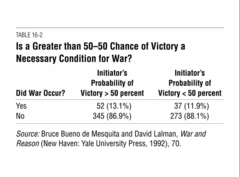
Empirical Evidence for Balance of Power neorealism
• Balance of power not an accurate description of empirical fact
- The existence of a balance of power more of an exception than the rule
- Periods where balance existed (or was thought to exist) were periods of war
There is no systematic relationship between the likelihood of war and the balance of power (Organski and Kugler 1980) - Major power dyads (1860-1980) - Independent variable: power measured using GNP - Dependent variable: war measured as any time two countries fight each other and there are at least 500 killed in battle

Assumptions of power transition theory
States are the central actors
• Hierarchical international structure
• States are either satisfied or dissatisfied
• States have policy objectives that they would like to impose on other states
Extensive Form game
a game tree that allows us to view all possible moves for the players in sequence. solved via backward induction, allowing us to find the subgame perfect nash equilibrium.
Payoff VS Strategy
Payoff = numbers Strategy = words
20 multiple choice questions (3 points each
fill in the blank questions
'20-25 points total of game theory expected utility
REMEMBER TO BRING CALCULATOR!!
you have to know only two formulas: quadratic loss function with one dimension, expected utility function
about 25% of the questions are going to be math based
necessary sufficient
could show up like ir did on the homeowlr
there is always a subgame perfect nash equilibrimfm
dont need to know liberalism need to know a lot about neorealism and realism
Quadratic Loss Function