17 - Temperature Regulation
 Call Kai
 Learn
 Practice Test
 Spaced Repetition
 Match
 Flashcards
 Knowt Play
1/18

There's no tags or description
Looks like no tags are added yet.
19 Terms
List the body’s main focus regarding Temperature Homeostasis
Primary focus = keeping a constant core temperature
Prevent overheating/over-cooling
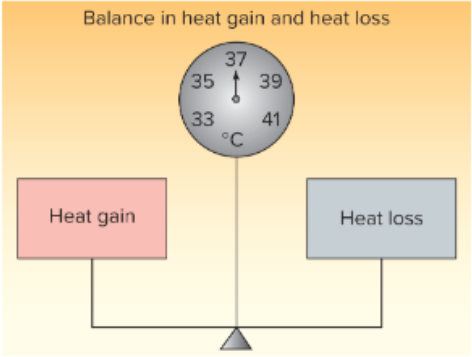
Heat loss < heat production = net GAIN in body temp
Heat loss > heat production = net LOSS of body temp
Describe the relationship between Metabolism & heat production
Human body operates at a metabolic efficiency of only 20% - 30%
Converting nutrients into energy
70% - 80% of the total energy expended during physical activity is released as heat
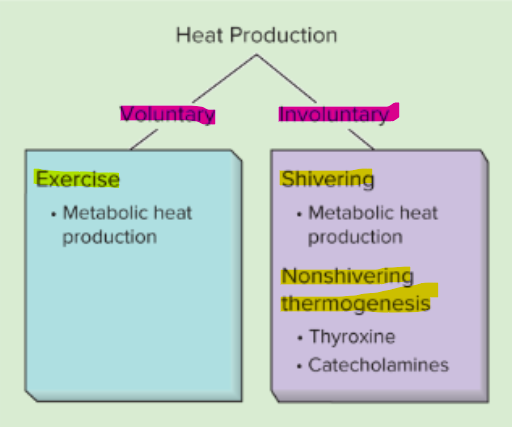
List the Voluntary (1) & Involuntary (2) methods of PRODUCING heat
Voluntary:
Exercise
Metabolic heat production
Involuntary:
Shivering
Metabolic heat production
Non-shivering thermogenesis
Thyroxine
Catecholamines
List the 4 ways the body LOSES heat
Radiation → infrared rays (w/out physical contact)
Conduction → heat moves from warmer to cooler objects (direct contact)
Convection
Evaporation
Convection (3) — heat loss
Transfer (loss) of heat due to the movement of air molecules on the skin (layer of hot air replaced with cold air)
The amount of dissipated heat is depended to the air flow
Typically the primary form of heat loss when exercising in a well-tempered environment
Evaporation (3) — heat loss
Transfer (loss) of heat due to liquid turning into a vapour (liquid → vapour)
Via sweat on the skin surface
Depends on:
Humidity & temperature
Convective currents around the body
Amount of skin surface exposed
Most important means of heat loss during exercise
What is the body’s “thermostat” & how does it regulate body temp?
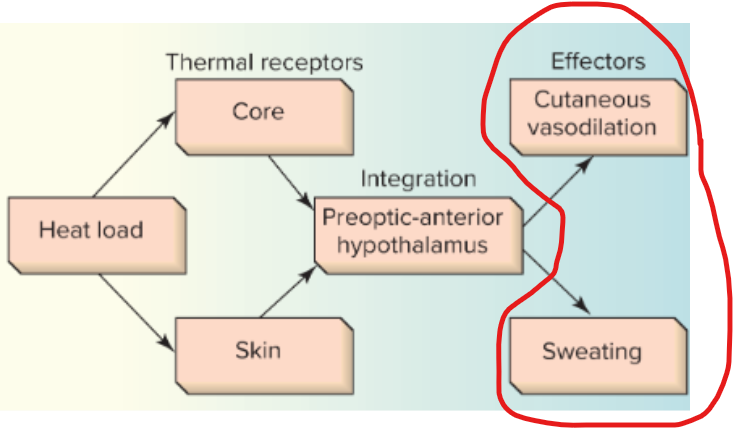
The Preoptic-Anterior Hypothalamus (POAH)
Body temp controlled through a combo of physical processes & chemical signals
Primary goal = maintain core temp
List the 3 ways the POAH controls body temp
Heat production
Muscular contraction
Venous blood draining (from exercising muscles to rest of body)
POAH sensing
Detects change in temp & adjusts for thermal error
Effector Response
Autonomic NS → cutaneous vasodilation (increasing skin blood flow) & sweating (enhancing heat dissipation)
Describe the heat loss dynamics over time (4)
Exercise induces rapid metabolic heat generation
Convective & radiative loss → plays a small, but constant role
Evaporative heat loss → gradually increases until steady state is attained (dominant cooling pathway)
T or F; core body temperature increases linearly with VO2?
True; both have a direct relationship to increased exercise intensity
What is the Effect of Ambient Temperature (increased environmental temp) regarding exercise (3)?
Temperature crossover point at 20oc → increase in room temp = convective & radiative heat loss decreases
Reduced radiative/convective loss → higher room temp reduces skin-to-air thermal gradient
Critical threshold (>35oc) → if environmental temps exceed skin temp, evaporation becomes the main method of heat loss
Describe the relationship between Heat PRODUCTION and Heat LOSS
Linear metabolic increase → energy output & heat production increase linearly w/ exercise work rate
Constant convective/radiative loss → dry heat loss stays unchanged across work rates
Evaporative dominance → most effective form of heat loss
What are the physiological challenges to hot/humid environments?
Poses a stressful challenge to body temp & fluid homeostasis
Reduces radiative and convective cooling (humidity limits sweat evaporation)
Uncompensated heat storage leads to:
Rapid core temp elevation
High sweat rates
Severe dehydration
Elevated risk of hyperthermia
What are 3 factors that impact an Individual’s Sweat Rate?
Heat adaptation
Heat-acclimated people exhibit an earlier onset of sweating & higher max sweat rates
Body size & mass
Greater body mass = greater total sweat volumes
Biological sex
Both females and males demonstrate equivalent sweating capacities
What are the key causes of Performance Decline regarding heat gain (3)?
Accelerated muscle fatigue → increased rate of glycogen breakdown (higher BLa concentration)
Cardiovascular strain → Reduced SV, CO, & reduced blood flow to active muscles
CNS → hyperthermia depresses mental drive & reduces central activation
What Metabolic Changes occur in Muscle during HYPERthermia (4)?
Accelerated glycogen breakdown
Increased lactate production
Elevates blood and muscle lactate levels, reducing intracellular pH & directly hindering muscle contraction force
Free radical generation
Skeletal muscle generates increased reactive oxygen species (ROS), causing oxidative damage to action and myosin
Afferent feedback inhibition
Stimulation of muscle chemoreceptors sends type III/IV neural feedback to the brain, suppressing central motor drive
List the 3 Physiological Responses to Cold
Vasoconstriction
Constricting skin blood flow → reduces convective heat loss
Shivering
Rhythmic muscle contractions → produces metabolic heat
Nonshivering
Increased metabolic heat production → brown adipose tissue by catecholamines
What are 2 factors that affect Heat LOSS?
Biological sex
Females often have more body fat → greater tolerance due to more insulation
Age & body composition
Children have a large surface-area-to-mass ratio, causing greater heat loss
Older adults with decreased muscle mass have reduced tissue insulation
What Impact does Cold Stress have on Performance/Physical Dexterity
Hand exposure reduces neural transmission speed via vasoconstriction → reducing manual dexterity
In cold water, muscle cooling reduces muscle strength and power (also leads to hypothermia sooner → 25x greater)