lecture 16 - changing membrane potential
 Call Kai
 Learn
 Practice Test
 Spaced Repetition
 Match
 Flashcards
 Knowt Play
1/48

There's no tags or description
Looks like no tags are added yet.
Name | Mastery | Learn | Test | Matching | Spaced | Call with Kai | Chat |
|---|
No analytics yet
Send a link to your students to track their progress
49 Terms
to create an electrical signal, you need to change the _______ ________. this is done via ____ channels
membrane potential, gated

true or false: ligand-gated channels are specific to a certain type of ligand
true

mechanically-gated channels respond to _________ vibration or _______ stimuli
mechanical, pressure
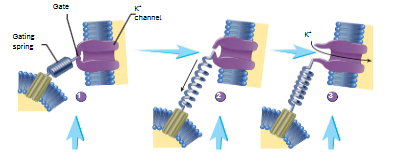
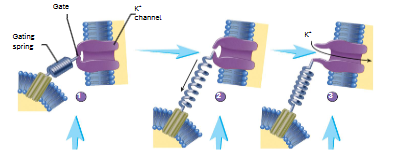
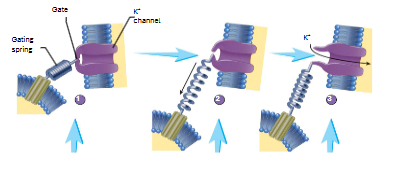
gating spring
part of mechanically-gated channels; is like a coil that opens a door

mechanically-gated channels explanation
movement occurs b/w 2 cells (2 cells w/ gating spring attached)
gating spring is pulled, opening the channel
voltage-gated ion channels are found primarily in the ____ regions of our neuron, with some in the _________ _____
axon, presynaptic terminal

mechanically-gated ion channels are associated w/
special sensory regions

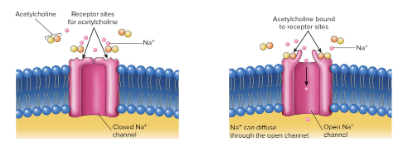
ligand-gated channels are found
somas of interneurons + motor neurons
dendrites of sensory neurons (pain)
mechanically-gated channels are found
dendrites of sensory neurons (touch, pressure, pain)
voltage-gated channels are found
axons in all neurons

leak channels are found
all cells (any part of neuron)

2 types of electrical signals
graded potentials (GP)
action potentials (AP)
graded vs action potentials (GP vs AP)
AP allows communication over both short + long distances; GP allows communication over short distances ONLY
AP uses voltage-gated ion channels; GP uses ligand-gated + mechanically-gated ion channels

graded potentials (GP) are also known as
local potentials

why are graded potentials called that
dependent on how much stimuli you have to open the gates + how many gates there are

why can’t graded potentials communicate over long distances
membrane potential changes can only be caused around the area of the gates that are open
voltage-gated ion channels are like the domino effect. why?
you only need enough voltage change to trigger the opening of 1 voltage-gated channel
ions will move to other side + cause a change in membrane potential, → causes the next voltage-gated channel to go off

situations in which a ligand-gated or mechanically-gated channel will open
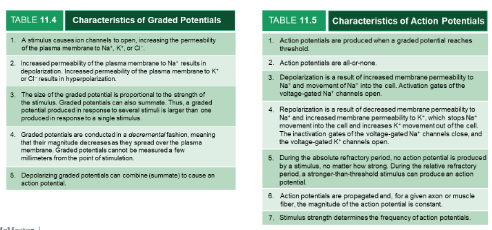
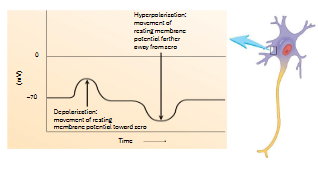
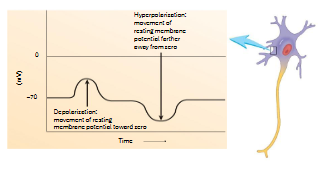
depolarization
hyperpolarization

depolarization
membrane potential change where it gets closer to 0mV (from -70mV)
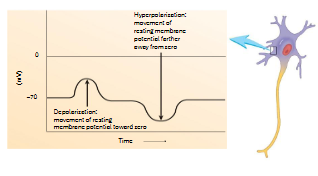
hyperpolarization
membrane potential change where it gets further from 0mV (ie -70mV to -75mV)

if you open the sodium channels, do you get a hyperpolarization or depolarization?
depolarization (Na+ starts on outside and wants to come in, inside is more -ve, therefore you are decreasing the difference b/w the voltage of inside and outside)

if you open the calcium channels, do you get a hyperpolarization or depolarization?
depolarization (Ca+2 starts on outside and wants to come in, inside is more -ve, therefore you are decreasing the difference b/w the voltage of inside and outside)

if you open the potassium channels, do you get a hyperpolarization or depolarization?
hyperpolarization (K+ starts on inside and wants to go out, inside is more -ve, therefore you are increasing the difference b/w the voltage of inside and outside)

if you open the chloride channels, do you get a hyperpolarization or depolarization?
hyperpolarization (Cl- starts on outside and wants to come in, inside is more -ve, therefore you are increasing the difference b/w the voltage of inside and outside)
when there are 2 diff gradients (electrical + [ ] gradient), ions tend to move with which gradient first?
[ ]
the amplitude of a graded potential depends on the ________ strength
stimulus (ie. amount of pressure on mechanical gates/amt of chemical signal/ligand being released)
the greater the stimuli, the greater the change in membrane potential

graded potentials can be added tgth to become _____ in amplitude
larger
(ie you have signals coming in rapid succession then the signals get added together to become a bigger signal)

summation
when graded potentials come in rapid succession; the signals add together to increase in amplitude

a large enough graded potential causes the membrane to reach something known as _______
threshold

threshold
causes an action potential
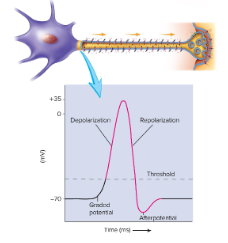
how are action potentials created
depolarization - graded potential reaches to threshold, where 1st voltage-gated channels open → ions (+ve) rush into cell
activation gate of Na+ channel opens
Na+ rushes into cell
some K+ gates open (MUCH MORE SLOWLY) and K+ moves out of the cell (doesn’t change shit)
greater -ve charge on outside and +ve charge on inside for a short time (+35mV)
Na+ inactivation gate closes (K+ channels still open and opening more rapidly out of the cell)
repolarization - membrane potential brought back down to resting conditions
when threshold is passed on the way down, Na+ activation gate closes again, and inactivation gate re-opens
hyperpolarization/after-potential phase - overshoot of trying to bring the membrane potential back to resting conditions
K+ channels stay open longer than they should (membrane potential drops to -90mV)
K+ channels eventually close
Na+/K+ pump can now bring resting potential back to -70mV
resting membrane potential re-established
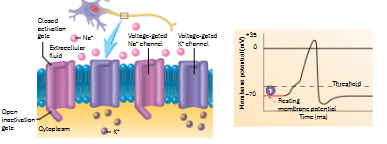
in the trigger zone, there are many _____-gated ion channels
voltage

all-or-none principle
you either get a large enough graded potential (GP) to create an action potential (AP) or you get nothing (no action potential)
once you open the first voltage-gated channel, they will all open (cannot be stopped)

if you want to reach threshold, you need to have a _________ graded potential occurring
depolarizing

action potentials don’t “travel,” they _____ across the axon
spread

the ________ of the action potential (AP) always stays constant
magnitude (ie always going to go from -70mV to +35mV)

sodium voltage-gated channels have _ gates, whereas potassium voltage-gated channels have _ gates
2, 1

in the resting condition, how are the gate(s) of the Na+ and K+ voltage-gated channels behaving?
Na+: inactivation gate open, activation gate closed
K+: gate is closed

activation gate
gate on the extracellular side of the plasma membrane

inactivation gate
gate on the inside of the plasma membrane

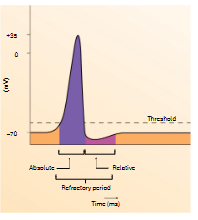
refractory period
after an action potential (AP), the membrane is less sensitive to another stimulus (you lose the ability to stimulate that axon for a period of time)

2 types of refractory periods
absolute
relative

absolute refractory period
even maximum stimulus will NOT begin another action potential (AP) (aka you can’t get an AP no matter what you do)
during depolarizing + repolarizing phase of AP

relative refractory period
CAN get an AP, but need a stimulus that is larger than what we typically need to reach threshold to create an even larger graded potential (GP) to get to threshold
during hyperpolarizing/after-potential phase

stimulus strength is determined by ________ of action potentials; until the max rate is reached
frequency
threshold stimulus
stimulus just strong enough to make a single action potential (AP)

maximal stimulus
strong stimulus that will make the most amount of action potentials (AP)
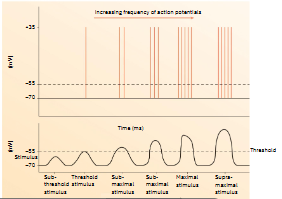
subthreshold stimulus
stimulus that will not produce an action potential (AP)

supramaximal stimulus
stimulus that is stronger than what is needed to make the max amount of action potentials
