SN1 and SN2 Reactions
 Call Kai
 Learn
 Practice Test
 Spaced Repetition
 Match
 Flashcards
 Knowt Play
1/43

There's no tags or description
Looks like no tags are added yet.
44 Terms
water (polar protic / polar aprotic solvent)
protic solvent
CH3OH (polar protic / polar aprotic solvent)
polar protic
CH3CH2OH (polar protic / polar aprotic solvent)
polar protic
Acetone (polar protic / polar aprotic solvent)
polar aprotic solvent
DMF (polar protic / polar aprotic solvent)
polar aprotic solvent
DSMO (polar protic / polar aprotic solvent)
polar aprotic solvent
MeCN (polar protic / polar aprotic solvent)
polar aprotic solvent
anything that’s the conjugate of a strong acid is a rlly good….
leaving group
Polar protic: nucleophilicity ___ down the pt
increases
Polar aprotic: nucleophilicity ___ down the pt
decreases
Bulky groups makes a nucleophile…
poor
The greater the EN, the ___ the nucleophile
worser
Polar protic solvent (SN1 or SN2)
SN1
Polar aprotic solvent (SN1 or SN2)
SN2
3* carbon (SN1 or SN2)
SN1
methyl, 1*, 2* substrate (SN1 or SN2)
SN2
All solvolysis reactions occur in __ steps
3
Tertiary carbons are __ stable than primary and secondary carbons
more
Polar protic: nucleophilicity increases___ across the pt
right to left
Polar aprotic: nucleophilicity increases ___ across the pt
right to left
Leaving group ability increases __ (up/down) the pt
down
Leaving group ability increases __ (left to right / right to left) across the pt
left to right
SN1: the ___ step is the rate determining step
first
Wat does the graph for SN1 look like
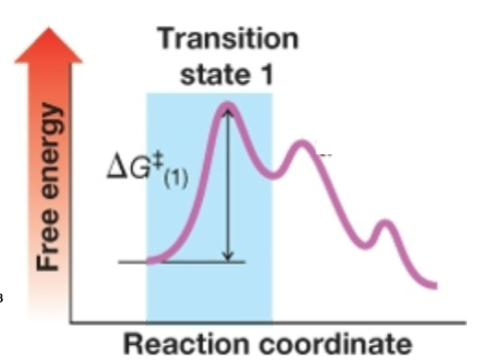
Wat does the graph for SN2 look like
An SN1 reaction w/ a negatively charged nucleophile occurs in how many steos?
2
An SN1 reaction w/ a neutral charged nucleophile occurs in how many steos?
3
SN1 reaction first step:
leaving group comes off
SN1 reaction second step
nucleophile attacks carbocation
SN1 third step (for neutrally charged nucleophiles)
Nucleophile removes hydrogen (acid-base rxn)
SN1 (unimolecular / bimolecular)
unimolecular
SN2 (unimolecular / bimolecular)
bimolecular
For which rxn (SN1 or SN2) do you have to draw attack from front and back side?
SN1 (after step 1, carbon is planar, flat, sp2 — can react from back or front)
In SN1, the rate determing step is.. (endo/exo)
endothermic
more stable product forms… (faster/slower)
faster (ex. SN1 — product w/ tertiary carbon forms faster)
Order of determining SN1 or SN2
Substrate, Nucleophile, Solvent, Leaving group
Weak lewis base (SN1 or SN2)
SN1 (weak = not negatively charged)
Strong lewis base (SN1 or SN2)
SN2 (strong = negatively charged)
Inversion of configuration (SN1 or SN2) - like only once
SN2
When we talk about allylic vs. benzylic we are referring to.. (nucleophile / substrate)
substrate
What does allylic mean
a carbon attached to a c—c double bond

What does benzylic mean
a carbon attached to a benzene ring

Rate rxn for SN1
Rate = k[substrate]
Rate rxn for SN2
Rate = k[substrate][nucleophile]