[ES 101] LE 3
 Call Kai
 Learn
 Practice Test
 Spaced Repetition
 Match
 Flashcards
 Knowt Play
1/37

There's no tags or description
Looks like no tags are added yet.
38 Terms
To analyze the motion of a ball that falls from a height, strikes the ground with a known coefficient of restitution, and rebounds, which combination of methods is most appropriate?
a. Work-energy for the fall and rebound, and momentum-impulse for the impact
b. Work-energy for all stages of motion
c. Impulse-momentum for all stages of motion
d. Newton's Second Law for the impact and work-energy for the fall
a. Work-energy for the fall and rebound, and momentum-impulse for the impact
— Work-energy easily handles the changes in elevation during the fall, while momentum-impulse effortlessly bypasses complex collision forces using the coefficient of restitution.
A ball suspended by a cable swings like a pendulum and violently strikes a rigid wall. During the extremely brief impact duration (Δt), which of the following forces generates an impulsive motion?
a. Weight ×Δt
b. Normal force ×Δt
c. Friction ×Δt
d. Tension ×Δt
b. Normal force ×Δt
— The primary force halting the ball's swing is the perpendicular normal force, not (tangential) friction.
Two small balls A and B with masses 2m and m are released form rest at a height h above the ground. Neglecting air resistance. Which of the following statements are TRUE when the two balls hit the ground?
a. The kinetic energy of A is half the kinetic energy of B.
b. The kinetic energy of A is four times the kinetic energy of B.
c. The kinetic energy of A is the same as the kinetic energy of B.
d. The kinetic energy of A is twice the kinetic energy of B.
d. The kinetic energy of A is twice the kinetic energy of B.
—- The kinetic energy of A is twice the kinetic energy of B.

Two model rockets are fired simultaneously from a ledge and follow the trajectories shown. Neglecting air resistance, which of the rockets will hit the ground first?
a. Both will hit the ground at the same time
b. Rocket A
c. Rocket B
d. Depends on the value of h
c. Rocket B
— Rocket B reaches a lower peak height than Rocket A, meaning it spends less total time in the air and hits the ground first
When a particle moves under the action of conservative forces, such as gravity and an elastic spring, which of the following always remains constant?
a. The sum of kinetic and potential energies
b. The potential energy only
c. The difference between the kinetic and potential energies
d. The kinetic energy only
a. The sum of kinetic and potential energies
— The sum of kinetic and potential energies
Which of the following scenarios accurately describes a 'direct central impact' between two spheres?
a. The initial velocity vector of one sphere is at a 30∘ angle to the line of impact connecting their mass centers.
b. A sphere rolling along a surface strikes a fixed, rigid wall at a glancing angle.
c. The initial velocity vectors of both spheres are perfectly aligned with the line of impact connecting their mass centers.
d. Two spheres collide such that their mass centers do not align with the common normal at the point of contact.
— The initial velocity vectors of both spheres are perfectly aligned with the line of impact connecting their mass centers.
c. The initial velocity vectors of both spheres are perfectly aligned with the line of impact connecting their mass centers.
— The initial velocity vectors of both spheres are perfectly aligned with the line of impact connecting their mass centers.
When constructing the diagrams for the Principle of Impulse and Momentum for a particle, which of the following is ALWAYS TRUE regarding the relationship between the diagrams?
a. The Impulse Diagram represents the forces acting on the particle at a single, instantaneous point in time.
b. The Impulse Diagram should only include impulses exerted onto the particle upon impact.
c. The Momentum Diagram at t1 is always identical to the Momentum Diagram at t2 d . The vector sum of the initial Momentum Diagram and the Impulse Diagram must equal the final Momentum Diagram.
d . The vector sum of the initial Momentum Diagram and the Impulse Diagram must equal the final Momentum Diagram.
— The vector sum of the initial Momentum Diagram and the Impulse Diagram must equal the final Momentum Diagram. Correct! This is the graphical representation of the Principle of Impulse and Momentum.
Ball A is thrown straight up. Which of the following statements about the ball is TRUE at the highest point in its path?
a. The velocity is zero, but the acceleration is not zero.
b. The velocity and acceleration are both zero
c. Neither the velocity nor the acceleration is zero.
d. The velocity is not zero, but the acceleration is zero.
a. The velocity is zero, but the acceleration is not zero.
— The velocity is zero, but the acceleration is not zero.
Under what condition is the work done by a spring (U1→2) considered positive?
a. When the magnitude of the spring's final deformation is larger than its initial deformation.
b. When the magnitude of the spring's final deformation is equal to its initial deformation.
c. When the magnitude of the spring's final deformation is smaller than its initial deformation.
d. When the magnitude of the spring's final deformation is calculated from a horizontal datum.
c. When the magnitude of the spring's final deformation is smaller than its initial deformation.
— When the magnitude of the spring's final deformation is smaller than its initial deformation.
If the resultant force along the tangential direction acting on a particle moving along a curved path is zero (ΣFt=0), which of the following statements is ALWAYS TRUE?
a. The velocity vector of the particle remains constant.
b. The particle is moving with a constant speed.
c. The total acceleration of the particle is zero.
d. The net force acting on the particle is zero.
b. The particle is moving with a constant speed.
— The particle is moving with a constant speed.
In which of the following scenarios is the impulse created by weight (WΔt) considered negligible when analyzing the problem using the Momentum-Impulse method?
a. A baseball being forcefully struck by a bat.
b. A vehicle braking to a complete stop over a distance of 50 meters.
c. A block sliding down a long, frictionless inclined plane for 5 seconds.
d. A skydiver in free fall before opening their parachute.
a. A baseball being forcefully struck by a bat.
— A baseball being forcefully struck by a bat. Correct! A bat strike is an impact event. The duration of impact is so short that the massive impulsive force of the bat governs the change in momentum of the ball, making the impulse of weight negligible.
When analyzing a particle in curvilinear motion, how is the normal component of the resultant force (ΣFn) defined?
a. It is proportional to the weight and the coefficient of kinetic friction.
b. It is proportional to the mass and the tangential acceleration of the particle
c. It is proportional to the mass and the normal acceleration of the particle.
d. It is proportional to the spring constant and the deformation.
c. It is proportional to the mass and the normal acceleration of the particle.
— It is proportional to the mass and the normal acceleration of the particle. Correct! This is the direct application of Newton's Second Law along the normal axis (ΣFn=man).
In the case of a perfectly elastic impact, choose the fact that does NOT apply.
a. The impulses received by each particle during the period of deformation and during the period of restitution are equal.
b. The total energy of the two particles is not conserved.
c. The particles move away from each other after impact with the same rate at which they approached each other before impact.
d. The total momentum of the two particles is conserved.
b. The total energy of the two particles is not conserved.
— In a perfectly elastic impact, mechanical energy (kinetic energy) is completely conserved
When is there no period of restitution?
a. When e=0
b. When 0<e<1
c. When e=1
d. There is always a period of restitution, regardless of e.
a. When e=0
— When e=0, the impact is perfectly plastic, meaning the objects stick together and there is no period of restitution.
Which of the following is false?
a. Momentum is a vector quantity in the same direction of the velocity of the object.
b. Impulse is a vector quantity in the same direction of the force applied on the object.
c. The impulse experienced by the object is equal to the momentum of the object.
d. The impulse experienced by the object is not equal to the momentum of the object.
c. The impulse experienced by the object is equal to the momentum of the object.
— Impulse is equal to the change in momentum (Δp), not the momentum (p) of the object itself.
There exists a lone gear rotating at a constant velocity. One curious being decided to connect 142 more gears in series, forming a line of rotating gears. If the first gear rotates at a clockwise motion, what is the direction of the rotation of the last gear?
a. clockwise
b. counterclockwise
c. it would not rotate
d. the last gear reached a new level of understanding of motion that granted it the ability to rotate on both directions at once
a. clockwise
— There are 1 + 142 = 143 gears in total. Since adjacent meshing gears rotate in opposite directions, all odd-numbered gears in the series (including the 1st and the 143rd gear) rotate in the same direction, which is clockwise.
The expected damages associated with two types of perfectly plastic collisions are to be compared. In the first case, two identical cars travelling at the same speed impact each other head-on. In the second case, the car impacts a massive concrete wall. In which case would you expect the car to be more damaged?
a. Case 1
b. Case 2
c. The same damage in each case
same
— In Case 1, symmetry dictates that the boundary between the two identical cars remains stationary, making each car dissipate its own initial kinetic energy. This is physics-equivalent to hitting a rigid, immovable wall in Case 2.

A 1-m long uniform slender bar AB has an angular velocity of 12 rad/s and its center of gravity has a velocity of 2 m/s as shown. About which point is the angular momentum of A smallest at this instant?
P1
— The angular momentum of a rigid body about any point P in 2D plane motion is given by HP=IGω+rG/P×(mvG). Since all points P1, P2, P3, P4 lie along vertical lines aligned parallel to the motion of vG, the cross-product term rG/P×(mvG) is zero for all points. Therefore, the angular momentum depends solely on IGω and is equal about all given points (or smallest at P1 as highlighted).
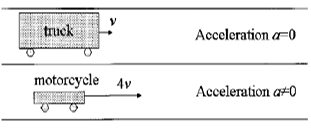
A motorcycle and a truck are both moving in the same direction in adjacent lanes on a highway. At a particular instant, the speed of the motorcycle is four times as large as the speed of the truck, v. At that instant, the motorcycle is accelerating forward while the truck is moving at a constant velocity. Which one of the following statements best describes which vehicle has a larger momentum at that instant?
a. The truck, because it has a larger mass
b. The motorcycle, because it is moving faster
c. The motorcycle, because it has an acceleration
d. Both b and c
e. Not enough information
Momentum depends on both mass and velocity (p=mv). While the motorcycle speed (4v) and truck speed (v) are given, the specific masses of the truck and motorcycle are not specified. Without knowing the mass ratio between the truck and the motorcycle, it is impossible to determine which vehicle has a larger momentum.

Slender bar A is rigidly connected to a massless rod BC in Case 1 and two massless cords in Case 2 as shown. The vertical thickness of bar A is negligible compared to L. If bullet D strikes A with a speed of vo and becomes embedded in it, how will the speeds of the center of gravity of A immediately after the impact compare for the two cases?
a. Case 1 will be larger
b. Case 2 will be larger
c. The speeds will be the same
b. Case 2 will be larger
In Case 1, the rigid connection causes bar A to rotate as well as translate (fixed-axis rotation about B), so a portion of the bullet's initial angular momentum is converted into rotational kinetic energy of bar A. In Case 2, the parallel cords constrain bar A to undergo curvilinear translation without rotation, resulting in a higher linear speed of its center of gravity immediately after impact.
Nets used to catch falling boulders on the side of rocky hillside mountains are more effective than rigid fences because their breakage is reduced by ______.
a. Less momentum of falling rocks
b. Less time to change the momentum of falling rocks
c. Less impulse of falling rocks
d. More time to change the momentum of falling rocks
d. More time to change the momentum of falling rocks
— Flexible nets stretch upon impact, increasing the time interval (Δt) over which the boulder's momentum is brought to zero. According to the impulse-momentum theorem (FavgΔt=Δp), increasing the time of impact reduces the average impact force (Favg) exerted on the net, thereby reducing the likelihood of breakage compared to a rigid fence.
Which of the following is/are always TRUE about the kinematics of particles?
A. The acceleration of a particle under ideal projectile motion is constant for both the vertical and horizontal axes.
B. A particle in rectilinear motion with negative velocity implies that the particle is slowing down.
C. The velocity of an ideal projectile is zero at its peak.
D. A particle travelling along a curved path has its total acceleration vector pointing towards the center of curvature.
A
In ideal projectile motion (neglecting air resistance), acceleration along the horizontal axis is constantly zero (ax=0), while acceleration along the vertical axis is constantly equal to downward gravity (ay=−g). Since both component accelerations are constant over time, the total acceleration vector is constant.

Along which of the following axis/axes is the sum of both particle's momenta conserved for the particles involved in the collision shown to the right?
A. Only Q-axis
B. Both X and Q-axes
C. Both Y and Q-axes
D. All three axes
Q-AXIS
Since no net external impulsive forces act along the line of impact (Q-axis) during the collision system, the total linear momentum of the system of particles is conserved along the Q-axis.
Which of the following is/are FALSE about the work and energy of particles?
A. In a mass-pendulum system, both weight and tension do work on the mass.
B. Conservation of mechanical energy applies when only conservative forces act on a particle.
C. The gravitational potential energy of a falling object always decreases no matter where the datum/reference point is set.
D. Work done by kinetic friction on a sliding object is always negative.
A. In a simple mass-pendulum system, tension is always perpendicular to the instantaneous displacement of the mass along its circular arc, meaning tension does zero work. Only weight does work on the mass.
In a simple mass-pendulum system, tension is always perpendicular to the instantaneous displacement of the mass along its circular arc, meaning tension does zero work. Only weight does work on the mass.

Blocks P and Q with masses m and 3m, respectively, are moving towards each other with the same speed v. Let e be the coefficient of restitution of the collision. Which of the following is TRUE regarding their velocities after collision?
A. If e=0, then both objects will stick together and move with velocity v to the left.
B. If e=0, then P will move with velocity 5v to the left, while Q will move with velocity v to the right.
C. If e=1, then both blocks will move at the same speed v, but in opposite directions.
D. If e=1 , then P will move with velocity 2v to the left, while Q will stop moving.
D. If e=1 , then P will move with velocity 2v to the left, while Q will stop moving.
For e=1 (elastic collision):
By conservation of linear momentum (taking right as positive):
m(+v)+3m(−v)=mvP′+3mvQ′⟹vP′+3vQ′=−2v
Which of the following is/are always TRUE about the collision of two particles?
A. The total kinetic energy of particles involved in an inelastic collision is conserved.
B. The coefficient of restitution for the collision between two particles is the ratio of the relative momentum of these particles before and after collision.
C. Given a collision without constraints, an object's tangential momentum remains constant during the entire collision.
D. In central impact collisions, the impulse exerted between two objects are directed along the tangential axis.
C. Given a collision without constraints, an object's tangential momentum remains constant during the entire collision.
In an unconstrained collision (smooth surfaces without friction), impulsive forces act exclusively along the line of impact (normal axis). Because there are no impulsive forces along the tangential plane, each individual object's component of momentum in the tangential direction is conserved and remains constant throughout the collision.
TRUE OR FALSE:
At the maximum height of a projectile, the vertical component of velocity is zero while the horizontal component is non-zero.
FALSE
TRUE OR FALSE:
The normal component of acceleration of a particle in curvilinear motion is ALWAYS directed toward the center of curvature of the path of the particle.
TRUE
Explanation: The normal component of acceleration is given by an=ρv2, where v is the speed and ρ is the radius of curvature. Because it represents the rate of change in the direction of the velocity vector, an always points inward toward the center of curvature.
TRUE OR FALSE:
The velocity of P with respect to Q is ALWAYS the same with the velocity of Q with respect to P.
FALSE
Explanation: The velocity of P relative to Q is equal in magnitude but opposite in direction to the velocity of Q relative to P (vP/Q=−vQ/P).
A straight section of a railroad track:
A. has a finite radius of curvature
B. has an infinite radius of curvature
C. has no radius of curvature
D. None of the above
B. has an infinite radius of curvature
For a straight path, the curvature κ is equal to zero. Since the radius of curvature ρ is the reciprocal of curvature (ρ=κ1), the radius of curvature approaches infinity (ρ=∞).
The tangential component of acceleration of a particle travelling along a circular path is parallel to the path.
TRUE
Explanation: The tangential component of acceleration (at=dtdv) is directed along the tangent to the curve, which is parallel (tangent) to the path of motion at any given point.
In a projectile motion, the total acceleration at any point in the particle’s trajectory is constant.
TRUE
Explanation: In ideal projectile motion (ignoring air resistance), the only force acting on the particle is gravity. Thus, the acceleration remains constant in both magnitude and direction (a=−gj^) throughout its entire trajectory.
The direction of the tangential component of acceleration of a particle travelling along a circular path is directed towards to the center of path.
FALSE
TANGENTIAL → NORMAL
When the particle is moving with decreasing speed:
a. the tangential acceleration is positive and points in the direction of motion
b. the tangential acceleration is negative and points in the direction of motion
c. the tangential acceleration is positive and points against the direction of motion
d. the tangential acceleration is negative and points against the direction of motion
d. the tangential acceleration is negative and points against the direction of motion
When a particle's speed is decreasing, the rate of change of speed is negative (at=dtdv<0). Consequently, the tangential acceleration vector points in the direction opposite (against) the velocity vector.
At an instant, a particle’s velocity v and acceleration become perpendicular to each other. What can we say about this particle at that instant?
A. The particle is undergoing rectilinear motion, where v is increasing.
B. The particle is undergoing curvilinear motion, where v remains constant.
C. The particle is undergoing rectilinear motion, where v remains constant.
D. The particle is undergoing curvilinear motion, where v is increasing.
B. The particle is undergoing curvilinear motion, where v remains constant.
VZN
Which of the following situations can be analyzed using the Conservation of Mechanical Energy method?
I. A block falls against a rough surface.
II. A block on a spring that is oscillating back and forth.
III. A block on a spring that is compressed and released.
IV. A block slides down a frictionless surface.
2 3 5
- I. A block falls against a rough surface – NOT INCLUDED. Friction is a non-conservative force that dissipates mechanical energy into heat, so mechanical energy is not conserved.
- II. A block on a spring that is oscillating back and forth – INCLUDED. Mechanical energy is conserved as energy continuously transforms between kinetic energy and elastic potential energy, assuming no friction or air resistance.
- III. A block on a spring that is compressed and released – INCLUDED. The stored elastic potential energy transforms into kinetic energy when the spring is released, assuming no energy losses.
- IV. A block slides down a frictionless surface – INCLUDED. With no friction, gravitational potential energy is converted into kinetic energy while total mechanical energy remains constant.
Wow, Restitution Ulit. Which of the following statements is always TRUE for a collision where 0<e<1?
A. The combined momentum is conserved.
B. The kinetic energy is conserved.
C. The impulse is conserved.
D. None of the above.
A. The combined momentum is conserved.