Chapter 3 Paying for Health Service
 Call Kai
 Learn
Learn Practice Test
 Spaced Repetition
 Match
Match Flashcards
 Knowt Play
1/62

There's no tags or description
Looks like no tags are added yet.
Name | Mastery | Learn | Test | Matching | Spaced | Call with Kai | Chat |
|---|
No analytics yet
Send a link to your students to track their progress
63 Terms
What does Public Spending represent?
expenditures by federal, state, and local governments

Payroll taxes
are assessed on the wage or salary paycheck of almost all workers and split between the employer and employee
What are the funds of payroll taxes used for ?
to fund Social Security, Medicare Hospital Insurance, and unemployment insurance

Excise Taxes
collected on the sale of such items as fuel, alcohol, and tobacco
Estate tax
tax on assets transferred to the deceased heirs on items such as cash,real estate, or stock
Before the passage of the ACA what was the traditional method of reimbursement for healthcare services?
fee-for-service
Fee-for-service
provider or hospital is financially rewarded for the volume of services performed- for instance number of laboratory tests, numbers of surgeries, and number of days in the hospital
What did fee for service make providers priortize
quantity than quality which increase
Capitation
defined as a paying the practitioner or hospitals a fixed amount for a specific service
How does capitation pay for their service?
by providing a set fee to cover all the services
How does fee for service pay for service?
pays only for the particular service(s) rendered (itemized) at a given time

Health maintenance organizations (HMOs)
limits consumer choice to health professionals and hospitals that contract with the HMO
Managed care organizations (MCOs)
a healthcare delivery system designed to manage cost, utilization, and quality
Medicaid Advantage Plans
are form of MCO; Medicare pays a fixed dollar amount per enrollee per month to the insurance company offering Medicare Advantage Plans
Hospital Readmission Reduction Program
in which receive lower reimbursement rate for all patients on Medicare if hospital readmission occurs sooner than 30 days after discharge
Bundled payments
one payment for each episode of care (an example of capitation)
What are bundled payments focus
efficiency during & after procedure
Accountable Care Organization (ACOs)
address quality and cost for a population (an example of capitation)
What is the focus ACO ? Leader Primary Care
prevention
True or False: Medicare and Medicaid are government or public health insurance programs that benefit one in three Americans
true
Medicare
a federal health program for people aged 65 years and older, certain disabled people younger than 65, any adult with permanent kidney failure (end-stage renal disease) or amyotrophic lateral sclerosis (ALS, or Lou Gehrig’s disease)
How many states expanded Medicare and what percentage does is cover?
38 states and it covers 80%
In 2019 Medicare provided health insurance for how many people?
61.5 million people—8.5 million permanent disabilites under age 65 and 53 million 65 years of age and older
Department of Health and Human Services (HHS)
responsible for implementing Medicaid
Federal poverty level
measure of income level issued yearly by HHS used to determine eligibility for Medicaid, CHIP, and the cost of premium for health insurance purchased through health exchanges
Medicaid
federal--state cooperative health insurance plan for those who are not eligible for health insurance through an employer and cannot afford to buy health insurance through the Marketplace
What share of Americans did Medicaid over based of 2019 enrollment data?
one in five
Once ACA was establish what groups of people became eligible for Medicaid
U.S citizens or legal immigrants, pregnant women, children, parents of low-income children, seniors, and those with disablities

Which group account for the largest percentage of average monthly Medicaid enrollment?
Children at 43%

Which group had the highest average annual federal spending per Medicare enrollee?
blind and disabled at $13,470

What are the mandatory services required by Medicaid?
inpatient hospital, outpatient hospital, Early and Periodic Screening, Diagnostic, and treatment services (EPSDT), Nursing facilities, Home health, etc
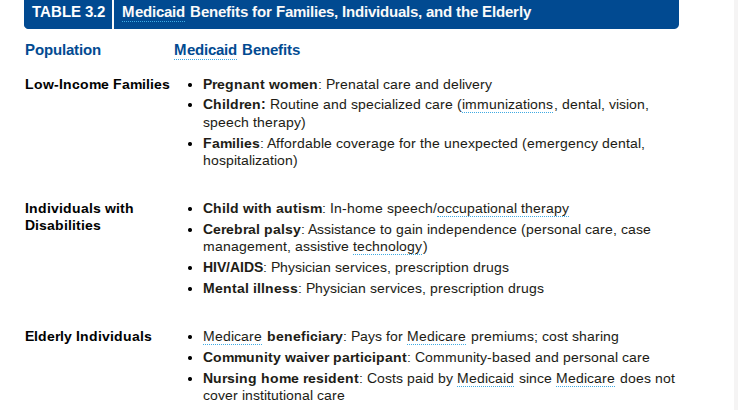
Who get Medicaid benefits?
families, individuals, and the elderly
Which subset of the Medicaid beneficiaries is the majority of money spent on?
physical or mental disabilities
Early and Periodic Screening, Diagnostic and Treatment (EPSDT)
infants, children, and adolescents under age of 21 who are enrolled in Medicaid
What is the function of EPSDT?
to identify and treat physical and developmental condition and mental illness
How can EPSDT address or find children’s health needs?
through yearly physicals
Dual-eligiblies
those enrolled in both Medicare and Medicaid
Who pays first in dual eligibles?
Medicare then Medicaid filling the difference
Copayments
the share of the cost for healthcare service not covered by the hospital a fixed amount
Medicaid waivers
to test new or existing ways to deliver and pay for healthcare services in Medicaid and CHIP
Children’s Health Insurance Program (CHIP)
covers children in families who earn too much to qualify for Medicaid but not enough to afford private insurance
How does CHIP fill in the coverage gap?
fills in the coverage gap by paying for children health expenses from government funding
What support came from the early efforts of government healthcare efforts during the times 1915, 1920, and 1930s?
limited financial support for public health and healthcare services for mother and children
How did the government in 1950s improve healthcare efforts?
improved access for those on public assistance and the needy elderly
Describe the first private hospital insurance plan developed in 1929?
started because of a group of Dallas teachers contracted with Baylor University Hospital to provide 21 days of hospitalization for a fixed payment of $6
Blue Crose
prepaid hospitals plans and allowed subscribers a free choice of physician and hospital
Blue Shield
physician sponsored plans affiliated
What and where were the first managed care insurance programs?
started with HMO — Kaiser Permanente in California and Group Health Cooperative in Washington State
True or False: Medicare policies to slow price increases by doctors and hospitals and to decrease the unnecessary use of hospital services
true
Diagnosis-related group
a set of payment catergories that are used to classify patients for the purpose hospital reimbursement with a fixed fee
How did the 1983 prospective payment bill changed the way Medicare paid hospitals?
Medicare would not pay beyond the set fees for the identified type of illness, no matter how long the patient was hospitalized
Managed care
a system in which employer and health insurers channel patients to the most cost effective sit of care
Health Maintenance organization
a form of prepaid health insurance that only covers care provided by provideders and healthcare facilities inside the HMO network, they give basic and supplemental health maintenance to enrollees who pay a fixed fee
How can people under HMO see a specialist?
through a referral
What happens to someone who tries seeking care outside of HMO?
they would’t receive any benefits
PPO
cover care provided both inside and outside the plan’s provider network
What happens to the copayment when enrollees go outside the network under PPO
consumer pay a higher percentage of the cost
True or False: PPOs are fee for service and HMOs are capitated
True
EPOs
similar to HMOs because they don’t provide benefits outside of network but enrollees can see a specialist without referral
Coinsurance
a percentage of the cover amount for dr office visits, hospitalizations, outpatient surgery and prescription drugs
Deductibles
dollar amount paid out of pocket for healthcare services before health insurance will the cost
Cost-sharing subsidy
reducing monthly premiums because you pay with your employed
LTSS
providing health and personal care support for the disabled, elderly, or other chronic health problems in people’s home