SLEEP, DREAMING, AND CIRCADIAN RHYTHMS

0.0(0)
Studied by 0 people
call kaiCall Kai
learnLearn
examPractice Test
spaced repetitionSpaced Repetition
heart puzzleMatch
flashcardsFlashcards
GameKnowt Play
Card Sorting

1/55

encourage image

There's no tags or description

Looks like no tags are added yet.

Last updated 9:13 PM on 10/15/26
Name
Mastery
Learn
Test
Matching
Spaced
Call with Kai
Chat

No analytics yet

Send a link to your students to track their progress

56 Terms

1
New cards

Sleep

is an active biological state involving organized changes in brain activity, physiology, behavior, and consciousness.

<p>is an <u><mark data-color="blue" style="background-color: blue; color: inherit;">active biological state involving organized changes in brain activity, physiology, behavior, and consciousness.</mark></u></p>
2
New cards

Electroencephalogram (EEG)

- A recording of electrical activity produced by the brain.

- It is used to distinguish the different stages of sleep.

<p>- A <u><mark data-color="#f7f8cf" style="background-color: rgb(247, 248, 207); color: inherit;">recording of electrical activity produced by the brain</mark></u><mark data-color="#f7f8cf" style="background-color: rgb(247, 248, 207); color: inherit;">.</mark> </p><p>- It is used to distinguish the different stages of sleep.</p>
3
New cards

Electrooculogram (EOG)

A recording of eye movements that helps identify rapid eye movements associated with REM sleep.

<p>A <u><mark data-color="red" style="background-color: red; color: inherit;">recording of eye movements that helps identify rapid eye movements</mark></u> associated with REM sleep.</p>
4
New cards

Electromyogram (EMG)

- A recording of muscle activity that helps identify changes in muscle tone during sleep.

- These three measures are the standard psychophysiological measures used to define sleep stages.

<p>- A <strong>recording of muscle activity</strong> that helps <u><mark data-color="blue" style="background-color: blue; color: inherit;">identify changes in muscle tone during sleep.</mark></u></p><p>- These three measures are the standard psychophysiological measures used to define sleep stages.</p>
5
New cards

Alpha Waves

Relatively regular 8-12 Hz EEG waves associated with relaxed wakefulness.

<p>Relatively regular<strong> 8-12 Hz EEG waves </strong>associated with relaxed wakefulness.</p>
6
New cards

Stage 1 Sleep

The initial stage of NREM sleep, characterized by a low-voltage, relatively high-frequency EEG.

<p>The <strong>initial stage of NREM sleep</strong>, characterized by a<u><mark data-color="green" style="background-color: green; color: inherit;"> low-voltage, relatively high-frequency EEG.</mark></u></p>
7
New cards

Stage 2 Sleep

A deeper NREM stage characterized by sleep spindles and K complexes.

<p>A <strong>deeper NREM stage</strong> characterized by <u><mark data-color="green" style="background-color: green; color: inherit;">sleep spindles and K complexes.</mark></u></p>
8
New cards

Stage 3 Sleep

A deeper sleep stage in which delta waves begin to appear.

<p>A <strong>deeper sleep stage</strong> in which <u><mark data-color="#faeee5" style="background-color: rgb(250, 238, 229); color: inherit;">delta waves begin to appear.</mark></u></p>
9
New cards

Stage 4 Sleep

The deepest traditional NREM stage, characterized by a predominance of delta waves.

<p>The <strong>deepest traditional NREM stage</strong>, characterized by a <u><mark data-color="#e5f7f8" style="background-color: rgb(229, 247, 248); color: inherit;">predominance of delta waves.</mark></u></p>
10
New cards

REM Sleep

A sleep state characterized by rapid eye movements, low-amplitude high-frequency EEG activity, and loss of tone in the core muscles.
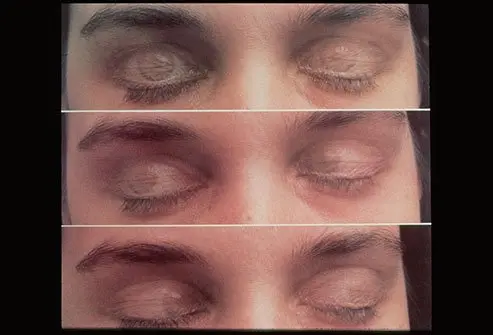
<p>A s<u><mark data-color="#fce9f3" style="background-color: rgb(252, 233, 243); color: inherit;">leep state characterized by rapid eye movements, low-amplitude high-frequency EEG activity</mark></u>, and loss of tone in the core muscles.</p>
11
New cards

NREM Sleep

The collection of sleep stages that are not REM sleep.

<p>The<u><mark data-color="#faecfe" style="background-color: rgb(250, 236, 254); color: inherit;"> collection of sleep stages that are not REM sleep.</mark></u></p>
12
New cards

Slow-Wave Sleep (SWS)

Stages 3 and 4 of traditional sleep staging, characterized primarily by slow delta-wave activity.

<p>Stages 3 and 4 of traditional sleep staging, characterized <u><mark data-color="#fce9f2" style="background-color: rgb(252, 233, 242); color: inherit;">primarily by slow delta-wave activity.</mark></u></p>
13
New cards

Dreams recall

- occurs predominantly after awakening from REM sleep.

- do not necessarily occur instantaneously; research indicates that their duration can correspond reasonably well with real time.

<p>- occurs <u><mark data-color="#e3f6fb" style="background-color: rgb(227, 246, 251); color: inherit;">predominantly after awakening from REM sleep.</mark></u></p><p>- do not necessarily occur instantaneously; research indicates that their <u><mark data-color="#e1f7fb" style="background-color: rgb(225, 247, 251); color: inherit;">duration can correspond reasonably well with real time.</mark></u></p>
14
New cards

REM sleep

is strongly associated with dreaming, but dreaming is not exclusively a REM phenomenon.

15
New cards

Sleep Deprivation

A condition in which an individual obtains substantially less sleep than normally required.

<p>A condition in which an <u><mark data-color="#faebdb" style="background-color: rgb(250, 235, 219); color: inherit;">individual obtains substantially less sleep than normally required.</mark></u></p>
16
New cards

Reduced attention

— difficulty maintaining focused attention.

<p>— <u><mark data-color="yellow" style="background-color: yellow; color: inherit;">difficulty maintaining focused attention.</mark></u></p>
17
New cards

Impaired executive function

— reduced ability to plan, regulate behavior, and make effective decisions.

<p>—<u><mark data-color="#faf0e8" style="background-color: rgb(250, 240, 232); color: inherit;"> reduced ability to plan</mark></u>, regulate behavior, and make effective decisions.</p>
18
New cards

Microsleeps

brief episodes of sleep that may occur while a sleep-deprived person appears to remain awake.

<p><strong>brief episodes of sleep</strong> that may occur <u><mark data-color="#f8fde1" style="background-color: rgb(248, 253, 225); color: inherit;">while a sleep-deprived person appears to remain awake.</mark></u></p>
19
New cards

Reduced cognitive and physical performance

— Deterioration in performance becomes increasingly evident with prolonged deprivation.
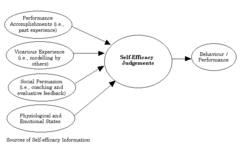
<p>— <u><mark data-color="#fcf5e6" style="background-color: rgb(252, 245, 230); color: inherit;">Deterioration in performance</mark></u> becomes increasingly evident with prolonged deprivation.</p>
20
New cards

REM-Sleep Deprivation

produces a REM rebound, meaning an increased proportion of REM sleep following deprivation.

<p>produces a <strong>REM rebound</strong>,<u><mark data-color="#f4fede" style="background-color: rgb(244, 254, 222); color: inherit;"> meaning an increased proportion of REM sleep following deprivation.</mark></u></p>
21
New cards

Circadian Rhythm

- A biological rhythm that follows an approximately 24-hour cycle.

- Sleep-wake patterns, body temperature, eating, and many other physiological processes display circadian rhythmicity.

<p>- A <u><mark data-color="#faf3e4" style="background-color: rgb(250, 243, 228); color: inherit;">biological rhythm that follows an approximately 24-hour cycle.</mark></u></p><p>- <strong>Sleep-wake patterns, body temperature, eating, </strong>and many other physiological processes display circadian rhythmicity.</p>
22
New cards

Zeitgebers

- Environmental time cues that entrain or synchronize circadian rhythms.

- for mammals is the daily light-dark cycle.

<p>- <u><mark data-color="#efe5f7" style="background-color: rgb(239, 229, 247); color: inherit;">Environmental time cues that entrain or synchronize circadian rhythms.</mark></u></p><p>- for mammals is the daily light-dark cycle.</p>
23
New cards

Free-Running Rhythm

A circadian rhythm that continues in the absence of environmental time cues.

<p>A <u><mark data-color="#f6f6cd" style="background-color: rgb(246, 246, 205); color: inherit;">circadian rhythm that continues in the absence of environmental time cues.</mark></u></p>
24
New cards

Free-Running Period

The duration of a free-running circadian cycle under conditions without zeitgebers.

<p>The<u><mark data-color="#fcfedd" style="background-color: rgb(252, 254, 221); color: inherit;"> duration of a free-running circadian cycle under conditions without zeitgebers.</mark></u></p>
25
New cards

Internal Desynchronization

A condition in which normally coordinated circadian rhythms become separated and follow different timing patterns.

26
New cards

Shift Work

Circadian disruption produced when work schedules require individuals to remain active or sleep at times that conflict with their natural sleep-wake cycle.

<p><strong>Circadian disruption</strong> produced when <u><mark data-color="#e8f9ff" style="background-color: rgb(232, 249, 255); color: inherit;">work schedules require individuals to remain active or sleep at times that conflict with their natural sleep-wake cycle.</mark></u></p>
27
New cards

jet lag

Circadian disruption caused by rapid travel across time zones.

<p>Circadian disruption caused by<u><mark data-color="#dffcf8" style="background-color: rgb(223, 252, 248); color: inherit;"> rapid travel across time zones.</mark></u></p>
28
New cards

Suprachiasmatic Nuclei (SCN)

- Structures located in the medial hypothalamus that function as the major circadian clocks in mammals.

- Damage to the SCN disrupts the normal circadian timing of sleep-wake cycles and other biological rhythms.
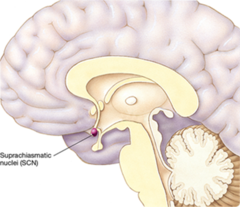
<p>- Structures located in the medial hypothalamus that function as the <u><mark data-color="#e2f8fe" style="background-color: rgb(226, 248, 254); color: inherit;">major circadian clocks in mammals.</mark></u></p><p>- Damage to the SCN disrupts the normal circadian timing of sleep-wake cycles and other biological rhythms.</p>
29
New cards

Retinohypothalamic Tracts

- Neural pathways carrying information about environmental light from the retina to the SCN.

- They provide an important route through which the light-dark cycle synchronizes the circadian clock.

<p>- Neural pathways carrying information about environmental light from the retina to the SCN.</p><p>- They provide an important route through which the light-dark cycle synchronizes the circadian clock.</p>
30
New cards

Melanopsin

A photopigment found in specialized retinal ganglion cells that contributes to the synchronization of circadian rhythms by light.

<p>A photopigment found in specialized retinal ganglion cells that contributes to the synchronization of circadian rhythms by light.</p>
31
New cards

Circadian Genes

Genes involved in the molecular mechanisms responsible for maintaining biological rhythms.

<p>Genes involved in the molecular mechanisms responsible for maintaining biological rhythms.</p>
32
New cards

Tau Gene

A mammalian circadian gene first identified through research on hamsters with unusually short

free-running rhythms.

<p>A mammalian circadian gene first identified through research on hamsters with unusually short</p><p>free-running rhythms.</p>
33
New cards

circadian system

is internally generated but continuously synchronized with environmental cues, particularly light.

<p>is internally generated but continuously synchronized with environmental cues, particularly light.</p>
34
New cards

Hypothalamus

- Several hypothalamic areas participate in sleep-wake regulation.

- Damage to different regions can produce excessive sleepiness or difficulty sleeping.

<p>- Several hypothalamic areas participate in sleep-wake regulation. </p><p>- Damage to different regions can produce excessive sleepiness or difficulty sleeping.</p>
35
New cards

Reticular Formation

A brain-stem system involved in maintaining arousal and wakefulness.

<p>A brain-stem system involved in maintaining arousal and wakefulness.</p>
36
New cards

Reticular Activating System

The ascending neural system associated with cortical activation and alertness.
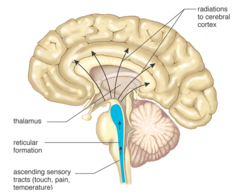
<p>The ascending neural system associated with cortical activation and alertness.</p>
37
New cards

Reticular REM-Sleep Nuclei

Brain-stem nuclei involved in producing the physiological characteristics of REM sleep.

38
New cards

Orexin

- A neuropeptide involved in promoting wakefulness.

- Reduced ____ levels and reduced _____-producing neurons are associated with narcolepsy.

39
New cards

Melatonin

- A hormone synthesized from serotonin in the pineal gland.

- Its secretion follows a circadian pattern and is highest during darkness.

- is considered

particularly relevant in this context because it can shift circadian timing.

<p>- A hormone synthesized from serotonin in the pineal gland. </p><p>- Its secretion follows a circadian pattern and is highest during darkness.</p><p>- is considered</p><p>particularly relevant in this context because it can shift circadian timing.</p>
40
New cards

Chronobiotic

- A substance that adjusts the timing of internal biological rhythms.

41
New cards

Freudian Theory

- Freud proposed that dreams express disguised versions of unacceptable or repressed wishes.

42
New cards

Activation-Synthesis Theories

Hobson's theory proposes that neural activity generated during REM sleep provides largely random signals to the cerebral cortex, which then attempts to synthesize these signals into a meaningful dream experience.

<p>Hobson's theory proposes that neural activity generated during REM sleep provides largely random signals to the cerebral cortex, which then attempts to synthesize these signals into a meaningful dream experience.</p>
43
New cards

Insomnia

Difficulty initiating or maintaining sleep.

<p>Difficulty initiating or maintaining sleep.</p>
44
New cards

Hypersomnia

Excessive sleep or excessive sleepiness.

<p>Excessive sleep or excessive sleepiness.</p>
45
New cards

Sleep Apnea

Repeated interruptions of breathing during sleep that disrupt normal sleep.
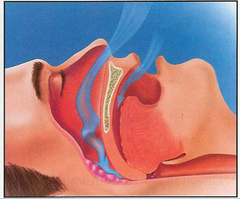
<p>Repeated interruptions of breathing during sleep that disrupt normal sleep.</p>
46
New cards

Narcolepsy

A disorder characterized particularly by sudden daytime sleep attacks and abnormal regulation of

REM-related phenomena.

<p>A disorder characterized particularly by sudden daytime sleep attacks and abnormal regulation of</p><p>REM-related phenomena.</p>
47
New cards

Cataplexy

A sudden loss of muscle tone during wakefulness, often triggered by emotional experiences.

<p>A sudden loss of muscle tone during wakefulness, often triggered by emotional experiences.</p>
48
New cards

Sleep Paralysis

Temporary inability to move when falling asleep or awakening.
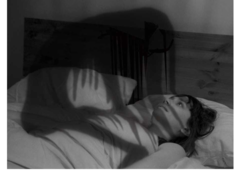
<p>Temporary inability to move when falling asleep or awakening.</p>
49
New cards

Hypnagogic Hallucinations

Dreamlike experiences that occur during wakefulness, particularly around the transition into sleep.
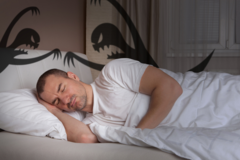
<p>Dreamlike experiences that occur during wakefulness, particularly around the transition into sleep.</p>
50
New cards

Hypnotic Drugs

- Drugs used to promote sleep.

- They may be useful for short-term sleep difficulties but can produce problems when used chronically.

51
New cards

Benzodiazepines

- Hypnotic drugs that can reduce sleep latency and increase total sleep time in the short term, but

chronic use can produce tolerance, dependence, altered sleep patterns, and next-day drowsiness.

<p>- Hypnotic drugs that can reduce sleep latency and increase total sleep time in the short term, but</p><p>chronic use can produce tolerance, dependence, altered sleep patterns, and next-day drowsiness.</p>
52
New cards

Antihypnotic Drugs

Drugs that promote wakefulness, often by increasing catecholaminergic activity.

<p>Drugs that promote wakefulness, often by increasing catecholaminergic activity.</p>
53
New cards

Melatonin Treatment

Exogenous melatonin has a modest sleep-promoting effect according to the chapter, but its more

established role is in adjusting circadian timing.

<p>Exogenous melatonin has a modest sleep-promoting effect according to the chapter, but its more</p><p>established role is in adjusting circadian timing.</p>
54
New cards

Monophasic Sleep Cycle

A sleep pattern in which sleep occurs primarily in one consolidated period each day.

55
New cards

Polyphasic Sleep Cycle

A sleep pattern in which daily sleep is divided into multiple periods.

56
New cards

Sleep Inertia

Temporary impairment in alertness and performance immediately after awakening.

<p>Temporary impairment in alertness and performance immediately after awakening.</p>



