PSY100 Lecture 4 Flashcards
 Call Kai
 Learn
Learn Practice Test
 Spaced Repetition
 Match
Match Flashcards
 Knowt Play
1/34

There's no tags or description
Looks like no tags are added yet.
Name | Mastery | Learn | Test | Matching | Spaced | Call with Kai | Chat |
|---|
No analytics yet
Send a link to your students to track their progress
35 Terms
Spatial vs. Temporal Resolution
Spatial: Measures precise location of brain activity (e.g. it happened in the amygdala)
Temporal: Measures exact timing of that brain activity
Electroencephalogram (EEG) (and Advantages + Disadvantages)
Brain cap measuring electrical voltage changes over time
Advantages: EXCELLENT Temporal Resolution for fast events like sleep
Disadvantages: POOR Spatial Resolution since it cannot pin down exact small brain structures
Positron Emission Tomography (PET) (and Advantages + Disadvantages)
Using a Synthetic Radiotracer like FLUORODEOXYGLUCOSE (FDG) to measure metabolic activity
Advantages: Shows exactly where a chemical or metabolic issue is located in the brain structure
Disadvantages: DECENT Spatial Resolution, better than EEG but worse than MRI; POOR Temporal Resolution due to 20-30 minute tracer accumulation lag
MRI vs. fMRI (and Advantages and Disadvantages)
MRI: Scan showing grey vs white matter
fMRI (Functional MRI): Scan tracking BOLD signal (Blood Oxygen-Level Dependent); tracks changes in blood oxygen and flow
Advantages: GREAT Spatial Resolution; best out of EEG and PET for studying brain activity
Disadvantages: Decent Temporal Resolution; couple seconds lag between activity and signal but still better than PET
Weaknesses of Lesion Studies
Lesions (like damaged brains) are rarely neat, cannot prove direct experiment causality, and can create too limited theories about what a brain region does
Sensation vs. Perception
Sensation: Receiving, collecting, and amplifying info from environment (BOTTOM-UP; 5 senses taking raw info from environment)
Perception: Interpreting/Organizing this info so we can understand + react to it (TOP-DOWN AND BOTTOM UP); Top-Down is brain using past experiences to make sense of the information
General Structure of a Sensory Pathway
Sensory Organ → Receptive Cells → Peripheral Nerve → Thalamus Relay (Thalamus routes all 5 senses EXCEPT SMELL/OLFACTION from body to cerebral cortex for conscious awareness) → Specific Cortical Areas
Cortical Area for Each Sense
Visual: Occipital
Hearing: Temporal
Touch: Parietal
Taste: Insula
Smell: Piriform
Structure of Vision Pathway
Eye → Photoreceptors → Optic Nerve → Thalamus → VISUAL/OCCIPITAL CORTEX (Image processor; takes signals from eyes and turns it into images you can see)
Rods vs. Cones
Rods: Photoreceptors packed in PERIPHERY for dim light and night vision
Cones: Photoreceptors packed in FOVEA/CENTRE for bright light and fine detail
Trichromatic Color Theory
Young-Helmholtz Theory; every perceived colour is created by blending RED, GREEN, and BLUE cone signals together
Opponent-Process Color Theory
Young-Helmholtz Theory; colour vision relies on three competing channels: red vs. green, blue vs. yellow, and black vs. white, where fatiguing the neurons for one colour causes brain to temporarily see its opposite as an afterimage
Types of Perceptual Visual Adjustments
Color Constancy - Adjusting object colour based on background lighting like the dress illusion
Spectral Sensitivity - Shift where yellow looks brightest in daylight while blue shifts in darkness
Contrast Enhancement - Process that detects brightness or colour transitions and increases contrast immediately around them
Blindsight
Phenomenon where people who are blind can respond to visual stimuli without consciously seeing them (because part of their brain is still processing visual information without them knowing it)
Auditory Pathway
Eardrum → Ossicles (malleus, incus, stapes; 3 smallest bones in human body) → Cochlea fluid → Hair Cells (receptors) → Vestibulocochlear Nerve → Thalamus →Temporal Cortex
Vestibular System
Fluid-filled canals in inner ear beside cochlea that process our perception of balance
Proprioception vs. Nociception
Proprioception: Body's unconscious ability to sense its own position, movement, and force in space without needing to look
Nociception: Nervous system's process of detecting harmful or potentially harmful stimuli (e.g. as intense heat); DIFFERENT from pain, since Nociception is just the biological alarm system
Taste Pathway
Taste buds → Bipolar cells (receptor) → Cranial nerves → Brainstem structures → Thalamus → Insula Cortex
Taste Map vs. Supertaster Bud Theory
Taste Map: FALSE theory that says certain parts of tongue are responsible for certain tastes (like bitter, sour, salty)
Supertaster Bud: People experiences flavours with different intensity depending on amount of taste buds they have
Olfactory/Smell Pathway
Starts with olfactory receptors in OLFACTORY EPITHELIUM (turns odours into electrical signals for brain); Bipolar cells (receptors)→ Glomerulus (hub that collects and sorts those signals before sending them deeper into brain) → Olfactory nerve → Piriform Cortex → Orbitofrontal Cortex
Sensory Interactions
McGurk Effect: Visual illusion showing that mismatched lip movements can trick brain into hearing a completely different sound ("ba" + "ga" = "da")
Synesthesia: When one sense triggers another (like tasting colours)
Absolute Threshold
Lowest stimulus intensity at which we can detected the stimulus correctly more than 50% of time
Subliminal Stimulus
Any sensory signal (e.g. image, sound, or word) presented below your threshold of conscious awareness, meaning it is too faint or shown too quickly for you to consciously notice, yet your brain still processes it (e.g. a single frame in movie flashing “BUY POPCORN”)
Signal Detection Theory Matrix
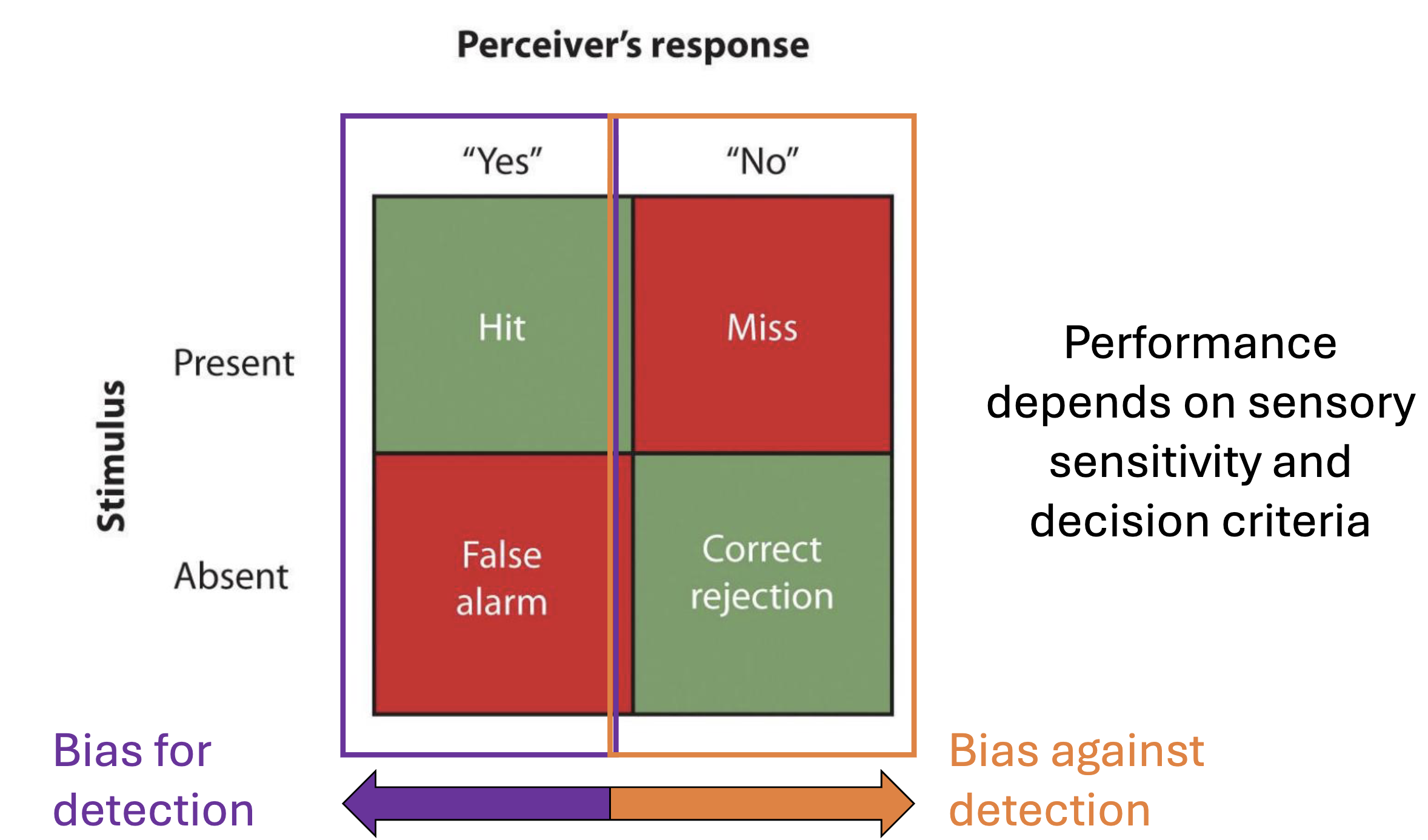
2x2 framework for detection performance; Hit (present + "yes"), Miss (present + "no"), False Alarm (absent + "yes"), Correct Rejection (absent + "no")
Response Bias
Your tendency to lean toward guessing "Yes" or "No" based on what you stand to gain or lose; Bias TOWARD detection (e.g. $10 reward per frog found) creates maximum hits, but high false alarms, Bias AGAINST detection (e.g. $10 penalty per wrong guess) creates maximum correct rejections, but high misses
Just Noticeable Difference (JND) and Weber's Law
JND: KNOWN AS DIFFERENCE THRESHOLD; Minimum change in a stimulus that a person can detect >50% of the time
Weber's Law: States that JND is PROPORTIONAL to background intensity (harder to notice 5kg added to 50kg than 5kg added to 1kg due to ratio of each; 10% vs. 500%)
Conscious vs. Unconscious
Conscious: Automatic Behaviours and Implicit Memory
Unconscious: Controlled Behaviours and Explicit Memory
Theories of Why We Sleep
Brain maintenance (clearing toxic waste), Memory consolidation (process that changes short-term memories into long-term), Emotional regulation, Energy conservation, and Dreaming
Sleep Stages and How To Distinguish
NREM1 & NREM2 (Light Sleep): Theta waves (4-7 Hz)
NREM3 (Deep Sleep): Delta waves (slowest, <4 Hz)
REM Sleep: Fast, awake-like waves (resembling Beta waves, >13 Hz)
Chronotypes
Preferences/variations in sleep-wake cycle
Theories of Why We Dream
Dream Protection: Freud's theory; Dreams act like a guardians, turning annoying noises or thoughts into harmless stories so you stay asleep)
Evolutionary: Dreams aren't random, but are survival tool to help humans survive and pass on their genes; like a “SURVIVAL SIMULATION”)
Activation-Synthesis: Dreams are your brain's attempt to make stories from random electrical signals produced during sleep
Neurocognitive: Dreaming is just your normal everyday brain thinking out loud while you sleep.
Overfitted Brain Hypothesis: Dreams create weird, random scenarios so your brain doesn't get locked into strict daily routines and stays adaptable (your mind might dream about driving a flying boat through a jungle so it stays adaptable when real life throws something weird at you if you spend all day in real life driving the same route to work)
Hypnosis and Factors Correlated
Induced trance-like state where about 20% are highly responsive; Eagerness/Expectation, Openness, and Focus make you more sensitive to hypnosis
Hypnosis Theories
Dissociative: Hypnosis causes a split in consciousness, where one part of consciousness follows the hypnotist while another part independently observes
Socio-Cognitive: Hypnosis is NOT a split of consciousness; instead, people are simply acting how they believe a hypnotized person should act (so like placebo effect)
Integrative: Combines both views, arguing that hypnosis involves genuine cognitive state changes (dissociation) AND role-playing working together simultaneously
Near-Death Experiences (NDEs)
Characteristics: Transformative, calming experiences during impending death evaluated on Greyson NDE (Near-Death Experience) scale
Causes: Impending death or can be chemically mimicked by ketamine, DMT, or hypoxia (oxygen deprivation)
Consequences: Transformative; changes in how you view the world after the Near-Death Experience
What Disorders Meditation Can Treat
Stress, anxiety, depression, and chronic pain