bio lecture 5: natural selectoin + adaptations
 Call Kai
 Learn
Learn Practice Test
 Spaced Repetition
 Match
Match Flashcards
 Knowt Play
1/15

There's no tags or description
Looks like no tags are added yet.
Name | Mastery | Learn | Test | Matching | Spaced | Call with Kai | Chat |
|---|
No analytics yet
Send a link to your students to track their progress
16 Terms
what is fitness how is it scaled
reproductive success. how well an org does compared to another
scaled from 0-1 (most fit = 1)
what is frequency dependent selection (positive and negative)
positive: the more common a genotype is, the more fit it becomes. selection rapidly drives the most common trait to become the only one left (fixation)
ex: where it happens: evolution of signaling traits/communication (flower colors to attract pollinators, bright colors on butterflies)
If a butterfly has a common pattern, predators recognize it and leave it alone.
If a butterfly has a rare pattern, predators don't recognize it yet and are more likely to attack it.
Negative: fitness declines as the genotype becomes more common. helps to maintain genetic diversity.
When a specific flower color becomes too common, pollinators learn to avoid it.
pollinators then switch to visiting the rarer color morph that they haven't learned to avoid yet, giving the rare morph higher reproductive success.
discrete vs. continuous traits
Discrete (Polymorphisms/mendelian traits): Controlled by single/few genes (e.g., human eye/hair color or ant queen social structures). distinct categories of traits. no in betweens
Continuous: Polygenic traits influenced by environment (e.g., human height or milk yield in livestock). a wide range of values. controlled by many genes.
what is a selective advantage
the amount by which individuals are better adapted to their environment b/c of their genotype
what is an agent of selection
any external factor that influences the fitness of individuals with a specific trait
Could be abiotic, biotic (predators), and anthropogenic (human-caused)
what are the 3 types of natural selection on alleles
Natural selection on alleles:
Positive (directional) selection
In a population the allele is spread through across generations until it's the only one
This is called "fixation on the adaptive allele"
Negative (purifying) selection
Neutral: selection to maintain variation (balancing)
what is a polygenic trait
trait controlled by multiple genes

what kind of natural selection is this
selection for continuous traits
what are the 3 types of selection for quantitative traits. does it inc or dec variation. give an example
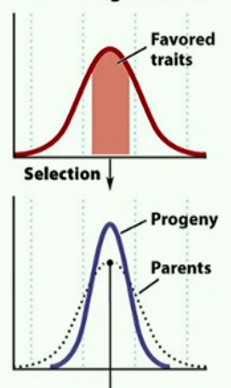
stabilizing selection
intermediate traits favored
decreases variation
ex: human birth weight
disruptive selection
favors both extremes, creates bimodal populations
increases variation
ex: either very big and small seeds with no medium sized seeds so the birds with big/small beaks are more fit
directional selection
favors one extreme
change in the mean of variation
ex: darwin’s finches beak size when drought happened and the finches with big beaks survived b/c big seeds
what kind of selection is this
stabilizing selection

what kind of selection is this
directional selection

what kind of selection is this
disruptive selection
what are the 3 ways to study adaptation by natural selection
Look for an external force in nature (an agent of selection) and see how the organism responds to it
Look for correlations across multiple different populations
Look for correlations in environment and traits across time (ex. Darwin's finches)
Apply genetic tools
Test for distinctive patterns in genes targeted by selection (at the nucleotide level)
dN/dS ratio
Conduct experiments in field and in lab (hardest to do but most powerful)
why is there a struggle to determine agents of selection
Lacking concrete documentation of the relationship between an agent of selection and the selection in nature
Ex: super easy to go study rabbits for a couple generations and conclude that bigger body size is favors, but HARD to determine the REASON for this selection
Recognize that evolution is happening but what is the cause?
Hard to play god and change factors in environmental selective pressures.
what are strategies to combat the struggle to determine agents of selection
correlation-based or genetics-based experiments in nature used to represent an agent of selection (like human pollution and see if pops adapt to it)
correlation-based:
evolution of pepper moth color (light to dark)
heavy metal tolerance in plants near mines
genetics-based:
evolution of vision in stickleback fish
Fish have SWS2 allele that affects vision
If there is a mutation, they can see better
When clear water fish come into the black lake, the allele should increase in frequency
Nearby the locus for SWS2, decrease diversity. Further away from locus, is more normal
what are hitchhiker alleles
when a good allele increases in frequency due to natural selection, and nearby alleles that are physically linked to it get carried along and also increase in frequency