Intro to Psych Exam 4
 Call Kai
 Learn
 Practice Test
 Spaced Repetition
 Match
 Flashcards
 Knowt Play
1/109

There's no tags or description
Looks like no tags are added yet.
110 Terms
emotion
feeling (also called affect) that can involve physiological arousal, conscious experience, and behavioral expression
physiological arousal
autonomic nervous system
sympathetic nervous system
parasympathetic nervous system
sympathetic nervous system (physiological arousal)
arouses
parasympathetic nervous system (physiological arousal)
calms
Theories of emotion
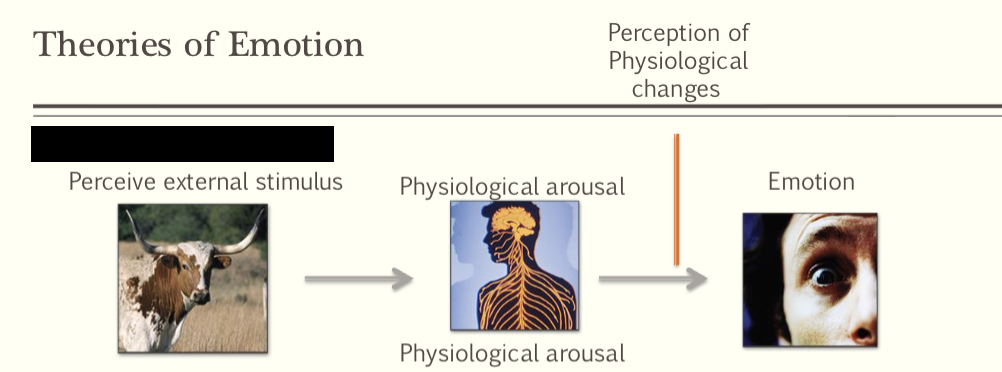
James-Lange Theory
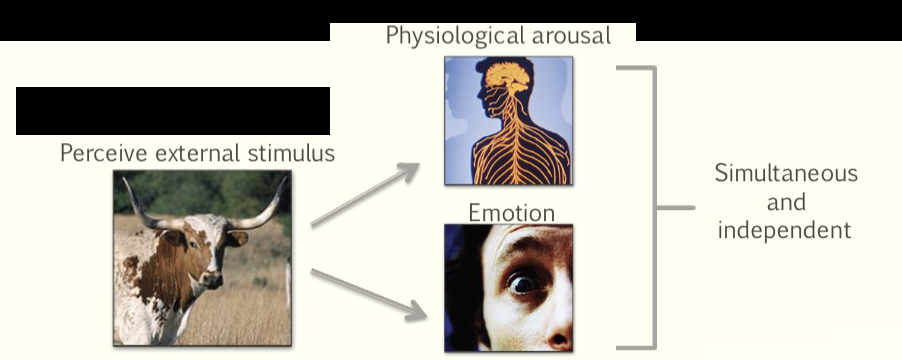
Cannon-Bard Theory
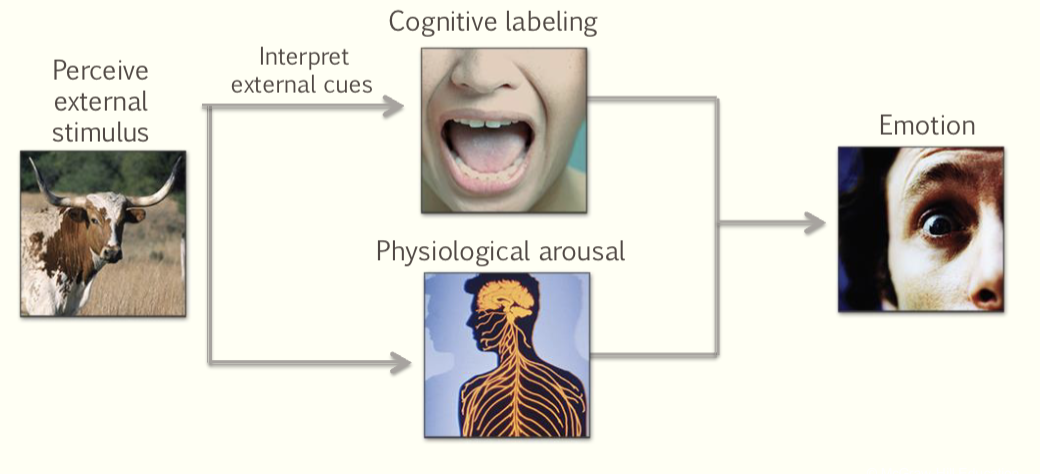
Two-factor theory of emotion (Schachter/Singer)
James-Lange Theory
1 type of emotion for 1 reaction
aware of arousal → emotion because of aware
Cannon-Bard Theory
many emotions quickly
Two-factor theory of emotion (Schachter/Singer) [Cognitive Factors]
why experiences change
Emotions-Behavioral Factors
Verbal expression
nonverbal expression
facial feedback hypothesis
Nonverbal expression (emotions-behavioral factors)
posture, gestures, actions, facial expressions
Facial feedback hypothesis (emotions-behavioral factors)
facial expressions influence AND express emotions
supports James-Lange theory
not a lot of support
feel and express
Sociocultural Factors
Strong biological component
blind children
Expression of emotions are similar across cultures
Ekman-New Guinea- similar expressions, yet had no to little contact with the outside world
Display rules determine when/how it is ok to express a given emotion
thumbs up is an insult in Greece
Classifying emotions
Valence
Arousal level
approach vs avoid
Valence (classifying emotions)
does it feel pleasant or not
positive or negative affect
arousal level (classifying emotions)
degree to which the emotion is reflected in an individual being active/engaged versus passive/calm
can be high or low
Approach vs avoid (classifying emotions)
anger is approach
fear is avoid
Why do we even have emotions
Negative emotions help us take immediate actions
▪ Scared of that snake, run awayBroaden and Build theory of positive emotion
▪ Broaden-see the whole picture
▪ Build-learn skills, build community for when there is troubleResilience
Resilience
have optimistic and excited outlook
better able to cope with negative life events
use positive emotions to combat negative feelings
Pursuit of Happiness
biological factors
obstacles
happiness activities and goal striving
Biological factors
well being (50-80% heritable)
set point-base level of happiness
Obstacles
hedonic treadmill (pleasure short-lived, happiness is fleeting)
direct pursuit of happiness can backfire
Happiness activities and goal striving
Altruism, physical activity, positive self-reflection (gratitude journal)
Personally meaningful goal investment
personality
a pattern of enduring, distinctive thoughts, emotions, and behaviors that characterize the way an individual adapts to the world
Evolutionary Theory
The need to pass your genes to the next generation
Drive-Reduction Theory
An aroused stage where we are motivated to remove our arousal
Goal is to return to neutral
Optimal Arousal Theory
There is an ideal middle ground for optimal performance that’s between being overenergized and completely tired
Yerkes-Dodson Law
Optimal performance is best under moderate levels of arousal
Intrinsic Motivation
The desire to perform for yourself
May lead to more positive outcomes and more overall growth
Extrinsic Motivation
The desire to perform for someone/something else
Self Regulation
Get feedback, from either yourself or another
Set moderately difficult goals – Not too easy, but not too hard
Can set smaller goals ahead of larger ones
Gratification Delay
Don’t allow instant rewards
Impulsivity
Doing things too quickly
Procrastination
Doing things too late
Psychodynamic Perspectives
Theoretical view emphasizing that personality is primarily unconscious.
Understanding personality involves exploring the symbolic meanings of behavior and the unconscious mind
Early childhood experiences sculpt the individual’s personality
Personality Structure
Id
Ego
Superego
Id
instincts and reservoir of psychic energy
pleasure principle
Ego
deals with the demands of reality
reality principle
Superego
moral branch of personality: “conscience”
Defense mechanisms
Conflict between the id, ego, and superego results in anxiety.
Defense Mechanisms
reduce anxiety by unconsciously distorting reality
not necessarily unhealthy
Repression
push unacceptable impulses out of awareness
foundation for all defense mechanisms
Repression (defense mechanisms)
forget the unacceptable
Rationalization (defense mechanisms)
claim different motive
displacement (defense mechanisms)
shift feelings to new object
Sublimation (defense mechanisms)
transform vile to valuable
projection (defense mechanisms)
attribute own faults to others
Reaction formation (defense mechanisms)
convert to opposite emotion
Denial (defense mechanisms)
disbelieve present reality
regression (defense mechanisms)
revert to earlier, “safer” period
Psychosexual stages (Freud)
Oral stage (0-18 months)
anal stage (18-36 months)
phallic stage (3-6 years)
latency stage (6 years- puberty)
genital stage (adolescence and adulthood)
fixation (remain locked in particular developmental stage)
believed that women/girls have penis envy
also implies that only men have a moral code developed through puberty
Criticisms of Freud’s Psychosexual stages
Sexuality
not pervasive force behind personality
Early Experience
not as powerful as Freud thought
Importance of Conscious thought
Sociocultural Influences
Horney’s Sociocultural Approach (Dissenters and Revisionists of Freud’s psychosexual stages)
both sexes envy the attributes of the other
need for security, not sex, is primary motivator
Jung’s Analytical Theory (Dissenters and Revisionists of Freud’s psychosexual stages)
collective unconscious and archetypes
Adler’s Individual Psychology (Dissenters and Revisionists of Freud’s psychosexual stages)
perfection, not pleasure, is key motivator
Evaluating Psychodynamic Theory
Criticisms
too much emphasis on earlyexperiences
too much faith in unconscious mind’s control
too much emphasis on sexual instincts
theory can not be tested
Contributions
importance of childhood experiences
development proceeds in stages
role of unconscious processes
Humanistic Perspectives
emphasis on a person’s capacity for personal growth and positive human qualities
Abraham Maslow
Carl Rogers
Abraham Maslow (Humanistic Perspectives)
Maslow’s Hierarchy of Needs
self-actualization
peak experiences
biased since the focus was on highly successful individuals
Carl Rogers (Humanistic Perspectives)
personal growth and self-determination
unconditional positive regard
conditions of worth
self-concept
empathy
genuineness
Evaluating Humanistic Perspectives
Contributions
self-perception is key to personality
consider the positive aspects of human nature
emphasize conscious experience
Criticisms
too optimistic about human nature
promotes self-love and narcissism
Trait Perspectives
Trait
an enduring disposition that leads to characteristic responses
traits are the building blocks of personality
Trait Theories
people can be described by their typical behavior
strong versus weak tendencies
Gordon Allport
personality understood through traits
behavior consistent across situations
lexical approach → 4500 traits
W. T. Norman
five factor model
broad traits – main dimensions of personality
Openness (Five Factor Model of Personality)

Conscientiousness (Five Factor Model of Personality)
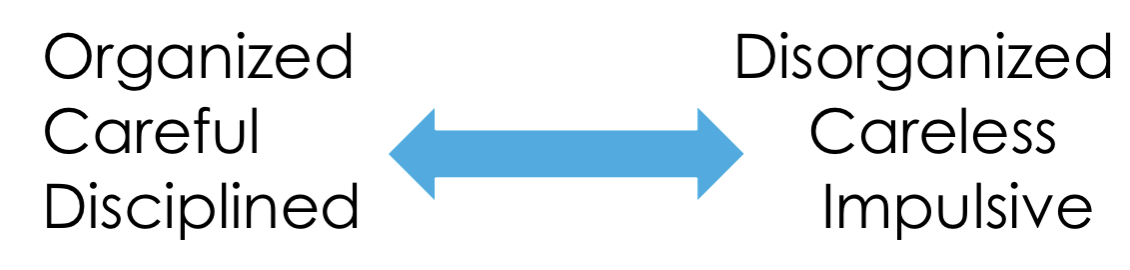
Extraversion (Five Factor Model of Personality)

Agreeableness (Five Factor Model of Personality)

Neuroticism / Stability (Five Factor Model of Personality)

Evaluating Trait Perspectives
Contributions
traits influence health, cognitions, career success, and interpersonal relations
Criticisms
ignores the role of the situation in behavior
ignores nuances of an individual’s personality
Social Cognitive Perspectives
Emphasis is on conscious awareness, beliefs, expectations, and goals.
Incorporates principles from behaviorism when exploring:
Reasoning
Beliefs
self reflection
interpretation of situation
Albert Bandura
reciprocal determinism
behavior, environment, and cognitive
factors interact to create personality
Key Processes and Variables
observational learning
Locus of control
Internal v external
self-efficacy
Reciprocal Determinism

Social Cognitive Perspectives
Walter Mischel
Situationalism
behavior and personality vary considerably across context
CAPS Model of Personality
stability over time rather than across situations
interconnections among cognitions and emotions affect our behavior
Evaluating Social Cognitive Theory
Contributions
focuses on interactions of individuals with their environments
suggests people can control their environment
Criticisms
too concerned with change and the situation
ignores the role of biology
very specific predictions hinder generalization
Biological Perspectives
Personality and the Brain
brain damage alters personality
brain responses correlate with personality
Predispositions in sensitivity to arousal, differences in inhibition, and activity of neurotransmitters
Biological Perspectives
Behavioral Genetics
twin studies reveal substantial genetic influence on Big Five traits
most traits influenced by multiple genes
Evaluating the Biological Perspective
ties personality to animal learning, brain imaging, and evolutionary theory
criticisms (e.g., biology may be the effect, not the cause, of personality)
Personality – Stability vs Change
Traits are stable by definition yet positive traits increase across adulthood (social maturity).
Personality Assessment
Self-Report Tests
Neuroticism Extraversion Openness Personality Inventory-Revised
assesses the big five factors and 6 subdimensions
Myers Briggs Type Indicator
Projective Tests
Thematic Apperception Test (TAT) or Picture Story Exercise (PSE)
Self-Report Tests (Personality Assessment)
beware social desirability
empirically-keyed tests used to get around social desirability problem
test takers do not know what is being measured
test items not related to purpose of test
MMPI is an example
Minnesota Multiphasic Personality Inventory
567 items
controls for social desirability
assesses mental health and used to make hiring decisions and to determine criminal risk
Myers Briggs Type Indicator (Personality Assessment)
four dimensions used to make personnel decisions:
extraversion-introversion
sensing-intuiting
thinking-feeling
judgment-perception
not empirically supported
Barnum effect
Projective Tests (Personality Assessment)
psychodynamic approach
project own meaning on ambiguous stimuli
Rorschach Inkblot Test
personality score based on description of inkblots
questionable reliability and validity
Thematic Apperception Test (TAT) or Picture Story Exercise (PSE) [Personality Assessment]
series of ambiguous pictures viewed one at a time
elicited stories reveal an individual’s personality
Other Personality Assessment Methods
Direct Behavioral Observation
Cognitive Assessment of Attention and Memory
Peer Ratings
Psychophysiological Measures (e.g., polygraph)
Brain Imaging
Abnormal behavior is:
deviant (atypical)
maladaptive (dysfunctional)
personally distressing (despair)
Danger to self/other
Theoretical Approaches to abnormal psychology
biological approach
psychological approach
sociocultural approach
biopsychosocial model
Biological Approach
Medical Model
disorders with biological origins
Psychological Approach
experiences, thoughts, emotions, personality, behavior
Sociocultural Approach
social context…important for deviance
Biopsychosocial Model
interaction of biological, psychological and
sociocultural factorsDiathesis stress model
DSM-V Classification System
Advantages
provides a common basis for communication
helps clinicians make predictions
naming the disorder can provide comfort
Disadvantages
stigma (shame, negative reputation)
medical terminology implies internal cause
focus on weaknesses, ignores strengths
Anxiety Disorders
uncontrollable fears that are disproportionate and disruptive
generalized anxiety disorder
panic disorder
specific phobia
social anxiety disorder
Generalized Anxiety Disorder
Diagnosis and Symptoms
persistent anxiety for at least 6 months
inability to specify reasons for the anxiety
Etiology
biological factors
genetic predisposition, GABA deficiency, Respiration
psychological and sociocultural factors
harsh self-standards, critical parents, negative thoughts, trauma
Panic Disorder
Diagnosis and Symptoms
recurrent, sudden onsets of intense terror that often occur without warning
Etiology
biological factors: genetic predisposition
psychological factors: conditioning to CO2. High concentration = fear
sociocultural factors: gender differences
Specific Phobia
Diagnosis and Symptoms
an irrational, overwhelming, persistent fear of a particular object or situation
Etiology
psychological factors: learned
biological factors: genetic disposition
Social Anxiety Disorder
Diagnosis and Symptoms
intense fear of being humiliated or embarrassed in social situations
Etiology
biological factors:
genetic disposition
neural circuitry
Serotonin
psychological factors:
over-protective / rejecting parenting
social experiences
Anxiety-Related Disorders
Anxiety-related, but not classified in DSM-5 as anxiety disorders:
obsessive-compulsive disorder
post-traumatic stress disorder
Obsessive-Compulsive Disorder
Diagnosis and Symptoms
persistent anxiety-provoking thoughts and/or urges to perform repetitive, ritualistic behaviors to prevent or produce a situation
Etiology
biological factors:
genetic predisposition
Neurotransmitters
psychological factors: avoidance learning
Post-Traumatic Stress Disorder
Diagnosis and Symptoms
Symptoms develop as a result of exposure to a
traumatic event, oppressive situation, natural or
unnatural disastersflashbacks
avoidance of emotional experiences
anxiety, excessive arousal
difficulties with memory and concentration
impulsive outbursts
Mood-Related Disorders
disturbance of mood that affects entire emotional state
Symptoms may include
cognitive, behavioral, or physical symptoms
interpersonal difficulties
Types
major depressive disorder
Mood-related but not DSM-5 mood disorder:
bipolar disorder
Major Depressive Disorder (MDD)
Diagnosis and Symptoms
significant depressive episode that lasts for at least two weeks
daily functioning is impaired
symptoms may include
fatigue, sense of worthlessness, reduced interest
appetite & sleep disturbance
Major Depressive Disorder (MDD)
Etiology
biological factors:
genetic disposition
underactive prefrontal cortex
regulation of neurotransmitters
psychological factors:
learned helplessness
ruminating on negative, self-defeating thoughts
pessimistic attribution
sociocultural factors
poverty
gender differences
Bipolar Disorder
Bipolar I and Bipolar II
Characterized by extreme mood swings that include mania
Overexcited, unrealistic optimism, euphoric, sleep little
Frequency and separation of episodes
usually separated by 6 months to a year
Etiology
strong genetic component
swings in metabolic activity in cerebral cortex
levels of neurotransmitters
Dissociative Disorders
sudden loss of memory or change in identity
Dissociation
◦ protection from extreme stress or shock
◦ problems integrating emotional memoriesTypes
◦ dissociative amnesia
◦ dissociative identity disorder (DID)Dissociative Amnesia
individuals experience extreme memory loss caused by extensive psychological stress
Dissociative Identity Disorder
Diagnosis and Symptoms
the same individual possesses two or more distinct personalities
each personality has unique memories, behaviors, and relationships
only one personality is dominant at a time
Etiology
extraordinarily severe abuse in early childhood
social contagion
mostly women
runs in families
Schizophrenia-Spectrum
highly disordered thought
split from reality (psychotic)
typically diagnosed in early adulthood
high suicide risk
Psychosis-perceptions and thoughts removed from reality
Symptoms of Schizophrenia
Positive Symptoms
hallucinations and delusions
thought disorders
disorders of movement
Negative Symptoms
flat affect
Cognitive Symptoms
attention difficulties and memory problems
impaired ability to interpret information and make decisions
Etiology of Schizophrenia
Biological Factors
genetic predisposition
structural brain abnormalities/deterioration
Enlarged ventricles
regulation of neurotransmitters: dopamine & glutamate
Psychological Factors
vulnerability-stress hypothesis
Sociocultural Factors
influence how disorder progresses