WEEK 11: Compensation: Employee benefits/recognition programmers
 Call Kai
 Learn
 Practice Test
 Spaced Repetition
 Match
 Flashcards
 Knowt Play
1/20

Earn XP
Description and Tags
Chapter 16 = Benefits → What benefits employees receive and how benefits plans are designed. Chapter 17 = Retention & Engagement → How organizations keep employees and improve commitment. Chapter 18 = Recognition → How organizations recognize and reward contributions and behaviours.
21 Terms
Employee Benefits
Employee benefits are non-cash rewards that they receive in addition to their salary. The purpose is to support employees’ health, financial security, and personal well-being while fulfilling legal and market mandates.
Strategic Rationale & Perspectives
· Statutory Mandates (law legislation): Labor legislation globally establishes baseline protection for medical care, disability, time off, unemployment, retirement, and survivor benefits.
· Employer Perspective: Benefits increase employee engagement at a lower net cost than direct cash wages due to tax advantages and bulk-purchasing power.
· Employee Perspective: Benefits provide a safety net for personal and family health, income protection, and long-term wealth accumulation.
· Global vs. Local Policy: Because statutory rules and tax regulations vary widely by country, organizations typically manage benefits via localized policies rather than rigid global plans.
Major categories of benefits

Statutory Benefits (Required by Law):
Workers' Compensation: Provides medical care, short-term/long-term disability, survivor benefits, and rehabilitation for work-related injuries or occupational diseases.
Social Security: Funded via employer and employee taxes to partially replace lost income due to retirement, disability, or death.
Unemployment Compensation: Funded by employer taxes to provide temporary income protection (typically 6 to 18 months) during job transitions.
Medical Benefits Continuation & Leave: Requires health coverage continuation for laid-off staff (up to 3 years) or up to 12 weeks of paid/unpaid family and medical leave.
Medical & Health Benefits:
Healthcare: Covers doctor visits, hospitalization, surgery, prescription drugs, X-rays, and laboratory fees, often expanding to mental health and Employee Assistance Programs (EAPs).
Short-Term Disability (STD): Pays a percentage of income for up to 6 months for medical conditions extending beyond standard sick leave.
Long-Term Disability (LTD): Insures 40% to 60% of base salary for individuals unable to work past STD, paying out from 2 years up to lifetime.
Dental & Vision Insurance: Dental covers preventive and curative care (excluding cosmetic procedures); vision covers eye exams, lenses, and frames.
Delivery Modalities: Health coverage is delivered via National Health Systems, Health Maintenance Organizations (HMOs), Preferred Provider Organizations (PPOs), Point-of-Service plans (POSs), or group Health Insurance policies.
Retirement Schemes & Singapore Central Provident Fund (CPF):
Defined Benefit (DB) Plans: Pays a pre-determined pension based on seniority and average earnings over the employee's final 3 to 5 years (typically 30%–80% of final salary); noted as uncommon in Singapore.
Defined Contribution (DC) Plans: Savings plans where employers and employees contribute fixed monthly percentages (typically 6%–10% of pay); final payouts depend on investment returns.
Cash Balance Plans: A hybrid model structured as a defined benefit plan that functions like a DC account, where employer deposits grow at a set interest rate.
Central Provident Fund (CPF - Singapore): Mandatory retirement savings scheme for Citizens and Permanent Residents (PRs) split across four accounts:
Central Provident Fund (CPF - Singapore): Mandatory retirement savings scheme for Citizens and Permanent Residents (PRs) split across four accounts:
Ordinary Account (OA): Housing, education, and approved investments.
Special Account (SA): Old age and retirement financial products.
Retirement Account (RA): Created at age 55 to meet basic old-age needs.
Medisave Account (MA): Hospitalization and approved medical insurance.
Contribution Rates: Employee rates scale down from 20% to 5%, and employer rates scale down from 17% to 7.5% as employee age increases.
Life Insurance & Other Perquisites:
Life Insurance: Group term policies valued at 12 to 36 months of base pay, 100% employer-paid, with employee-paid add-on options up to 10 years of cover and double indemnity for accidental death.
Time Off & Perquisites: Paid Time Off (PTO), child care, elder care, domestic partner benefits, financial advice, legal insurance, company cars/drivers, housing allowances, and gym memberships.
Contingent/Gig Workers: Receive lower benefit costs, generally limited to basic health and life coverage under third-party vendor contracts.
Planning, Design, & Administration: Core Administration Decisions
Who should be covered? (Active full-time staff, dependents, retirees, probation periods, laid-off workers).
What choices to offer? (Standard baseline vs. Flexible/Cafeteria plans vs. Core-plus-option models, private exchanges).
How to fund? (Non-Contributory = 100% employer; Contributory = shared cost; Employee-Financed = 100% employee).
How should benefits be administered?
Legal & Tax Compliance: Ensuring adherence to national tax deductible limits and statutory mandates.
Three Operational Tasks:
Executing Employee Communication (via updated intranet Employee Benefit Handbooks and individualized Benefit Statements), Claims Processing, and Cost Control (vendor bidding and regional brokers).
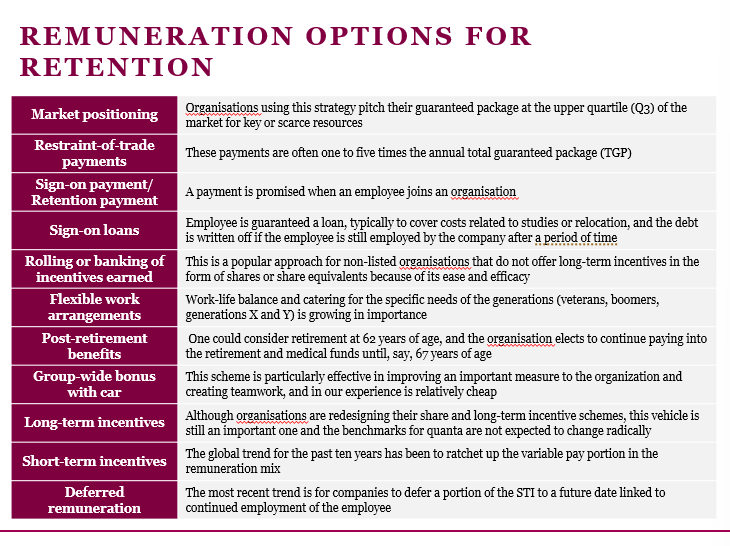
Renumeration options for retention
Definition of retain:
“to hold or keep in possession” and “to engage the services of”. Organisations need to shift their thinking and focus on what they need to do to help these employees become fully engaged in the organisation.
What engage employees?
Engagement needs to be built into the corporate culture. What engages employees is the feeling that they are making a difference in the work that they care about, that they are working with people who share their mission and values, and that their organisation respects them.
Engaged employees feel that:
Shaffer’s 4 Dimensions
Their work contributes to business goals (line of sight)
They can influence outcomes (involvement)
They have the information needed to make decisions
Their contributions are rewarded and recognised

Organisations often pay extra attention to employees with:
Critical skills: essential for business operations. Managed via higher base pay positioning (e.g., 85th percentile) within standard pay scales without separate allowances.
Scarce skills: limited supply in the labour market. Market supply-and-demand shortages. Kept at normal grade midpoints, supplemented by a separate market premium/allowance (5%, 7.5%, or 10% of scale midpoint) so fixed base scales are not distorted once market supply normalizes.
High-fliers: consistently high performers with exceptional competence. Consistently top-performing talent whose pay progresses rapidly toward the upper guide or maximum of the pay range.
Incentives VS Recognition
Incentives
Reward achievement of pre-set targets
Usually financial
Formula-driven and announced in advance
Recognition
Rewards positive contributions and behaviours
Often non-financial
Focuses on psychological value and appreciation
Accenture's 5 Pillars of Engagement
(1) Recognize & Reward Superior Performance, (2) Establish a Learning Environment, (3) Create Knowledge-Sharing Communities, (4) Manage the Culture of Change, (5) Provide Opportunities to Grow & Develop
Four Core Design Characteristics for recognition plan:
Participants - who is eligible (is it individual, team-based or both).
Criteria - what performance or behaviours are recognized.
Nomination and selection process - how winners are chosen (peer nominations, manager recommendations).
Awards - what rewards are given.
Symbols or utilities (certificates, trophies, gifts, merchandise)
Points that can be accumulated and redeemed for rewards later.
Lottery Scheme
A group-wide recognition programme based on achieving one key organizational goal ("strike factor"), such as:
Airline: on-time departures and arrivals
Manufacturing: safety performance
Food chain: reduction in shrinkage
Insurance: sales volume
Lottery scheme: Eligibility, reward structure, purpose
Eligibility
All employees can participate unless they are undergoing disciplinary action.
Reward Structure
If the organization achieves the target, all eligible employees receive a small cash bonus (e.g., $500).
If the goal is achieved for six consecutive months and employees meet attendance requirements, they receive a lottery ticket for a draw with a major prize.
Purpose
Encourages teamwork because everyone works toward the same organizational goal.
Relatively low-cost way to improve an important business outcome.
Highlights
Virtual Scorecards: Balances recognition between spotlight roles (sales) and back-office support roles (customer service account retention)[55].
Seven Celebration Principles: Recognition must be personal, public, timely, specific, sincere, culturally aligned, and peer-inclusive[56].
Monetary vs. Non-Monetary Trade-offs: Cash recognition is desirable but quickly spent without lasting memory value; non-monetary recognition (praising, Hall of Fame, executive dinners, time off) builds deep emotional commitment at minimal cost [248–251].