test 1
 Call Kai
 Learn
Learn Practice Test
 Spaced Repetition
 Match
Match Flashcards
 Knowt Play
1/35

There's no tags or description
Looks like no tags are added yet.
Name | Mastery | Learn | Test | Matching | Spaced | Call with Kai | Chat |
|---|
No analytics yet
Send a link to your students to track their progress
36 Terms
entropy
measure of disorder of a system J mol-1 K-1
entropy increase
with t
solid → liquid → (greater) gas
perfect crystals at 0 K = 0
big increase on state changes
total entropy change

entropy change of the system
+ve → increase in entropy - favourable
-ve → decrease in entropy

entropy change of the surroundings

feasibility of a reaction
possibility that reaction will occur spontaneously
feasibility depends on
balance between S [system] and S [surroundings]
t (higher t decrease magnitude of S [surroundings], so its contribution to S [total] is less)
reaction is thermodynamically feasibility if
S [total] is + ve
exo or endo more favourable
exo
why S [system] -ve
moles decrease
decrease in disorder
why high Ea
bonding/electrostatic attraction is strong
or
large amount of energy needed to break bonds in …
ionisation
1 mole of gaseous atoms loses e-
1st and 2nd endo
electron affinity
1 mole of gaseous atoms gains e-
1st - exo, 2nd - endo
enthalpy of atomisation
1 mole of gaseous atoms produced
from element in standard state
endo
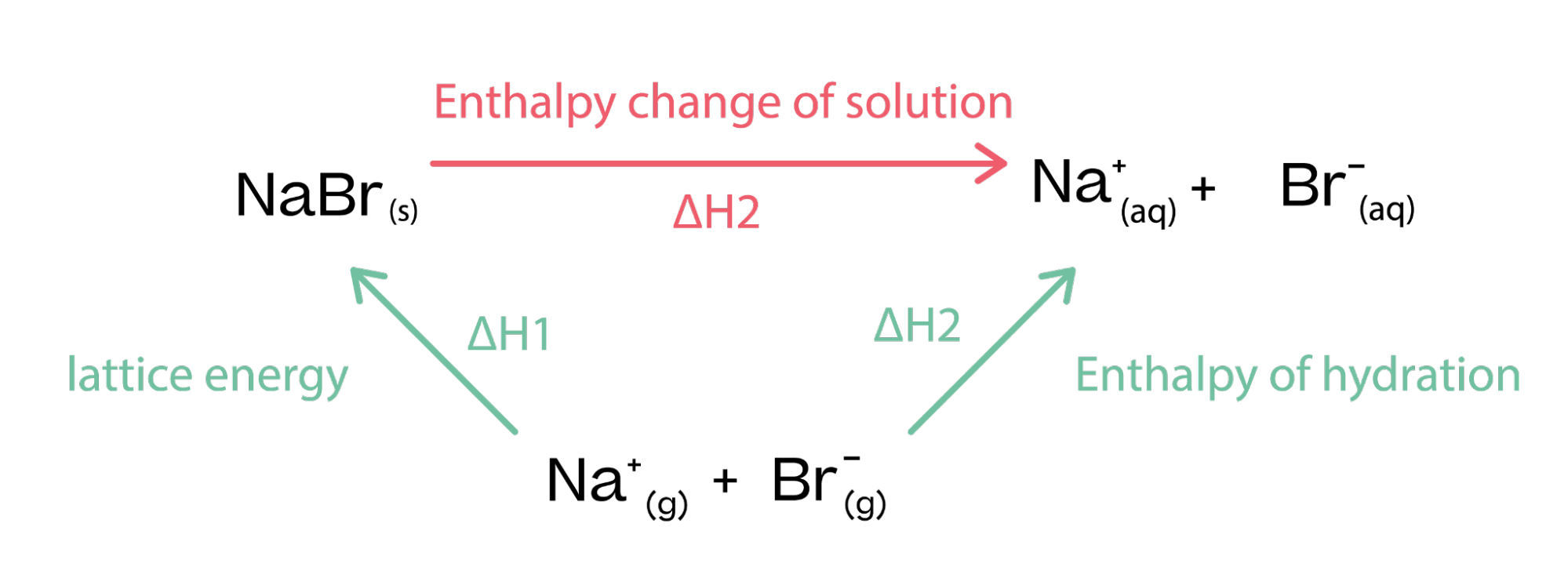
hydration enthalpy
1 mole of gaseous ions is hydrated (dissolved)
…(g) + aq → …(aq)
exo
enthalpy of solution
1 mole of an ionic solid dissolves so that ions are separated
…(s) + aq → …(aq) + …(aq)
bond dissociation enthalpy
1 mole of covalent bonds is broken
in gaseous state
…2 (g) → 2…(g)
endo
lattice enthalpy of formation
1 mole of ionic solid is formed
from ions in gaseous state
…(g) + …(g) → …(s)
exo
lattice enthalpy of dissociation
1 mole of ionic solid is broken up
into ions in gaseous state
…(s) → …(g) + …(g)
endo
enthalpy of vaporisation
1 mole of liquid turned into gas
exo
enthalpy of fusion
1 mole of solid turned into liquid
endo
Born-Haber cycle
formation ↓
atomisation ↑
ionisation (1st, 2nd) ↑
e- affinity (1st, 2nd) ↑
lattice enthalpy of formation ↓
does the sign of S [system] make sense
disorder increases/decreases
as no. of molecules/moles increases/decreases
advantages and disadvantages of using t higher than … in Haber process
rate of reaction is higher
more … produced in given time
at higher t S [surr] is less +ve (decreases)
S [total] more -ve
Kp decreases
eq position moves further right/left
effect of charge and size of ion on lattice energy
(compound) more exo
(ion) larger than (ion)
charges on ions are the same
(ion) forms stronger attractions

is atm or Pa bigger
atm
rate determining step
all reactants from rate equation have to be in this step or made in steps before
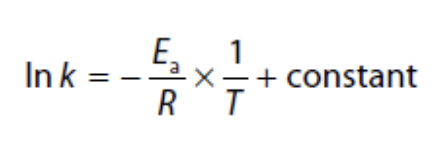
why k for the reaction is higher at higher t
more particles have E > Ea
rate is higher
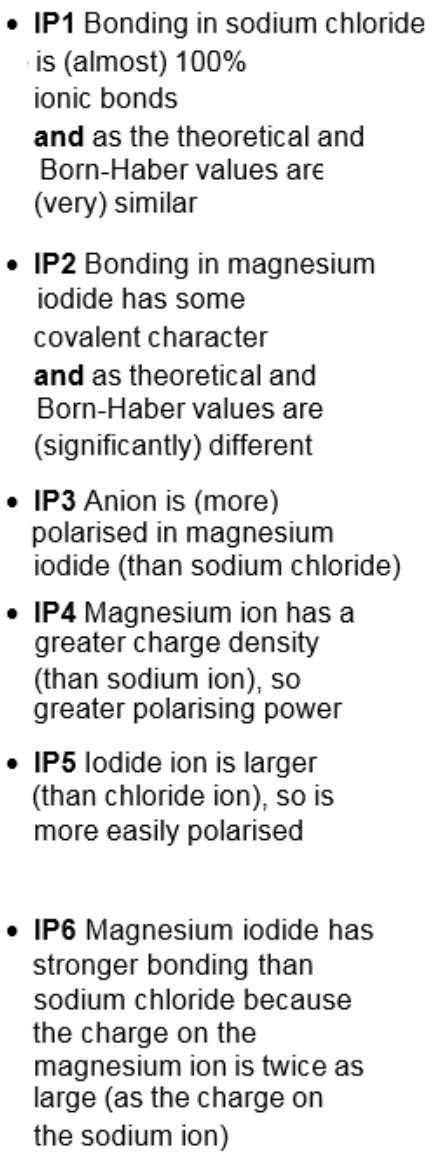
ionic compound w most covalent character
caton - high charge and small radius
anon - large radius
why experimental value of lattice energy more exo than theoretical

why … only slightly soluble
S [sys] is large and positive
S [total] is positive
S [total] = Ssurr + Ssys
how to find equilibrium constant using S [total]

e affinity of Cl VS I
Cl
more exothermic
as Cl ion is smaller
stronger attraction/ more electronegative
when you have 2 constants

expression for K
