Oral path 3 FINAL
 Call Kai
 Learn
Learn Practice Test
 Spaced Repetition
 Match
Match Flashcards
 Knowt Play
1/237

There's no tags or description
Looks like no tags are added yet.
Name | Mastery | Learn | Test | Matching | Spaced | Call with Kai | Chat |
|---|
No analytics yet
Send a link to your students to track their progress
238 Terms
salivary duct cyst, salivary gland tumor (canalicular or pleomorphic adenoma) , nasolabial cyst
lesions more commonly found on the UPPER LIP
mucocele, SCC, mucoepidermoid carcinoma (salivary gland tumor)
lesions more commonly found on the LOWER lip
canalicular adenoma
MONOMORPHIC adenoma of UPPER lip found in individuals over 60 y/o
pleomorphic adenoma
MIXED tumor of UPPER lip found more common in individuals under 40
nasolabial cyst
swelling of upper lip ALWAYS LATERAL to MIDLINE
canalicular adenoma/monomorphic adenoma
asymptomatic UPPER LIP lesion almost exclusively in minor salivary glands, MIDLINE or LATERAL

salivary gland tumor and nasolabial cyst
if there is a swelling on the LATERAL side of the UPPER lip what is on your DDx
true
T/F if there is a swelling on the MIDLINE of the UPPER lip NASIOLABIAL cyst can be excluded in DDx
surgical excision
Treatment for nasolabial cyst or salivary gland tumor <2cm
incisional biopsy before excision
Treatment for nasolabial cyst or salivary gland tumor >2cm
pleoomorphic adenoma
MOST COMMON BENIGN salivary gland tumor
mucocele
LOWER lip lesion in CHILDREN due to TRAUMA
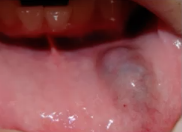
fibroma
LOWER lip lesion due to REACTIVE process with smooth pink surface
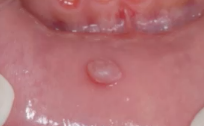
pyogenic granuloma
LOWER lip lesion in YOUNG individualls, that is normally MOST COMMONLY FOUND ON GINGIVA

salivary duct cyst has epithelial lining
MICROSCOPIC difference between salivary duct cyst and mucocele
mucocele more common in KIDS and due to trauma
CLINICAL difference between salivary duct cyst and mucocele
lower (mucoepidermoid carcinoma)
MALIGNANT salivary gland tumor are more commonly found on the _____ lip
caliber persisent artery (CPA)
linear PULSITLE elevation on labial mucosa most common of UPPER lip

none
managment of CALIBER perrsistent artery
SCC
LOWER lip lesion due to chronic sun exposure

incisional biopsy followed by surgical excision
treatment for SCC of the lip
lip
do SCC of lip or oral cavity have BETTER PROGNOSIS?
pyogenic granuloma can occur on the lip
which of the following statments is TRUE

lipoma (mesenchymal tumor)
yellowish swelling on BUCCAL mucosa

traumatic neuroma
reactive mesenchymal tumor in buccal mucosa due to trauma
pleomorphic adenoma
most common salivary gland tumor
mucoepidermoid carcinoma
most common malignant salivary gland tumor
pleomorphic adenoma is a benign salvivary gland neoplasm
which of the following statement is CORRECT?

fibroma, abscess (parulis), pyogenic granuloma (PG), peripheral ossifying fibroma (POF), peripheral giant cell granuloma (PGCG)
most common GINGIVAL lesions
periapical abscess/parrulis
ACTIVE infection, presents with PAIN on PERCUSSION
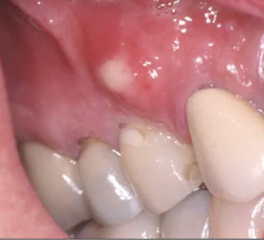
sinus tract (fistula)
connection between abcess on gingiva and infected tooth
inflammatory fibrous hyperplasia (epulis fisuratum)
reactive (hyperplastic) folds of tissue associatd with ILL-FITTING DENTURE
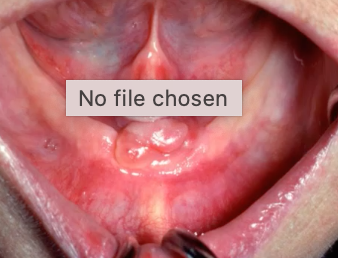
surgical excision and remake denture
treatment for inflammatory fibrous hyperplasia (epulis fisuratum)
peripheral giant cell granuloma (PGCG)
lesion EXCLUSIVELY on GINGIVA, might show CUPPING RESORPTION of underlying bone

peripheral ossifying fibroma
reactive lesions EXCLUSIVELY on GINGIVA, HIGH RECURRRENCE rate

pyogenic granuloma/pregnancy tumor
reactive lesion that most commonly occurs on GINGIVA but can occur on other sites

epulis granulomatosis
pyogenic granuloma in extraction socket
gingival cyst of adults
painless blue swelling in mandibular canine and premolar regions of ADULTS

gingiva
most common SOFT tissue location of METASTATIC DISEASE
lung, breast, colon, renal, prostate
most common metastatic disease orgins
peripheral ossifying granuloma occurs on the buccal mucosa
all the following are true EXCEPT:

ranula/mucocele, sialolith, salivary duct cyst, SCC
most common swellings on FLOOR of mouth
ranula
SUBLINGUAL gland lesion LATERAL to midline, increases in size during meals

sublingual
which gland is RANULA associated with
salivary duct cyst
epithelial lined cavity in ADULTS, more commonly found on UPPER LIP but can occur in FOM
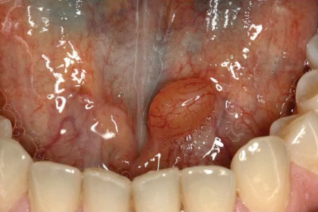
sialolith
radiopaque calcified structure most common found associated with SUBMANDIBULAR GLAND

surgical removal including minor salivary gland
treatment for MUCOCELE
dermoid cyst/ teratoma
FOM swelling usually in the MIDLINE
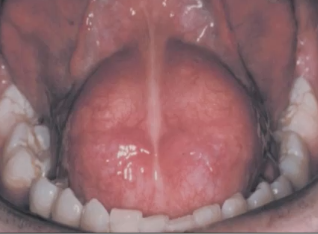
lateral border is a low risk site for SCC
which of the following is FALSE

pleomorphic adenoma, mucoepidermoid carcinoma, adenocystic carcinoma
salivary gland neoplasms that can occur on the PALATE
adenoid cystic carcinoma
MALIGNANT salivary gland lesion that commonly occur on palate, can cause PAIN
kaposi sarcoma
malignant neoplasm of ENDOTHELIAL cells assoiciates with AIDS/HHV-8

non-hodkin lymphoma
BOGGY swelling caused by lymphocyte malignancy

nasopalatine duct cyst
MOST COMMON NON-NEOPLASTIC swelling on PALATE
nasopalatine duct cyst
heart shaped lesion in midline of anterior maxilla
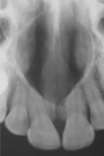
cyst of incisive papilla
occurs ony on soft tissue, between max incisors

abcess
pt presents with pain on percussion, biting or palpitaion
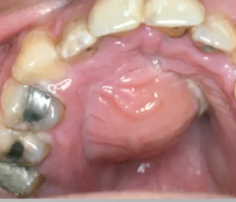
torus palatinus
exophytic growth of normal compact bone on hard palate

none (unless inference w/ denture)
treatment for torus palatinus
necrotizing sialometaplasia
locally destructive inflammatorry condition of salivary gland that can mimic malignancy
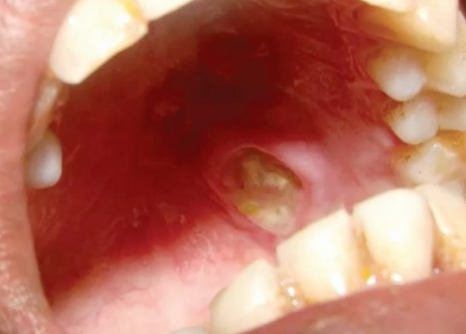
nasopalatal duct cyst
a heart shaped radiolucency between #8 and #9 is most likely:
dental abscess
which of the following PALATAL lesions would most likely be seen on a dental clinical practice?

neurofibromas
benign neural neoplasm of skin, can be associated with NF1

neurofibromatosis type 1/ von recklinghausen disease of skin
what do you want to rule out with neurofibromas?
neuroma
benign neural neoplasm associated with MULTIPLE NEUROENDOCRINE NEOPLASIA types 2B (MEN2B)
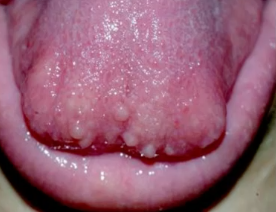
peripheral giant cell granuloma
all the following can present as multiple lesiosn EXCEPT:

squamous papilloma and condyloma acuminatum
lesions associates with HPV 6 and 11
squamous papilloma
most COMMON oral HPV lesion

verruca vulgaris
HPV 2 lesion in CHILDREN thats contagious

condyloma acuminatum
HPV 6 and 11 lesion with sessile base and multiple papules, most commonly on LABIAL MUCOSA
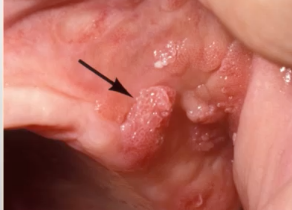
multifocal epithelial hyperplasia
HPV 13 and 32 lesion in CHILDREN and INDIGENOUS papulations

none (spontaneous resolution)
treatmemt for multifocal epithelial hyperplasia
verruxiform xanthoma (VX)
painless papillary/pebbly lesion in ADULTS of unkown cause

inflammatory papillary hyperplasia (IPH)
benign reactive lesion often caused by illfitting dentures, CANDIDA
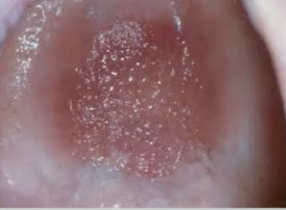
giant cell fibroma
pedunculated or sessile nodule in YOUNGER age group
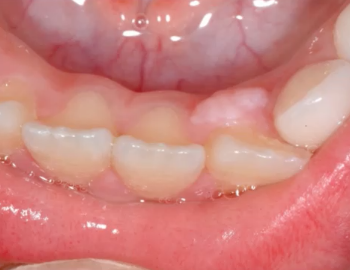
verrucous carcinoma
low grade oral SCC, can be caused by smokeless tobacco or PVL

squamous papilloma
HPV lesion most commonly seen in dental practice
phenytoin (dilantin), leukemia, perio, scurvy
causes for generalized gingival hyperplasia
cyclosporine, Ca channel blockers (nifedipine, verapamil), birth control, dilantin (phynytoin)
medications that can cause gingival hyperplasia
thyroid gland enlargment (hyperthyroidism), thyroglossal duct cyst, dermoid cyst, plunging ranula
DDx for MIDLINE neck masses
cat scratch disease, infectious mono, TB, malignacy, lipoma, brachial cleft cyst
DDx for LATERAL neck masses
thyroglossal duct cyst
mass moves up and down when swallowing

hyperthyroidism
swelling in neck, more common in FEMALES

plunging ranula
mucin filled mass that disects mylohyoid muscle

medication
treatment for hyperthyroidism
malignancy
firm, immobile lymph nodes indicate:
metastatic disease
which of the following neck lesions typically occurs in the lateral side of the neck

nifedipine
which of the following is a BP medication that can cause GINGIVAL HYPERPLASIA

squamous cell carcinoma
54 year old male, slowly enlarging, painless submucosal mass on right upper lip, present for past 3 years. which is LEAST likely to be in DDx:

gingival cyst
27 year old, pregnant woman w/ 2cm erythematous nodule on facial gingiva betweeen #8 and #9. slowly growing and causing separation of teeth. which is NOT in the diagnosis

metastatic disease
61 y/o man, gingival mass near tooth #19 causing pain numbness and bone destruction. What do you want to rule out?
pleomorphic adenoma
50 y/o man, large swelling on right palate causing mild discomfort. lesion is encapsulated with no bone detuction. which of the following in the most likely diagnosis:
mucoepidermoid carcinoma
kaposi sarcoma
pleomorphic adenoma
non-hogkin lymphoma
neurofibroma (not papillary)
47 y/o woman, asymptomatic papillary lesion on laterral border of tongue. which is NOT in the differential diagnosis:
verruca vulgaris
neurofibroma
squamous papilloma
condyloma acuminatum
reactive
whatt is the most likely ORIGIN of the lesion
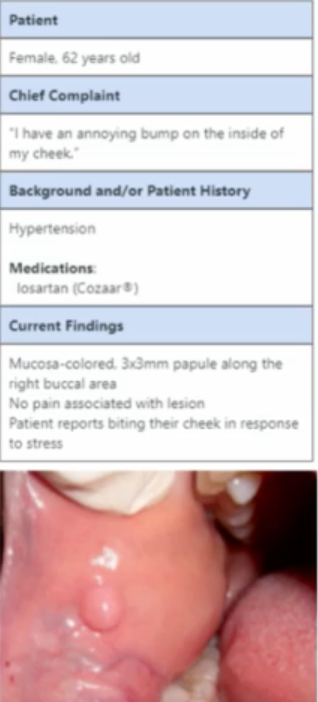
peripheral ossifying fibroma (indicated by calcifications)
what is the most likely diagnosis
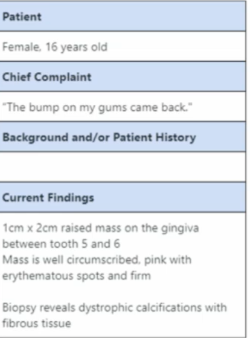
mucoepidermoid carcinoma
what is the most likely diagnosis?

warthins tumor
benign salivary gland tumor of the PAROTID gland
tongue
from what location was the lesion most likely excised

associated with alcohol
which of the following best describes HPV-negative oropharyngeal carcinoma:
more common in females
increasing incidence
associated with alcohol
better prognosis that HPV-positive
pleomorphic adenoma (most common on palate and parotid)
which of the following is LEAST likely the cause of this patient’s symptoms:
rhabdomyoma
pleomorphic adenoma
schwannoma
leiomyoma