Organic Chemistry Lab Exam
 Call Kai
 Learn
 Practice Test
 Spaced Repetition
 Match
 Flashcards
 Knowt Play
1/130

There's no tags or description
Looks like no tags are added yet.
131 Terms
What is the name of the strawberry flavouring agent we are trying to synthesize?
2-butoxynaphthalene
What is 2-butoxynaphthalene synthesized from and via what type of reaction
2-butoxynaphthalene is synthesized from 2-naphthol via an SN2 (Substitution, Nucleophile and bi-molecular reaction)
Aside from 2-butoxynaphthalene what are the other products of the reaction which synthesizes it?
NaBr and H2O
What are the two other components in the waste product mixture from the other company, aside from the desired 2-naphthol?
Benzoic Acid and 1,4-dimethoxybenzene
During acidification (Lab 1 !), which sample will produce gas?
NaHCO3/Benzoic Acid
What gas is produced in the sample that produces gas during acidification (Lab 1!)?
Carbon dioxide
Can gravity filtration in the first lab be perfomed outside of the fumehood?
No!
Describe the 2-naphthol you obtained at the end of Lab 1 (e.g., color, shape, appearance)
The 2-napthol we obtained was a light orange solid, of a creamy, almost pasty but not gritty consistency which was likely influenced by the moisture that still remained after the vacuum filtration.
What would happen if only NaHCO3 were used during the extraction, and how would this affect product separation?
NaHCO3 is a weak base and favours the removal of a proton from a stronger acid, which is why it is used for the benzoic acid (the stronger acid) and not 2-naphthol the weaker acid. Thus 2-napthol requires a strong base for the extraction and had a weak base like NaHCO3 been used instead the extraction would not have worked.
Describe the benzoic acid crystal before recrystallization (e.g., color, shape, appearance)
Before recrystallization the benzoic acid crystals were hard rounded, pitted, opaque aggregates that were peach-ish white in colour.
Lab 2 during the recrystallization of Benzoic Acid did we want rapid cooling or slow cooling and why?
The slower the cooling the larger the crystals will be and also rapid cooling causes impurtities to be trapped in crystals. Thus we wanted slow cooling to get better, bigger and purer crystals.
Could using an excessive amount of solvent effect our recovery of benzoic acid during recrystallization?
Yes, using an excessive amount of solvent could decrease the recovery of benzoic acid.
For an ideal recrystallization solvent, the compound should be:
Highly soluble when hot and poorly soluble when cold
During rotary evaporation in this experiment, which component is primarily removed?
Dichloromethane
What would happen if vacuum filtration were used instead of gravity filtration during the charcoal filtration step (Lab 2)?
The hot gravity filtration method was used to seperate the decolorizing agent (the charcoal) from the benzoic acid and water solution, while keeping the solution hot. This step must occur at hot temperatures to prevent the benzoic acid from recrystallizaing too soon and too quickly, which had it been done with vacuum filtration would have likely resulted in the loss of some benzoic acid crystals with the charcoal because it is not done at hot temperatures and the air might flow might have contributed to further unwanted early recrystallization.
Describe the 2-butoxynapthalene you obtained at the end of this lab (Lab 3) (e.g., color, shape, appearance).
The 2-butoxynapthalene at the end of the lab had the appearance of flaky and shiny semi-transparent bright orange crystals.
Which functional group is formed when 2-naphthol is converted to 2-butoxynaphthalene?
Ether
Compared with 2-naphthol, 2-butoxynaphthalene is expected to be what in relation to polarity?
Less polar
During reflux, what is the liquid primarily dripping back into the round bottom flask from the condenser (Lab 3)?
Ethanol
Explain why the reaction mixture is poured onto ice at the end of the experiment
The mixture is poured onto ice to cool down the solution after reflux, which is done at high temperatures, to encourage crystallization of the 2-butoxynaphthalene so that it can be extracted from the solution by vacuum filtration.
Picture of the reaction that gives you 2-butoxynapthalene

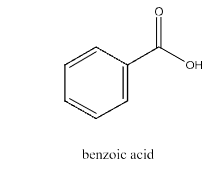
Structure of Benzoic Acid
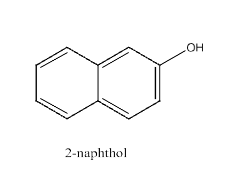
Structure of 2-napthol
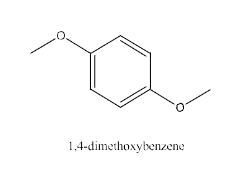
Structure of 1,4 - dimethoxybenzene
What are the conditions for the deal to be worthwhile to the food company you work for?
In order for this deal to be worthwhile to the food company, 2-butoxynapthalene must be synthesized with a 50% percent yield and all final compounds must be in their pure form.
Name the 4 lab sessions as listed in the lab manual
Session 1: Extraction of a mixture to obtain three components: 2-naphthol, benzoic acid and 1,4- dimethoxybenzene.
Session 2: Distillation of 1,4-dimethoxybenzene & Recrystallization of benzoic acid.
Session 3: SN2 reaction on 2-naphthol to obtain 2-butoxynaphthalene.
Session 4 (DRY): Melting point determination of: 1,4-dimethoxybenzene, crude and recrystallized benzoic acid, 2-naphthol, and 2-butoxynaphthalene
What is the solvent in the first mixture from Lab 1 (the mixture that we extracted the three compounds from)?
Dichloromethane (Cl2 CH2 ) and in the lab the three compounds were dissolved in 50 mL of it
In Lab 1 we labelled four 250 mL Erlenmeyer flasks, what did each label say?
1) Naphthol + Dimethoxybenzene, 2) NaOH/Naphthol, 3) NaHCO3/Benzoic Acid and 4) DCM/1,4-dimethoxybenzene
Describe the extraction process (steps and rationale for why we do certain things)
Process where a compound of interest present in a mixture is moved from one phase into another phase using a solvent.
This type of solvent called an extraction solvent
Liquid-liquid extraction is most commonly used technique in organic chemistry.
Uses two solvents which are immiscible (have different polarities), one is usually water called the aqueous layer and the other is the organic layer (dichloromethane or diethyl ether) —> in this lab dichloromethane
To extract desired substance must be more soluble in one of the layers.
Through mixing of the two layers desired substance will transfer from one layer to the other where it can then be isolated and drawn off
We use a separatory funnel for liquid-liquid extraction
In the funnel will form two layers —> upper and lower layer
Location of the aqueous and organic layers is dependent on density
The denser solvent will always be the bottom layer
Steps:
1. Place the separatory funnel in a ring clamp on a stand (see Figure 1)
2. Close the stopcock by placing it in the horizontal position.
3. Place a glass funnel in the neck (top portion) of the separatory funnel. Add the liquid with the component you wish to extract and then add the extraction solvent. (The total volume of both liquids should not exceed three quarters of the funnel’s capacity.)
4. Swirl the flask.
5. Insert the stopper into the neck of the separatory funnel.
6. Pick up the separatory funnel using both hands and partly invert it, with your right hand holding the stopcock, and the first two fingers of your left hand holding the stopper in place.
7. Holding the separatory funnel with its outlet above the liquid level and its stem pointing away from you or your neighbours, vent it by slowly opening the stopcock to release any pressure build up.
8. Close the stopcock, shake the separatory funnel gently for a few seconds, and vent it as before.
9. Venting should be continued until there is no longer an audible hiss of escaping vapors when the stopcock is opened.
10. Replace the funnel on its support, remove the stopper, cover the separatory funnel with a small beaker and let the funnel stand until there is a sharp line dividing between the two layers.
11. Remove the bottom layer into a clean Erlenmeyer flask. If the top layer is required, pour the liquid through the neck (the top) of the separatory funnel. Repeat the extraction procedure as needed.

What are the two main purposes of extraction in organic chemistry?
To obtain and isolate a desired substance from a mixture of substances
As a method to purify an organic substance through the removal of impurities
During the extraction process which solvent was our upper layer and which was the bottom layer?
The organic layer (the dichloromethane solution) was the bottom layer and was added first
Aqueous layer (the 25 mL 10% sodium bicarbonate (NaHCO3) solution) was added second and was the upper layer
Densities of water and dichloromethane
Water: 1.000 g/mL
Dichloromethane: 1.335 g/mL
What are the two most common organic solvents used in extractions and what are their advantages?
Dichloromethane (methylene chloride)
not flammable
Diethyl ether
has low boiling point
can dissolve both polar and non-polar components
Issue? It is highly flammable
What role does polarity have to do with the process of extraction?
Extraction is a particularly effective technique of separating organic compounds especially if one of the compounds in the mixture can be chemically converted into an ionic form. The ionic form would be soluble in the aqueous layer and could be extracted into it. Other non-ionized species in the mixture would remain dissolved in the nonpolar organic layer. A separatory funnel provides a secure environment where liquids can be mixed, pressure can be built up while shaking and then the stopcock can be opened to allow the lower layer of the liquid to be drained out. The top layer is poured from the top of the separatory funnel.
What mixture are we isolating in the extraction in Lab 1?
A mixture of equal parts of the neutral compound, 1,4 dimethoxybenzene, a stronger acid compound, benzoic acid, and a weaker acid compound, 2-naphthol, in a dichloromethane solution are to be isolated through extraction.
How many times did we repeat the extraction process in Lab 1 to extract the first compound and seconf compounds?
Three times until we had 75 mL of solution in the NaHCO3 / Benzoic Acid Erlenmeyer flask. And then another three times until we had 75 mL of solution in the NaOH/Naphthol Erlenmeyer flask.
Extraction, Polarity and the isolation of the three important compounds in our experiment (Lab1)
The extraction begins with all three compounds being uncharged. Uncharged compounds are more soluble in the organic layer (dichloromethane) and NOT the aqueous layer (water). Therefore, the extraction begins with all three compounds being located in the layer of dichloromethane.
Dichloromethane and water are two liquids that are immiscible meaning the two liquids will not mix. This is because dichloromethane is non-polar compared to the highly polar compound water.
One method of extracting a compound is to turn the neutral compound into a charged compound. The charged compound will then move from the organic layer and preferentially dissolve in the aqueous layer where it can then be extracted.
The concept behind this extraction is using compounds of differing acidities which can be separated by using bases of different strengths.

Explain what happens and what you are getting with the first extraction?
The first extraction will extract benzoic acid using the weak base sodium bicarbonate (NaHCO3).
The weak base sodium bicarbonate will preferentially remove the proton of a stronger acid. Due to benzoic acid’s pKa being smaller than that of 2-naphthol, benzoic acid is the stronger acid and will more readily have its proton removed by the weak base. This results in the formation of the charged salt, sodium benzoate. Due to the fact that it is charged (polar) it will prefer to be in the aqueous layer (polar). Sodium benzoate will move from the organic layer to the aqueous layer where it will be isolated and can be drawn off.

Explain what happens and what your are getting with the second extraction?
The second extraction uses the strong base, NaOH to remove the proton from the weaker acid, 2- naphthol. A charged molecule is produced which will move from the organic layer into the aqueous layer where it can be dissolved and then drawn off.
(Note that in our procedure we put our 10% NaOH solution into an ice bath)
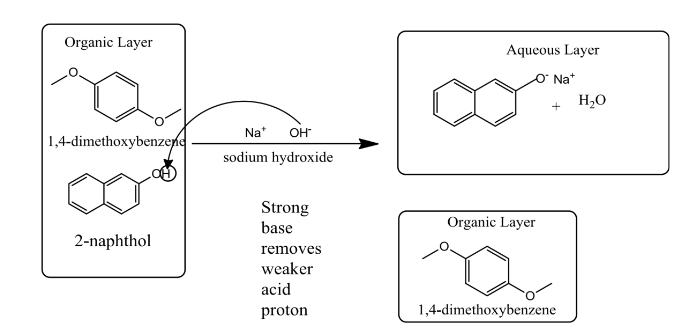
What is the purpose of acidification after extraction in Lab 1?
The two charged compounds (related to benzoic acid and 2-naphthol) are then exposed to acidic conditions (addition of HCl) in order to return them back into neutral compounds as show below.

Where is the 1,4-dimethoxybenzene in the extraction process?
After the other two compounds become charged and are extracted the neutal 1,4-dimethoxybenzene is the only compound remaining in the organic layer.
Once the solution is acidic how are 2-naphthol and benzoic acid collected?
Via vacuum filtration
How do we isolate 1,4-dimethoxybenzene?
The dichloromethane is distilled off in order to obtain the solid 1,4- dimethoxybenzene
Is there a reason we should not rely on the colour of the solution to identify the DCM layer during our extractions?
We should not rely on colour because it will change during the extraction. The DCM (lower density than water) will always be the lower layer in this experiment.
After extraction and before acidification what do we do with the NaHCO3 /Benzoic Acid and the NaOH/Naphthol flasks?
We put them on ice in the fumehood to cool.
In Lab 1 what do we add to the DCM/ 1,4- dimethoxybenzene flask and why?
We add sodium sulphate to dry the solution. The instructions say to add enough to dry the solution, and to use 1g to start. We might need to add more if the sample contains lot of water due to poor separation of aqueous and organic layers in the initial separation.
What type of glassware did we use to collect the 1,4- dimethoxybenzene after gravity filtration?
A round bottom flask with a 24/40 neck joint (that we weigh before using).
What is the purpose of gravity filtration (+ some extra notes on gravity filtration)
The purpose of gravity filtration is to remove a solid from a liquid component. Gravity filtration is normally conducted during recrystallization to remove impurities, to remove activated carbon or to remove a drying agent (magnesium sulfate or sodium sulphate) from dried organic liquids. It is conducted through the use of a funnel containing filter paper. The liquid is then poured into the funnel where the filter paper catches the solid and the liquid drips into a collecting flask (usually an Erlenmeyer flask). The liquid collected is called the filtrate. The funnel is placed in a ring support positioned directly over the collecting flask.
Important things to be aware of and consider for gravity filtration
The filter paper must be folded correctly
fold in half two times and then, only open it from one layer on one side
wet the filter with the solvent before adding the solution you want to filter
When conducting recrustallization, the solvent is hot. In order to prevent the crystals from crystallizing in the funnel, the funnel is heated.—> This is hot gravity filtration
During the experiment we used both cold and hot gravity filtration, for lab one after extraction with DCM and 1,4 - dimethoxybenzene we used cold.

What was the concentration of the HCl we used for the acidification?
37% HCl
Did we leave the two flasks on ice during acidification?
Yes, so that they could form enough crystals for vacuum filtration.
What is the purpose of vacuum filtration?
Vacuum filtration is a common technique in organic chemistry to isolate a solid from a solid/liquid mixture or in removing impurities from a large quantity of liquid.
Information and notes about vacuum filtration and its steps
Vacuum filtration, also known as suction filtration, set-up can be seen below. It involves placing a porcelain Buchner funnel onto a vacuum filter flask. This filter flask is connected via thick vacuum tubing to the inlet of a vacuum aspirator (yellow inlet that says vacuum on it). Clamp the filter flask to stand and connect the vacuum aspirator to the filter flask via a rubber tube. Insert the Buchner funnel onto the filter flask. Place a circular piece of filter paper is on the Buchner funnel. The vacuum aspirator is then turned on. The filter paper is then moistened with an appropriate ice-cold solvent (generally whatever liquid the crystals are currently in). The solid/liquid mixture is then poured onto the filter paper. The vacuum aspirator then forces the liquid through the filter paper and collects into the filter flask. The solid is left on the filter paper where it will compact. The solid is then air-dried for several minutes by allowing the air to pass through the filter paper. To turn off the vacuum, disconnect the rubber tubing at the vacuum source and then close the inlet.
Notes:
Don’t turn on vacuum too high so as not to rip your filter or in the case of Lab 3 to be careful with the fine crystals of 2- butoxynaphthalene
Use a spatula to transfer both the filter and the crystals into a clean and dry filter so that they can air dry the rest of the way

What was the initial masses of each of the compounds?
Benzoic acid: 1.0 g
2-naphthol: 1.5 g
1,4-dimethoxybenzene: 1.0 g
Thus this would also be the theoretical mass of the compounds we are trying to recover.
What gas is produced in the separatory funnel during extraction?
CO2
Why should you be careful to not point the stem of the separatory funnel at anyone when venting?
The out-rushing gas can cause liquid to spew out
After inverting and mixing the separatory funnel in extraction should you let it rest after placing it back on the ring clamp before draining solutions?
Yes you should let it rest 1 minute.
Flow chart for the separation of Benzoic Acid, Napthol and 1,4-dimethoxybenzene
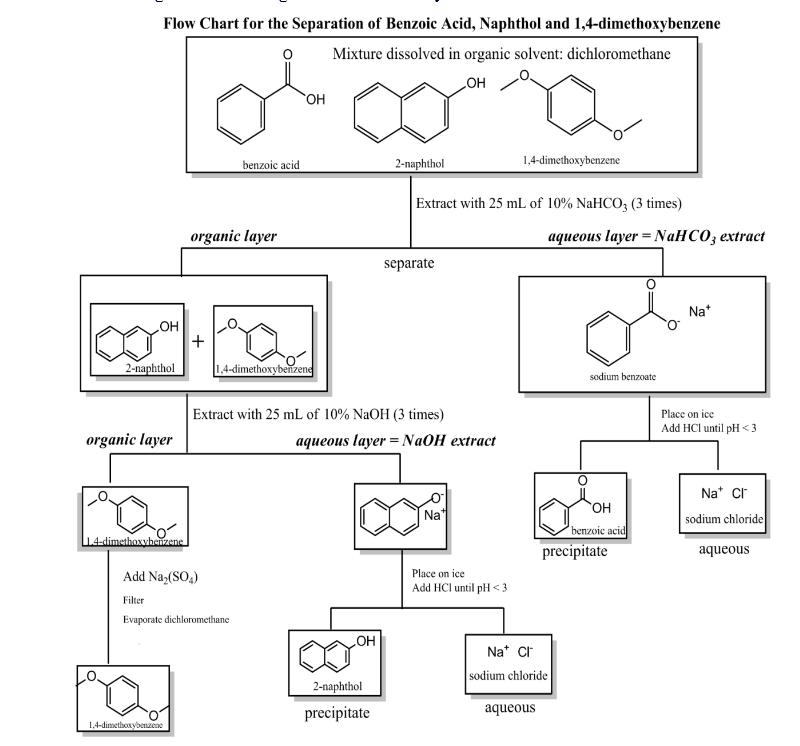
Did we actually perform distillation in this lab? If not what did we use instead and to obtain what compound?
No, distillation was replaced by the Rotovap operation which was performed by the TAs, and it was done to isolate 1,4-dimethoxybenzene by distilling the remaining dichloromethane from it.
Notes on distillation (what is it and important considerations)
Distillation is the process of vaporizing a liquid mixture in a round bottom flask and condensing the vapors through a condenser and then collecting the vapors in a graduated cylinder.
Distilland —> the liquid mixture.
The liquid mixture is heated in a round bottom flask —> sometimes called the pot, with a heating mantle.
Vapors from the pot travel through the water-cooled condenser
Upon contact the vapors condense and travel to the reciever (usualy a graduated cylinder)
If more than one liquid component in the distilland, component that is the most volatile will be in the recieving flask first and the lesser volatile component in the pot.
The vapor above the liquid will always contain the lower boiling compoenents than the liquid in the pot.
This results in the lower boiling compoenents being removed from the pot and the higher boiling point component in the pot itself.
Other important stuff:
Round bottom flask should never be more than half full
Round bottom flask should contain boiling chips to prevent bumping (help control the boiling)
Thermometer is used to monitor the boiling point of the vapors (which is why it is essential to know the boiling point of dichloromethane)
Thermometer installed in the distillation head. Thermometer bulb should be centered in the stillhead and the bulb directly below the side arm connection—> ensures that thermometer is immersed in vapors to obtain an accurate boiling point (thermometers too high or too low in placement can result in incorrect temperature readings).

Why is recrystallization done?
Recrystallization is the most widely used method in organic chemistry to purify a substance. As the name suggests it uses a substance that has already crystallized but then dissolves it in a hot solvent and crystallizes it again to remove the impurities.
Why does recrystallization work?
The principle works because most substances are more soluble in hotter solvents than in cold ones.
Also, impurities have different solubilities than the parent compound.
Notes on the Rotovap procedure
It removes volatile solvents from a non-volatile sample
It increases the rate of evaporation of the solvent by:
Reducing the pressure to lower the solvent boiling point
Rotating the sample to increase the effective surface area
Heating the solution
Also (like with distillation) uses a round bottom flask that is no more than half full.
Steps for recrystallization (and important stuff!)
Starts with dissolving the solid in an appropriate hot recrystallization solvent.
Then we add the decolorizing agent —> to remove soluble coloured impurities.
Then filtered with hot gravity filtration to remove impurities
Solution then allowed to cool slowly
First to room temp
Then put on ice to induce more crystals to form
The crystals are formed
Then collected through vacuum filtration and washed with ice-cold recrystallization solvent

What is the importance of slowly cooling the solution in the context of recrystallization?
Slowly cooling the solution results in crystals being large compared to rapid cooling which results in smaller crystals. Also, rapid cooling causes impurities to be trapped in the crystal.
What is the recrystallization solvent we used in Lab 2 in the recrystallization of Benzoic acid?
Water is the recrystallization solvent
What is the decolorizing agent used for in recrystallization and why is it used?
Often a decolorizing agent (activated carbon, NORIT) is used at this point to remove soluble colored impurities. We use charcoal in this lab (Lab 2).
In lab 2 what did we use recrystallization for?
To recrystallize benzoic acid.
What is an issue that could arise when using the decolorizing agent?
Care must be taken to only use a small amount because large amounts can result in loss of product.
How does recrystallization work?
Recrystallization is effective at removing impurities because the recrystallization solvent is heated until the boiling point of the solvent. Often at the boiling point of the solvent impurities are insoluble at this temperature and are removed via hot gravity filtration. The addition of too much recrystallization solvent can result in a reduction in the yield and can prevent recrystallization from occurring at all.
Another important factor during recrystallization is the removal of colored impurities through the use of activated carbon.
Why might no crystals form even after slowly cooling to room temperature during recrystallization?
It is because the solution is supersaturated. Crystallization can be induced by lightly scratching the tip of a glass stirring rod on the side of the receiving flask for a few minutes. Crystallization can also be induced by “seeding” which involves adding a small crystal from the pure compound.
How to choose the right recrystallization solvent?
The ideal recrystallization solvent is one that dissolves a large amount of the substance to be recrystallized in hot solvent and only a small amount in cold solvent.
Also, the melting point of the recrystallized substance should NOT be significantly lower than the boiling point of the recrystallization solvent. The reason for this being that the substance being recrystallized will melt as opposed to dissolve when the recrystallization solvent is being boiled. As a result, the solid will form a liquid that is no longer soluble in the solvent. This is often referred to as oiling out and as a result the liquid will not recrystallize.
Another characteristic for selecting a recrystallization is the volatility of the solvent. A solvent with a low boiling point can be removed easily through evaporation. A solvent with an extremely high boiling is difficult to remove and often requires heating under a vacuum.
Why would it be important to crush any clumps of Benzoic acid before starting the recrystallization process?
Because you want to increase the surface area of the impure crystals to make it easier for them to dissolve in your recrystallization solvent. Not crushing them small enough is probably why it took some of us so long to just dissolve our benzoic acid in the water during Lab 2.
When putting a flask on the hot plate, to set up a hot gravity filtration apparatus for example, why would we put a small amount of water in the bottom?
To prevent cracking the glass.
What is the approximate amount of charcoal that we added to the benzoic acid and water solution during recrystallization?
Approximately 0.15 g a small amount.
After adding the charcoal what speed should you set your magnetic stirrer and why?
At medium-low speeds to avoid distintigration of the charcoal.
During the hot gravity filtration in recrystallization, why does everything need to remain hot?
To prevent crystals to form on the filter paper with the charcoal, which would mean loss of benzoic acid.
Why would you swirl the cooling benzoic acid after hot gravity filtration in the ice bath in Lab 2?
You would swirl it to promote maximum crystallization.
When rinsing your flask with water to ensure all crystals from the solution are added to the buchner funnel during vacuum filtration after recrystallization, what temperature should the water be at?
It should be ice cold water.
In Lab 3 what is 2-naphthol reacted with and what is the description of the reaction that will give you 2-butoxynaphthalene?
This experiment uses the 2-naphthol that you extracted from your mixture in Experiment 1. 2-naphthol will be reacted with sodium hydroxide (NaOH) to generate 2-naphthoxide. This will be reacted with 1-bromobutane to give the desired strawberry flavor agent, 2-butoxynaphthalene.

What is the formula to calculate percent yield?
Percent Yield = (Actual Yield / Theoretical Yield) x 100
And then the answer given in percent (%)
What is another name for 2-butoxynaphthalene?
Butly naphthyl ether
Before starting Lab 3, what are the specifics about the amount of 2-naphthol we should be using?
If you have less than 0.5 g you must see the TAs, but do not use more than 1.0g. If you have more than 1.0g, set the excess aide and record the mass of 2-napthol used.
What is the importance of heating in the matter and why is heating under reflux done ?
Heating is generally done to increase the rate of most organic reactions. One technique that uses heat while preventing the loss of solvent is known as reflux.
Describe Heating Under Reflux (important steps and considerations)
Heating under reflux involves heating the liquid at its boiling point and then using a condenser that has cold water rushing along the side of its wall to cause the solvent vapors to condense and flow back into the reaction vessel.
The time for refluxing is normally given for a given reaction. The time of refluxing refers to once the reaction begins to boil and not from when the heating began. The heat source should be set to a level where one drop of solvent drops back into the flask per second.
You want a little bit of space between the round bottom flask (RBF) and the hotplate.
Steps for set up:
1. Begin by positioning the heat source on a stand.
2. Select an appropriate size RBF (should be filled to no more than half).
3. The flask should then be clamped securely to the stand.
4. Add the reactants to the round bottom flask using a funnel.
5. Add a few boiling chips or a magnetic stirring bar.
6. Connect the tubes to the condenser
7. Place the condenser onto the RBF
8. Connect the lower tube of the condenser to the cold-water source
9. The upper tube should be placed in the drain of sink, ensure that the tube is long enough to securely fit into the drain to ensure no water splashed out.
10. Turn on the heat source. Ensure that the solvent boils gently (solvent should be dripping back at approximately 1 drop per second).
11. There should be a reflux ring of condensing vapors that is clearly visible. If this ring appears more than halfway up the condenser reduce the heat.

Is there any specific way to connect the water tubes for heating under refux in Lab 3?
The bottom tube opening on the condenser connected to the water tap and the top water opening connected to the tube that leads to the drain. Might be a good idea to use a clamp to secure the drain tube to the drain.
During heating under relfux why should you never heat the reaction before the condenser has water running through it?
Because solvent vapours can escape and cause a fire or a health hazard.
Is there anything special to be considered when choosing the round bottom flask for heating under reflux?
The round bottom flask should be a special one that is flatttened on its underside (flat-bottomed round bottom flask), allowing for there to be space between the hot plate and the glassware. We do not want the flask to crack and to break the glassware.
In reflux what is dripping back into the round bottom flask?
The solvent which in the case of Lab 3 is ethanol.
During reflux, what rate of solvent dripping from the condenser back into the round bottom flask is what we want?
1 drop of solvent per second.
What does the time for reflux refer to (i.e. when can we consider it started?)
Once the reaction begins to boil and not from when the heating began.
Do we set up the reflux appartus inside or outside of the fumehood?
Inside the fumehood.
What was the solvent we dissolved the 2-naphthol in for heating under reflux?
It was ethanol (we added 20 mL)
What did we add to the round bottom flask during the first round of reflux and how much?
Aside from our 2-naphthol, we also added 5 pellets of NaOH (approximately 0.56 g, which is 14.0 mmol) and then the ethanol (solvent).
How long did we reflux the solutions in Lab 3?
We did so for 30 minutes each
At what temperature and at what rate of stirring did we do reflux, in Lab 3?
Hot plate could be set around 450°C with the rpm at 500.
How many times did we do heating under relfux in Lab 3?
Twice —> first with 2-naphthol and NaOH dissolved in ethanol and then second with the resulting solution and 1-bromobutane.
What did we do after the first round of heating under relfux in Lab 3?
Remove the heat source and allow the solution to cool slightly.
Remove the reflux condenser (make sure the solution has stopped boiling BEFORE you remove the condenser) and add 1.0 mL of 1-bromobutane (8.8 mmol) to the flask.
How what did we add to the solution after the first round of heating under relfux in Lab 3 and how much?
We added 1.0 mL (8.8 mmol) of 1-bromobutane.
After the rounds of heating under reflux how long do we let the solution cool before removing the condenser?
After the second reflux period, remove the heat source and allow the solution to cool for 1 minute before removing the condenser.