Mood
 Call Kai
 Learn
 Practice Test
 Spaced Repetition
 Match
 Flashcards
 Knowt Play
1/16

There's no tags or description
Looks like no tags are added yet.
17 Terms
Whats the overview of mood?
Major depressive episode: severe depression or loss of interest/pleasure including cognitive symptoms(You don’t have to see all of these below)
Feelings of worthlessness
Altered sleep patterns
Changing appetite and weight
Notable loss of energy
Slowing down
Fatigue
Concentration problems
Thoughts of death
Depression lasts two weeks
•General loss of interest
•Anhedonia: inability to experience pleasure
•Behavioural and emotional shutdown
Mania: extreme pleasure in every activity
Hyperactivity, rapid speech
Flight of ideas
Person may require hospitalization
7+ days
Hypomanic episode: not as severe as a manic episode
•No marked impairment in social or occupational functioning
•4+ days
Whats the structure of a mood disorder?
Unipolar mood disorder: mood remains at one pole of depression–mania continuum
Bipolar mood disorder: mood travels between depression– elation poles
Mixed features: mix of symptoms
Describe major depressive disorder
A. 5+ of following in 2-week period; at least 1 is either (1) or (2)
1. Depressed mood most of the day, every day
2. Diminished interested or pleasure in almost all activities
3. Significant weight loss or weight gain or decreased/increased appetite nearly every day
4. Insomnia or hypersomnia
5. Psychomotor agitation or retardation
6. Fatigue/loss of energy
7. Worthlessness or excessive guilt
8. Concentration problems/indecisiveness
9. Recurrent thoughts of death, suicidal ideation, planning or attempt
No previous manic/hypomanic episode
Describe persistant depressive disorder
A. Relatively unchanged depressed mood for 2+ years
B. While depressed, 2 or more of:
poor appetite/overeating
in/hypersomnia
low energy
poor concentration or decision making
hopelessness
low self-esteem
C. Never w/o symptoms A or B for 2+ months
D. Can meet MDE for 2+ years
*Double depression Persistent depression with periods of significantly worsening mood (MDE’s)

Describe these pictoral representations of non-bipolar depression
a) two major depressive episodes b)persistent depressive disorder c) double depression d) chronic major depressive disorder e) major depressive disorder in remission f) recurrent major depression with

What are the 4 depressive disorder specifiers?

Describe 4 types of grief?

what are the 3 types of bipolar disorders?
Bipolar 1: 1 manic episode
Bipolar 2: 1 manic episdoe
Cyclothymic disorder: Mood elevation and depression. Not as severe

WHat is a manic episode?
A. Abnormally and persistent elevated, expansive, or irritable mood, goal-directed activity, or energy for 1+ week
B. 3+ symptoms of following or 4 if mood is only irritable
Inflated self-esteem/grandiosity
Decreased need for sleep**
More talkative/pressured speech
Flight of ideas/racing thoughts
Distractibility
Increased goal-directed activity
Involvement in high-risk activities
whats the difference between bipolar 1 and bipolar 2?
Bipolar I Disorder A. One manic episode
Can have depressive episodes
Cycle between the two
Bipolar II Disorder
A. One hypomanic episode AND one major depressive episode
Never full mania
Rapid-cycling specifier: 4 manic or depressive episodes within 1 year
Ultrarapid: days to weeks(ultrawear)
Ultraultra rapid:
Whats the onset and duration of bipolar 1 and 2?
Average age of onset:
Bipolar I disorder: 18 years
Bipolar II disorder: 22 years (10%–13% progress to Bipolar I)
Suicide risk increases with diagnosis
60% of cyclothymic patients are women – onset in teens
Whats the serotonin hypothesis around mood disorders?
Low levels of serotonin may impact mood?
Serotonin regulates emotions?
No test of serotonin levels in the brain
Body serotonin does not cross the blood-brain-barrier
What contrinutes to mood disorders?
Low serotonin
stressful life events
sleep problems
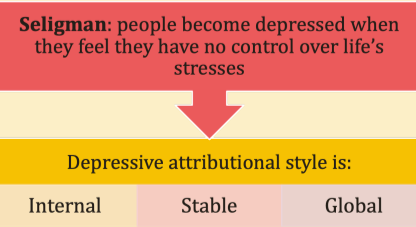
Describe learned helplessness theory around depression?
what re the treatments for depression?
Cognitive Behavioural Therapy
Correcting cognitive errors
Realistic thinking encouraged by monitoring and logging thought processes
Socratic questioning and cognitive restructuring
Behavioural experiments and activation are encouraged
Interpersonal Psychotherapy
Time-limited and structured treatment
Focuses on how current relationships and life events influence mood.
Targets one of four key interpersonal problem areas: Grief, Role Disputes, Role Transitions, or Interpersonal Deficits.
Uses techniques such as interpersonal incident analysis and communication exploration to build insight.
Goal: Improve relationship functioning and alleviate depressive symptoms by resolving interpersonal difficulties.
What are 3 psychosocial treatments for bipolar

What are the 3 basic antidepressent medications?
Tricyclics
MAOIs
SSRIs