Innate recognition
 Call Kai
 Learn
 Practice Test
 Spaced Repetition
 Match
 Flashcards
 Knowt Play
1/23

There's no tags or description
Looks like no tags are added yet.
24 Terms
What are PAMPs?
PAMPs (pathogen-associated molecular patterns) are motifs on pathogenic organisms:
– bacterial endotoxin (LPS), peptidoglycan (both in the bacterial membrane) and flagellin (on nearly all flagellated bacteria)
– single-stranded viral RNA (e.g. SARS-CoV-2) and double-stranded viral DNA (e.g. herpes)
What are DAMPs?
DAMPs (danger-associated molecular patterns) are endogenous molecules "shielded" from the immune system until after injury: heat shock proteins, uric acid crystals, ATP, DNA, β-amyloid plaques, and some cytokines (IL-1α) released after cell damage.
What cells contain PRRs and what happens upon detection?
Innate cells (neutrophils, monocytes, macrophages, DCs, NK, mast cells, basophils, eosinophils) carry PRRs for PAMPs and DAMPs.
On detection: increased phagocytosis and ROS, plus cytokine and chemokine release. These coordinate immune responses and can be pro- or anti-inflammatory; their overproduction is a major contributor to disease.
What are the differences between innate and adaptive receptors?

Where are PRRs found in a cell?
Extracellular: TLRs (bacterial cell wall lipid), lectins (fungal polysaccharide).
Endosomes: TLRs (nucleic acids of ingested microbes).
Cytosol: NLRs (bacterial peptidoglycans), RLRs (viral RNA).
What extracellular PRRs are found on phagocytes?
Extracellular receptors on phagocytes (binding triggers phagocytosis)
Mannose receptor: C-type lectin; binds carbohydrates on yeast, parasites, bacteria.
Dectin-1 / β-glucan receptor: C-type lectin; binds β-glucans (antifungal response).
Scavenger receptors: bind low-density lipoproteins and sialic acid (bacteria and yeast).
Lipid receptors: direct immune function and metabolism.
Complement receptors: bind CR3, CR4, LPS, lipophosphoglycan (bacteria and yeast).
What are Toll-like receptors?
An ancient pathogen-recognition system, discovered in Drosophila. Membrane-bound (plasma membrane and endosome).
They form homo- and heterodimers, which dictate what they recognise.
Structure: extracellular leucine-rich repeats (LRRs), a transmembrane domain, and an intracellular Toll-IL-1 receptor (TIR) domain.
What types of TLRs are there?
Plasma-membrane TLRs (bacterial/fungal PAMPs)
TLR2/6 heterodimer: diacyl lipopeptides.
TLR2/1 heterodimer: triacyl lipopeptides.
TLR5 homodimer: flagellin.
TLR4 homodimer: LPS.
Endosomal TLRs (viral PAMPs)
TLR3 homodimer: dsRNA.
TLR7 homodimer: ssRNA.
TLR9 homodimer: CpG DNA.
What happens downstream of TLR activation?
TLRs activate the TFs NF-κB, AP-1 and IRF to induce cytokines and interferons, which drive anti-viral or anti-bacterial responses.
Dimerised TLRs recruit IRAK1 and IRAK4, which activate the E3 ubiquitin ligase TRAF6.
TRAF6 and NEMO are polyubiquitinated, forming a scaffold for TAK1 activation.
TAK1 associates with IKK and phosphorylates IKKβ, which phosphorylates IκB.
IκB is degraded, releasing NF-κB into the nucleus → cytokine gene expression.
TLR3 and 4 signal via TRIF and the rest signal via MyD88; both induce IFN gene expression. These are the adaptors that bind to TLRs and recruit downstream proteins.
What are downstream effects of IRF TFs?
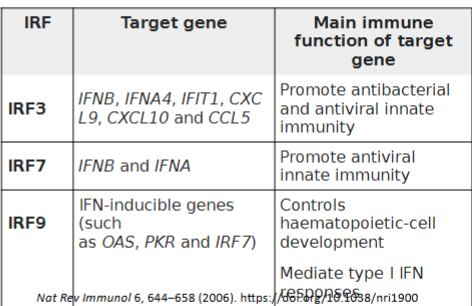
What are RIG-I-like receptors (RLRs)?
RLRs have RIG-like helicases that recognise cytoplasmic viral RNA and cellular RNAs that are unusual, mislocalised or misprocessed.
RIG-I recognises mainly ssRNA; MDA-5 recognises mainly dsRNA.
Cytoplasmic viral replication makes uncapped RNA with a 5′-triphosphate. Binding to RIG-I makes it associate with the adaptor MAVS (mitochondrial membrane), causing dimerisation.
MAVS induces cytokines and IFNs by activating NF-κB and IRFs.
What are cGAS and STING?
cGAS (cyclic GMP-AMP synthase) and STING (stimulator of interferon genes) sense intracellular infection. STING recognises cyclic dinucleotides.
Without DNA, cGAS is autoinhibited (it has a nucleotidyltransferase domain and 2 major DNA-binding domains).
Viral dsDNA activates cGAS → it makes cGAMP from ATP and GTP.
cGAMP binds the STING dimer on the ER membrane → STING is activated.
STING activates the kinase TBK1, which phosphorylates IRF3.
IRF3 enters the nucleus → type I interferon genes are expressed.
What are Nod-like receptors?
Sense bacterial PAMPs and non-bacterial DAMPs, directly or indirectly. Some help form the inflammasome. They work in the cytoplasm.
General structure: N-terminal, functional domain, NACHT, LRR, C-terminal. There are 5 subfamilies (NLRA, B, C, P, X).
Two types: non-inflammasome forming (make TFs) and inflammasome forming.
NOD1 and NOD2 (non-inflammasome) recognise bacterial PAMPs in the cytosol. They activate RIP2, which activates IKK and TAK1 → NF-κB and MAPK respectively → more cytokines.
What ways are cytokines released?
Different cytokines are released differently.
IL-6 is released by the classical secretory pathway (ER → Golgi → vesicles → exocytosis).
IL-18 and IL-1β use alternative pathways: they are made as pro-proteins, cleaved by the inflammasome, then released.
What are inflammasomes?
Inflammasomes are molecular complexes formed when pattern detection makes sensors, adaptors and effectors (e.g. a caspase) oligomerise into a large complex. They can cleave pro-cytokines or cause pyroptosis, a form of cell death in which the cell bursts and releases inflammatory molecules. Different inflammasomes form depending on the NLR.
What is the NLRP3 inflammasome?
Triggers: viral RNA, pore-forming toxins, ATP detection, K⁺ efflux. Lysosome damage (and release of cathepsins) also triggers it.
Cleaves pro-inflammatory cytokines and GSDMD → pyroptosis.
Lysosomal damage also causes Ca²⁺ influx, activating calpain, which cleaves pro-IL-1α.
What is the NLRC4 inflammasome?
Important in epithelial cells, where it mainly regulates IL-18 and IL-1β. Specifically recognises Gram-negative bacteria.
IRF8 drives production of NAIPs (NLR family apoptosis inhibitor proteins), which bind bacterial components in the cytosol and bind NLRC4 adaptors to form the inflammasome.
Activates caspase-1, which cleaves gasdermin D (pyroptosis) and pro-IL-18/IL-1β.
What is the NLRP1 inflammasome?
Activated by ribosomal stress in some infections, or UV damage.
NLRP1 is ubiquitinylated at its N-terminal domains and degraded by the proteasome. This releases the C-terminal UPA-CARD, which promotes assembly; caspase-1 is recruited.
How does receptor expression link to inflammasome formation?
Expression: macrophages express NLRP3, NLRP1 and AIM2 (another inflammasome); epithelial cells express NLRP1, which suits its detection of UV damage.
What are features of NLR autoinflammaotry diseases?
NLRs can drive autoinflammatory diseases.
These are caused by gain-of-function (GOF) mutations.
They are autosomal dominant - presence of just 1 copy of a mutated gene can cause the disease = high levels of IL-1β secretion.
What is CAPS?
NLRP3 (or cryopyrin) has been implicated in CAPS (cryopyrin periodic associated syndromes). CAPS are a spectrum of diseases that share many clinical features: rash, fever, joint pain, fatigue and eye redness/pain.
Canakinumab is a mAb which is administered by subcutaneously every 8 weeks which results in a complete resolution of symptoms and signs of CAPS.
Anakira is an IL-1 receptor antagonist administered by injection every week.
There are small molecule NLRP3 inhibitors under development, improving patient outcomes and reducing the need to frequently visit hospital.
What is NLRC4 mutation linked to?
NLRC4 GOF is associated with hyper inflammation; early onset recurrent fever, enterocolitis, and recurrent macrophage activation syndrome (MAS). It is characterised by high levels of IL-18.
There are several clinical trials for IL-18 blockers such as anti-18 mAb called camoteskimab or MAS825, which is a bispecific anti-IL-1β and IL-18 mAb.
What is NLRP1 mutation linked to?
NLRP1 GOF mutations cause skin diseases such as multiple self-healing palmoplantar carcinoma (MSPC).
These skin diseases cause hyperplasia, cancer susceptibility and inflammation as a result of inflammasome activation and paracrine IL-1 signalling.
What is NOD2 mutation linked to?
NOD2 loss of function mutations cause Chron’s disease which is a type of inflammatory bowel disease (IBD) that may affect any part of the GI tract from mouth to anus.
Signs and symptoms include abdominal pain, diarrhoea, fever and weight loss.
It also causes Blau syndrome (GOF) which is spontaneous inflammation of eyes, joints and skin.
There are no specific NOD2 inhibitors yet available.