Mobility in Context: CH 3,5,1
 Call Kai
 Learn
 Practice Test
 Spaced Repetition
 Match
 Flashcards
 Knowt Play
1/83

There's no tags or description
Looks like no tags are added yet.
84 Terms
What must be considered at all times by Pt and Therapist ?
Safety
Management of the environment ?
You are responsible for cleaning and preparing. Don’t let aides take care of your mess.
What should you do with equipment not functioning ?
should be tagged, removed from the treatment area, and reported immediately.
Annual inspection ?
of all electrical, thermal and mechanical equipment by a biomedical engineer is required
Being Prepared ?
Having supplies in area avoids leaving a patient unguarded or interrupting treatment.
Body Mechanics ? BOS VS COG ?
Proper posture.
BOS: part of the body in contact with the supporting surface
COG: the point at which the three cardinal planes intersect.
Cardinal rules 5 L’s ?
1.) Load: only carry what is appropriate for you and your strength.
2.) Lever: keep load as close to you as possible.
3.) Lordosis: use isometric contractions of back extensor and abdominal muscles
Do not twist
Move feet to change direction
Place feet in stride and slightly apart (stronger leg in the back infront of another)
4.) Legs: lift with legs
Avoid trunk flexion or extension
Use appropriate base of support (wide)
5.) Lungs: avoid holding breath
Exhale during contraction
Valsalva Maneuver ?
is closing the glottis during heavy exertion resulting in increased intrathoracic and intra-abdominal pressure, which can cause increased BP.
Body Mechanics during transfers ?
Transfers require movements that move the COG away from the center of BOS
Can cause loss of balance
Increasing the size of the BOS by setting the feet in stride and slightly apart provides a larger BOS
Proper arrangement of the chair/bed can reduce the distance during a transfer
Avoid crossing the legs, because it will decrease the BOS
Body Mechanics during guarding ?
you should be positioned with feet in stride and the body at a 45-degree angle, slightly to the side and behind the patient.
If a pt starts to fall, this position allows the pt’s COG to be pulled toward the PTA.
Instructions and verbal commands ?
Make sure the patients understand before the activity is performed by asking “Do you understand the instruction?
Have patients repeat instructions
Before treatment, inform your patient the general sequence of events that will occur during that treatment session.
Sharp, loud tone receives quick responses
Soft or low tones elicit slower responses.
What is draping ?
Draping is covering a patient at a modest and comfortable level.
Purposes: (good to know ****)
Protect pt’s modesty
Provide warmth
Protect wounds, scars, residual limbs
Expose area for treatment.
Gait Belts
You have control of patient movements
Apply correctly
Make sure it does not interfere with other equipment: IV, oxygen lines, GI tubing, etc.
Do not pull too hard on gait belt because it can interfere with the activity.
IV’s /Catheters
Catheters should be below the level of bladder
IV bags must remain above the heart level
Take care not to disrupt lines during movement
Transporting
Lock wheels before transfers.
Adjust IVs before moving patients
Put up siderails on cart if leaving pt unattended and when pushing the cart.
Transporting via Gurney
Gurneys have 4 swivel wheels. Push Gurney from the end at which a pateint head is place so patients can see where they are going.
3 Positions in which a lock can be set ?
When the lock lever is in the horizontal, both swivel and rolling movements can occur
When lock levers are tilted in one direction, swivel movements are not possible and rolling movements are permitted
Tilting lock levers in the other direction locks wheels completely.
Transporting via Wheelchair
Leg rest and foot rest in place
Arms in lap
Descending Curb- Backward
Ascending Curb- Forward.
Door ways opening away
position pt facing away from door
PTA walks backwards thru the doorway pulling the WC backward thru the doorway using back to hold the door.
Doorways opening toward
Positon pt/WC parallel to door
PTA opens door with 1 hand block door with foot and guide WC.
Intensive care unit
Overall goal for pt in the ICU will be to minimize or prevent inactivity and assist each person to become functionally independent.
Treatment aspects: contracture mobilized for too long.
Fowlers Positon ?
When the upper portion is raised slightly.
45 degree angle of semi-reclining position.
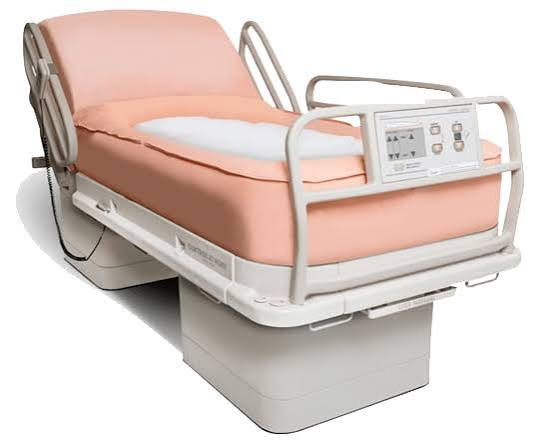
Types of bed - (Clinitron)
Air fluidized support bed/ feel like a water bed
Uses: pt who have several infected wounds/burns and spinal cord injury.
Disadvantages: can be punctured easily
Reduces the need for topical meds and dressings due to healing factors of the microclimate.

Roto Rest ?``
Post trauma mobility beds. designed to maintain a seriously injured patient in a stable position/maintain proper postural alignment.
Oscillates from side to side
Uses: those with restrictive respiratory function/multpile ulcers
Low Air loss Therapy bed
Air pressure in each bladder can be controlled
indicated for ppl who require prolonged immobilization of risk of ulcers.
patients weight can be inflated or deflated based on senors for the bed.
Disadvantages- bladders can be punctured or torn.
NG Tube - Nasogastric tube
flexible tube attached to a electric pump containing liquid nutrition inserted via nasal passages thru esophagus down into stomach.
NPO
Head and neck movements should be closley monitored
Colostomy Bag
Collection of fecal matter
Urinary Catheter ?
Tube inserted into bladder via urethra providing drainage of the bladder. Tube is taped to the thigh to prevent removal.
keep bag below bladder level.
Alternative types: Condom Catheter - males , Pure Wick - Women
Cardiac Leads ?
12 lead wires connecting electrodes to the torso to a central cardiac unit.
IV Line (intravenous)
Thin line inserted with a needle for drug
commonly found on back of the hand or forearm.
Pulse Oximeter
Applied to clip of fingertip or earlobe
Used to monitor 02 Saturation rates of blood.
Normal: 90-100%
Exercise: above 90%
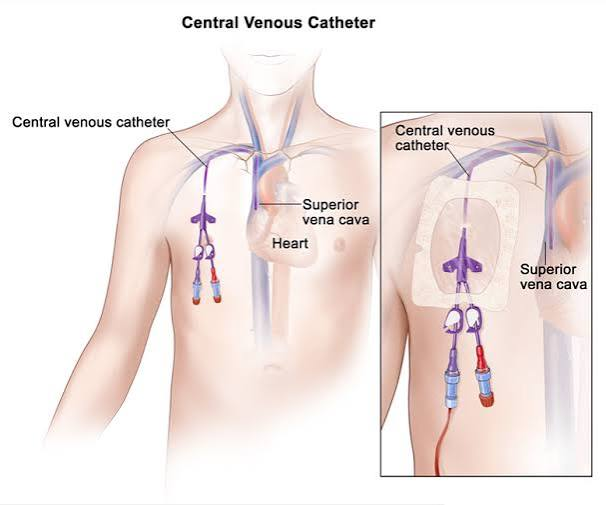
Hickman Catheter
Neck area
inserted thru jugular vein under skin then to superior vena cava of the heart.
Arterial Line
Connected to a artery/monitor
Radial and Brachial most common
Sequential compression device
Cuff placed on pt leg attached to a pump that inflates the sleeve.
Purpose: to prevent blood clots.
Respiratory system device: Endotracheal Tube ?
Large flexible breathing tube inserted thru mouth into trachea and connected to a ventilator.
Respiratory system device: Tracheostomy ?
Flexible tubing inserted thru neck into trachea.
Maintains an open airway
Respiratory system device: Nasal Cannula
External tube for providing oxygen
Delivers 1-2 L of O2/Min
Patient controlled analgesia (PCA)
Pump that delivers medicine thru a pump w/Button.
NG suction tube (Nasogastrol)
tube inserted thru nose attached to a suction device to remove stomach contents.
postoperative surgical Drain ( HemoVac)
Postoperative device that drains pt”s own blood from surgical wounds.
Mechanical Ventilator ?
Respirators that bring air into lungs.
Monitoring - Telemetry
Vital sign monitor- measures everything

Halo
Cervical spine external device

Hoffman”s device
External fixation ( see from outside)
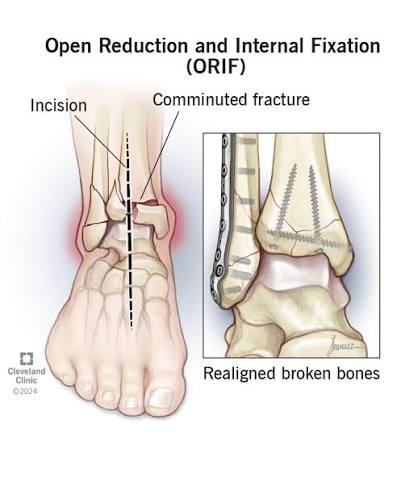
Internal Fixation
Screws bone plates wires nails and rods inserted for proper alignment ( from the inside)
Laboratory values
To screen for disease or system imbalance
to monitor progress of a disease
Laboratory Values: Cardiac Enzymes, creatine Kinase (CK), Arterial Blood Gasses (ABG’s)
Troponin (Tnl, TnT)
Found in cardiac muscle/When found in vlood indicates acute MI has happened.
Levels of oxygen transport/Measurement of diff gasses in blood.
Lab Values: Red Blood Cells (RBC)
Transports oxygen to cells
Polycythemia when count is high
Lab Values: White Blood Cells (WBC)
Helps fight infection and other disease.
Lab Values: Hemoglobin ( Hgb)
Protein found in RBC that transport oxygen
Lab Values: Hematocrit
Measures volume percent of packed RBC’s in a sample of blood.
Platelet count ?
clotting of blood.
Lipid profile ?
Group of test to help determine coronary risk based on target levels.
Total Cholestrol: <200
High density lipoprotein : >60
Low density lipoprotein: >190 high risk
Triglycerides: <165
Arthrography ?
Joint
Myelography ?
Spinal cord
Angiography ?
Dye is injected either intra arterially or intravenously.
Blood vessels
CT/SCAT scan - Computed Tomography
X-ray combines many x-ray images with the aid of computer to generate cross sectional views.
CT Myelogram ?
Diagnostic tool uses radio-graphic dye injected into subarachnoid space (cerebrospinal fluid)
To check for : Inflammation of the membrane that covers the brain/spinal cord
Problems with the blood vessels to the spine.
Electromyogram
test used to record electrical activity of muscles.
Lumbar Puncture
Looking specially CSF
Needle into L3-L4
Heart Catheterization/Coronary angiogram ?
Insert of a catheter thru major artery femoral or radial thru aorta till reaches left ventricle to examine function of heart (usually Femoral)
Doppler ultrasound
Beneficial to reveal DVT
Uses sound waves to measure blood flow thru major arteries and veins.
Reveal blood clots in leg veins(deep vein thrombosis or DVT that could break loose and block blood flow to the lungs (pulmonary embolism) (Blood clot to travel called Pulmonary Embolism).
Vital Sign: Abbrev. oxygen saturation
Sp02
Normal is 90-100%
When to take Pulse ?
At rest
during exercise
after treatment
Basal Heart rate (First thing in the AM)
Whats is Patency ?
Absence of a pulse
Doppler measurement are used to examine Patency.
Method for Pulse ?
Oximeter
Manual Palpation: Don’t use thumb,don’t press hard/count 60 seconds. (True accurate HR)
Sites for HR
2 main sites radial and carotid.
Best sites to monitor Patency ?
Brachial, popliteal, posterior tibial and dorsal pedal arteries.
Report it as absent or present.
Range for Pulse BPM: Athletes? , infants and children? Adults ?
Athletes:40-60 BPM
Infants and children: 80-100 BPM
Adults: 60-100 BPM
Tachycardia? Bradycardia?
Tachy - Over 100 BPM
Brady: Less then 60 BPM
Abnormal HR response
Rapid rate of rise
very slow rate of rise in untrained.
Maximal Heart Rate ? Target heart rate ?
220 - age =MHR
.60 x (220-age)+.80 x (220-age) = THR
Blood Pressure Systolic vs Diastolic
Systolic: When the heart is contracting
Diastolic: Not contracting
Blood Pressure 1 cuff size
80% of circumference of upper arm and width is 40%
Left arm most accurate
Normal: slightly below 120/80 mm Hg
BP Levels to know pre hyper,stage 1 and stage 2
Pre hypertension: 120-139/80-89
Stage 1: 140-159/90-99
Stage 2: >160/>100
Normal response to BP
Diastolic BP remains unchanged or decreases during aerobic activity.
Pt’s response to exercise: diastolic remains stable (10 mm of mercury)
Rubor dependency Test ?
Test to asses if there is an interruption of capillary circulation.
Method 1: Have pt supine. raise 1 LE at a 45 degree angle. Maintain position for 1 min. Pallor will occur when decrease Patency is present.
Respiration
each cycle is 1 inspiration and one expiration
Method: Visual, Auditory and palpation
Respiration 1 Norms ?
Adults: 12 RR
Children: 20 RR
Temp ? sites ?
Site: Oral, rectal and Axillary
Norms: 98.6 F or 37C
Most accurate is rectal
Hyperthermia: above 106
Hypothermia: below 94
What is Malingering ?
Pain is expressed when an injury or disease does not truly present pain. ******
Purpose of measuring pain ?
Diagnosis
prognosis
Appropriate interventions
responses to treatment
site for pain ?
Body diagrams can be used to document the site of pain *****
What is Anthropometrics ?
Monitoring patients height and weight