Biochemistry Exam 2
 Call Kai
 Learn
 Practice Test
 Spaced Repetition
 Match
 Flashcards
 Knowt Play
1/168

There's no tags or description
Looks like no tags are added yet.
169 Terms
How does an enzyme play a role in the energy barrier
By the interactions within the active site that help stabilize the transition state (enough energy required)
Increases rate not gibbs or equilibrium
For a reaction to occur what 3 conditions are required?
Sufficient energy (from collision of molecules)
Correct orientation (for necessary interactions)
Transition state (not stable)
Gibbs free energy trend?
ΔG < 0 = rxn favored in forward direction
ΔG > 0 = rxn not favored in forward direction
ΔG = 0 = equilibrium
What is gibbs free energy?
Represents the energy available to drive a rxn
Lock and key model
Enzyme shape is complementary to transition state (not substrate)
Allows stability for transition state (lowers activation energy)
What happens if an enzyme is complementary to the substrate
Hard to make a product because lots of activation energy is required.
Factors that influence enzyme activity
Temp
pH
Concentration of substrate, product and/or enzyme
Inhibitors and activators
Cofactor availability
Changes in enzyme factors affects?
Measured reaction velocity
What does loss of enzyme structure do?
Changes active site, reduces substrate binding, and catalytic activity due to temperature being above the optimal.
What happens to an enzyme if the temperature is too high?
Denaturation - permanent loss of enzyme activity
What does pH changes do?
Changes concentration of hydrogen ions (alters charge of AA side chains in enzyme)
pH of pepsin?
1.5 - 2
pH of trypsin?
7.5 - 8
Reaction velocity
How quickly product forms or substrate disappears
Max velocity (Vmax)
Max rxn velocity of an enzyme catalyzed rxn (enzyme dependent)
Reached when enzyme is saturated with substrate
All active sites are occupied by substrate
Michaelis constant (Km)
Substrates concentration at ½ Vmax
Indicator of an enzyme’s apparent affinity for its substrate
Km trends
Low Km = less substrate required at ½ Vmax
High Km = more substrate required at ½ Vmax
Km is a characteristic of?
A specific enzyme and substrate pair under defined conditions

Michaelis-Mentons equation
Kcat is?
The turnover number (catalytic constant)
= Vmax/[E]total
The larger the number indicates a faster catalytic cycle under saturating substrate conditions
What does Michaelis Menten kinetics provide?
A quantitative framework for understanding enzyme activity, substrate concentrations, Km, and Vmax
What is enzyme inhibition?
Reduction or loss of enzyme activity caused by an inhibitory molecule
Interacts with the enzyme and reduces its ability to catalyze a rxn (does not necessarily change the structure)
Denaturation of an enzyme involves?
Disruption or unfolding of the enzyme structure
Irreversible Inhibition occurs when?
Inhibitor permanently inactivates the enzyme
Reversible Inhibition occurs when?
Inhibitor can be removed and enzyme activity can be recovered
Prevents enzyme from returning to its active form
Irreversible inhibition forms what kind of bonds with enzymes?
Covalent bonds
What are the three types of irreversible inhibitors?
Group specific reagents
Affinity labels (active site directed reagents)
Suicide inhibitors
Types of reversible enzyme inhibition
Competitive
Uncompetitive
Noncompetitive
Mixed
Competitive inhibition
Inhibitor is structurally similar to the substrate and acts as a substrate analog
Can be outcompeted by high substrate concentration
Most frequently encountered type of enzyme inhibition
Km increases and Vmax is unchanged
Enzyme inhibtion example
ACE inhibitors - involved in regulation of blood pressure
ACE inhibitors bind to ACE enzyme to reduce the activity
Explain how ACE enzyme works
ACE converts angiotensin I into angiotensin II
Angiotensin II causes blood vessels to constrict and contributes to increased blood pressure
How do ACE inhibitors work?
Binds to ACE and reduces activity
Less angiotensin II produced
Blood pressure decreases
Examples of ACE inhibitors
captopril, enalapril, and lisinopril
Noncompetitive inhibitor
Inhibitor binds to the enzyme at a site other than the active site
Can bind to the free enzyme or the enzyme substrate complex
Reduces the enzyme’s ability to convert substrate into product
Can’t be overcome by increased substrate concentration
Km is unchanged and Vmax decreases
Example of noncompetitive inhibition
Heavy metal inhibition - binds to sulfhydryl group on cysteine and alters enzymes structure
Interferes with enzymes involved in heme synthesis
Uncompetitive inhibition
Inhibitor binds only to the enzyme substrate complex
Inhibitor binds at a site different from the active site
Prevents enzyme substrate complex from forming product efficiently
Increasing substrate concentration does not overcome inhibition
Km and Vmax decrease
Mixed inhibition
Binds at a site different from the active site
Can bind to both the free enzyme and the enzyme substrate complex
Inhibitor has different binding affinities for the free enzyme and enzyme substrate complex
Increasing substrate concentration cannot completely overcome the inhibition
Both Km and Vmax change (binding affinity dependent though)
End product inhibition/ feedback inhibition
A regulatory mechanism in which the final product of a metabolic pathway reduces the activity of an enzyme involved earlier in the pathway
Mechanism of feedback inhibition
End product accumulates and binds to regulatory site on the enzyme
Regulatory site is separate from the active site (allosteric site)
Binding of the end product causes a conformational change in the enzyme and reduces the enzymes activity
Reduced activity slows the pathway and prevents unnecessary production of the end product
Example of end product inhibition
Cholesterol synthesis in the liver is regulated through this mechanism
Cholesterol levels increase = decrease in the activity of enzymes involved in cholesterol synthesis
Limits further cholesterol production when sufficient cholesterol is already availiable
Enzyme catalysis is?
A substrate binds to the enzyme active site, if it is surrounded by specific amino acid side chains
Side chains help position and hold substrate in correct orientation so they can participate in the chemical rxn
General acid base catalysis
Transfer of protons between amino acid side chains in the enzyme and the substrate
AA side chains can donate or accept protons during the rxn
Most common form of enzyme catalysis
Common AAs involve histidine, aspartate, glutamate, lysine, cysteine and tyrosine
Covalent catalysis
Formation of temporary covalent bonds between the enzyme and the substrate
Formation of this covalent intermediate activates the substrate for further rxn
Enzyme is regenerated at the end of the rxn
Metal ion catalysis
Enzyme uses a metal ion to assist in catalysis by stabilizing the transition state, orienting the substrate within the active site, or participate in the transfer of electrons or protons between the enzyme and substrate
Ions include Mg2+ , Mn2+, Zn2+, Fe2+, and Cu2+
Example of metal ion catalysis
Vitamin B12 contains cobalt which is located in the center of the corrin ring
Cobalt has the ability to form and break bonds with a carbon group
B12 converts methylmalonyl CoA into succinyl CoA
Explain allostery regulation of enzyme activity
Common regulatory mechanism in metabolic enzymes
Regulatory molecule binds away from active site (can cause allosteric activate or end product inhibition of the enzyme)
Explain regulatory subunit regulation of enzyme activity
Binds to specific regulatory molecules that can increase or decrease enzyme activity and or change the enzymes shape
Explain covalent modification regulation of enzyme activity
Enzyme activity can be regulated by adding or removing a chemical group from specific AA residues
Phosphorylation is one of the most common forms (can activate or inhibit activity)
Explain enzymatic degradation regulation of enzyme activity
Increasing enzyme degradation decreases the amount of enzyme availability for catalysis
Ubiquitin can be attached to proteins that are targeted to be degraded by a proteasome
Explain limited proteolysis regulation of enzyme activity
Enzymes synthesized through inactive precursors (zymogens or proenzymes) and goes through this process to active the enzyme through cleaving specific peptide bonds
Example of limited proteolysis
Trypsin is synthesized as inactive zymogen trypsinogen
Trypsinogen is activated by cleavage of a specific peptide bond
Results in an active protease
Common phosphorylation sites?
serine, threonine, and tyrosine
What classic example produces a sigmoidal oxygen binding curve?
Hemoglobin - Binding of one oxygen molecule makes additional oxygen binding more favorable
Allostery example for regulation of enzyme activity
Aspartate transcarbamoylase (ATCase) catalyzes early step in pyrimidine nucleotide biosynthesis
CTP inhibits ATCase
ATP activates ATCase
Regulatory subunits example for regulation of enzyme activity
cAMP is produced from ATP by adenylyl cyclase
cAMP binds to regulator units of protein kinase A (PKA) and causes regulatory and catalytic subunits to separate (catalytic becomes active)
Example of covalent modification for regulation of enzyme activity
Glycogen phosphorylase helps break down glycogen
Phosphorylation activates glycogen phosphorylase
Regulation of enzyme activity phosphorylation
Adrenaline binds to its receptor that activates a g protein that activates adenylyl cyclase which produces cAMP from ATP.
cAMP activates PKA which phosphorylates target proteins
Ubiquitin Mediated Protein Degradation
E1 activates ubiquitin
E2 carries activated ubiquitin
E3 recognizes specific protein and transfers E2 ubiquitin to the target protein
What is α1 antitrypsin?
A protease inhibitor that inhibits elastase to protect lung tissue from excessive proteolytic activity (cigarette smoke oxidizes a methionine residue in α1 antitrypsin
what are carbohydrates composed of?
Carbon, hydrogen, and oxygen
What are the building blocks of carbohydrates and what do they form?
Monosaccharides are the building blocks
They can be linked to form disaccharides, oligosaccharides (3-10), and polysaccharides (over 10)
How are glycocojugates formed?
Glycoconjugates are formed through the covalent bond between carbohydrates and proteins / lipids
What is the role of carbohydrates?
They serve as major sources of metabolic energy for cells
Provide energy storage in the form of glycogen in animals and starch in plants
Provide carbon skeleton (biosynthesis of AA, nucleotides and more)
Function as recognition signals when attached to proteins and lipids (example blood types)
What is the major carbohydrate product produced by plants
Cellulose
What do carbohydrates contain structurally?
Multiple hydroxyl groups and may contain an aldehyde or ketone function group

Name this D-aldose
D-Glyceraldehyde

Name this D-aldose
D-Erythrose

Name this D-aldose
D-Threose

Name this D-aldose
D-Ribose
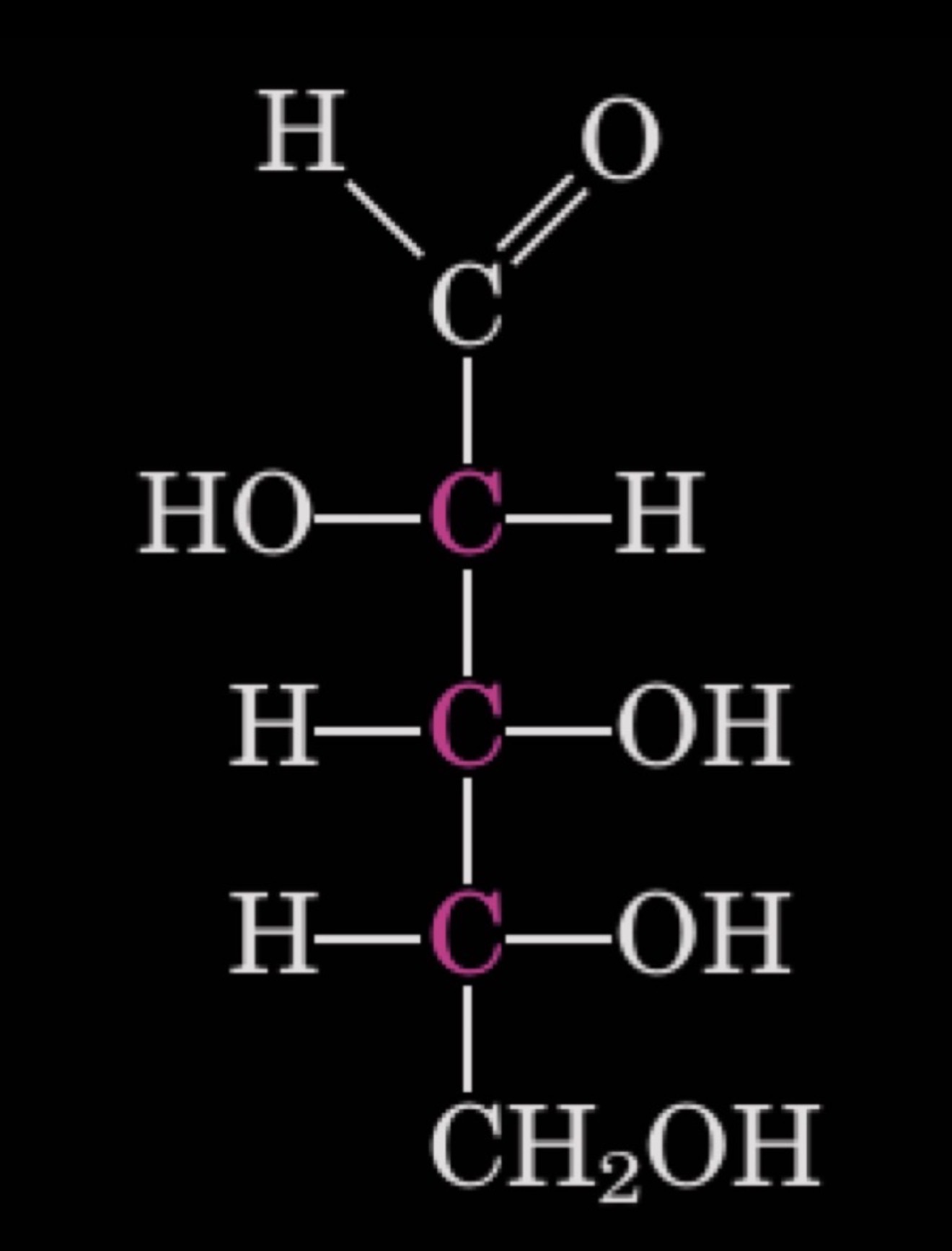
Name this D-aldose
D-Arabinose

Name this D-aldose
D-Xylose

Name this D-aldose
D-Lyxose

Name this D-aldose
D-Allose

Name this D-aldose
D-Altrose

Name this D-aldose
D-Glucose

L-Glucose

Name this D-aldose
D-Mannose

Name this D-aldose
D-Gulose

Name this D-aldose
D-Idose

Name this D-aldose
D-Galactose

Name this D-aldose
D-Talose

Name this D-Ketose
Dihydroxyacetone

Name this D-Ketose
D-Erythrulose

Name this D-Ketose
D-Ribulose

Name this D-Ketose
D-Xyulose

Name this D-Ketose
D-Psicose

Name this D-Ketose
D-Fructose

Name this D-Ketose
D-Sorbose

Name this D-Ketose
D-Tagatose
Most naturally occurring sugars?
D-sugars
Carbohydrates can occur in what forms?
Both linear and cyclic
Enantiomers
Mirror image stereoisomers (D and L)
D-glucose is known as?
Dextrose or blood sugar
Major fuel molecule used by cells to obtain energy
Mutarotation
The interconversion of α and β anomers through the open chain form in solutions
Furanose
5 membered ring
Pyranose
6 membered ring
Can adopt boat (steric interactions) or chair (best stability) conformations
Cyclization of monosaccharides occurs when?
A hydroxyl group reacts with the sugar’s carbonyl group
Aldoses react with alcohols to form?
Hemiacetals
Ketones react with alcohols to form?
Hemiketals
What are the glucose anomers?
α-D-glucose (down OH group) and β-D-glucose (up OH group)