Chemistry OCR - Module 5: Section 2 Energy
 Call Kai
 Learn
 Practice Test
 Spaced Repetition
 Match
 Flashcards
 Knowt Play
1/25

There's no tags or description
Looks like no tags are added yet.
26 Terms
What is the definition of standard lattice enthalpy?
The standard lattice enthalpy, ΔLEH⦵, is the enthalpy change when 1 mole of ionic lattice is formed from its gaseous ions under standard conditions.
The standard lattice enthalpy is a measure of ionic bond strength. The more negative the lattice enthalpy, the stronger the bonding.
What are standard conditions?
298 K (25 °C) and 100 kPa.
What factors impact lattice enthalpy and how?
The higher the charge on the ions, the more energy is released when an ionic lattice forms. This is due to the stronger electrostatic forces between the ions.
More energy released means that the lattice enthalpy will be more negative. So the lattice enthalpies for compounds with 2+ or 2- ions are more exothermic than those with 1+ or 1- ions.
The smaller the ionic radii of the ions involved, the more exothermic the lattice enthalpy. Smaller ions have a higher charge density and their smaller ionic radii mean that the ions can sit closer together in the lattice. Both these things mean that the attractions between the ions are stronger.
How can Born-Haber Cycles be used to calculate lattice enthalpies?
If the compound has a group 2 element, then two ionisation energies are required and 3 for a group 3 element.
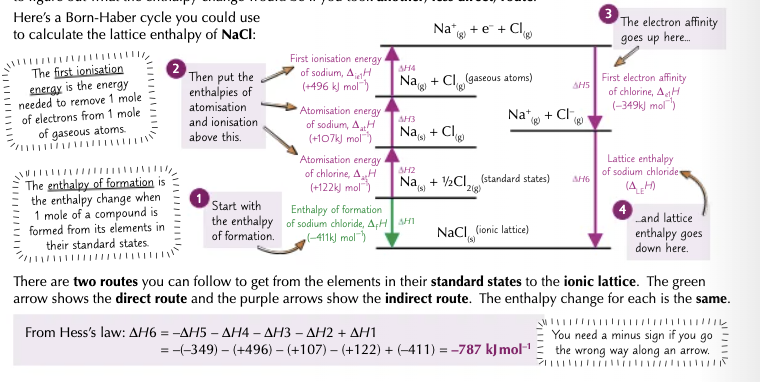
What is Hess’s law?
It says that the total enthalpy change of a reaction is always the same, no matter which route is taken. This shows the conservation of energy.
What is the first ionisation energy?
The energy needed to remove 1 mole of electrons from 1 mole of electrons from 1 moles of gaseous atoms
What is the enthalpy of formation?
The enthalpy change when 1 mole of a compound is formed from its elements in their standard states.
What is the enthalpy change of atomisation?
The total energy required to turn one mole of a substance into individual, isolated atoms in the gaseous state.
What is electron affinity?
the energy change that occurs when an electron is added to a neutral, gaseous atom or molecule to form a negative ion (anion).
What is the enthalpy change of hydration?
ΔhydH⦵, is the enthalpy change when 1 mole of gaseous ions dissolves in water.
What is the enthalpy change of solution?
ΔsolH⦵, is the enthalpy change when 1 mole of solute dissolves in water.
How does ionic charge affect the enthalpy of hydration?
Ions with a higher charge are better at attracting water molecules than those with lower charges, the electrostatic attraction between the ion and the water molecules is stronger. This means more energy is released when the bonds are made giving them a more exothermic enthalpy of hydration.
How does ionic radius affect the enthalpy of hydration?
Smaller ions have a higher charge density than bigger ions. They attract the water molecules better and have a more exothermic enthalpy of hydration.
What is entropy?
Entropy is a measure of the number of ways that particles can be arranged and the number of ways that the energy can be shared out between the particles.
The more disorder the particles are, the higher the entropy is. A large, positive value of entropy shows a high level of disorder.
How do physical states affect entropy?
Solid - Particles just wobble about a fixed point, there is hardly any randomness, so they have the lowest entropy.
Gas - particles whizz around wherever they like, they have got the most random arrangements of particles, so they have the highest entropy.
How do more particles increase entropy?
The more particles there are, the more ways they and their energy can be arranged.
What does thermodynamically stable mean?
When a substance reaches its maximum entropy state (its lowest energy state), it is said to be thermodynamically stable. This means it will not react any further without the input of energy.
How do more arrangements of particles mean more stability?
Substances prefer disorder as they are more energetically stable. So particles will move to try to increase their entropy.
This is why some reactions are feasible (they just happen by themselves without the addition of energy) even when the enthalpy changes is endothermic.
How can you calculate entropy change?
ΔS = Sproducts - Sreactants
The units of entropy are JK-1mol-1
Reactions with a positive value of ΔS are more likely to be feasible, but a negative change in entropy of reaction does not guarantee the reaction cannot happen, enthalpy, temperature and kinetics also play a part in whether or not a reaction occurs.
What is free energy change?
The tendency of a process to take pace is dependent of three things, the entropy ΔS, the enthalpy, ΔH, and the temperature T. When all of these are put together you get the free energy change, ΔG. ΔG tells you if a reaction is feasible or not, the more negative the value of ΔG, the more feasible the reaction.
ΔG = ΔH - TΔS units are J mol-1
When ΔG = 0, the reaction is just feasible. So the temperature at which the reaction becomes feasible can be calculated by rearranging the equation: T = (ΔH)/(ΔS)
Why does a negative ΔG not guarantee a reaction?
The value of the free energy change does not tell you anything about the reaction’s rate/ Even if ΔG shows that a reaction is theoretically feasible, it might have a really high activation energy or happen so slowly that you would not notice it happening at all.
What is an oxidising agent?
An oxidising agent accepts electrons and gets reduced.
What is a reducing agent?
A reducing agent donates electrons and gets oxidised.
What can you add to a half-equation to balance it?
Besides multiplying up the reactants and products you can add electrons, H+ ions and water.
Why are transition elements used as oxidising and reducing agents?
Transition elements are good at changing oxidation state. This makes them useful as oxidising and reducing agents as they will readily give out or receive electrons. As they change oxidation state they often also change colour so it is easy to spot when a reaction is finished.
How are titrations using transition element ions redox titrations?
To work out the concentration of a reducing agent, you need to titrate a known volume of it against an oxidising agent of known concentration. This allows you to work out how much oxidising agent is needed to exactly react with your sample of reducing agent.
To find out how many manganate (VII) ions (MnO4-) are needed to react with a reducing agent:
Measure out a quantity of the reducing agent, e.g. aqueous Fe2+ ions, using a pipette, and put it in a conical flask.
Add some dilute sulfuric acid to the flask, this is an excess, so yo do not have to be too exact.
Gradually add the aqueous MnO4- ( the oxidising agent) to the reducing agent using a burette, swirling the conical flask as you do so.
You stop when the mixture in the flask just becomes tainted with the colour of the MnO4- (the end point) and record the volume of the oxidising agent added.
Run a few titrations and then calculate the mean volume of MnO4-.