Lecture 4: Groups
 Call Kai
 Learn
Learn Practice Test
 Spaced Repetition
 Match
Match Flashcards
 Knowt Play
1/33

There's no tags or description
Looks like no tags are added yet.
Name | Mastery | Learn | Test | Matching | Spaced | Call with Kai | Chat |
|---|
No analytics yet
Send a link to your students to track their progress
34 Terms
What is a Group?
A collection of individuals who have relations to one another that make them interdependent to some degree
Interdependence can vary
Groups harder to define, less interdependent
This class for example. Come each week, learn together, might feel you are a group and interdependent not how everyone feels
On a bus, are you a group then?
Most people would say that individuals riding together in an elevator aren’t a group- but suppose that elevator broke down and those inside must figure out how to escape or summon help, then most would say that those people in the elevator now seem like a real group
People in functioning elevator don’t make up a group because they are not interdependent, but once elevator breaks down they must decide on joint action and become more interdependent and hence more of a group
A collection of individuals who perceive some level of entitativity
Perception a collection has some common attributes &
Greater entitativity can come from physical traits, from a cause a movement which might be one time meetup.
Entitativity part of being a group. If people on bus there was a robert, greater entitativity
the psychological perception that a collection of individuals forms a cohesive, unified group rather than a loose aggregate of unrelated people
What are some advantages to group living?
For our ancestors, group living offered:
Protection from predators (safer with larger group than alone)
Obtaining resources (food)
Assistance in child-rearing
Defense against human aggressors
Fulfills a psychological need to belong
What are disadvantages of groups?
Intergroup competition and status differentials emerge between groups
Some groups higher rank than others
Dominant & dominated groups emerge
Race
Socioeconomic status
Intergroup Bias
Stereotyping
Prejudice
Discrimination
While groups great, important for wellbeing there is darker sides
How does a group Influence the individual? Does mere presence of others make you better or worse at an activity?
What is Social Facilitation?
Idea that another's presence increases arousal, energy level of physiological arousal you have. This strengthens your dominant response
Different in every situation, but whatever you’re most likely to do
Make you more likely to do what you would do anyways
Can have diverging effects on behaviour
If dominant response is correct, enhances your behaviour.
Be better at that thing
For example to tie shoe & timed you, and had you do it again but everyone was watching. You would do it faster
If dominant response incorrect, for things much harder, if what would naturally do isn't the correct response, difficult, hard
For example do complex math problem on board by yourself. You would do an ok job, moderately fast
Then put entire audience, difficult, not great at it, having bunch of people around and arousal it brings will slow you down.
Depends if doing something easy vs hard for you. Is dominant behaviour your likely to engage in correct or not.
Summary
(1) the mere presence of others makes us more aroused- we therefore need to be more alert, aroused in their presence so we can react to what they may do
(2) Arousal tends to make us more rigid & narrowly focused in that we become more inclined to do what we’re already automatically inclined to do
More likely to make a dominant response: the response that person is most likely to make
(3) Increase in dominant response facilitates performance on simple or well learned tasks, as the dominant response likely to be the correct one. Presence of others, facilitates dominant response & improves performance
(4) For difficult or novel tasks, dominant response likely not to be correct response, and the presence of others facilitates an incorrect response & hinders performance

What is an example of Social Facilitation?
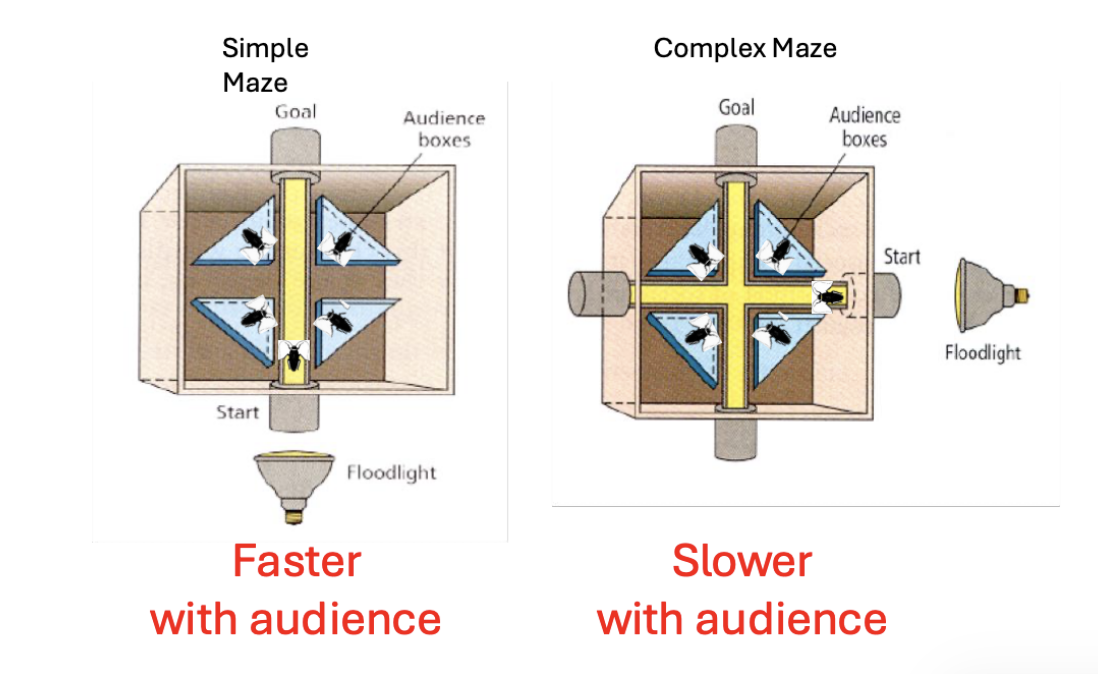
Cockroaches have a dominant response, run away from light, they do not like light
Researchers used this to there advantage, put them in a box and had them run away from flood light
Very simple maze, run out other side, dominant response is the correct response
In one condition had light turn on,
In other condition put other cockroaches, audience watch
Cockroaches faster to get out the other side when they had audience, compared to when they were alone
Arousal at presence of others, increases dominant response run away from light in straight line, made them go faster
Also made a second maze, that was more complicated
If run straight wont make it out need to turn
Had them do it alone or put the cockroaches in audience boxes
Slower with audience
Just like social facilitation model would suggest
Dominant response is to run straight, now that is not correct, have to do things that are not the dominant response
Arousal from audience increasing dominant response to run straight, that is incorrect, so taking them longer
Practice so the complicated becomes routine- Expert vs. Novice
Expert
Lots of practice makes difficult response, dominant response
Gymnast who spend hours practicing routine, that routine so deeply embedded, for them its their dominant response
Putting them in front of audience enhance outcome, perform better
Difficult, but sheer amount of hours has turned that into their dominant response
Novice
No practice means difficult response, NOT dominant response
If haven’t going to be worse
Karaoke analogy
Does the mere presence of others make you better or worse at an activity?
BETTER for simple or well-learned tasks
Mere presence of others tends to facilitate performance of simple or well-learned tasks
WORSE for difficult or novel tasks
Mere presence of others tends to hinder performance on difficult or novel taks
What is Social Facilitation
The effect—either positive or negative— of the presence of others on performance
Is it just the mere presence of others that matters? What is Evaluation Apprehension?
Evaluation Apprehension is the concern about looking bad in eyes of others
People’s concern about how they might appear or be evaluated in the eyes of others
When put people in audience,bodies of people there, but something psychological, evaluating concern of looking bad in front of others
Evaluation Apprehension Task
Pseudo-recognition Task
nansoma, paritaf
zabulon, calpito, joni, plaban…
Researchers designed study mere presence of others vs. evaluation apprehension
What they did was created pseudo recognition task: list of 10 nonsense words & then made participants practice 2/10 of the words more than other words
If do that a bunch of times get comfortable with these words & those words will therefore come dominant response
They are told same words they learned are going to appear on a screen, so briefly may not be able to see it. And the goal was to identify which word they saw from list. If they couldnt see word, they should just guess. (300ms)
Had 2 words very comfortable with, in list of 10, trying to figure out which word on computer screen
How many times accidentally guess words practice a ton: dominant response, by practicing them over & over again, trying to make it into their dominant response, if don;t know go toward dominant response
Idea is are the guessing words training more?
Results
Compared participants performance across 3 conditions: when alone, when in front of evaluative audience & when in front of audience but audience was blindfolded so they cannot evaluate the subject’s performance
Interested in how often the participants gave a dominant response by guessing the most familiar word they had practices most
Participants performing in front of an evaluative audience made more dominant responses than those performing alone did, but those performing in front of a blindfolded audience didn’t
Study shows its not just bodies that cause increase in arousal, its this perception you’re being evaluated that is leading to it
Its the concern about others as a source of evaluation & not their mere presence that’s responsible for social facilitation

What is Social Loafing?
Tendency to exert less effort when working on a group task in which individuals contributions cannot be monitored
Feel when people can blend into group and efforts not seen
If you’re helping friend move a couch up the stairs, might have been tended to hold less than fair share of weight
Group of people pulling on rope, did not pull as hard collectively vs. by themselves
Only one person, the rest confederate, see how hard pulling where they feel like they are blending in vs. when enough
Pull less hard in group, vs individually alone
See this in group protects, tendency to see this type of social loafing.
Part of group, blend into what the group is doing
What is Deindividuation?
Most of the time we feel individuated, we consider ourselves identifiable by others, consider ourselves responsible for our actions and concerned with the consequences of our behaviour
However when we’re in a large group, we often experience a loss of individual identity- a sense of deindividuation (Exercise where shows people have dark thoughts)
Reduced sense of individual identity and self-control that occurs in large groups.
Getting “lost in the crowd, diminished sense of responsibility for our actions
Conditions
More Anonymity
Diffusion of responsibility
High arousal & heightened activity
Sensory overload
Internal State
Less self-observation & self- evaluation
Less concern with evaluations of others
Weakening of internal controls (guilt, fear, shame)
less concern for how others perceive us
Behavior
Impulsivity
Irrationality
Emotionality
Antisociality
Vancouver Riots (2011) Stanley Cup Loss

Deindividuation Study
Halloween deindividuation, drinking, masks
Had 27 homes, over 1000 participants in study
Had setups for kids, kid can take one piece of candy from the bowk, also left some coins out
Will they disregard rule? And take more? And take some coins?
Recorded whether tricker treating alone, or whether in groups & did manipulation where person would say to the kid what’s your name and where do you live.
Trying to individuate them
4 conditions: alone & take candy
One person at house asking name and where they live
Or same things in groups.
If look at alone conditions, lower individuated and alone
In group when anonymous big jump up.
Effect even more reduced when person asking name and where they live.
Counteract that through individuation
The children who arrived in groups were much more likely to transgress than those who were alone, regardless of whether they were alone or not.
Children who were anonymous were much more likely to transgress than those who were individuated, regardless of whether alone or in groups
Anonymous children in groups were most likely to transgress

How can we increase individuation?
Individuation refers to an enhanced sense of individual identity produced by focusing attention on the self
Leads people to act carefully, deliberately & in accordance with their sense of propriety & values
Self-Awareness- What is Self Awareness Theory?
Predicts that when people focus their attention on themselves, they become more concerned with self-evaluation & how their current behaviour conforms to their own standards & values
Activate or reactivate sense of self and self-awareness.
Spotlight effect
Mirrors in store
Many experiments have shown that people act in ways more consistent with their attitudes & values when they’ve been made self-conscious by being placed in front of a mirror or an attentive audience
What is the Spotlight Effect?
Conviction that other people are paying attention to them (appearance or behavior) more than they actually are.
Vision of yourself that you’re under a spotlight.
Had food in teeth, embarrassing, but everyone prob didn’t even realize.
Participation during class for example
Participants asked to put on a Barry Manilow shirt
Overestimated how many people realized they were wearing this shirt
Seems deindividualization at play in very large groups.
How does the internet promote Deindividuation? Is this a good or bad thing?
Do we make better decisions together (as a group)?
Group Decision-making: Groupthink
Faulty thinking by members of a highly cohesive group in which critical scrutiny that should be devoted to the issues at hand is subverted by social pressures to reach a consensus
Groupthink = when keeping the group in agreement becomes more important than thinking critically
Everyone wants to agree so make decisions to meet consensus
Both bad events
Bombing of Pearl Harbour
Messages coming in to DC, no one take it seriously
Challenger Explosion
Information that there was a danger, disregarded
Groupthink is the compromised decision making of a group, fueled by shallow examination of information, narrow consideration of alternatives & sense of invulnerability
Conditions
High cohesiveness
The group is very close and values harmony. Members may avoid disagreeing because they don't want conflict or to upset the group.
Insulation
The group is isolated from outside opinions or information.
Lack of procedures for search and appraisal of information
High stress
Strong Leaders
Symptoms
Illusion invulnerability/moral superiority
The group becomes overly confident: “We're right. We know what we're doing. Our decision can't fail.”
Pressure on dissenters/self- censorship
Pressure to not speak up, pressure to conform & silence themselves
Collective rationalization
Rationalizing whatever decision making, at group level
Stereotypes out-groups
The group develops oversimplified negative views of outsiders or people who disagree with them.
Illusion of unanimity
Think all making same decision, but people who disagree but don’t know how to speak up
Effects on Decision-making
Poor information search
The group doesn't gather enough relevant evidence before deciding.
Shallow examination of information
Even when they have information, they don't analyze it carefully or critically.
Narrow consideration of alternatives
They consider only a few options instead of asking, “What else could we do?”
Bias in processing information
They favour information that supports what the group already wants to believe and discount contradictory evidence.
Failure to work out contingencies
They don't develop backup plans for what they'll do if their original plan fails.
How do we prevent Groupthink?
Leader refrains from making opinions known
Introduce people into the group at different stages
Helps
Designate a devil’s advocate
Tasking one person with bringing to the group’s attention any weaknesses in the group’s deliberations & plans
Group Decision Making- Group Polarization
Tendency for group decision to be more extreme than those made by individual
Group decisions tend to be more extreme than those made by individuals
Being in groups can make group more extreme
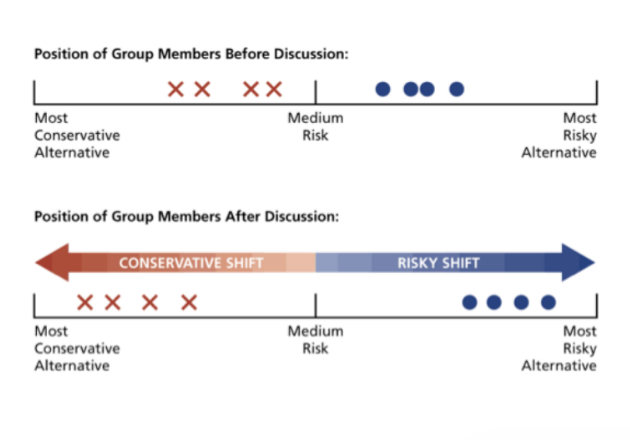
Whatever way the majority of individuals in a group are learning, group discussion tends to make them lean even further in that direction
Imagine position of each group member is like this
As a group make decision, all moved over to more risky decision
Can see on other end too, individual members on more conservative side, when all together, get even more conservative
Everyone has some agreement, then once get together makes everything more extreme
Political Polarization
What can be happening here, is that as we get individuals together, on conservative side with other conservative and liberal
We see this separation and extremism emerging
How are Groups Organized?
All groups have hierarchies, help keep groups stable
At the top, people who have high power
Power
Power is the ability to control one’s own outcomes and those of others
What leads someone to gain power?
2 pathways
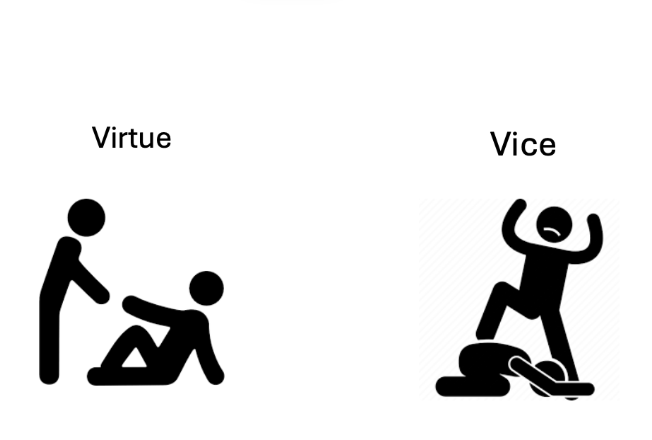
One more virtuous: gain power for doing things good of the group
Share power, share knowledge, mentor, help others
More vice driven way: characterized by dark triads
Manipulative perspective (Machiavellianism)
Any means are justified to get to the end
Narcissism
Psychopathy
More dominance based structure
Use charisma and charm to attain management roles despite poor performance & engage in more Machiavellian behaviours
Can both lead to power
Vice good at getting power, not good at holding onto it
Those who use virtuous takes longer but tend to hold onto power
Drawn to narcissistic leaders but end up falling. Dont last very long, dont help group as much as they should.
How does power influence a person?
Power corrupts
What is Approach/Inhibition Theory?
High-power people tend to inclined to go after their goals & make quick (sometimes rash) judgments
Low-power people more inclined to constrain their behavior & pay careful attention to others
High power approach oriented, have goals, want to get them, can go for them
Low power people more inhibited, don’t have power, what others do determine their world, attentive to what people need, attentive to people
Approach behaviour: tend to be less concerned about the evaluations of others & more inclined to act in goal driven ways
Reduced power associated with increased dependence on others, as a result less power people show inhibition behaviour: tend to be more vigilant and careful in making judgements & decisions & more restrained when taking action
Empathy
Power affects how one perceives others and reduces empathy
Impacts empathy: how we feel other people’s emotions & feel their thoughts
Approach vs. inhibited mindset, how that may map onto empathy
Across a bunch of these studies higher people less empathetic than lower
High-power people inclined to go after their own goals, less careful and less systematic in their thoughts about others
High power individuals more likely to stereotype others than to carefully attend to individuating informationa bout them
High-power people are less accurate judges of others emotions
Often fail to respond empathetically to others as they are less careful in their judgements,,

What is the E Test?
Put people in low or high power mindset
Had them recalled time controlled by someone or exerted control over someone
Then had people draw E on forehead
Effortful mental rotation, how would this person see me
Considers marker of perspective taking.
Had them complete a simple perspective taking test: drawing the letter E on their forehead so someone sitting across them could read it. Requires participants to take the other person’s perspective & draw the E in reverse.
Higher power people did worse compared to low power
Effect on how well able to do perspective taking rotation task.

Disinhibited Behaviour
Influences how constrained behaviour is
High power people do little things approach oriented, interrupt more, swear more, disinhibited
Low power people do those things less, more constrained & inhibited so dont jump in or swear
Higher power more likely to act unethically
Selfish
High power in approach mindset more likely to engage in selfish, unethical things to met their ends
Higher power people engage in appropriate acts more than lower power: more touch of other people, overestimate peoples sexual interest in them, lead to more sexual inappropriate behaviour
Very unconstrained approach, reward seeking, disinhibited person thats what power does.
Power within a hierarchy
Correlated with power: more powerful they are = more likely they were
Do unethical things, unconstrained behaviour when have more power

Inhibition: Low Power people more likely to:
Inhibit themselves
Constrict their posture
Dampen expression
Refrain from speaking up
Safe behaviours
Power corrupts the corruptible
Power doesn’t necessarily corrupt but makes us more like what we were originally
If your someone on selfish side, more selfish
Cases where people more prosocial, gain power, those people look even more prosocial when they have social, always vared about people, now unconstrained and uninhibited do more of that
Right side what power doing, amplifying who we were in the first place.
