Blood

0.0(0)
Studied by 0 people
call kaiCall Kai
learnLearn
examPractice Test
spaced repetitionSpaced Repetition
heart puzzleMatch
flashcardsFlashcards
GameKnowt Play
Card Sorting

1/29

encourage image

There's no tags or description

Looks like no tags are added yet.

30 Terms

1
New cards

Hematocrit

  • determines the percent of RBCs in your entire blood volume.

  • normal: 37-47% RBCs

  • elevated: patient dehydrated or blood doping

  • low: anemia


2
New cards

Components of blood

  • Plasma 55%: water, proteins (albumins, globulins, fibrogen, regulatory protein)

  • Buffy coat >1%: leukocytes, lymphocytes, platelets

  • Erythrocytes 44%: red blood cells


3
New cards

Albumin

  • smallest and most abundant plasma protein

  • regulates water movement between blood and interstitial fluid

  • helps with osmolarity

  • also carries ions, hormones, lipids, vitamins, and hormones


4
New cards

Globulins

  • second largest group of plasma proteins

  • immunoglobulins → soluble proteins produced by immune cells

  • globulin produced by the immune system


5
New cards

Fibrinogen

  • fibrinogen is converted to fibrin → helps to form a blood clot

  • released by platelets


6
New cards

Why would a blood smear be done?

  • to see cellular components of blood → blood is not all cells


7
New cards

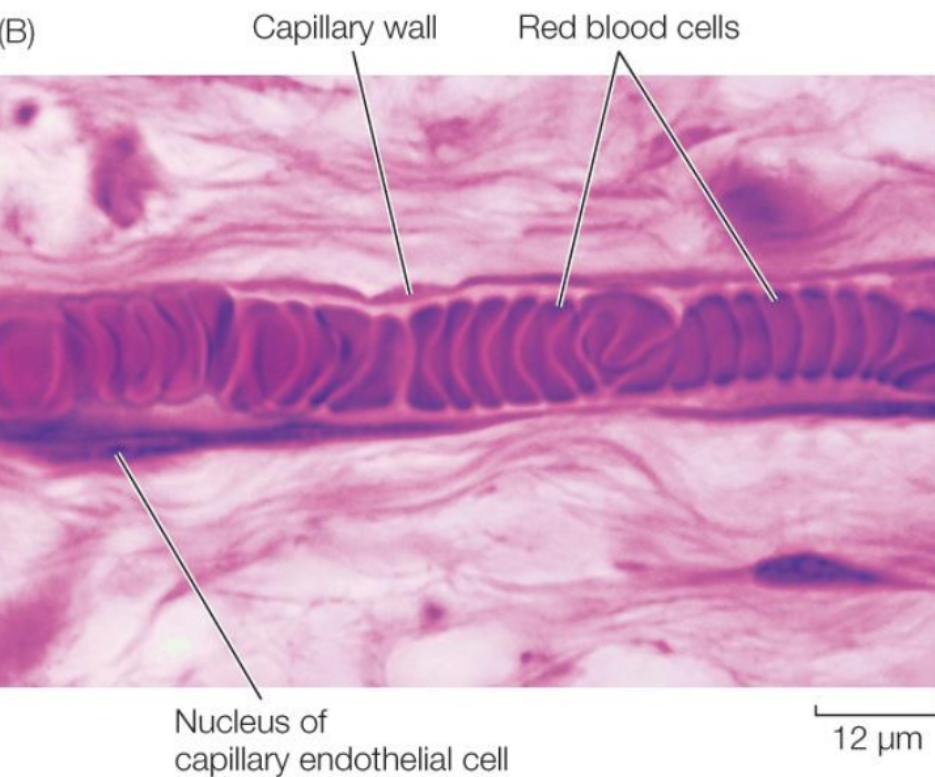
Erythrocytes

  • red Blood Cells → 44% of Whole Blood

  • no nucleus or organelles

  • transport oxygen to tissue and carbon dioxide to lungs

  • shape: biconcave disc shape facilitates gas exchange

    • help RBCs squeeze through capillaries

    • allows for rapid diffusion of gas


<ul><li><p>red Blood Cells → 44% of Whole Blood</p></li><li><p><strong>no nucleus or organelles</strong></p></li><li><p>transport oxygen to tissue and carbon dioxide to lungs</p></li><li><p><strong>shape</strong>: biconcave disc shape facilitates gas exchange</p><ul><li><p>help RBCs squeeze through capillaries</p></li><li><p>allows for rapid diffusion of gas</p></li></ul></li></ul><p></p>
8
New cards

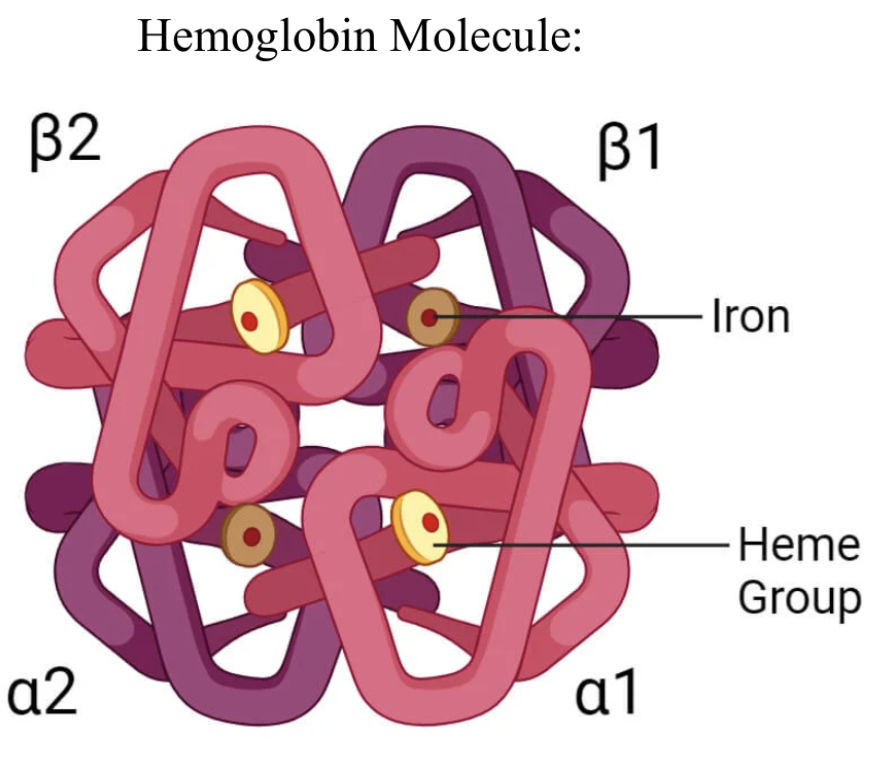
Hemoglobin

  • 4 globin chains

  • 4 heme units

    • each heme unit contains 1 iron

      • each iron binds 1- O2 molecule

      • iron binds O2 or CO2 during gas exchange

<ul><li><p>4 globin chains</p></li><li><p><strong>4 heme units</strong></p><ul><li><p>each heme unit contains <strong>1 iron</strong></p><ul><li><p>each iron binds 1- O2 molecule</p></li><li><p>iron binds O2 or CO2 during gas exchange</p></li></ul></li></ul></li></ul><p></p>
9
New cards

Hematopoiesis

  • occur in red bone marrow

  • hematopoietic stem cells → hematocytoblasts

  • hematocytoblasts produce lymphoid and myeloid cells


<ul><li><p><strong>occur in red bone marrow</strong></p></li><li><p>hematopoietic stem cells → <strong>hematocytoblasts</strong></p></li><li><p>hematocytoblasts produce <strong>lymphoid and myeloid cells </strong></p></li></ul><p></p>
10
New cards

Myeloid cells

  • produce: erythrocytes, megakaryocytes and all leukocytes, except lymphocytes


11
New cards

Lymphoid cells

  • only produce lymphocytes: B cells, T cells, NK cells


12
New cards

Erythropoiesis

  • stimulated by erythropoietin (hormone)

  • where:

    • midline bones: skull, sternum, ribs, vertebrae, scapula, pelvis

    • proximal end of proximal long bones: humerus and long bones

    • pretty much everywhere but distal areas of extremities


<ul><li><p>stimulated by <strong>erythropoietin</strong> (hormone)</p></li><li><p><strong>where</strong>:</p><ul><li><p><strong>midline bones:</strong> skull, sternum, ribs, vertebrae, scapula, pelvis</p></li><li><p><strong>proximal end of proximal long bones</strong>: humerus and long bones </p></li><li><p>pretty much everywhere but distal areas of extremities </p></li></ul></li></ul><p></p>
13
New cards

Bone marrow transplants

  • infuses healthy blood-forming stem cells into your body

  • reasons: blood cancers, sickle cell anemia, autoimmune diseases


14
New cards

Erythrocyte Life Cycle

  • erythrocytes form in red bone marrow

  • circulate and live for 120 days

  • in spleen and liver → erythrocytes are decomposed and recycled

  • hemoglobin and iron are recycled → stored in red bone marrow for new RBC production


<ul><li><p>erythrocytes form in red bone marrow </p></li><li><p>circulate and live for <strong>120 days</strong></p></li><li><p>in <strong>spleen</strong> and <strong>live</strong>r → erythrocytes are <strong>decomposed and recycled</strong></p></li><li><p><strong>hemoglobin and iron are recycled</strong> → stored in <strong>red bone marrow </strong>for new RBC production </p></li></ul><p></p>
15
New cards

Blood types

  • cell surface antigens: A, B, and O

  • all blood cells have O

  • presence or absence of A/B determine blood type

  • white blood cells produce antibodies not found on own RBCs (no need for prior exposure)

    • type A: anti-B antibodies

    • type B: anti-type A antibodies

    • type O: anti B and anti-A antibodies


16
New cards

Blood type mismatch

  • if a blood type different from one’s own is introduced to body → immune cells attack

  • antibodies will form complexes with foreign blood cells → hemoylsis (destruction)

  • complexes are called agglutination


17
New cards

Type O blood

  • is a universal DONOR

  • but can only RECEIVE type O → because body creates anti-A and anti-B antibodies


18
New cards

Type AB blood

  • universal RECIPIENT

  • because body has no antibodies


19
New cards

RH blood type

  • determined by presence or absence of RH surface antigen

  • when surface D is present → individual is Rh+

  • unlike ABO blood group, body only forms anti-D antibodies AFTER exposure

  • pregnancy is special circumstance of exposure

  • ABO and Rh blood types are independent of each other


20
New cards

Leukocytes

  • white blood cells: macrophage/monocyte, neutrophil, eosinophil, basophil, dendritic cell, B cell, T cell, NK cell

  • initiate immune response

  • contain nuclei

  • larger than RBCs

  • can leave bloodstream

  • classified as granular or agranular


<ul><li><p><strong>white blood cells</strong>: macrophage/monocyte, neutrophil, eosinophil, basophil, dendritic cell, B cell, T cell, NK cell</p></li><li><p><strong>initiate immune response</strong></p></li><li><p>contain nuclei</p></li><li><p>larger than RBCs</p></li><li><p>can leave bloodstream</p></li><li><p>classified as granular or agranular</p></li></ul><p></p>
21
New cards

Granular leukocyte

  • have visible cytoplasmic granules

  • nuclei divided into 2-5 lobes

  • also referred to as polymorphonuclear (PMN)

  • neutrophils, eosinophils, basophils


<ul><li><p>have visible cytoplasmic granules</p></li><li><p>nuclei divided into 2-5 lobes</p></li><li><p>also referred to as polymorphonuclear <strong>(PMN)</strong></p></li><li><p><strong>neutrophils, eosinophils, basophils </strong></p></li></ul><p></p>
22
New cards

Granules

  • digestive enzymes that destroy bacteria


23
New cards

Pus

  • accumulation of dead tissue, cells, and bacteria


24
New cards

Agranular

  • cytoplasmic granules are not visible

  • single lobed, large nucleus

  • monocytes, lymphocytes


<ul><li><p>cytoplasmic granules are not visible</p></li><li><p>single lobed, large nucleus</p></li><li><p><strong>monocytes, lymphocytes</strong></p></li></ul><p></p>
25
New cards

Neutrophils

  • granular

  • most abundant WBC

  • nucleus has 2-5 connected lobes

  • first immune cells are site of infection

  • leave blood stream and enter infected tissue


<ul><li><p><strong>granular</strong></p></li><li><p>most abundant WBC</p></li><li><p>nucleus has 2-5 connected lobes</p></li><li><p><strong>first immune cells are site of infection</strong></p></li><li><p>leave blood stream and enter infected tissue</p></li></ul><p></p>
26
New cards

Eosinophils

  • granular

  • 1-4% of WBCs

  • nucleus with 2 connected lobes, granules stain red

    • earmuff shaped

  • attack parasites


<ul><li><p><strong>granular</strong></p></li><li><p>1-4% of WBCs</p></li><li><p>nucleus with 2 connected lobes, <strong>granules stain red</strong></p><ul><li><p>earmuff shaped</p></li></ul></li><li><p><strong>attack parasites</strong></p></li></ul><p></p>
27
New cards

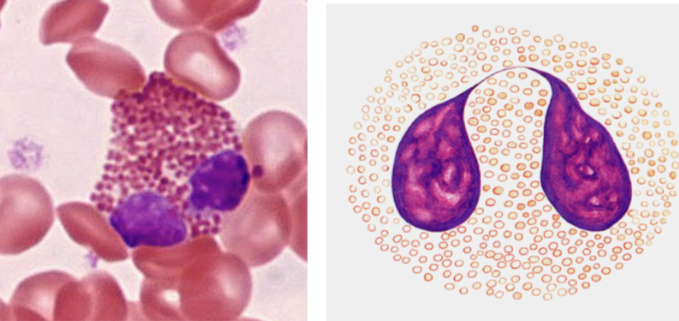
Basophil

  • granular

  • least abundant WBC → 0.5-1%

  • U or S shaped nucleus

  • granules stain dark blue (blue for basophil)

  • release histamine or heparin during allergic reaction or inflammatory response


<ul><li><p><strong>granular</strong></p></li><li><p><strong>least abundant WBC</strong> → 0.5-1%</p></li><li><p>U or S shaped nucleus</p></li><li><p>granules <strong>stain dark blue </strong>(<strong>b</strong>lue for <strong>b</strong>asophil)</p></li><li><p>release <strong>histamine or heparin</strong> during <strong>allergic</strong> reaction or <strong>inflammatory response</strong></p></li></ul><p></p>
28
New cards

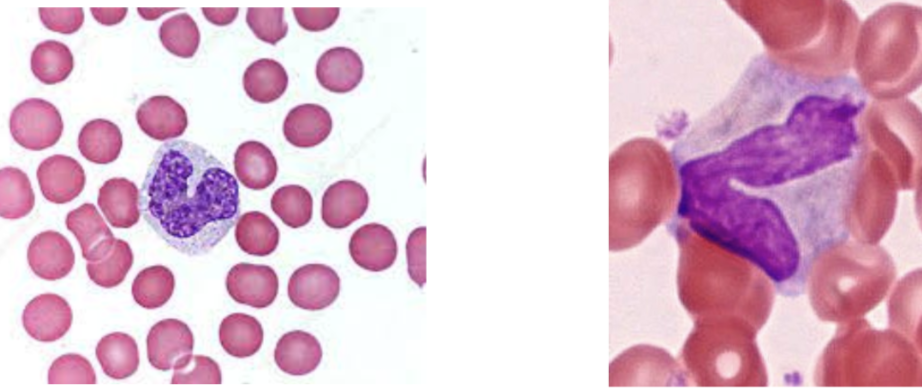
Monocytes

  • agranular

  • 2-8% of WBCs

  • nucleus 3x the size of RBC

  • horseshoe shaped nucleus

  • phagocytize (ingest) bacteria and cells

  • in the blood: called a monocyte

  • out of blood: macrophages


<ul><li><p><strong>agranular</strong></p></li><li><p>2-8% of WBCs</p></li><li><p>nucleus 3x the size of RBC</p></li><li><p>horseshoe shaped nucleus</p></li><li><p><strong>phagocytize</strong> (ingest) bacteria and cells</p></li><li><p>in the blood: called a <strong>monocyte</strong></p></li><li><p>out of blood: <strong>macrophages</strong></p></li></ul><p></p>
29
New cards

Lymphocytes

  • agranular

  • 20-40% of WBCs

  • nucleus almost fills cell

  • reside in lymphatic structures and organs


<ul><li><p><strong>agranular</strong></p></li><li><p>20-40% of WBCs</p></li><li><p><strong>nucleus almost fills cell</strong></p></li><li><p>reside in lymphatic structures and organs</p></li></ul><p></p>
30
New cards

Platelets (Thrombocytes)

  • don’t have a nucleus

  • platelets are NOT cells → are cell fragments not whole cells

  • produced by megakaryoctes in bone marrow

  • how they work:

    • megakaryocytes extend processes into blood vessels

    • force of blood breaks off pieces → creating platelets


<ul><li><p><strong>don’t have a nucleus</strong></p></li><li><p><strong>platelets are NOT cells</strong> → are cell fragments not whole cells<strong> </strong></p></li><li><p>produced by <strong>megakaryoctes </strong>in bone marrow</p></li><li><p>how they work:</p><ul><li><p><strong>megakaryocytes</strong> extend processes into blood vessels</p></li><li><p>force of blood breaks off pieces → <strong>creating platelets</strong></p></li></ul></li></ul><p></p>