Organic Chem - Test

0.0(0)
Studied by 0 people
call kaiCall Kai
learnLearn
examPractice Test
spaced repetitionSpaced Repetition
heart puzzleMatch
flashcardsFlashcards
GameKnowt Play
Card Sorting

1/13

encourage image

There's no tags or description

Looks like no tags are added yet.

14 Terms

1
New cards

Alkanes/Base formula?

Single bond, CnH(2n+2)

<p>Single bond, CnH(2n+2)</p>
2
New cards

Alkene/Base formula?

Double bond (C=C), CnH(2n)

<p>Double bond (C=C), CnH(2n)</p>
3
New cards

Alkyne/Base formula?

Triple bond, CnH(n-2)

4
New cards

Stereoisomers/Which group on top/bottom?

Cis- both hydrogen or lower priority on bottom

Trans - adjacent

<p>Cis- both hydrogen or lower priority on bottom</p><p class="has-focus">Trans - adjacent</p>
5
New cards

Aromatic Hydrocarbons

Formula: C6H6

Groups attached/parent - Benzene

Substituent - Phenyl

One methyl - Toluene

example: Chlorobenzene, bromo benzene

Ortho (1,2), Meta (1,3), Para (1,4)

1,2 - dimethyl benzene — orthoxylene (alt. Naming)


Properties:

Generally nonpolar.

Insoluble in water.

Soluble in nonpolar solvents.

Combustible.

Benzene is toxic


Reaction: Undergo substitution under extreme conditions (alkylation, halogenation, nitration) replace an H w/ alkyl, halogen, nitrate (NO2)

6
New cards

Alcohol

Functional group - Hydroxyl (-OH)

Suffix (-ol), when not priorjty (hydroxy)

Choose longest chain with (OH)

Primary - attached to 1 R group, secondary - attached to 2 R group, tertiary, attached to 3 R groups

Properties:

Polar because of –OH.

Can form hydrogen bonds.

Higher boiling points than comparable alkanes.

Short-chain alcohols are water-soluble.

Solubility decreases as carbon chain length increases

<p>Functional group - Hydroxyl (-OH)</p><p class="has-focus">Suffix (-ol), when not priorjty (hydroxy)</p><p class="has-focus">Choose longest chain with (OH)</p><p class="has-focus">Primary - attached to 1 R group, secondary - attached to 2 R group, tertiary, attached to 3 R groups</p><p class="has-focus">Properties: </p><p class="has-focus">Polar because of –OH.</p><p class="has-focus">Can form hydrogen bonds.</p><p class="has-focus">Higher boiling points than comparable alkanes.</p><p class="has-focus">Short-chain alcohols are water-soluble.</p><p class="has-focus">Solubility decreases as carbon chain length increases</p>
7
New cards

Ethers

Functional group : R-O-R¹

Oxygen connects two groups

alkOXYalkane

(Side with longer chain is -ane)

E.g., methoxyethane

Properties:

Slightly polar due to C–O bonds.

Can accept hydrogen bonds but cannot hydrogen bond with themselves.

Lower boiling points than comparable alcohols.

Small ethers have some water solubility.

<p>Functional group : R-O-R¹</p><p class="has-focus">Oxygen connects two groups</p><p class="has-focus">alkOXYalkane</p><p class="has-focus">(Side with longer chain is -ane)</p><p class="has-focus">E.g., methoxyethane</p><p class="has-focus">Properties:</p><p class="has-focus">Slightly polar due to C–O bonds.</p><p class="has-focus is-empty">Can accept hydrogen bonds but cannot hydrogen bond with themselves.</p><p class="has-focus is-empty">Lower boiling points than comparable alcohols.</p><p class="has-focus is-empty">Small ethers have some water solubility.</p>
8
New cards

Aldehydes

Contains a (C=O) carbonyl group

Always on Carbon #1

Suffix -ol

Properties:

Polar due to C=O.

Can accept hydrogen bonds but cannot hydrogen bond with themselves.

Lower boiling points than comparable alcohols.

Small aldehydes are water-soluble
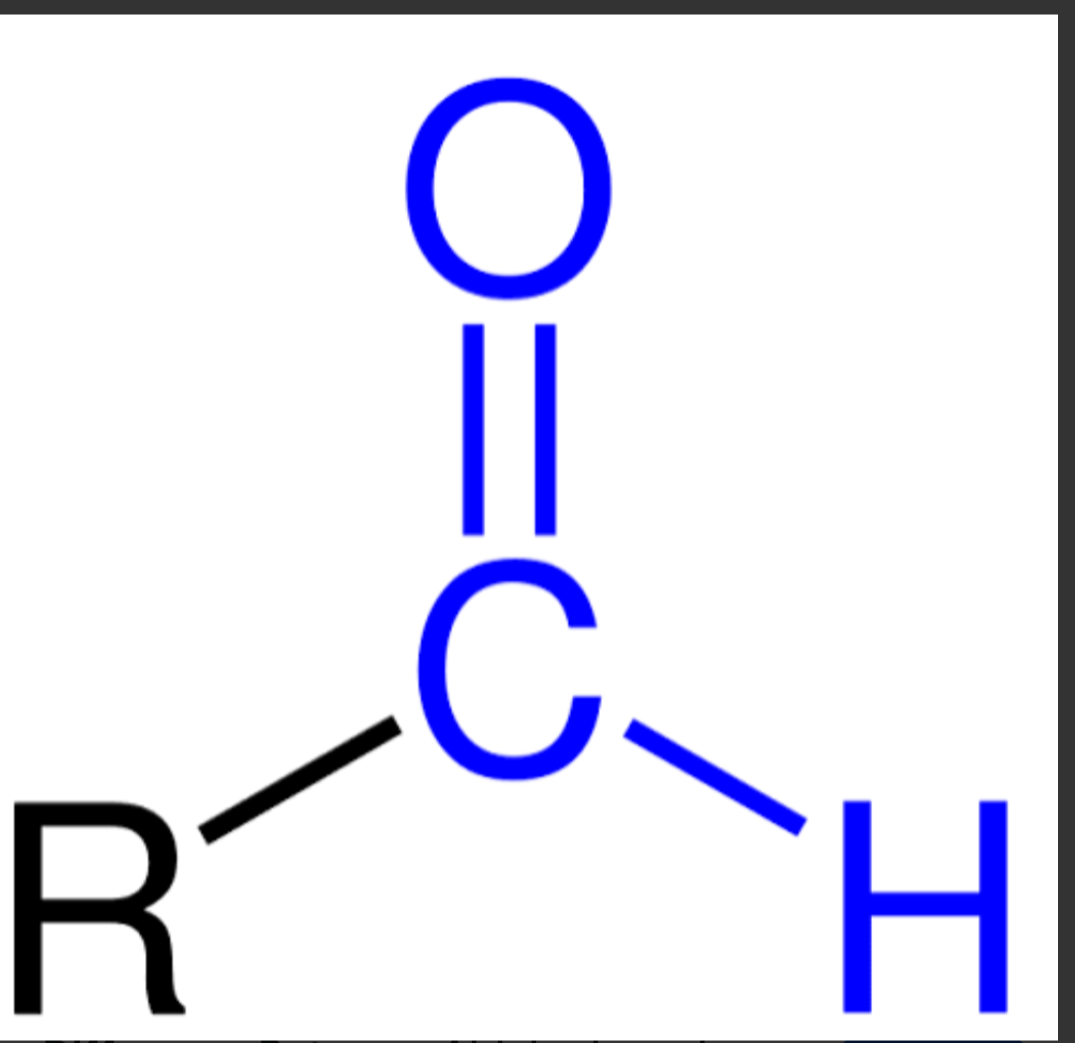
<p>Contains a (C=O) carbonyl group</p><p class="has-focus">Always on Carbon #1</p><p class="has-focus">Suffix -ol</p><p class="has-focus">Properties:</p><p class="has-focus">Polar due to C=O.</p><p class="has-focus is-empty">Can accept hydrogen bonds but cannot hydrogen bond with themselves.</p><p class="has-focus is-empty">Lower boiling points than comparable alcohols.</p><p class="has-focus is-empty">Small aldehydes are water-soluble</p>
9
New cards

Ketones

Contains (C=O) carbonyl group

Gen. R-CO-R¹

Always within carbon chain

Example: propanone (acetone)

Give lowest possible number

Properties:

Polar due to C=O.

Can accept hydrogen bonds but cannot hydrogen bond with themselves.

Higher boiling points than comparable alkanes.

Lower boiling points than comparable alcohols.

Small ketones are water-soluble.

<p>Contains (C=O) carbonyl group</p><p class="has-focus">Gen. R-CO-R¹</p><p class="has-focus">Always within carbon chain</p><p class="has-focus">Example: propanone (acetone)</p><p class="has-focus">Give lowest possible number</p><p class="has-focus">Properties:</p><p class="has-focus">Polar due to C=O.</p><p class="has-focus is-empty">Can accept hydrogen bonds but cannot hydrogen bond with themselves.</p><p class="has-focus is-empty">Higher boiling points than comparable alkanes.</p><p class="has-focus is-empty">Lower boiling points than comparable alcohols.</p><p class="has-focus is-empty">Small ketones are water-soluble.</p>
10
New cards

Carboxylic Acid

Contains (COOH) carboxyl group

Has C=O and OH

Suffix (oic acid)

Always in #1 carbon

Could have multiple COOH group, dioic (keep -e)

E.g., ethanoic acid


Properties:

Polar.

Can form hydrogen bonds.

High boiling points.

Weak acids (partially ionize in water).

Small carboxylic acids are water-soluble.


<p>Contains (COOH) carboxyl group </p><p class="has-focus">Has C=O and OH</p><p class="has-focus">Suffix (oic acid)</p><p class="has-focus">Always in #1 carbon</p><p class="has-focus">Could have multiple COOH group, dioic (keep -e)</p><p class="has-focus">E.g., ethanoic acid</p><p class="has-focus"></p><p class="has-focus is-empty">Properties:</p><p class="has-focus">Polar.</p><p class="has-focus is-empty">Can form hydrogen bonds.</p><p class="has-focus is-empty">High boiling points.</p><p class="has-focus is-empty">Weak acids (partially ionize in water).</p><p class="has-focus is-empty">Small carboxylic acids are water-soluble.</p><p class="has-focus is-empty"></p>
11
New cards

Esters

Gen structure: R - COO - R¹

(Oxygen in the middle, double bond O on one side, alkyl group on other side)

Carboxylic acid + alcohol —> esterification

alkYLalkylOATE

-yl from alcohol

-oate from carboxylic acid

E.g., ethyl ethanoate

(Side with double bond O is the -oate side)


Properties:

Polar.

Cannot hydrogen bond with themselves.

Lower boiling points than comparable carboxylic acids.

Often have fruity smells.

Small esters have some water solubility.


<p>Gen structure: R - COO - R¹</p><p>(Oxygen in the middle, double bond O on one side, alkyl group on other side)</p><p class="has-focus">Carboxylic acid + alcohol —&gt;  esterification </p><p class="has-focus">alkYLalkylOATE</p><p class="has-focus">-yl from alcohol</p><p class="has-focus">-oate from carboxylic acid</p><p class="has-focus">E.g., ethyl ethanoate</p><p class="has-focus">(Side with double bond O is the -oate side)</p><p class="has-focus"></p><p class="has-focus">Properties:</p><p class="has-focus">Polar.</p><p class="has-focus is-empty">Cannot hydrogen bond with themselves.</p><p class="has-focus is-empty">Lower boiling points than comparable carboxylic acids.</p><p class="has-focus is-empty">Often have fruity smells.</p><p class="has-focus is-empty">Small esters have some water solubility.</p><p class="has-focus"></p>
12
New cards

Amines

Derived from ammonia, NH2

Suffix - amine

When it is not the priority, use prefix amino

Primary, when it has 1 alkyl group, secondary, 2 alkyl group, tertiary, 3 alkyl groups

Properties: Polar.

Primary and secondary amines can hydrogen bond with each other.

Tertiary amines cannot hydrogen bond with themselves.

Generally weak bases (accept H⁺).

Small amines are water-soluble.

<p>Derived from ammonia, NH2</p><p class="has-focus">Suffix - amine</p><p class="has-focus">When it is not the priority, use prefix amino</p><p class="has-focus">Primary, when it has 1 alkyl group, secondary, 2 alkyl group, tertiary, 3 alkyl groups </p><p class="has-focus">Properties: Polar.</p><p class="has-focus">Primary and secondary amines can hydrogen bond with each other.</p><p class="has-focus">Tertiary amines cannot hydrogen bond with themselves.</p><p class="has-focus">Generally weak bases (accept H⁺).</p><p class="has-focus">Small amines are water-soluble.</p>
13
New cards
<p>Amides</p>

Amides

Functional group: CONH2

Contains carbonyl DIFFERENCE FROM AMINE : (C=O) directly on nitrogen

-amide suffix

-Use N- as prefix to say alkyl group attached to Nitrogen


E.g., N-ethyl-N-methylbutanamide

Butanamide = 4-carbon parent chain including the carbonyl carbon.

N-methyl = CH₃ branch on Nitrogren

N-ethyl = ethyl group attached directly to nitrogen.

The carbonyl carbon is always carbon 1.


Formed from - carboxylic acid + alcohol


Properties

Polar.

Primary and secondary amides can hydrogen bond.

High boiling points due to hydrogen bonding.

Small amides are generally water-soluble.

Generally neutral (not basic like amines).


14
New cards

Alkyl halides



