Veterinary Ectoparasitology: Fleas, Lice, Flies, Ticks, and Mites
 Note
Note Call Kai
 Learn
Learn Practice Test
 Spaced Repetition
 Match
Match Flashcards
 Knowt Play
1/49

Earn XP
Description and Tags
A comprehensive vocabulary flashcard set covering key terms, taxonomic orders, species, diagnostic procedures, and morphological features for veterinary ectoparasites based on lecture notes.
Name | Mastery | Learn | Test | Matching | Spaced | Call with Kai | Chat |
|---|
No analytics yet
Send a link to your students to track their progress
50 Terms

Genal Comb
A heavy spine-like comb structure located on the ventral margin of the head of certain flea species, such as Ctenocephalides.
Pronotal Comb
A comb-like row of heavy spines located on the posterior margin of the first thoracic segment (pronotum) of certain fleas.

Ctenocephalides felis
The cat flea, which is the most common flea species found on both dogs and cats; possesses both genal and pronotal combs.

Echidnophaga gallinacea
The poultry sticktight flea, characterized by having a sharply angled head and no pronotal or genal combs.
Xenopsylla cheopis
The oriental rat flea, a flea species lacking combs and featuring a rounded head, found on rodents and rabbits.
Cediopsylla simplex
The common eastern rabbit flea, which prefers infestation sites on the face and neck of rabbits.
Odontopsylla
The giant eastern rabbit flea, which preferentially infests the tail head region of rabbits.
Flea Dirt
Flea feces containing digested blood from blood meals, which turns red when water is applied.

Order Mallophaga
The order of chewing or biting lice, characterized by a head that is broader than the thorax.

Order Anoplura
The order of sucking lice, characterized by a head that is narrower than the thorax and mouthparts adapted for blood feeding.

Trichodectes canis
The canine biting louse belonging to the order Mallophaga.

Felicola subrostratus
The feline biting louse, distinguished by having a head that is pointed and notched at the tip.

Linognathus setosus
The canine sucking louse, lacking ocular points, whose second and third pairs of legs are larger than the first pair and end in large claws.

Haematopinus suis
The hog louse, which is the largest sucking louse found on domesticated animals; features prominent ocular points and legs of equal size.

Solenopotes capillatus
The little blue cattle louse, a sucking louse identified by projecting tubercles carrying spiracles on its abdominal segments.
Bovicola bovis
The biting louse of cattle, characterized by a head broader than its thorax.
Bovicola ovis
A small white or tan biting louse of sheep that can be difficult to detect in heavy fleece.

Melophagus ovinus
The sheep ked, a wingless fly (six-legged insect) often mistaken for a tick, whose excrement resembles flea feces.

Cuterebra
A genus of bot fly whose fully developed larvae reach about 2.5cm in length, are dark colored, and develop in subcutaneous tissue.

Oestrus ovis
The ovine nasal bot, which infests the nasal passages of small ruminants and leaves the host to pupate in the environment.

Gastrophilus intestinalis
The most common equine bot species, which attaches its eggs to the hairs of the forelegs of horses.
Hypoderma lineatum
The early third-instar cattle grub (warble), distinguished from fly maggots by its barrel-shaped body and subcutaneous location on the host's back.
Fly Strike
Myiasis occurring when an animal becomes infested with fly maggots, particularly common in sheep with wet or feces-soiled wool during warm weather.

Family Ixodidae
The family of hard ticks, defined by the presence of a hard dorsal scutum and prominent, anteriorly visible mouthparts.

Family Argasidae
The family of soft ticks, characterized by a soft leathery cuticle, ventrally located mouthparts not visible from above, and feeding habits involving frequent short blood meals.
Scutum
The hard dorsal chitinous plate in hard ticks that covers the entire dorsum in males and the anterior one-third or less in females.
Seed Tick
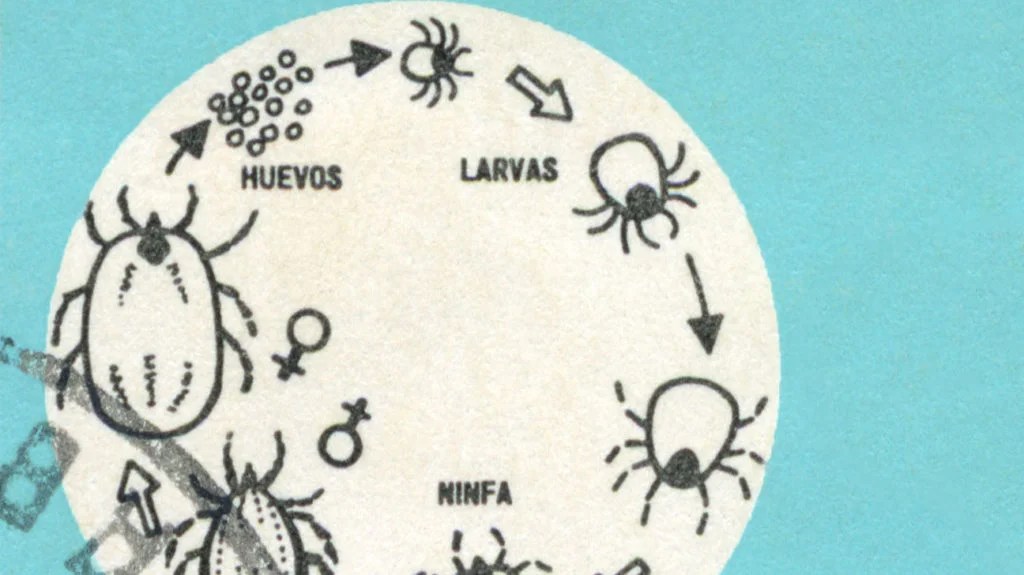
The larval stage of a tick, easily distinguished from nymphs and adults by possessing only six legs.

Amblyomma americanum
The lone star tick, whose adult female is easily identified by a prominent single white spot on the posterior margin of the scutum.
Amblyomma maculatum
The Gulf Coast tick, a hard tick with long mouthparts that feeds primarily on the head and neck of birds and mammals.

Ixodes scapularis
The deer tick, a primary vector of Lyme disease in the United States, characterized by an unornamented scutum and an anal groove running anterior to the anus.

Dermacentor variabilis
The American dog tick (wood tick), an ornamented hard tick with short mouthparts, a rectangular basis capituli, and festoons along the posterior margin.

Dermacentor andersoni
The Rocky Mountain wood tick, an ornamented hard tick species found in the central and western United States and Canada.

Rhipicephalus sanguineus
The brown dog tick, an unornamented tick with a hexagonal basis capituli featuring flared sides, capable of using dogs as hosts for every life cycle stage.

Rhipicephalus (Boophilus) microplus
A one-host tick of cattle with ridged palps that serves as the vector for bovine babesiosis.
Otobius
The spinose ear tick genus, a soft tick whose parasitic larval and nymphal stages are covered with spines and cluster in host ears.
Argas sp.
The fowl tick, a soft tick with a granulated surface and ventrally placed mouthparts.

Ornithodoros
A genus of soft tick whose surface is covered with mammillae (small bumps) and lacks a distinct body margin.
Cellophane Tape Preparation
A diagnostic technique for collecting surface lice and fur mites by pressing clear tape onto the skin and mounting it over a line of mineral oil on a slide.
Deep Skin Scrape
A diagnostic procedure for detecting burrowing mites performed by scraping an oil-dipped scalpel blade perpendicularly against pinched skin until capillary blood oozes.

Sarcoptes scabiei
The scabies mite, a round-bodied burrowing mite causing severe pruritus and skin thickening, characterized by short posterior legs, sawtooth dorsal scales, and long unjointed stalks with suckers.

Notoedres
A burrowing mite similar to Sarcoptes, distinguished by having its anus located on the dorsal surface and possessing scalloped dorsal scales.

Demodex folliculorum
The follicular mange mite of dogs, shaped like a cigar with short legs, measuring about 390μm in length, which resides in hair follicles and sebaceous glands.
Psoroptes cuniculi
An oval psoroptic mite with long legs and suckers on long, segmented stalks (pedicles), measuring up to 800μm, that causes crusty ear mange in rabbits and scab in ruminants.
Chorioptes
A genus of psoroptic-like surface mites distinguished by suckers attached to short, unsegmented leg stalks and copulatory suckers on the posterior end of males.
Otodectes cynotis
The common ear mite of cats, dogs, and ferrets; an oval surface mite with long legs and suckers on short unsegmented stalks that causes black "coffee ground" ear exudate.

Cheyletiella
The surface mite known as "walking dandruff", easily identified microscopically by prominent hook-like palpal claws and small combs on its legs instead of suckers.

Lynxacarus
The feline fur mite, characterized by a laterally compressed body like a flea and large sternal plates used along with the first two pairs of legs to grasp hair shafts.
Dermanyssus gallinae
The red poultry mite, which infests domestic and wild birds and is characterized by long whiplike chelicerae and an anus positioned on the posterior portion of the anal plate.
Ornithonyssus
A genus of mesostigmatid bird and rodent mites with long anterior legs, short chelicerae, and an anus located at the anterior end of the anal plate.
Trombicula
A genus of chigger mites whose six-legged larval stage is the only parasitic phase that feeds on mammalian hosts.