N245: Alterations in Somatosensory Function
 Call Kai
 Learn
Learn Practice Test
 Spaced Repetition
 Match
Match Flashcards
 Knowt Play
1/91

There's no tags or description
Looks like no tags are added yet.
Name | Mastery | Learn | Test | Matching | Spaced | Call with Kai | Chat |
|---|
No analytics yet
Send a link to your students to track their progress
92 Terms
Neurons
Individual cells in the nervous system that receive, integrate, and transmit information though electrical signals

Sensory (afferent) neurons
Neurons that carry incoming information from the sensory receptors to the brain and spinal cord

Motor (efferent) neurons
Neurons that carry outgoing information from the brain and spinal cord to the muscles and glands

Interneurons
Neurons within the brain and spinal cord that connect sensory neurons to motor neurons

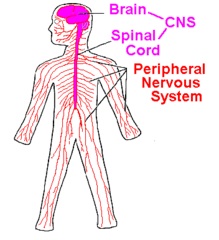
Central nervous system (CNS)
Consists of the brain and spinal cord

CNS function
Take in sensory signals, process information, and send out motor signals

Peripheral nervous system (PNS)
The sensory and motor neurons outside of the CNS

PNS function
Connect the CNS to the rest of the body and the external environment
Somatic nervous system
Part of the PNS that controls voluntary movements of skeletal muscles
Cranial nerves (12 pairs)
These nerves emerge from the brainstem; transmit information directly to or from the brain

Spinal nerves (31 pairs)
These nerves emerge from the spinal cord; carry impulses to the spinal cord and to muscles, organs, and glands

White matter
Myelinated neurons in the CNS

Gray matter
Unmyelinated neurons in the CNS

Dorsal roots of spinal cord
Contain sensory neurons entering the cord

Ventral roots of spinal cord
Convey motor outputs from CNS to PNS

Where are the cell bodies of sensory neurons located?
Outside the CNS in ganglia

Where are the cell bodies of motor neurons located?
In the CNS (brain and spinal cord)

Autonomic nervous system
Part of the PNS that controls involuntary movements such as cardiac and smooth muscle contractions

Sympathetic nervous system
Stimulates involuntary body processes (fight or flight)

Parasympathetic nervous system
Inhibits involuntary body processes (rest and digest)

Enteric nervous system
Regulates involuntary activities in the GI tract

Submucosal (Meissner) plexus
In GI submucosa; controls glandular secretion of mucosa and movements of muscularis

Myenteric (Auerbach) plexus
Between the two layers of the GI muscularis;
controls peristalsis and other contractions of muscularis

Glial cells
Cells in the nervous system that support, nourish, and protect neurons

Oligodendrocytes
Cells in the CNS that produce myelin --> ensures efficient transmission of action potentials

Astrocytes
Cells in the CNS that support neurons --> provide nutrients and insulation

Microglial cells
Cells in the CNS --> remove debris from injured or dead cells

Schwann cells
Cells in the PNS that produce myelin --> ensures efficient transmission of action potentials

Somatosensory System Function
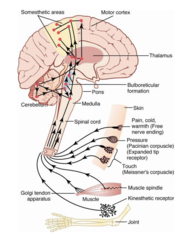
Relays sensory information from the body tissues to the CNS
General Somatic Afferent Neurons
Convey sensations of pain, touch & temperature; located all over the body

Special Somatic Afferent Neurons
Convey information about sight, sound, and balance; located in eyes and ears

General Visceral Afferent Neurons
Convey sensations of fullness and discomfort; located in organs

Special Visceral Afferent Neurons
Convey sensations of taste and smell; located in taste buds and olfactory mucosa

First-order neurons
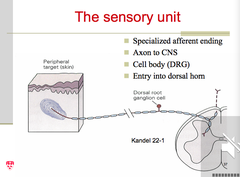
Detect stimulus and transmit signal to spinal cord or brainstem; form sensory units

Second-order neurons
Transmit impulses from the spinal cord/brainstem to the thalamus or cerebellum; form ascending pathways

Third-order neurons
Transmit impulses from the thalamus to the primary somatosensory area of the cortex; form central processing center

Sensory unit
A single afferent neuron plus all of the receptors it innervates
Cell body of sensory neuron
Part of the neuron that contains the nucleus; located in the dorsal root ganglia of spinal cord

Peripheral branch
Axon that extends from the cell body to the sensory receptor
Central branch
Axon that extends from the cell body to the dorsal horn of spinal cord
Six types of tactile receptors in skin
Touch, temp, pressure, movement, vibration, stretching

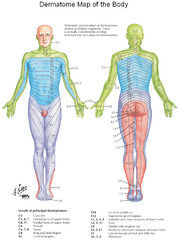
Dermatome
Area of skin supplied by a single spinal nerve
Ascending pathways
Conveys sensory information from the spinal cord to the thalamus

Discriminative pathway
Communicates sensory information about discriminative touch and spatial orientation; contains dorsal root ganglia (1st order), dorsal column neurons (2nd order), and thalamic neurons (3rd order)

Spinothalamic pathway
Communicates information about skin temperature, non-discriminative touch and pain from the spinal cord to the brain
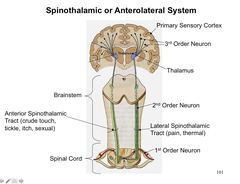
Neospinothalamic tract
3 neurons --> fast impulses; communicates acute pain

Paleospinothalamic tract
Many neurons --> slow impulses; communicates chronic/dull pain

Primary somatosensory cortex
Receives raw sensory information from the thalamus

Secondary somatosensory cortex
Stores and transforms the raw sensory input into meaningful information

Pain
An unpleasant sensory and emotional experience associated with actual or potential tissue damage

Pain threshold
The point at which someone perceives a stimulus as painful; consistent between individuals
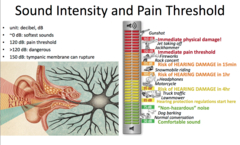
Pain tolerance
Maximum intensity or duration of pain that someone is willing to endure before seeking relief; varies among individuals

Pain receptors (nociceptors)
Respond to tissue damage (mechanical, electrical, or thermal stimuli)

Unimodal nociceptors
Respond to one type of stimulus only (mechanoreceptive, thermoreceptive, OR chemoreceptive )
Polymodal nociceptors
Respond equally to all kinds of damaging stimuli
A-delta fibers
Large, myelinated axons, conduct impulses quickly (10 to 30 m/s)
C fibers
Small, unmyelinated axons, conduct impulses slowly (0.5 to 2.5 m/s)
Endogenous Pain Inhibition
The ability to inhibit the perception of pain without the use of pain meds
Endogenous opioid peptides
Chemicals produced by the brain --> bind to opioid receptors in the spinal cord --> prevent transmission of sensory pain impulses up the ascending spinothalamic pathway

Descending inhibitory pathways
Neural pathways from the brain to the dorsal horns --> activation of the pathway prevents transmission of pain impulses up the ascending spinothalamic tract --> prevents transition from acute to chronic pain
Somatic pain
What: Pain that originates from skeletal muscles, ligaments, or joints
Etiology: Stimulation of somatic nociceptors

Cutaneous pain
What: Superficial pain usually involving the skin or subcutaneous tissue
Quality: Sharp, burning, well localized

Deep pain
What: Pain that occurs in tissues below skin level
Quality: Dull, aching, poorly localized

Visceral pain
What: A poorly localized, dull, or diffuse pain that arises from the abdominal organs, or viscera
Quality: Squeezing pain, poorly localized
Etiology: Stimulation of visceral nociceptors by strong contractions, distention, or ischemia affecting the walls of organs

Acute pain
What: Pain that lasts for

Chronic pain
What: Pain that lasts for >6 months
Course: Continuous
Purpose: Nothing useful, causes physical and psychological stress
Etiology: Persistent stimulation of nociceptors in chronic disorders (e.g. arthritis, cancer)

Referred Pain
What: Pain that is perceived at a location other than its site of origin
Etiology: ??
Hyperesthesia
Increased sensitivity to tactile stimulation (touch) due to irritation of the peripheral nerves

Hypoesthesia
Decreased touch sensation

Anesthesia
Loss of feeling or sensation

Hyperalgesia
Increased sensitivity to pain

Hypoalgesia
Decreased pain sensation

Analgesia
Pain relief; inability to feel pain

Neuropathic Pain
What: Pain that occurs when nerves are affected by injury or disease
Quality: Burning, stabbing pain
Etiology: Neurotoxic drugs, nerve compression, reactivation of varicella-zoster virus, uncontrolled diabetes

Trigeminal neuralgia
Compression of the trigeminal nerve by a blood vessel --> unilateral, excruciating face pain during talking/smiling

Post-herpetic neuralgia
Reactivation of latent varicella-zoster virus in the dorsal root ganglia neurons --> unilateral, painful, rash on the neck or chest (shingles)

Allodynia
Pain following a non-noxious, often repetitive stimulus that is not usually known to provoke pain (showering or bathing, wearing clothes, touching sheets on lying down)

Dynamic Allodynia
Pain that results from an object moving across the skin
Static/Tactile Allodynia
Pain that results from gentle touch/pressure
Thermal Allodynia
Pain that results from mild changes in environmental temperature
Phantom Limb Pain
Pain in a limb (or extremity) that has been amputated

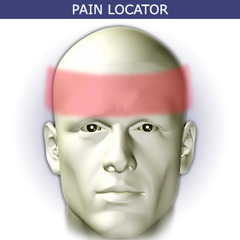
Tension Headache
What: Dull aching pain in the head, face or neck lasting for 30 minutes to 7 days
S+S: A sense of tightness/pressure around forehead
Cause: Physical/emotional stress, overexertion
Migraine Headache
What: Severe throbbing pain in the head lasting for 1 to 2 days
S+S: Nausea and vomiting, or sensitivity to light and sound, aura?
Causes: Periods, alcohol?
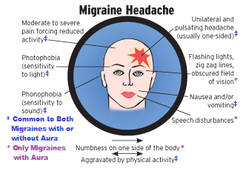
Aura
Temporary visual, motor, sensory, or verbal disturbances that occur during migraines

Cluster headache
What: Headaches occur in clusters over days/weeks
S+S: Excruciating pain behind the eye or cheek; occasional eyelid swelling, conjunctival redness, lacrimation, and a runny nose

Chronic daily headache
Headaches that occur 15 days or more per month

Numerical rating scale
Patient is asked to verbally rate their level of pain from 0 to 10

Visual analog scale
Patient is asked to mark an X on a scale that aligns with their level of pain

Wong-Baker faces scale
Patient is asked to point to the picture that best represents their level of pain

Non-pharmacologic pain management
Deep breathing, massage, acupressure, acupuncture

Pharmacologic pain management
Nonopioids, NSAIDs, opioids, hypnotics/sedatives

Pain Assessment
Onset, provocation/palliation, quality, region/radiation, severity, timing
