Osmolarity and Volume
 Call Kai
 Learn
 Practice Test
 Spaced Repetition
 Match
 Flashcards
 Knowt Play
1/18

There's no tags or description
Looks like no tags are added yet.
19 Terms
role of kidneys in Na+ homeostasis
regulate ECF osmolarity and volume

a change in ECF [Na+] will change ECF osmolarity - kidneys regulate ECF osmolarity by adjusting [Na+] of ECF
a change in ECF Na+ amount will change ECF volume (*intravascular volume) - kidneys can regulate ECF volume by adjusting ECF Na+ amount (via how much Na+ is excrete in urine)
relationship between [Na+] and osmolarity
[Na+] inc → osm inc
[Na+] dec → osm dec
fluids flow from low to high osm
low out = swelling = bad
high out = shrink = bad
hypernatremia
high ECF [Na+]
fluid leaves cells = shrink
rupture of cerebral vesseles/hemmorage
muscle weakness
behavioral changes/ataxia
coma → death
hyponatremia
low ECF [Na+]
fluid into cells = swelling
muscle weakness
seizures
cerebral/pulmonary edema
which statement about hyponatremia is most accurate?
a. ECF [Na+] will be higher than normal
b. osmolarity of extracellular fluid is likely to decrease
c. osmoreceptors in hypothalamus will shrink
d. ADH release will be increased
e. the animal will feel thirsty
b. osmolarity of extracellular fluid is likely to decrease
defense against osmolarity changes
kidneys can regulate ECF osmolarity by changing ECF Na+ concentration
[Na+] is the amount of Na+ in a unit volume of solvent (water)
osmoreceptors in hypothalamus shrink/swell as ECF osmolarity changes: elevated osmolarity = ADH release
stimulation of thirst mechanism: animal consumes fluid
hypervolemia
high ECF volume
ascites
pulmonary edema
hypovolemia
low ECF volume
hypovolemic shock
organ damage
struggle to get nutrients and O2 to tissues and to get waste away, heart is working v. v. hard
disorders of ECF Na+ amount → change in ECF volume
changes in ECF Na+ amount can cause volume changes - excessive salt consumption, excessive renal loss of Na+, etc.
ECF volume disorders can also be caused by other things - blood loss, vomiting, liver failure, etc
defense against volume changes
baroreceptors: stretch receptors in heart, aorta, and carotid sinus
sympathetic flow → inc Na+ reabsorption, inc volume
natriuretic peptide release → dec Na+ reabsorption, dec volume
juxtaglomerular apparatus: stretch receptors in afferent arterioles
Renin-Angiotensin System → inc Na+ reabsorption, inc volume
three mechanisms regulate GFR and reabsorption to control renal Na+ retention
Na+ retention effect on ECF volume
inc Na+ retention = inc ECF Na+ amt = inc ECF volume
dec Na+ retention = dec ECF Na+ amt = dec ECF volume
sympathetic flow
increased sympathetic flow to kidneys increases ECF volume
baroreceptors sense low ECF volume → sympathetic flow to kidney inc → promotes renal reabsorption of Na+
3 mechanisms norepinephrine
is a vasoconstrictor
promotes renin release
directly increases Na+ reabsorption from proximal tubule
norepinephrine is a vasoconstrictor
preferentially constricts efferent arteriole to increase GFR
alters starlings forces (at proximal tubule) at peritubular capillaries to increase Na+ reabsorption
how Starlings forces are affected
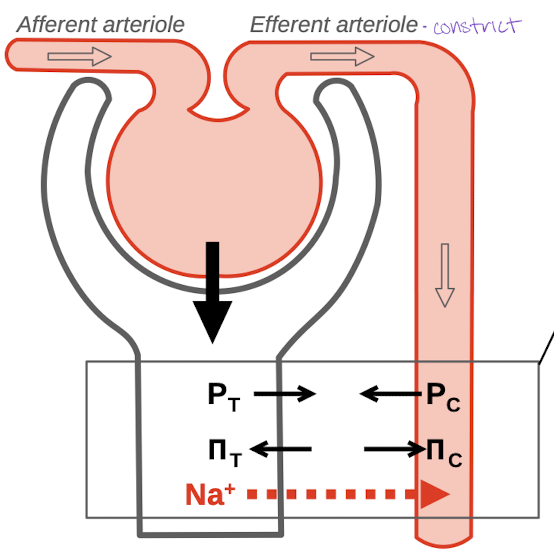
changes driven by efferent arteriole constriction
capillary hydrostatic pressure (Pc) - decrease : less blood in arteriole
tubular hydrostatic pressure (Pt) - increase
capillary hydrostatic pressure (πc) - increase : protein in capillary stays, fluid leaves
tubular oncotic pressure (πt) : not effected or slight, inc volume may reduce [protein]
net effect of increased sympathetic flow is to promote Na+ (and water) reabsorption from proximal tubule into peritubular capillaries
norepinephrine promotes renin release
triggers the renin-angiotensin system
renin release from kidneys inc ECF volume
low ECF volume triggers renin release from juxtaglomerular apparatus, RAS effectors inc renal absorption of Na+

norepinephrine directly increases Na+ reabsorption from proximal tubule
stimulates Na+/H+ antiporter
natriuretic peptides
trigger Na+ excretion in urine
decrease ECF volume
high ECF volume stretches cardiac muscle, releasing natriuretic peptides, promotes excretion of Na+

which statement about hypovolemia is accurate?
a. it is defined as high ECF volume
b. it is caused by low ECF Na+ concentration
c. the animal will respond increasing sympathetic flow to the kidneys
d. to correct it the Renin-Angiotensin system will be inhibited
c. the animal will respond increasing sympathetic flow to the kidneys
Low ECF volume id returned to normal by which of the following?
a. stimulation of Renin-Angiotensin-Aldosterone System (RAAS)
b. inc natriuretic peptide release
c. inc sympathetic flow to kidneys
a. stimulation of RAAS
AND
c. inc sympathetic flow to kidneys