M7 - Lipid Nucleotide Arminio Acid and Hydrocarbon Metabolism
 Call Kai
 Learn
Learn Practice Test
 Spaced Repetition
 Match
Match Flashcards
 Knowt Play
1/97

There's no tags or description
Looks like no tags are added yet.
Name | Mastery | Learn | Test | Matching | Spaced | Call with Kai | Chat |
|---|
No analytics yet
Send a link to your students to track their progress
98 Terms
Isoprenoids
Lipid molecules with 2+ isoprene units. Found in plastoquinone and ubiquinone (also carotenoids, archaeal lipids plasma membrane etc)
Lipophilic Compounds
Compounds that accumulate into inclusion bodies in the cytoplasm and serve as E and carbon storage. Most are synthesized from polymeric Polyhydroxybutrate (PHB) lipids, while some A/B have triglycerols and wax esters
FA metabolism
FA of various chains and lengths are can be metabolized as some aerobe’s organisms sole source of E and carbon. FA are degraded with Beta-oxidation pathway or used as precursors for phospholipid biosynthesis.
Proteins that help regulate FA uptake and regulation
FadL
FadD
FadR
FadL
Protein that functions as a ligand gated channel to allow the transport of lipids into a cell

FadD
Protein that functions as Fatty Acid acyl-CoA synthetase that activates FA by converting them into FA-CoA.

FA-CoA
Activated form of FA that binds to FadR, inactivating it.
Allows activation of biosynthetic pathways
FadR
Regulatory protein that uses FA-CoA as a ligand.
With FA-CoA, unable to repress transcription
W/out FA-CoA, represses transcription

Processes FadR regulates (5)
1 FA transport (fadLD)
2 FA catabolism (fadEFGBAH)
3 Universal Stress Protein (uspA)
4 Glyoxylate Shunt (iclR)
5 Unsaturated FA biosynthesis (FabA&B)

FadD (FA-CoA synthetase)
ATP dependent enzyme that catalyzes the addition of a CoA group to FA.
“requires 2” ATP
resulting AMP is later converted to ADP with ATP

Beta-Oxidation of Fatty Acids (4)
Pathway that Generates large number of reduced cofactors (NAD, FADH2, and Acetyl-CoA) that go to TCA
Common in aerobes
Basically a Cycle
Reactions largely occur on Beta-Carbon

Enzymes in Beta-Oxidation pathway
1 Acetyl-CoA dehydrogenase
2 Enoyl-CoA Hydratase
3 Beta-Hydroxyl acyl CoA Dehydrogenase
4 Beta-keto thiolase
Reactants/Products in Beta-oxidation (5)
1 Fatty-acyl-CoA
2 trans delta2 fatty enoyl-CoA
3 L-Beta-Hydroxy Acyl-CoA
4 Beta-keto acyl-CoA
5 FA-CoA and Acetyl-CoA
Propionyl Acetyl-CoA (3)
3C structure generated if acyl chain is odd
Used in amino acid biosynthesis (Ile, Val)
Can enter metabolic pathway (acrylyl-CoA, methylcitrate or methylmalonyl-CoA)
Beta-Oxidation of Palmitic Acid
oxidation pathway that yields 8 ATP from SLP and 123 ATP from OxPhos
Types of Hydrocarbon metabolism (2)
Aerobic Pathways
Anaerobic Pathways
Aerobic Hydrocarbon Pathways
Hydrocarbon metabolism pathway common to fungi and B
Require O2 and membrane-bound monooxygenases
Can be used to clean up oil spills
Anaerobic Hydrocarbon Pathways
Hydrocarbon metabolism pathway linked with SO4-2 reduction
Can cause oil well, souring, and corrosion
Monooxygenases
O2 dependent enzymes that cat oxidation of co-substrate and hydrocarbons.
Use Co-substrate rubredoxin, cytP450, or combnty***
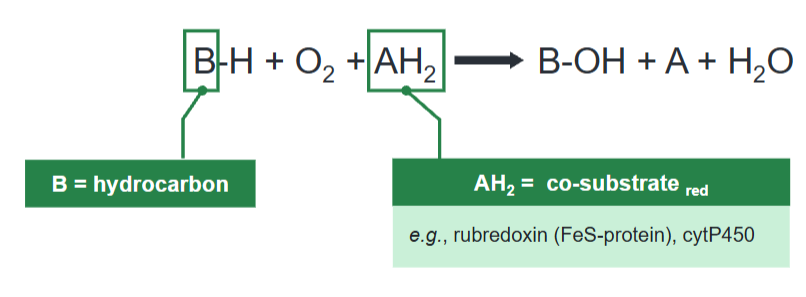
Hydrocarbon n-Alkane Metabolism pathways (2)
1 Terminal Oxidation pathway
2 Subterminal Oxidation Pathway
Terminal Oxidation pathway
Oxygen-dependent monooxygenase used with rubredoxin to metabolize alkanes.
Terminal alkane has hydroxyl group on terminal end
Products move to Beta-oxidation pathway

Steps in Terminal Oxidation pathway
1 rubredoxin: NADH oxidoreductase
2 n-alkane monooxygenase
3 Primary Alcohol dehydrogenase
4 Aldehyde dehydrogenase

Subterminal Oxidation Pathway
Uses 2 monooxygenases that aren’t O2 dependent
Initial monooxygenases introduce hydroxyl group subterminal
Generates acetate and more reduced cofactors
Products continue to beta-oxidation

Steps in Subterminal Oxidation Pathway
1 Monooxygenase 1
2 Secondary alcohol DH
3 Monooxygenase 2
4 Esterase
5 Primary alcohol DH
Terminal Oxidation Pathway Overall Reaction
HC + 1AH2 → 2NADPH + FA
Subterminal Oxidation Pathway Overall Reaction
HC + 2AH2 → 3NADH + Acetate + FA (-2C)
Acyl Carrier Protein (ACP) (6)
Involved in initial FA biosynthesis
Small Protein
carries acyl group that’s attached to FA
Activated when phosphorylated
Serine residue is phosphorylation target
Co-A-Like

PPTase (3)
Involved in initial FA biosynthesis
Phosphorylates ACP to activate it
CoA is substrate
FA Biosynthesis Pathway (3)
Cyclical pathway that converts acetyl-CoA into acyl-SACP
acyl-SACP (product) may be turned into acetyl-ACP (Earlier intermediate) (Malonyl-Carbon-CoA)
Requires ATP, 2NADPH, and HCO3
Produces C16-18 (or smaller) molecules
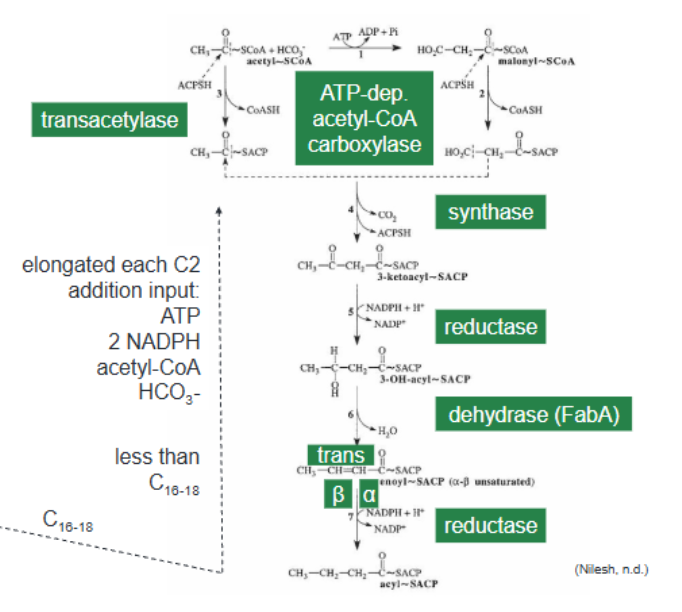
Fatty Acid Biosynthesis Pathway Steps (enzymes)
1 ATP-Dep Acetyl-CoA Decarboxylase
2/3 Transacetylase
4 Synthetase
5 Reductase
6 Dehydrase FabA
7 Reductase
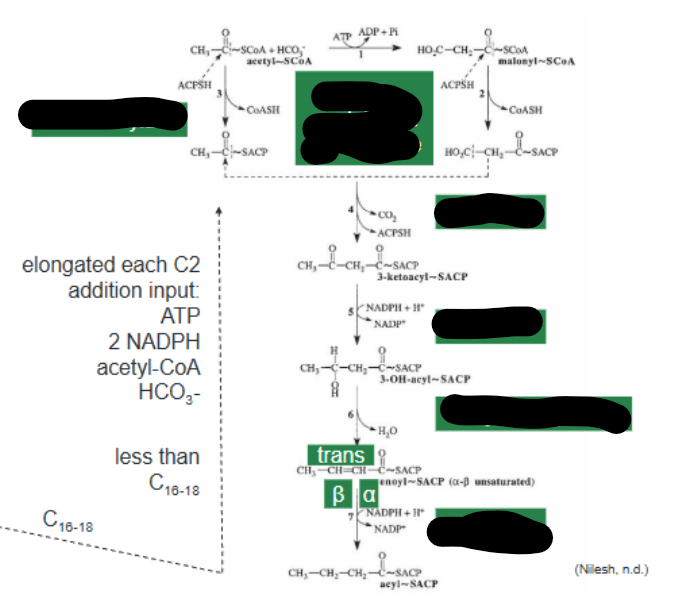
FA Biosynthesis Pathway Intermediates and Products
0 Acetyl-CoA
1 Malonyl-CoA
2 Malonyl-ACP
3 Acetyl-ACP (Malonyl-carbon-CoA)
4 3-Ketoneyl-SACP
5 3-OH acyl-SACP
6 enoyl~SACP
7 acyl~SACP

Malonyl-CoA formation (3)
First committed step in FA biosynth
Frist step of FA biosynth
Catylized by ATP-Dep Acetyl-CoA Decarboxylase
Unsaturated FA biosynth
Unsaturated FA are created by introducing db into chains
O2 dependent
O2 independent
Regulation of Unsaturated FA biosynth
Signals that alter membrane fluidity tell cell to increase of decrease fluidity
low temp → signals to increase fluidity
Bioproducts: ethanol → signals to decrease fluidity (makes more stable for bioproducts)
O2 Dependent Unsaturated FA Biosynthesis (3)
Desaturases used to introduce cis/trans bonds into FA
Uses O2 to draw e- from chain
Modification of a complete acyl-ACP molecule

Desaturase
Catalyzes formation of cis/trans db in FA
Requires O2 and NADPH
Integral membrane
Transfers 2e- from acyl group and 2e- form NADPH to reduce O2 to H2O

O2 Independent Unsaturated FA Biosynthesis (4)
Introduction of a db to a 10C or 12C chain during FA production/elongation
If db trans, saturated
If db cis, unsaturated
Fab Proteins used to convert between cis/trans conformation

Phospholipid biosynthesis
DHAP (Dihydroxyacetone phosphate) is eventually converted to CDP-diacylglycerol, which is used as a starting point to produce many phospholipids.
Involves products from central metabolism (DHAP) and FA biosynth (acyl-ACP/-CoA )

Steps/enzymes in Phospholipid Biosynth (4,3)
1 Glycerol-3-phosphate dehydrogenase (GPDH)
2 Acetyl Transferase
x Phosphatidic Acid
3 CDP-Diacyl-glycerol synthase (CDS)

Phospholipid Biosynthesis Step 1 (3)
DHAP is converted to G3P by GPDH (Glycerol-3-phosphate dehydrogenase).
Requires input of e- from NADH
DHAP is input from central metabolism

Phospholipid Biosynthesis Step 2 (3)
Acetyltransferase catalyzes the conversion of G3P to PA with the de-acetylaiton of acyl-ACP/CoA.
HIGHLY regulated
Inhibited by STARVATION

Phospholipid Biosynthesis Step 3 (4)
DP-diacylglycerol synthase (CDS) converts Phosphatidic Acid (PA) into CDP-diacylglycerol through the attachment of a CMP group.
Generates CDP-diacylglycerol, a high E intermediate (“ready for Nu attack")
Activates PA
CTP dependent

Phosphatidic Acid (PA)
Intermediate in and “Parent compound” for phospholipid metabolism
CDP-diacylglycerol ()
Key precursor for many phospholipids
Conversion/processing is cat by membrane bound enzymes
Has positivly charged and endophlilic phosphates (ready for Nu Attack)

S-Adenosyl Methionine (SAM) (4)
Coenzyme
Synthesized from Met and ATP
C1 Carrier for donation of methyl groups
Methylates when nucleophile attacks methyl group

Methionine acetyltransferase
Converts Met to SAM coenzyme with ATP
Regeneration of SAM
SAM is regenerated by cooperating methionine and folate cycles

Steps in SAM regeneration
1 5-Adenyl Homocysteine (5AH) is hydrated to adenosine and homocysteine (HCY)
2 HCY is subject to VB12-dep RXN, regenerating MET
3 Tetrahydrofolate (THF) accepts a C from serine, converting to 5,10-MTHF
4 5,10-MTHF is reduced to 5-MTHF, which can then donate the methyl to HCY in VB12 RXN
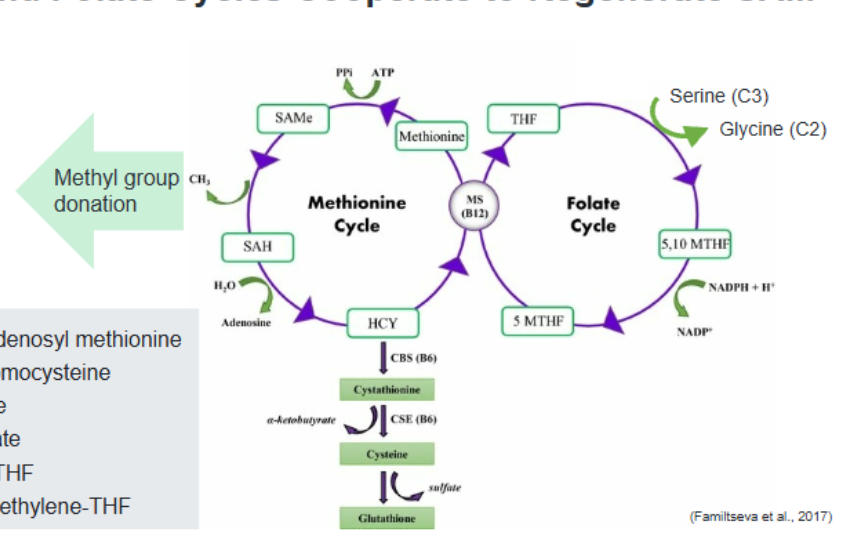
Tetrahydrofolate (THF)
C1 carrier in the folate cycle
Has pteridine ring that accepts the CH3 group (5-foryl THF)
Has p-ABA group that accepts an alt CH3 group (10-foryl THF)

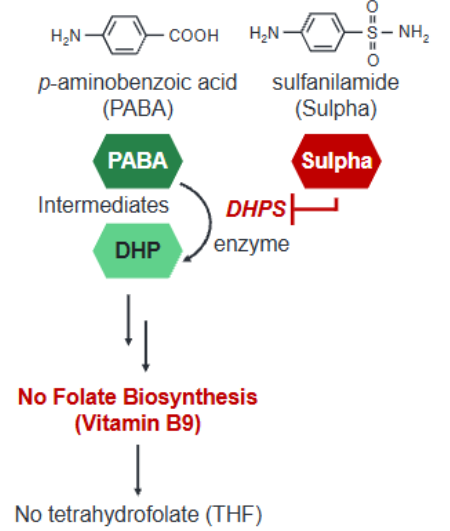
Sulfa Drugs
Drugs that prevent the Folate cycle by mimicking pABA (p-aminobenzoic acid) that makes folate
Inhibit folate biosynthesis, THF cycle, and purine biosynthesis
Bacteriostatic agents
Flippase (3)
Move phospholipids from outer to the inner membrane
ATP-dep
P4ATPase Family
(Flip → moves in )

Floppase (3)
Moves phospholipids from inner to outer membrane
ATP-dep
ABC Family
(Flop → moves out)

Scramblase
Moves phospholipids back and forth across membranes down their [gradient]
Ca+2 dep => E independent
(Evolutionarily Distinct Protein Families)
![<p>Moves phospholipids back and forth across membranes down their [gradient]</p><p>Ca+2 dep => E independent </p><p>(Evolutionarily Distinct Protein Families)</p>](https://assets.knowt.com/user-attachments/c765d655-48a7-4611-9a00-f10ff1c4695c.png)
Lipid Transport Between Membranes - Gram Negatives
Gram negatives must flip lipids and transport them between inner and outer membranes
AsmA like proteins
MIa proteins

AsmA like proteins (4)
Proteins that move lipids from inner to outer membrane in gram negatives
Have hydrophobic groove or “bridge” that shields lipids in the periplasmic space
Mediate lipid transport between organelles
Related to eukaryotic Beta-groove protein family

Archaeal Lipids
Have branched isoprene chains

Isoprenoid Biosynthesis
Common pathway in A that produces Isoprenoid Lipids (quinones, carotenoids, sterols, etc)
Two pathways
Mevalonate pathway
DXP pathway
Mevalonate pathway (4)
Pathway to produce isoprenoid lipids in A & E
Starts with Acetyl-CoA and includes mevalonate as key intermediate
HMG-CoA reductase is rate limiting step/Ez
Target of cholesterol lowering drugs

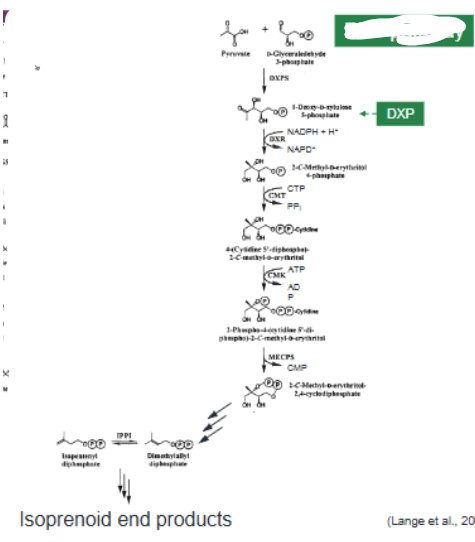
Dxp Pathway
Pathway to poroduce isoprenoid lipids in bacteria
No HMG-CoA reductase
Has Deoxy-xylose-phosphate (DXP) intermediate
Diversity in mevalonate pathways
Pathways branch heavily after production of mevalonate
Intersects with A biosynth of phospholipids (g-1-p backbone)
No ACYL-CARRIER protein
Pyrimidine Nucleotide synth (4)
THF-INDEPENDENT
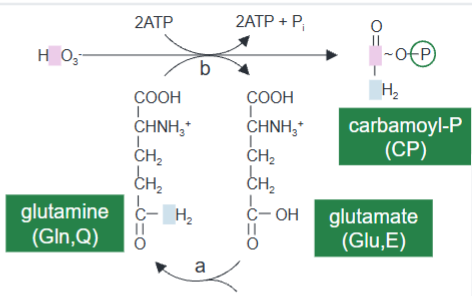
E-dep Synthetase domain incorporates Carbon from bicarbonate
Glutamase domain incorporates nitrogen from ammonia
Asparate provides remaining 4C backbone

Carbamoyl Phosphate Synthetase (CPS) (4)
Ez that initiates Pyrimidine synthesis
Type varies based on N donor (NH3 vs Gln)
Needs allosteric effector N-acetyl-l-glutamate for activity
Have glutaminase and synthetase domain
Inhibitors of Carbamoyl Phosphate Synthetase (CPS)
ornithine, IMP, and UMP
N-acetyl-l-glutamate
Activates Carbamoyl Phosphate Synthetase for Pyrimidine biosynth
Aspartate transcarboxylase (ATCase)
Ez that cat the 2nd step in Pyrimidine biosynthesis
Combines Asparate and CP into carbamoyl asparate (makes backbone)
Feedback Inhibited

Aspartate transcarboxylase (ATCase) INHIBITORS
Inhibited by CTP
Feedback inhibition
(inhibitors designed have applications in treating bacterial pathogens, malaria, oncology, immunosuppression, etc.)
Pyrimidine Nucleotide Biosynthetic Pathway Steps (Ez)
1 Carbamoyl phosphate synthetase
2 Aspartate transcarbamoylase
3 Dihydroorotase
4 Dihydroorotate dehydrogenase
5 Orotate phosphoribosyltransferase
6 Orotidylate decarboxylase
7 CTP synthetase

PRPP Synthetase (PRS) (4)
key biosynthetic precursor ENZYME for Pyrimidine, Purine, & AA pathways
Ribose-P-pyrophosphokinase
ATP-dep conversion of Ribose-5-Phosphate → PRPP (phosphoribosyl pyrophosphate)
Feedback inhibition

PRPP Synthetase (PRS) inhibitors
Feed back inhibited by AMP, ADP, GDP (LOW cellular E)
PRPP product
key precursor for purine, pyrimidine, NAD+/NADP+, and amino acid (His, Trp) biosynthesis
Purine biosynthesis (4)
More complex biosynthesis due to double ring structure.
Derived from G, D, Q, CO2, and C1 units (from formate or serine)
THD-dependent
INHIBITED by SULFA durgs

Purine Nucleotide Biosynthetic Pathway (4)
Early attachment of PRPP
Initial steps feedback inhibited by purine nucleotides
Step 1 = PRPP synthetase
Step 2, PRPP aminotransferase
Tetrahydrofolate (THF)-dependent
Inosine monophosphate (IMP, containing hypoxanthine) is a key intermediate
Produced at the end

Purine Nucleotide Biosynthetic Pathway Feedback INHIBITION
Feedback inhibition by ATP and GTP
Early steps also tightly regulated

Inosine monophosphate (IMP)
Key intermediate produced from Purine biosynthesis
Can be used as precursor for ATP and GTP biosynthesis
Feedback inhibition by ATP and GTP
Ribonucleotide Reductase (RNR)
Cat the conversion of RNA building blocks to DNA building blocks
ribose sugar of nucleotide diphosphate (NDP) to deoxynucleotide diphosphate (dNDP)
eduction of 2'OH-group

Thymidylate Synthase Pathway (4)
Pathway that methylates dUMP to dTMP
Involved in DNA synth
Antibiotic and chemotherapy target
Involves THF

Nucleotide Salvage
Base specific phosphoribosyltransferase salvage/recycle bases from nucleic acid (RNA/DNA)
turnover for use in biosynthesis

DNA/RNA Catabolism
When nucleic acids are used as a carbon and Nitrogen source (all domains)
Common to break down urea to extract purine/pyrimidine (common waste product)
Nucleotidase
nucleosidase
nucleases
nucleases
Ez that breaks down DNA/RNA polymers

Nucleotidase
Ez that dephosphorylates nucelotides, releasing Pi/phosphate from purine/pyrimidine bases

nucleosidase
Ez that release ribose and deoxyribose from nucleosides (purine/pyrimidine bases)

Glutamate and Glutamine in AA biosynth
AA that provide amino groups for biomolecules and AA
→ amino group donor and acceptor pair
transamination rxns
Catalyze the donation of an amine group form an amine group donor (like Glu) to form AA (or other biomolecules)
Gln
serve as a N-donor for His, Trp, Asn, asparagine, purines, pyrimidines, amino sugars, and NAD+
Ammonia Assimilation at High [NH3]
glutamate dehydrogenase and aminotransferase catalyze the assimilation of NH3 into AA (or other biomolecules)
glutamate dehydrogenase
Enzyme with LOW affinity for NH3
Catalyzes the reductive assimilation of NH3 into Glu
Oxidizes NADPH to NADP+ (requires NADPH for energy)
Reversable

aminotransferase
Cat the deamination of AA of amine donor
OR
Cat the amination of a keto-acid, ketone, or aldehyde (AA aceptor)
Reversable

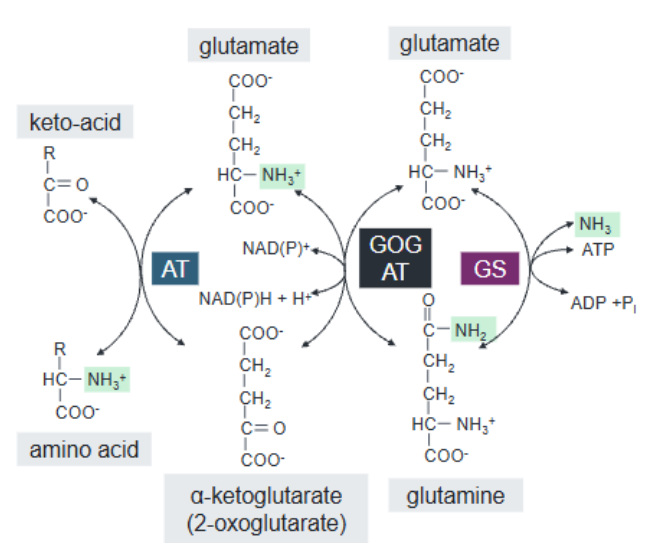
GS/GOGAT Pathway
Pathway that catalyzes Ammonia Assimilation at Limiting [NH3]
Ammonia Assimilation at Limiting [NH3]
Glutamine synthetase, Glutamine: 2-oxoglutarate Aminotransferase, and aminotransferase are used to catalyze the assimilation of NH3 into AA
Glutamine Synthetase (GS)
HIGH affinity for NH3
Catalyzes the ATP-dep assimilation of NH3 into Gln, glutamine
ATP-dependent reaction
Essential for growth (unless cells supplemented with Gln)

Glutamine: 2-oxoglutarate Aminotransferase (GOGAT)
Cat NADPH dep conversion of Gln to Glu
Synthesizes 2 mol glutamate from glutamine and α-ketoglutarate via aminotransferase reaction

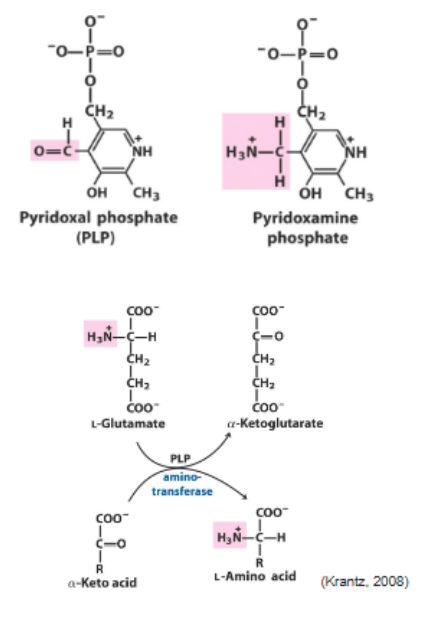
Pyridoxal 5′-phosphate (PLP)
Key cofactor for AA biosynthesis
Active form of VB6 involved in transamination
Binds to transaminase and acts as amine carrier
Amino Acid Catabolism
Catabolism of AA initiated by deamination RXNS to remove amino group
Generates alpha-Keto acids
Different breakdown for glucogenic and ketogenic AA
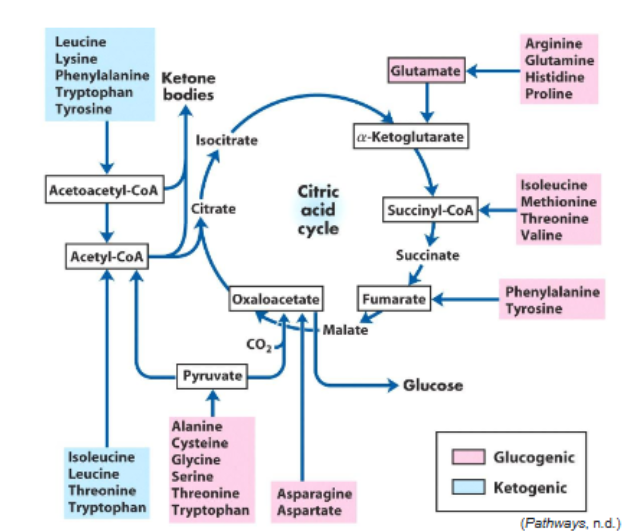
Glucogenic AA (catabolism)
AA can be converted into glucose through gluconeogenesis

Ketogenic AA (catabolism)
AA that can be broken down metabolically and converted into acetyl-CoA
Ile, Leu, Thr, Trp, Tyr, Phe, Lys
(“I’lL TrY Wed Fry weeKdays”)
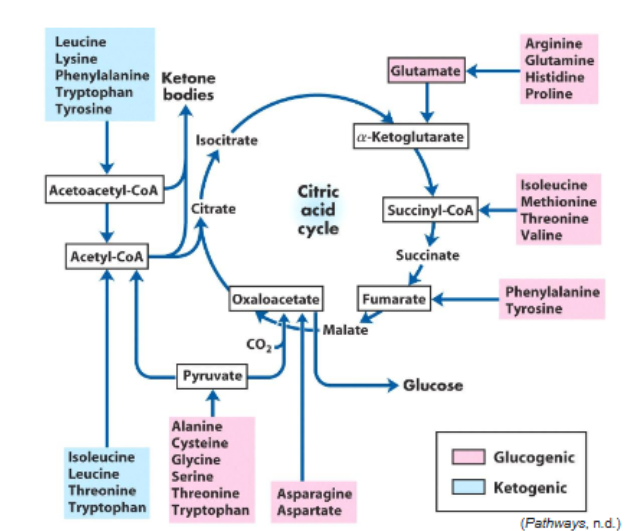
β-hydroxybutyrate (BHB)
A ketone body that serves as an energy source (for ketogenic AA) as resources become limiting
Acetyl-CoA is a precursor
L-amino Acid Catabolism
AA catabolism
Initiated by aminotransferases (primarily, shown earlier slides) or deaminases, depending on the amino acid

D-amino Acid Catabolism
AA catabolism
Initiated by D-amino acid oxidases (DAAO), which catalyze oxidative deamination
