DEVC 145 PART 1 (LESSON 1-4A)
 Call Kai
 Learn
 Practice Test
 Spaced Repetition
 Match
 Flashcards
 Knowt Play
1/63

There's no tags or description
Looks like no tags are added yet.
64 Terms
Diversity
recognize and praise the many ways students differ
Equity
fairness in access, opportunities, and resources
Inclusivity
all students feel welcomed, respected, supported, and involved
non formal learning
Educational Communication focuses on ______
EDCOM goal
to facilitate learning among intended development participants using appropriate ed media, assessment tools, and teaching and learning strategies
ROLE OF EDCOM:
“to innovate, pilot, test, refine, and assess mediated as well as nonmediated approaches in facilitating learning among disadvantaged groups”
What is distance learning?
a. A mode of learning in which students and teachers are physically separated from each other (RA No. 10650)
b. Delivery of instruction to learners who are separated from their teacher by time and/or location (Lever-Duffy & McDonald, 2008)
c. A way of learning remotely without being in regular face-to-face contact with a teacher in the classroom
d. institution-based, formal education where the learning group is separated, and where interactive telecommunications systems are used to connect learners, resources, and instructors.
Mode of Instruction
A mode of learning in which students and teachers are physically separated from each other (RA No. 10650)
Separation of teacher and student (in location and/or time)
Delivery of instruction to learners who are separated from their teacher by time and/or location (Lever-Duffy & McDonald, 2008)
______ is the key to providing effective learning.
Technology
_______ between teacher and learner, and among learners
Interaction
Synchronous
learning process happens in “real time” from the same or different location
Asynchronous
learning process wherein the teacher and the learner participate at different times from the same or different locations
Advantages of Distance Learning
1. Allows flexibility in the access of learning contents
2. Give learners greater access to learning resources
3. Accommodates different learning styles
4. Encourages active learning
5. Provides a venue for collaboration among learners
6. Cost-effective
Issues and Challenges: Readiness of the teacher
a. Skills
b. Motivation
c. Teaching Philosophy
d. Resources
Readiness of the learners
a. Skills
b. Motivation
c. Learning Style
d. Resources
Readiness of the institution
a. Policies
b. Resources
remote rural areas
Distance learning was originally developed to deliver instruction to students in _________.
1728
Shorthand correspondence courses were advertised in local newspapers (Boston Gazette).
1856
In Europe, language courses were established through post.
Isaac Pitman
taught shorthand by correspondence (1840s).
1922
Pennsylvania State College broadcasted courses across radio networks.
1934
: The University of Iowa became the first to use television as a learning tool.
1963
The FCC (Federal Communication Commission) dedicated 20 television channels for university use and instruction.
1986
Pennsylvania State University offers computer-based courses with audio conferencing.
1995
Regent University offered the first online PhD in communication.
1996
Duke University offered its Global MBA; combining online classes with campus learning.
1997
Web CT was released.
2002
The virtual learning environment, MOODLE was released.
2011
Instructure formally launched the Canvas LMS.
2008
Start of MOOCs.
2009
YouTube EDU introduced thousands of free lectures.
LMS / VLE
enables the delivery of learning content online
CMS
a system designed to help you manage content
1952
Pacifico Sudario produced an educ program for rural farmers in Iloilo called Farmer’s School-of- the-Air (FSA).
1963:
DZLB went on air; produced SOA , IBS, and radio forums
UPLB CDC was the first institution in the country to offer formal and non- formal training in educational broadcasts.
Comm Tech for Rural Education (CTRE) Project
____________________ served as a pilot study for DLS for small farmers.
1959
The Bureau of Public Schools and the Philippine Broadcasting Service established a school broadcasting organization; implemented Instructional Broadcasts.
1962-1963
BPS-PBS venture into educational television.
Feb 23, 1995
UPOU was established.
Various universities in the Philippines implemented different broadcast- based learning systems.
Government agencies implemented training programs through DL mode.
Mainstream media produced educational programs.
LEARNING APPROACH
philosophical or pedagogical concepts to learning / how learning takes place
LEARNING MODALITY
Mode/format of delivery or instructional methods / how and where learning is delivered
LEARNING STRATEGY
TLAs / what activities are being done?
Learning Approach samples
• Flexible learning
• U-learning
• Self-paced
• Self-directed
• Problem-based
• Project-based
• Inquiry-based
• Behaviorist
• Constructivist
• Cognitivist
Learning Modality Samples
• Distance learning
• Online learning
• F2F learning
• Blended learning
• Correspondence
learning
• Hybrid learning
• M-learning
• BYOD
Learning Strategy Samples
• Lecture-
discussion
• Film showing
• Field visit
• Recitation
Distance Learning
Type of Learning Shown in image

Media Based Learning
Type of learning shown

E-learning
Uses electronic/digital technologies to access the learning content outside of a traditional classroom; can be web-based or computer-based
Online learning
Uses web-based/internet-based learning technologies to access the learning content outside of a traditional classroom
M-learning
involves the use of mobile technology, either alone or in combination with other ICTs to enable learning anytime and anywhere
U-learning
an everyday learning environment that is supported by mobile and embedded computers and wireless networks in our everyday life
Blended learning
Combines face-to-face and online learning tools, technologies and approaches in delivering instruction
Definition of Instructional Design by Gustafson and Branch (2007)
systematic, complex process used to develop education and training programs in a consistent and reliable fashion
Characteristics of ID
1. ID is a systematic and dynamic process.
2. The primary goal of ID is to create effective and efficient learning environments using appropriate teaching and learning tools and approaches.
3. ID consists of several processes from planning to evaluation of learning systems.
4. ID processes are based on various research studies and theories.
ADDIE (Gustafon and Branch 2002)

Gerlach and Ely model
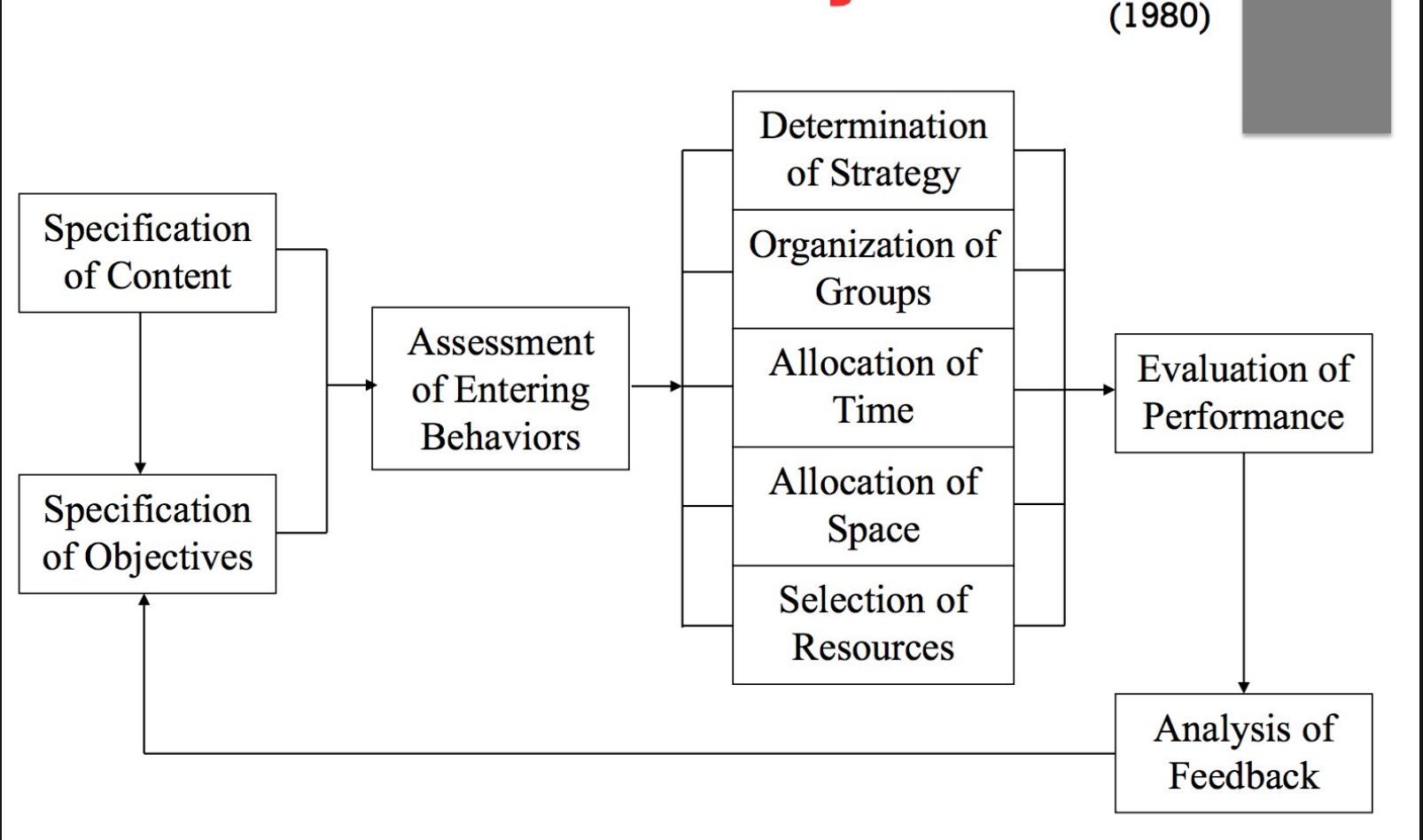
CAI design Model

Seels and Glasgow

Smith and Ragan Model

ASSURE MODEL

MRK MODEL

SYSTEMS APPROACH
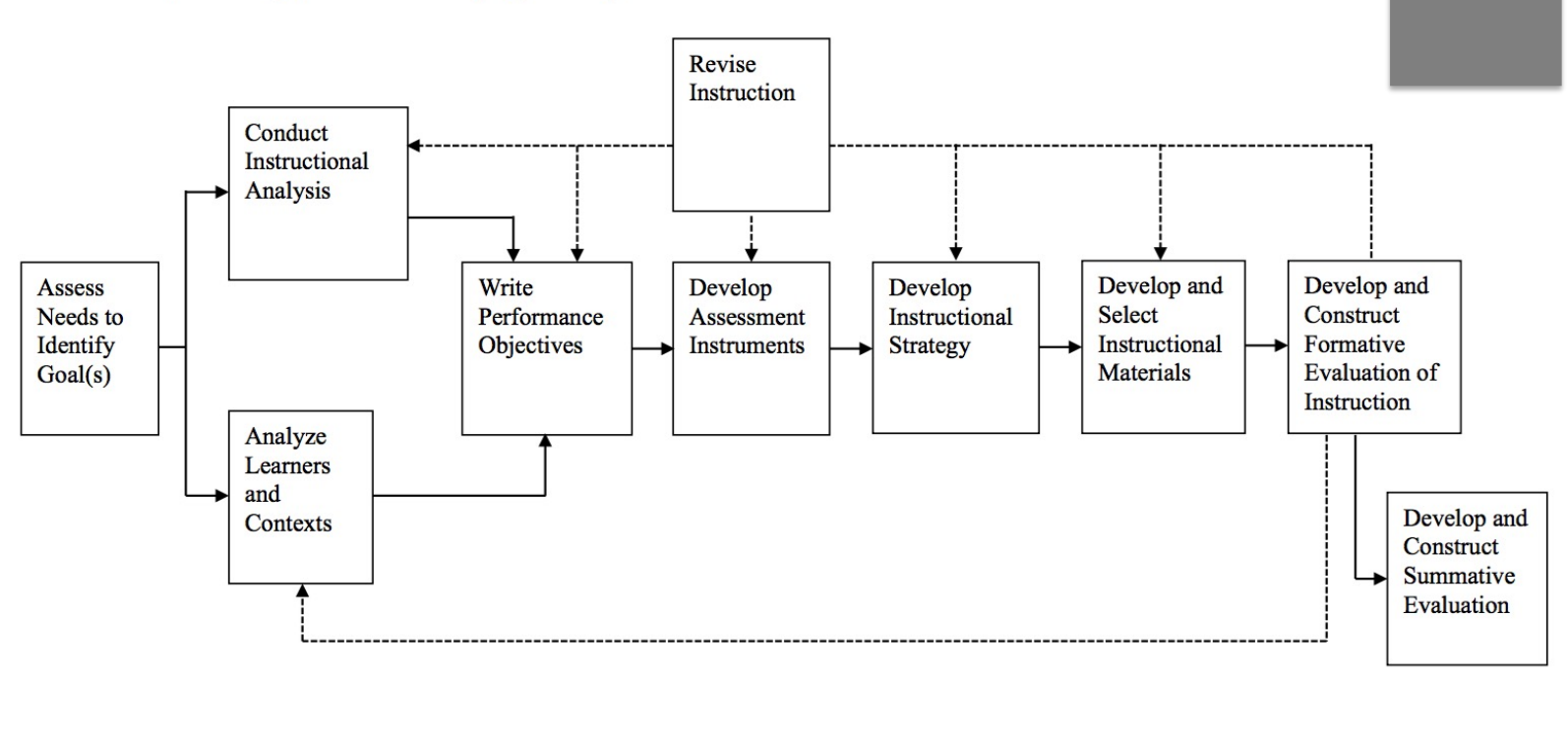
BACKWARD DESIGN
