ap physics 1 unit 2 test review Diagram
 Call Kai
 Learn
 Practice Test
 Spaced Repetition
 Match
 Flashcards
 Knowt Play
1/23

There's no tags or description
Looks like no tags are added yet.
24 Terms
Newton's First Law
An object at rest will remain at rest, and an object in motion will remain in motion with a constant velocity, unless acted upon by a net external force.
Inertia
The tendency of an object to resist changes in its motion.
Newton's Second Law
The acceleration of an object is directly proportional to the net external force acting on the object, and inversely proportional to its mass.
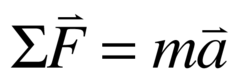
Inertial Mass
Can be determined using Newton's second law: a = F/m.
Newton's Third Law
For every action, there is an equal and opposite reaction; force pairs always act in opposite directions, but they do not always cancel each other out.
The car exerts a force on the rock, and the rock exerts a force on the car. The two forces are equal in magnitude.
A 1500kg car traveling along a road is hit by a 0.1kg rock that creates a small crack in the car's windshield. Describes the interaction between the windshield and the rock.
Normal Force (N)
A surface exerts an upward force on a body to balance the downward force of gravity.
Normal Force (N)
m × g × cos(θ)
Force of Gravity Perpendicular (Fg⊥)
m × g × cos(θ)
Force of Gravity Parallel (Fg∥)
m × g × sin(θ)
Force of Friction (f)
µ × N
Force of Friction (f)
Two surfaces rubbing against each other exert a force that resists relative motion.
Force of Gravity (Fg)
m × g
Force of Gravity (Fg)
Two bodies with mass attract each other and exert gravitational forces.
Force of Tension (T)
A rope or string pulled tight exerts a force on connected objects.
Applied Force
A force applied to a body causes the body to exert a force in the opposite direction.
Weight
A gravitational force exerted on a mass when it is within a gravitational field created by another mass; can be calculated by F=Mg.
Critical Velocity (Vcritical)
sqrt (r × g); shows minimum speed at a point of circular motion loop.
Period (T)
(time) ÷ (# cycles)
Frequency (f)
(# cycles) ÷ (time)
20N
If the mass of block B is 2kg, the gravitational force exerted on B is most nearly...?

Mg
A block of mass M is attached to a modified Atwood machine and is accelerated upward at 3a by a constant force Fₒ. What is the weight of the block?
No. Newton's third law states the block cannot exert a force on itself.
A block is placed on an inclined plane and remains stationary, as shown in the figure above. A student claims, "The block remains stationary because as gravity tries to pull the block down the ramp, the block exerts an equal and opposite force on itself up the ramp." Is the student's claim correct? Justify your answer.
If the angle is increased, then the normal force acting on the block will decrease (because the force of pull upward increases). The force of friction is related to the normal force by the equation Fₖ=µₖN. Therefore if the normal force decreases, so will the force of friction acting on the block.
A student pulls a block over a rough surface with a constant force Fp that is at an angle θ above the horizontal, as shown above. If Fp remains constant but the angle θ is increased, which of the following is true at some later time?