green- equine dental anatomy
 Call Kai
 Learn
 Practice Test
 Spaced Repetition
 Match
 Flashcards
 Knowt Play
1/56

There's no tags or description
Looks like no tags are added yet.
57 Terms
describe the diet of a horse
natural grazing animals, 14-18 hours a day on course roughage (shrubs, weeds, mature grasses, etc)
list 2 things that occurred in the evolution of the equine skull/dentition
teeth became tall and flat, an adaptation for extended mastication of abrasive and low-energy foodstuffs like grass
the skull lengthened and jars deepened to accomodate taller, broader teeth adn also to lift the eyes away from the ground to allow the horse to observe its surroundings while grazing
list the steps of the equine chewing motion
begins with mouth shut
jaw drops and moves sideways
jaw moves up and sideways, closing
jaw moves from one side to the other, grinding feed

what factors contribute to the large chewing surface area of equines?
6 cheek teeth in each arcade
act as one tooth (no gaps)
corrugated occlusal surface
anisognathia (upper and lower jaws differ in width)
what movement in chewing is considered the power stroke?
jaw moving sideways, grinding the feed
what are the 3 classifications of equine dentition?
hypsodont, diphodont, lophodont
describe hypsodont teeth
long rooted teeth, continual eruption and attrition (wearing down)

about how much attrition (wearing down) occurs to hypsodont teeth per year?
2-3 mm
what are diphyodont teeth?
name means double producing; has deciduous and permanent teeth— includes the incisiors and permanent teeth

what are lophodont teeth?
teeth with ridges

describe the ridges on lophodont teeth
transverse ridges across chewing surface; buccal-lingual direction
why is the occlusional angle important in equines?
allows for easier rotary chewing motion (increases lateral
what is anisognathia?
mandible is narrower than the maxilla
what is the normal occlusional angle range in equines?
15-35 degree angulation (palatal-buccal)

using this triadan numbering chart, what numbers are the wolf teeth?
105, 205, 305, 405
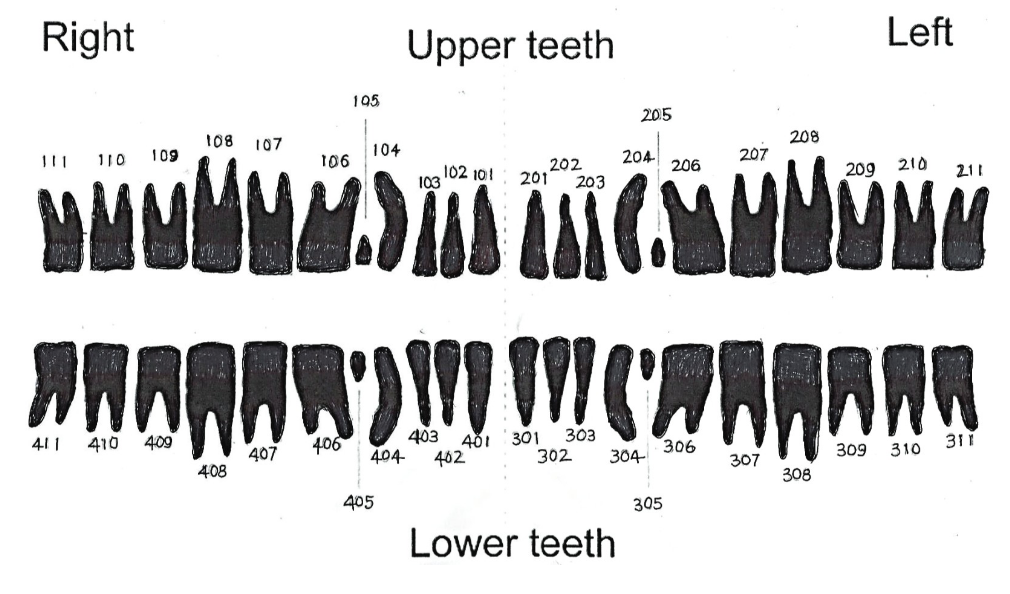
using this triadan numbering chart, what numbers are the canine teeth?
104, 204, 304, 304

using this triadan numbering chart, what numbers are the premolars?
-06, -07, -08

using this triadan numbering chart, what numbers are the molars?
-09, -10, -11
anatomic abbreviation for incisor
I1, I2, I3
anatomic abbreviation for canine
C
anatomic abbreviation for premolar
PM1, PM2, PM3, PM4
anatomic abbreviation for molar
M1, M2. M3
which PM number the wolf tooth?
PM1
what is the dental formula of the deciduous teeth in equine?
2(DI 3/3, DPM 3/3) = 24 teeth
what is the dental formula of the permanent teeth in equine?
2(I 3/3, C* 1(0)/1(0), PM* 3(4)/3(4), M 3/3) = 36-44
why is there variation in C teeth in the dental formula?
canine teeth are sexually dimorphic (males would use to fight)
what is the purpose of incisors?
grasp and cut food: sharp at the front of the mouth
what is the purpose of the canines?
fighting (stallions and geldings)
what is the purpose of molars and premolars?
grinders: spaced very closely together to act as one individual grinding surface
what is the purpose of wolf teeth?
they are classified as premolars but they are vestiigial and have no function
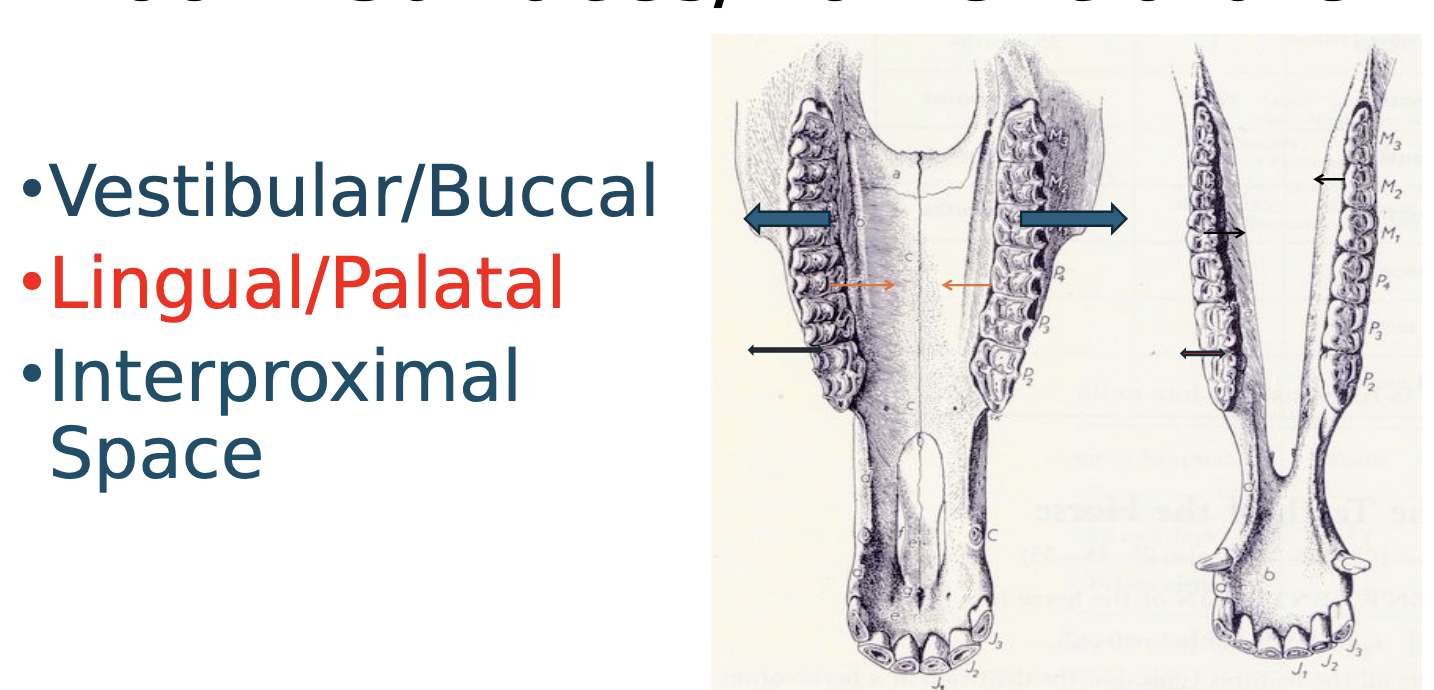
what is the vestibular/buccal tooth surface?
surface closest to the cheek

what is the lingual/palatal tooth surface?
surface closest to palate/tongue

what is the interproximal space?
space between each tooth

what is the name of the tooth surface indicated by the blue line?
occlusional/coronal (grinding surface)

what tooth surface/nomenclature is represented by the dark blue arrows?
apical (closest to the root of the tooth)
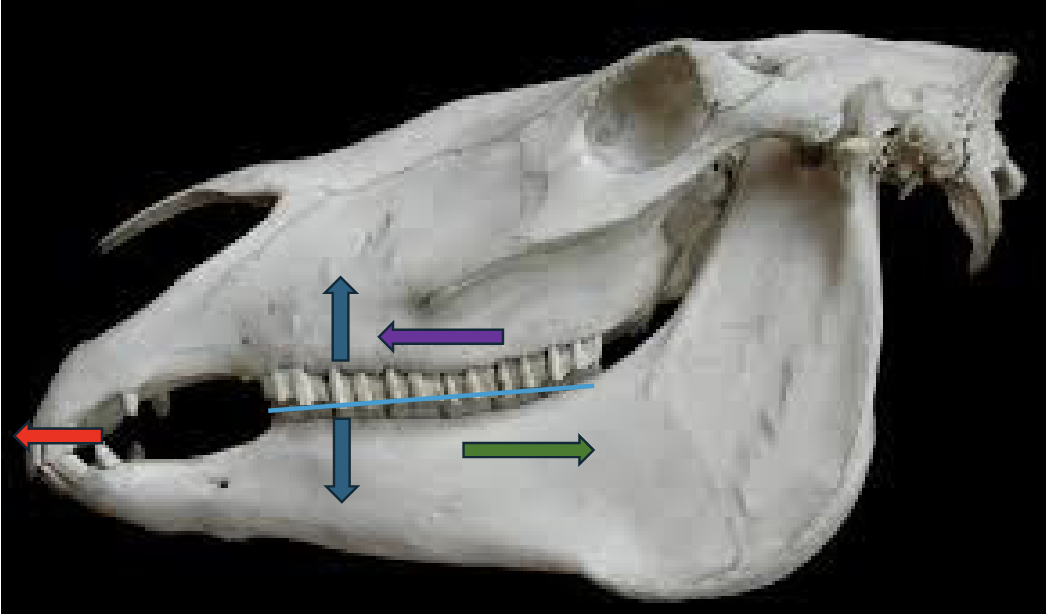
what tooth surface/nomenclature is represented by the red arrow?
labial (closest to lips)

what tooth surface/nomencature is represented by the purple arrow?
mesial (towards the middle/rostral)

what tooth surface/nomenclature is represented by the green arrow
distal (more caudal)
what makes up the periodontium?
gingiva, cementum, alveolar bone, periodontal ligament


describe alveolar bone
dense lamellar bone and trabecular bone, inner layer is porous to provide neurovascular supply to the periodontal ligament and attatchment for fibers of the periodontal ligament
what makes up the endodontic anatomy?
pulp, enamel, cementum, dentin

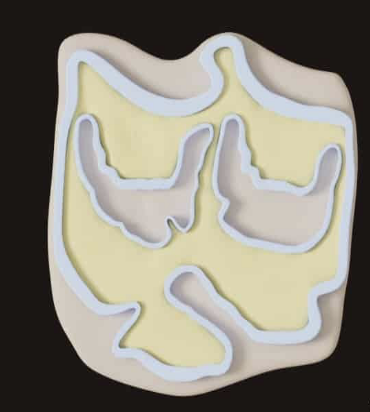
what are the 3 types of calcified tissue in the horse tooth?
dentin, cementum, enamel

what is the composition of primary dentin?
70% mineralized, 30% collagen fibers
what is the function of primary dentin and when is it made?
makes up the bulk of the mature tooth structure, formed during tooth development

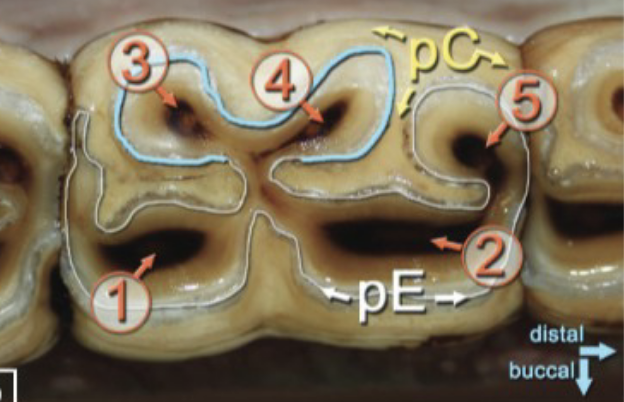
name the structures shown here
intertubuler dentin, peritubular dentin, dentinal tubules (between tubules)
what is the composition of secondary dentin?
70% mineralized and 30% collagen fibers
what is the structure and function of secondary dentin?
formed throughout life in response to attrition to occlud the pulp cavity— consists of dentinal tubules, intertubuler dentin, odontoblast process
when does tertiary dentin form?
respnse to insult (ex: broken tooth)

describe enamel
98% mineral (hydroxyapatite), 2% keratin-based organic material, prisms to provide structure, inert/dead tissue
what is responsible for producing enamel during tooth development before they die off?
amelioblasts
when do amelioblasts die off and stop producing enamel?
2-3 years
describe cementum
similar to bone, covers all of the crown and acts a the protective layer; attatchment point of the tooth with periodontal ligament fibers

what is the composition of cementum?
65% mineralized, 35% connective tissue
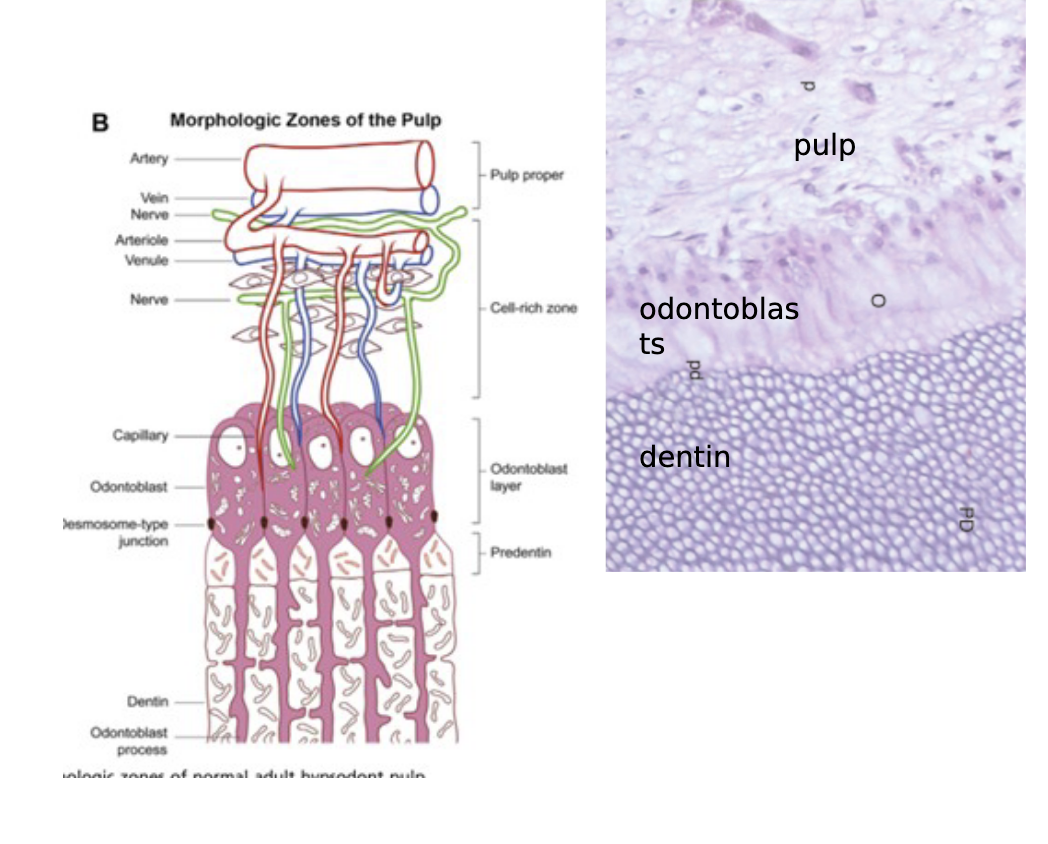
describe the pulp
living flesh; odontoblasts reside at the periphery
what is found in pulp?
CT, lymphatics, nerves, blood vessels
what is the infundibulum and where is it found?
blind ended cup of enamel filled with cementum ONLY present on maxillary cheek teeth and all incisors

where are scrolls of enamel located?
mandibular cheek teeth