Ch 13.1 Translation
 Call Kai
 Learn
Learn Practice Test
 Spaced Repetition
 Match
Match Flashcards
 Knowt Play
1/43

Earn XP
Description and Tags
History, Genetic Code, tRNA
Name | Mastery | Learn | Test | Matching | Spaced | Call with Kai | Chat |
|---|
No analytics yet
Send a link to your students to track their progress
44 Terms
___________
noticed that pts with ________ (a genetic condition) lacked enzyme _________
→ proposed that patients with diseases lacked an enzyme
→ connected concept of _____ to _____
Archibald Garrod
noticed that pts with alkaptonuria (a genetic condition) lacked enzyme homogentisic acid oxidase
→ proposed that patients with diseases lacked an enzyme
→ connected concept of genes to enzymes
enzyme mutations → problems in intermediates of metabolic pathways → human diseases
(view phenylalanine metabolism for concept)

_________ & _________
purposefully created mutations to verify mutations followed Mendelian inheritance
studied _________ (type of mold, fungi)
used x-rays to damage DNA
looked for cells lacking enzymes in the pathway to produce amino acids, including:
_________
_________
concluded __________________ hypothesis
Beadle & Tatum
purposefully created mutations to verify mutations followed Mendelian inheritance
studied Neurospora crassa (type of mold, fungi)
used x-rays to damage DNA
looked for cells lacking enzymes in the pathway to produce amino acids, including:
arginine
methionine
concluded one gene-one enzyme hypothesis
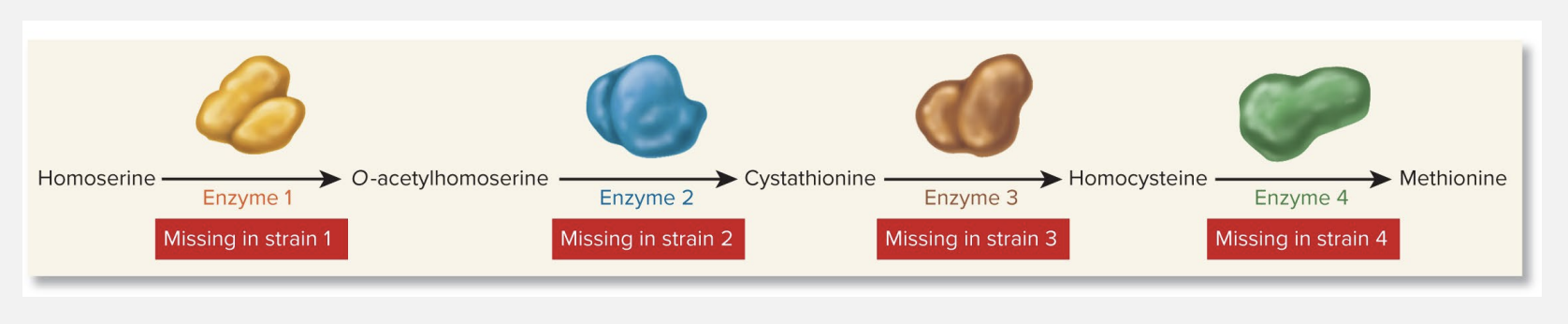
Beadle & Tatum grew plates with minimal media. They added substrates one at a time based on the pathway. For example, methionine:
__________
__________
__________
__________
Methionine
Beadle & Tatum grew plates with minimal media. They added substrates one at a time based on the pathway. For example, methionine:
Homoserine
O-acetylhomoserine
Cystathionine
Homocysteine
Methionine

View practice question from HW (1)
HW 7 Q13
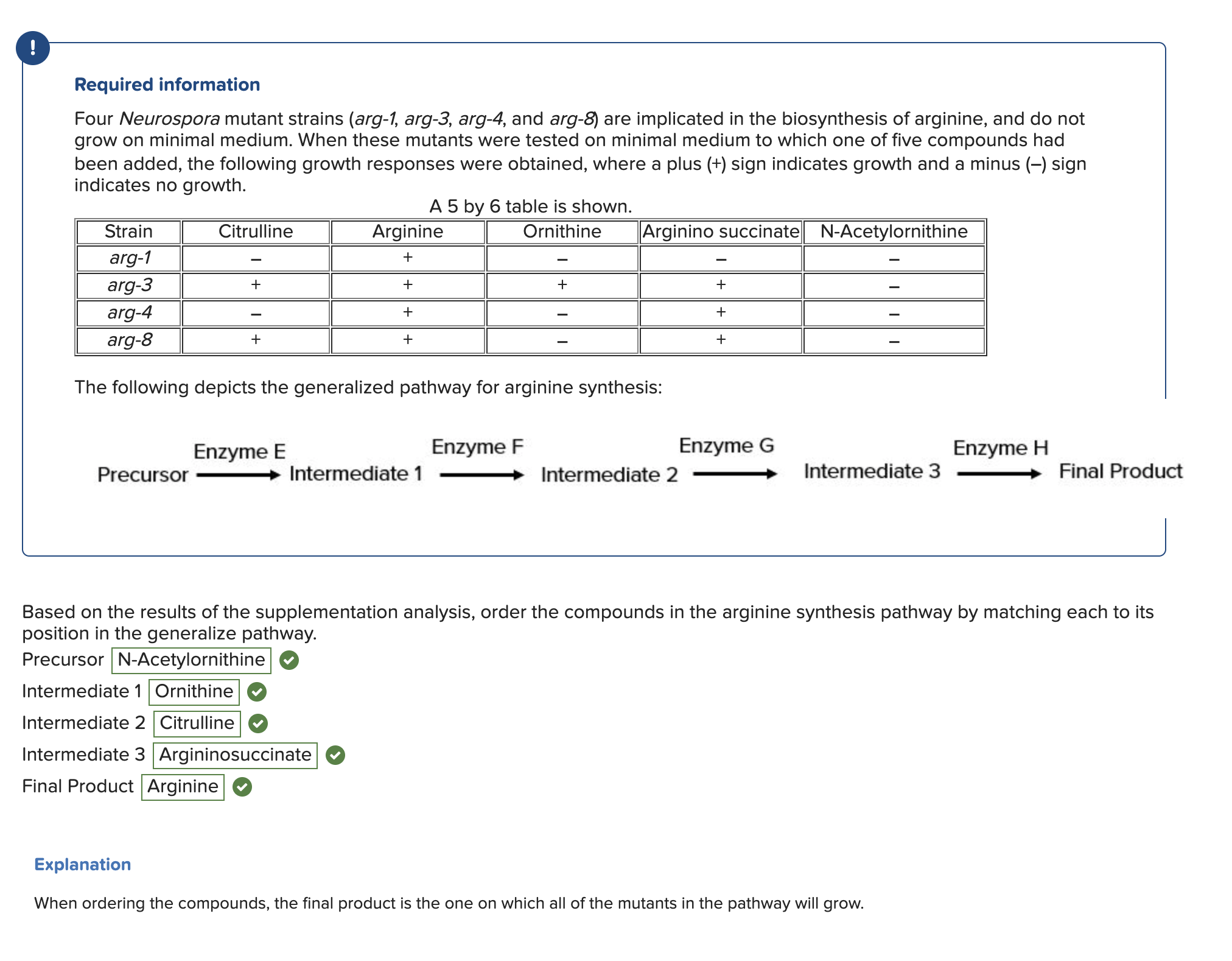
we want to “rescue” bacteria by giving them products that can get them arginine
so, all grow if given arginine
most grow if given second last product (unless very last enzyme is mutated)
and so on…
View practice question from HW (2)
HW 7 Q14
if almost everything can grow, early enzyme was mutated
if nothing can grow, late enzyme is mutated

One Gene-One Enzyme Hypothesis = one gene controls synthesis of one enzyme
4 modificatiosns were made to this theory
enzymes are only one category of ________
some proteins are made of 2+ ________
some genes code no polypeptides
ex: _______
some genes can code many polypeptides
via ___________
One Gene-One Enzyme Hypothesis = one gene controls synthesis of one enzyme
4 modificatiosns were made to this theory
enzymes are only one category of proteins
some proteins are made of 2+ polypeptides
some genes code no polypeptides
ex: tRNA, rRNA, etc.
some genes can code many polypeptides
via alternative splicing

one gene-one enzyme hypothesis was later updated to __________ hypothesis
one gene-one enzyme hypothesis was later updated to one gene-one polypeptide hypothesis
The Genetic Code = mRNA → amino acids
almost universal code
____ possible codons
start codon: ___
codes amino acid _________
stop codons: ___/___/___
The Genetic Code = mRNA → amino acids
almost universal code
64 possible codons
start codon: AUG
codes amino acid methionine
stop codons: UAA/UAG/UGA

the genetic code has _________ = multiple codons can specify same amino acid
__________ codons = codons that specify same amino acid
the genetic code has degeneracy = multiple codons can specify same amino acid
synonymous codons = codons that specify same amino acid

Exceptions to the genetic code
__________ (___) = “21st amino acid”
codon = ___
__________ (___) = “22nd amino acid”
codon = ___
downstream sequences are needed in order to incorporate these
found in specialty enzymes
Exceptions to the genetic code
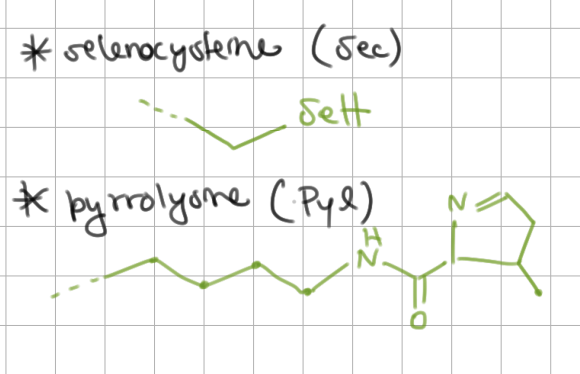
selenocysteine (Sec) = “21st amino acid”
codon = UGA
pyrrolysine (Pyl) = “22nd amino acid”
codon = UAG
downstream sequences are needed in order to incorporate these
found in specialty enzymes
______________ = sequence of codons beginning with start codon
_______/_______ can cause reading frame shift → amino acid sequence change
reading frame = sequence of codons beginning with start codon
deletions/insertions can cause reading frame shift → amino acid sequence change
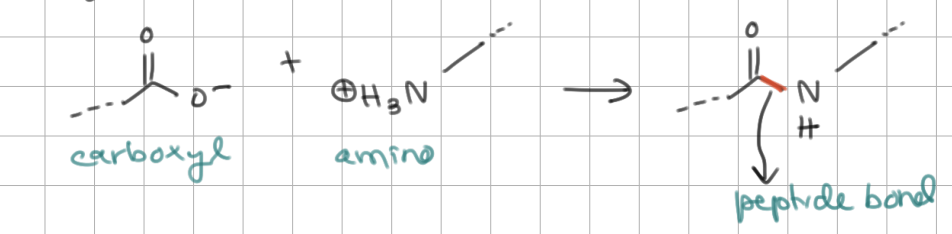
During polypeptide synthesis, a __________ bond is formed between old C/N-terminus and new C/N-terminus
During polypeptide synthesis, a peptide bond is formed between old C-terminus and new N-terminus
4 levels of protein structure
Primary = amino acid sequence
determines how protein folds
folding may be aided by _________
Secondary = _________ and _________
stabilized by _________ in peptide backbone
Tertiary = 3D structure
determined by _________, _________, _________ forces and _________
Quaternary = 2+ polypeptides → fully functional protein
4 levels of protein structure
Primary = amino acid sequence
determines how protein folds
folding may be aided by chaperones
Secondary = alpha helix and beta sheets
stabilized by H-bonds in peptide backbone
Tertiary = 3D structure
determined by hydrophobic, ionic, van der Waals forces and H-bonds
Quaternary = 2+ polypeptides → fully functional protein

Note!!! Review amino acids!!!

Proteins have many functions:
_________ - ex: sodium channels, hemoglobin
_________ - ex: myosin
_________ - ex: tubulin
_________ - ex: insulin, insulin receptor
_________ - ex: integrins
Proteins have many functions:
transport - ex: sodium channels, hemoglobin
movement - ex: myosin
cell shape & organization - ex: tubulin
cell signaling - ex: insulin, insulin receptor
cell surface recognition - ex: integrins
Note: every protein has a unique structure to match its function
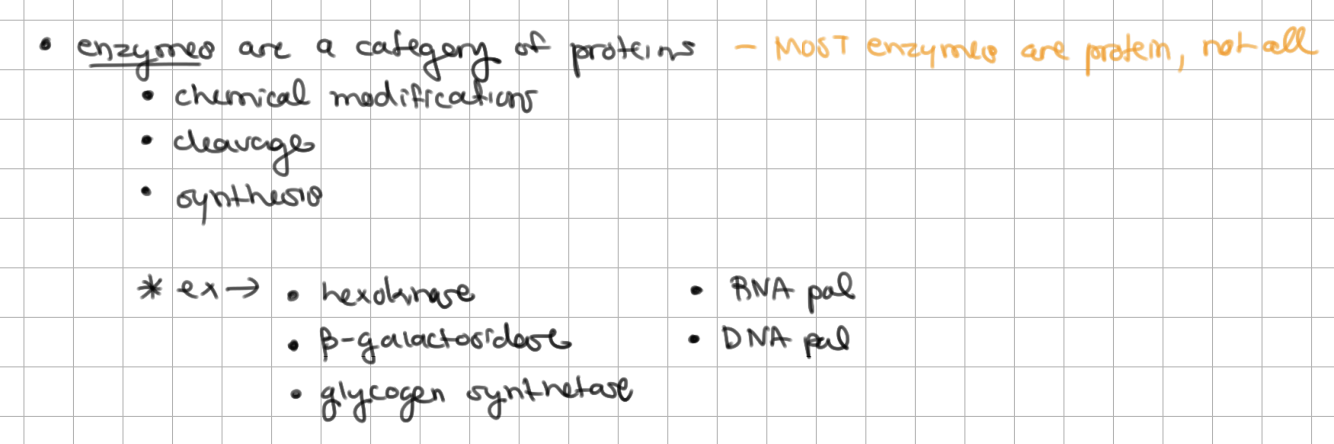
Enzymes review…
Experimental Determination of Genetic Code
deciphered by many researchers including _________ & _________
they used a ____________ system to produce amino acids, contains:
ribosomes, tRNAs, enzymes, etc.
they ________ amino acids to make them easy to detect
Experimental Determination of Genetic Code
deciphered by many researchers including Nirenberg & Khorana
they used a cell-free translation system to produce amino acids, contains:
ribosomes, tRNAs, enzymes, etc.
they radiolabeled amino acids to make them easy to detect
__________ = linked ribonucleotides into RNA → made ______ RNA
does not require template, order of nucleotides is random
an experimenter can control amount of nucleotides added and determine the codons by percentages of amino acids
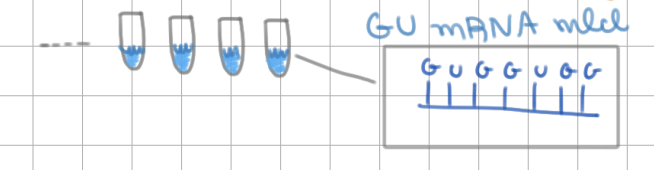
ex: 70% G and 30% U
polynucleotide phosphorylase = linked ribonucleotides into RNA → made synthetic RNA
does not require template, order of nucleotides is random
an experimenter can control amount of nucleotides added and determine the codons by percentages of amino acids
ex: 70% G and 30% U (view image)

Genetic Code Experiment Details
Put ___________ into 20 tubes
Genetic Code Experiment Details
Put cell-free translation system into 20 tubes

Genetic Code Experiment Details
Add ________ molecules
Add random mRNA molecules of G and U (made with polynuc phosphorylase)
Genetic Code Experiment Details
Add a different _________ amino acid to each tube + 19 other _________ amino acids
Genetic Code Experiment Details
Add a different radiolabeled amino acid to each tube + 19 other unlabeled amino acids

Genetic Code Experiment Details
________ for 60 minutes for translation to occur
Genetic Code Experiment Details
Incubate for 60 minutes for translation to occur

Genetic Code Experiment Details
Add __________ which precipitates ________
Genetic Code Experiment Details
Add tricholoracetic acid (TCA) which precipitates polypeptides, not amino acids
polypeptides => has been translated

Genetic Code Experiment Details
Capture precipitated polypeptides in a _____
Count radioactivity on filter in a _________
Calculated amount of radiolabeled amino acids in precipitated polypeptides
Genetic Code Experiment Details
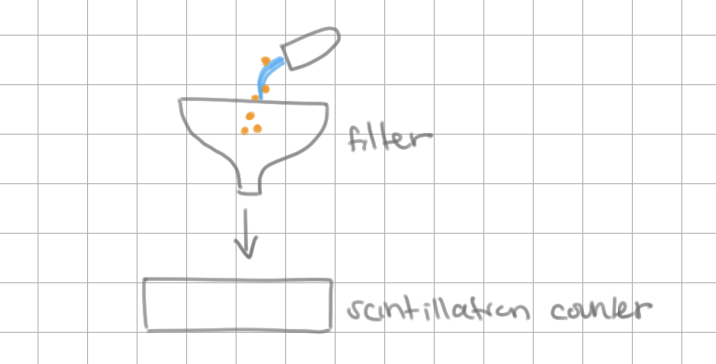
Capture precipitated polypeptides in a filter
Count radioactivity on filter in a scintillation counter
Calculated amount of radiolabeled amino acids in precipitated polypeptides
Interpretation of Experiment (just read)
ex: 49% glycine was found
from 70% G and 30% U, we know there is a 34% chance of GGG and 15% GGU, which adds up to 49% glycine
so, we can conclude that GGG and GGU most likely code for glycine
multiple experiments were needed to reveal more about the entire genetic code

__________ = RNA molecule made up of multiple nucleotides in a pattern
ex: UCUCUCUCUC
can form codons ___ and ____
these were used in above experiment to crack the genetic code
created by Khorana by creating short RNAs (2-4 nucleotides long) with a defined sequence and linking them
RNA copolymers = RNA molecule made up of multiple nucleotides in a pattern
ex: UCUCUCUCUC
can form codons CUC and UCU
these were used in above experiment to crack the genetic code
created by Khorana by creating short RNAs (2-4 nucleotides long) with a defined sequence and linking them
Additional Experiment: Triplet-Binding Assay
__________ and __________ discovered that 3 nucleotides in RNA directly corresponded to amino acids
so, they conducted another experiment to obtain the genetic code with clearer patterns
Additional Experiment: Triplet-Binding Assay
Nirenberg and Leder discovered that 3 nucleotides in RNA directly corresponded to amino acids
so, they conducted another experiment to obtain the genetic code with clearer patterns
Triplet binding assay
They mixed one __________ in 20 different tubes with a different radiolabeled amino acid
Triplet binding assay
They mixed one triplet RNA in 20 different tubes with a different radiolabeled amino acid

Triplet binding assay
Samples were filtered - only amino acids stuck to _______ were retained
→ showed which amino acid this triplet RNA corresponded to
Triplet binding assay
Samples were filtered - only amino acids stuck to ribosome were retained
→ showed which amino acid this triplet RNA corresponded to

Structure and Function of tRNA
—
__________ hypothesis (by Crick) = tRNA has 2 main functions:
recognize codon in mRNA
carry amino acid based on codon
adaptor hypothesis (by Crick) = tRNA has 2 main functions:
recognize codon in mRNA
carry amino acid based on codon
tRNA are named by amino acid they carry
ex: ______ = tRNA that carries phenylalanine
tRNA are named by amino acid they carry
ex: tRNAPhe = tRNA that carries phenylalanine

tRNA structure
3 ____-loop structures
3’ ____ acceptor site
a few _________ sites (differ between tRNAs)
modified nucleotides
I = ______
ml = ______
T = ______
UH2 = ______
m2G = ______
P = ______
tRNA structure
3 stem-loop structures
3’ ACC acceptor site
a few variable sites (differ between tRNAs)
modified nucleotides
I = inosine
ml = methylinosine
T = ribothymidine
UH2 = dihydrouridine
m2G = dimethylguanosine
P = pseudouridine

Charging tRNAs
______________ = attach amino acids to tRNAs ( = “charging”)
there are 20 of these (one per aa)
charged tRNA = ______________ = tRNA with attached aa
Charging tRNAs
aminoacyl-tRNA synthetases = attach amino acids to tRNAs ( = “charging”)
there are 20 of these (one per aa)
charged tRNA = aminoacyl-tRNA = tRNA with attached aa
Charging tRNAs Mechanism
_________ & _________ bind to enzyme
Charging tRNAs Mechanism
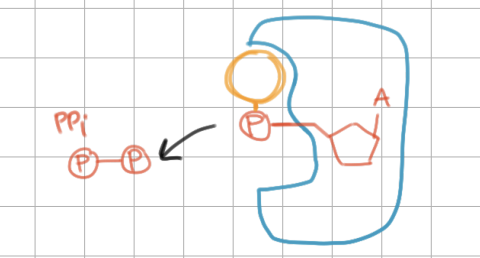
amino acid & ATP bind to enzyme

Charging tRNAs Mechanism
____ is released
Charging tRNAs Mechanism
PPi is released
Charging tRNAs Mechanism
_______ binds to enzyme and ____ is released
Charging tRNAs Mechanism
tRNA binds to enzyme and AMP is released

Charging tRNAs Mechanism
charged tRNA is released
Charging tRNAs Mechanism
charged tRNA is released

Additional Notes
aminoacyl tRNA synthetases are very ______!
= “second genetic code”
tRNA has sequences used as _______ sites
_________ may affect
translation rates
recognition by aminoacyl tRNA synthetases
codon-anticodon recognition
Additional Notes
aminoacyl tRNA synthetases are very accurate!
= “second genetic code”
tRNA has sequences used as recognition sites
modified bases may affect
translation rates
recognition by aminoacyl tRNA synthetases
codon-anticodon recognition
genetic code usually has degneracy at ___ position
exceptions: serine, leucine, arginine (these have a different reason for wobble)
genetic code usually has degneracy at 3rd position
exceptions: serine, leucine, arginine (these have a different reason for wobble)
for example… (view image)

__________ hypothesis (by Crick) =
When codons are being paired with anticodons…
the first 2 positions pair ________ with AU/GC rule
the 3rd position moves a little = “______”
→ tolerates mismatches
Wobble hypothesis (by Crick) =
When codons are being paired with anticodons…
the first 2 positions pair strictly with AU/GC rule
the 3rd position moves a little = “wobbles”
→ tolerates mismatches
________ tRNA = different codons, same aa
these may recognize same codon due to wobble
isoacceptor tRNA = different codons, same aa
these may recognize same codon due to wobble
ex: for serine
tRNA 1 with anticodon AGA → codon UCU
tRNA 1 with anticodon AGA → codon UCU, UCU via wobble
Wobble pairing rules (idk if I need to know, view image)
